






The U.S. Food and Drug Administration (FDA) has delivered two significant approvals that expand first-line treatment options for patients with metastatic breast cancer, marking another milestone in a series of recent advances in the field.
The approvals include new indications for sacituzumab govitecan in metastatic triple-negative breast cancer and palbociclib as maintenance therapy for HR-positive, HER2-positive metastatic breast cancer.
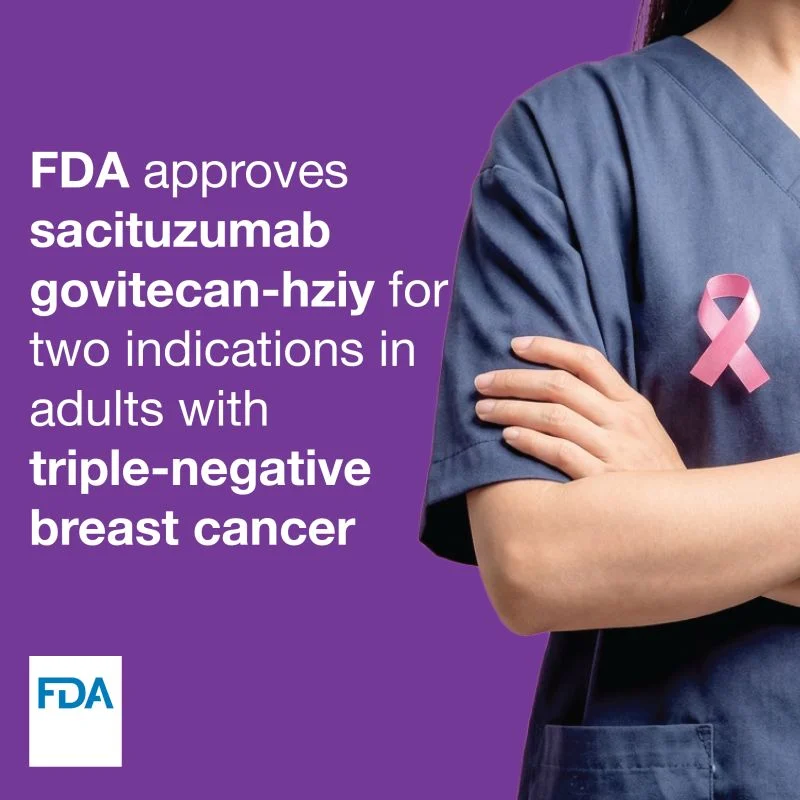
“Today, FDA approved sacituzumab govitecan-hziy (Trodelvy, Gilead Sciences, Inc.) for two indications in adults with triple-negative breast cancer (TNBC).
The first indication, supported by ASCENT-03, is for sacituzumab govitecan-hziy as a single agent for the first-line treatment of adults with unresectable locally advanced or metastatic TNBC who are not candidates for PD-1 or PD-L1 inhibitor-based therapy. The second indication, supported by ASCENT-04/KEYNOTE D-19, is for sacituzumab govitecan-hziy in combination with pembrolizumab (Keytruda, Merck and Co., Inc.) or pembrolizumab and berahyaluronidase alfa-pmph (Keytruda Qlex, Merck and Co., Inc.) for the first-line treatment of adults with unresectable locally advanced or metastatic TNBC whose tumors express PD-L1 (CPS ≥ 10) as determined by an FDA-authorized test.
The prescribing information for sacituzumab govitecan-hziy contains a boxed warning for diarrhea and neutropenia and includes warnings and precautions for hypersensitivity and infusion-related reactions, nausea/vomiting, patients with reduced UGT1A1 activity, and embryo-fetal toxicity. The pembrolizumab prescribing information includes warnings and precautions for immune-mediated adverse reactions, infusion-related reactions, complications of allogeneic hematopoietic stem cell transplantation, and embryo-fetal toxicity.
Learn more in the FDA-approved prescribing information.”
“Today, FDA approved palbociclib (Ibrance, Pfizer Inc.) in combination with trastuzumab, with or without pertuzumab, and endocrine therapy for the maintenance treatment of adults with HR-positive, HER2-positive locally advanced or metastatic breast cancer following induction treatment.
The prescribing information includes warnings and precautions for neutropenia, interstitial lung disease/pneumonitis, and embryo-fetal toxicity.
Learn more in the FDA-approved prescribing information”

‘FDA approvals in metastatic breast cancer are coming one after another.’
The announcements have been met with enthusiasm from leading oncologists, who described the approvals as practice-changing and highlighted their potential to improve outcomes for patients.
“U.S. FDA approves our treatment for first-line metastatic triple-negative breast cancer, marking a new backbone therapy for people who previously had few options. Read more on this much-needed treatment option for the mTNBC community.”
“BREAKING: FDA approves palbociclib with trastuzumab with or without pertuzumab with ET as 1L maintenance in HR+/HER2+ metastatic breast cancer based on PATINA!
Median PFS 44.3 versus 29.1 months a >15-month gain for adding a CDK4/6i to anti-HER2 + endocrine therapy after induction. (Any induction approved).
The first phase III trial to show benefit of CDK4/6 inhibition in HR+/HER2+ MBC.”
“Sacituzumabgovitecan approved for TNBC 1st line with pembro and without pembro today for metastatic bcsm based on ASCENT03 and ASCENT04 trials.
Plus PATINA maintenance palbociclib approved 1st line HER-2+ bcsm today as well. Yes, 3 approvals today!
This makes not 1,2,3,4,5,6, but now 7 FDA approvals in breast since May 1st!
With currently decreased oncology FDA staffing, this is really impressive.
Massive thank you to the dedicated public servants at the FDA for continuing to go above and beyond for all the patients that rely on you. We see you, and we thank you.”
“PATINA got FDA approved today. Palbociclib + trastuzumab ± pertuzumab + ET as 1L maintenance in HR+/HER2+ mBC. 44.3 versus 29.1 months PFS. A 15-month gain in a chemo-free maintenance phase. Including patients with asymptomatic CNS mets. And I’m sitting here thinking about the triple-positive patients I started on T-DXd + pertuzumab six months ago.
DB_09 changed 1L HER2+ in December. Continuous IV every 3 weeks, no defined induction-to-maintenance transition, no THP backbone. If your triple-positive patient is on that regimen, PATINA doesn’t slot in. There is no palbociclib insertion point. The architectures are incompatible.
So today we have two FDA-approved 1L strategies for the same patient, built on fundamentally different structural paradigms. The patient in front of you gets one. You’re choosing blind. PATINA is a real win and the biology is coherent. Congratulations to Otto Metzger and the full investigator team. Metzger O, Mandrekar S, Goel S, et al.”
“The PATINA regimen FDA approved! An immense congratulations to Otto Metzger for his leadership and the PATINA Steering Committee and Pfizer for believing in this approach.
Options for patients with breast cancer is a win!”
“Today, the 1L HER2+ maintenance space just got a lot more interesting with the FDA approval of palbociclib with trastuzumab/pertuzumab (PATINA) for 1L maintenance in HR+/HER2+ mBC.
What the approval does:
- Validates the induction-to-maintenance pathway for triple-positive patients stable after taxane + HP induction.
- Adds an endocrine/CDK4/6 intensification layer within maintenance without touching induction.
- With existing NCCN guideline footing, gains real prescribing credibility.
- Sets up a potentially cost-attractive option as palbociclib LOE approaches in March 2027.
What it doesn’t answer:
- Will oncologists actually defer ADC-based therapy for stable HR+/HER2+ patients and if so, for how long?
- How does PATINA sit alongside HER2CLIMB-05 (tucatinib + HP, soon to be approved) as another 1L maintenance contender for the broader HER2+ population?
- Does extending CDK4/6-based maintenance deliver meaningful OS benefit?
- Does prior CDK4/6 exposure influence downstream response to ADC-based therapy?
The 1L maintenance conversation in HER2+ mBC is evolving fast. Sequencing decisions are becoming as important as drug selection. Would love to hear your thoughts?”
Quoting the post by The ASCO Post:
“FDA Approval!
The FDA approved palbociclib (Ibrance) in combination with trastuzumab, with or without pertuzumab, and endocrine therapy as maintenance treatment for adult patients with HR-positive, HER2-positive locally advanced or metastatic breast cancer following induction therapy.
The approval was based on results from the phase III PATINA trial, which demonstrated a significant improvement in progression-free survival compared with standard maintenance therapy alone.
This approval introduces a new treatment option for patients with HR+/HER2+ metastatic breast cancer and further expands the role of CDK4/6 inhibition in breast cancer care.”
“The US FDA approved two regimens today based on Dana-Farber’s Breast Oncology Center led clinical trials, including maintenance AI + palbo in HER2+ MBC, and sacituzumab govitecan in first line TNBC.”
“FDA approves sacituzumab govitecan-hziy as monotherapy and in combination with pembrolizumab for first-line treatment of triple-negative breast cancer.”
“The approval of palbociclib maintenance for HER2+ MBC is an example of translational science par excellence led by Dana-Farber Cancer Institute Breast Oncology starting with Shom Goel and Jean Zhao in Cancer Cell 2016.
And ending with Otto Metzger and colleagues in NEJM 2026.
Supported by many many others in academia, industry and advocacy, it is a testament to the importance of basic and translational science in changing our standard of care.”
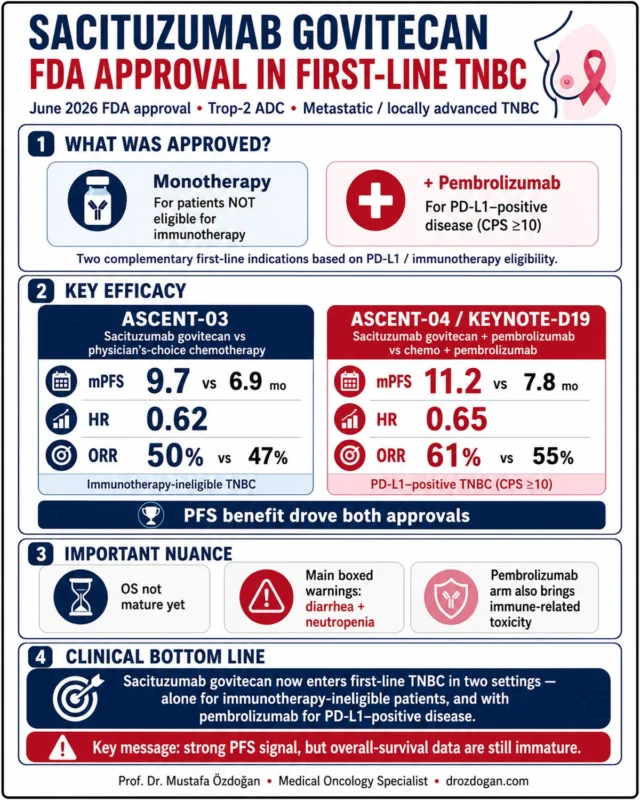
“The FDA has approved sacituzumab govitecan for first-line triple-negative breast cancer (TNBC) in two settings:
- As monotherapy for patients not eligible for immunotherapy,
- And with pembrolizumab for PD-L1–positive disease.
This expands a Trop-2 ADC into the first-line setting, with both approvals driven by a clear PFS benefit.”
Find more oncology content on OncoDaily