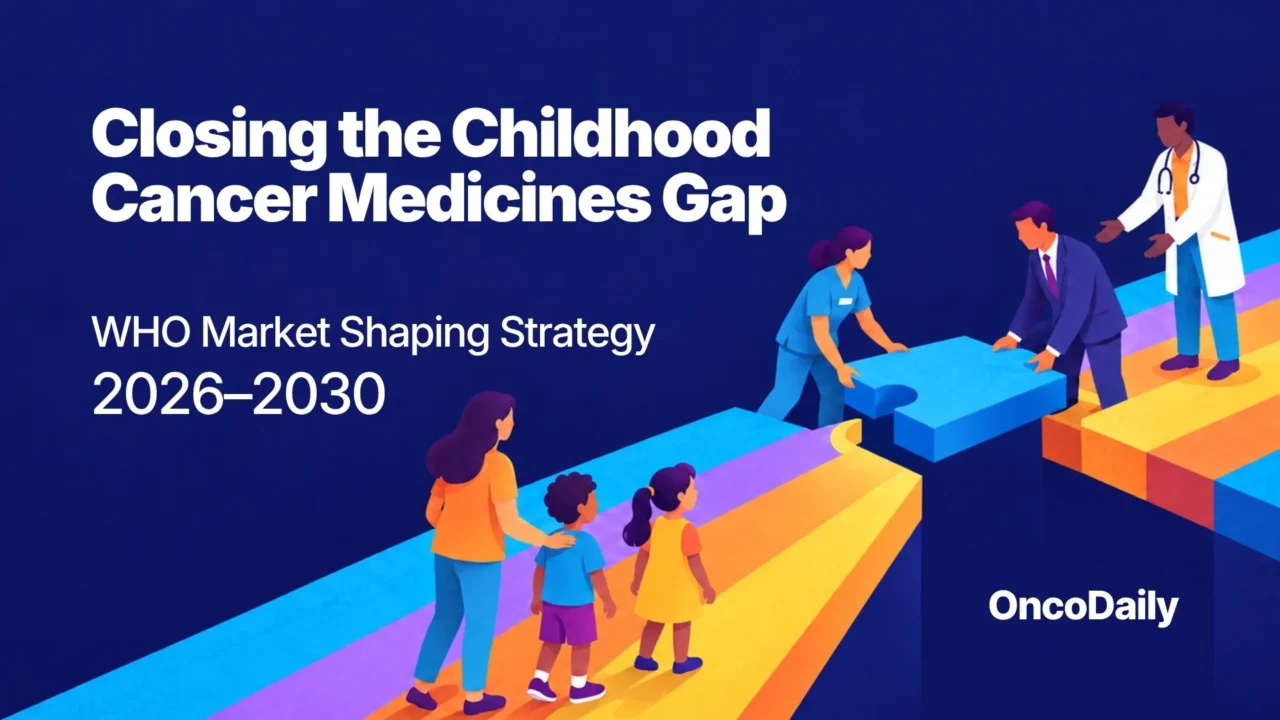
The World Health Organization (WHO) has unveiled a new global strategy aimed at addressing persistent inequalities in access to childhood cancer medicines and narrowing one of the starkest survival gaps in global oncology.
The new report, Closing the Childhood Cancer Survival Gap Through Sustainable Access to Medicines: Market Shaping Strategy 2026–2030, sets out a five-year plan to improve the availability, accessibility, affordability and quality of essential childhood cancer medicines, particularly in low- and middle-income countries (LMICs).
An estimated 400,000 children and adolescents develop cancer every year worldwide, approximately 90% of them in LMICs. Yet outcomes remain dramatically different depending on where a child lives. In high-income countries, more than 80% of children diagnosed with cancer survive at least five years, while in many LMICs fewer than 30% do.
WHO argues that this divide is not primarily a failure of science. Many of the medicines needed to cure childhood cancers have existed for decades. Instead, survival is often determined by whether children are diagnosed in time, reach appropriate care, and can access and complete treatment without interruptions.
Dr Jeremy Farrar, WHO Assistant Director-General for Health Promotion, Disease Prevention and Care, wrote in the report:
“No child should die of a curable cancer because of market failure.”
The strategy seeks to move beyond responding to individual medicine shortages and instead reshape the market conditions that determine whether quality-assured cancer medicines are reliably available to children who need them.
The medicines exist, but access remains deeply unequal
Close to 40 medicines with paediatric oncology indications are included on the WHO Model List of Essential Medicines for Children, and most are off-patent and comparatively inexpensive to manufacture.
Yet access remains far from universal.
WHO reports that close to 70% of children in low-income countries and LMICs live in countries with suboptimal availability of essential childhood cancer medicines. Fewer than 60% of essential childhood cancer medicines are reliably accessible at hospital level in LMICs.
A baseline assessment conducted before countries began receiving medicines through the Global Platform for Access to Childhood Cancer Medicines found that only around 45% of essential cancer medicines were available across 51 hospitals. Even when medicines appeared on procurement lists or hospital records, nearly half had reportedly been out of stock for at least one month during the previous year.
These shortages have direct implications for care. Paediatric cancer treatment frequently relies on combinations of medicines administered according to carefully timed protocols. Delays or interruptions can compromise treatment and, in some settings, contribute to treatment abandonment.
Access problems also extend beyond whether a medicine is physically present. Specialized paediatric oncology services in many LMICs are concentrated in major cities, meaning families may have to travel considerable distances for repeated treatment. Transportation, accommodation, diagnostic costs and out-of-pocket payments can make continuing care increasingly difficult.
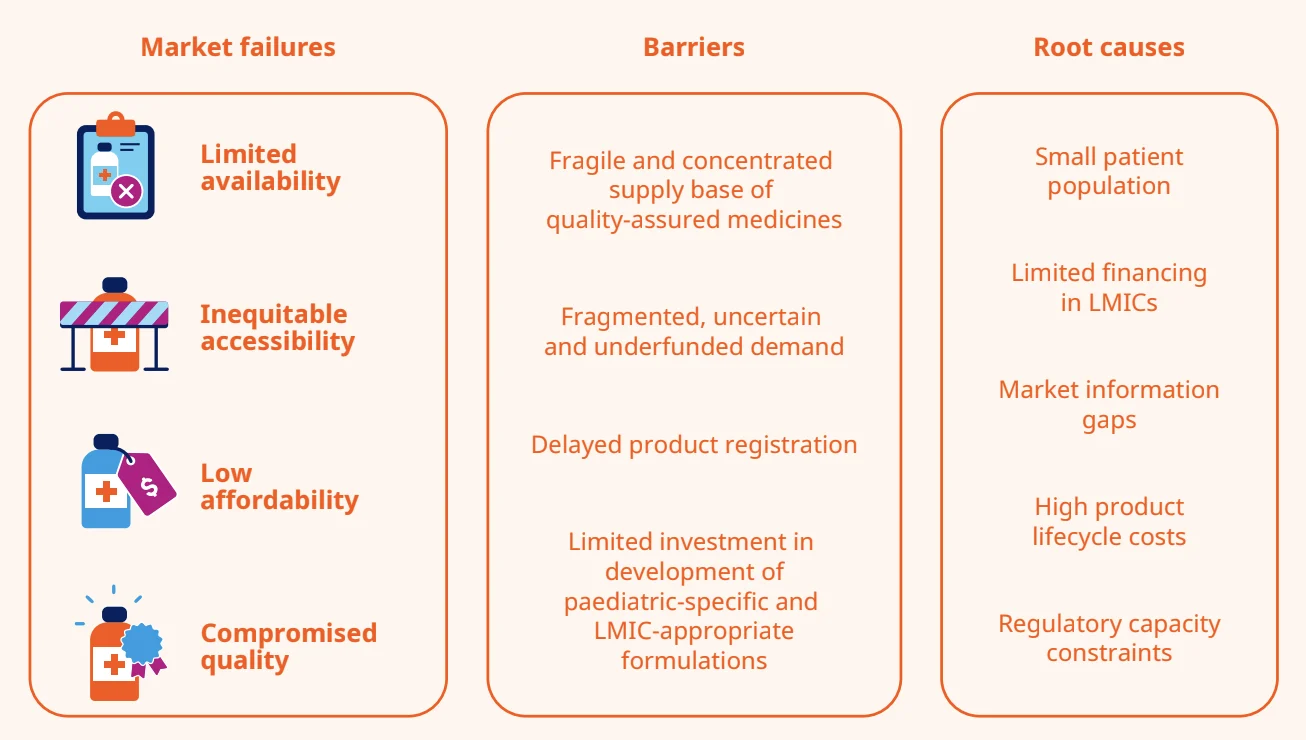
Market failures, barriers and root causes affecting access to childhood cancer medicines. Source: World Health Organization, 2026.
WHO analysis identifies a fragile global supplier base
The new strategy also highlights vulnerabilities on the supply side.
A WHO analysis conducted in 2025 found that 24 of 44 oncology medicines included on the 2023 WHO Model List of Essential Medicines for Children had either a low or critically low supplier base.
Fourteen were classified as having a low supplier base and 10 as critically low. WHO stresses that these findings should be interpreted as an indicator of potential supply-base fragility rather than a comprehensive assessment of actual medicine availability or market access.
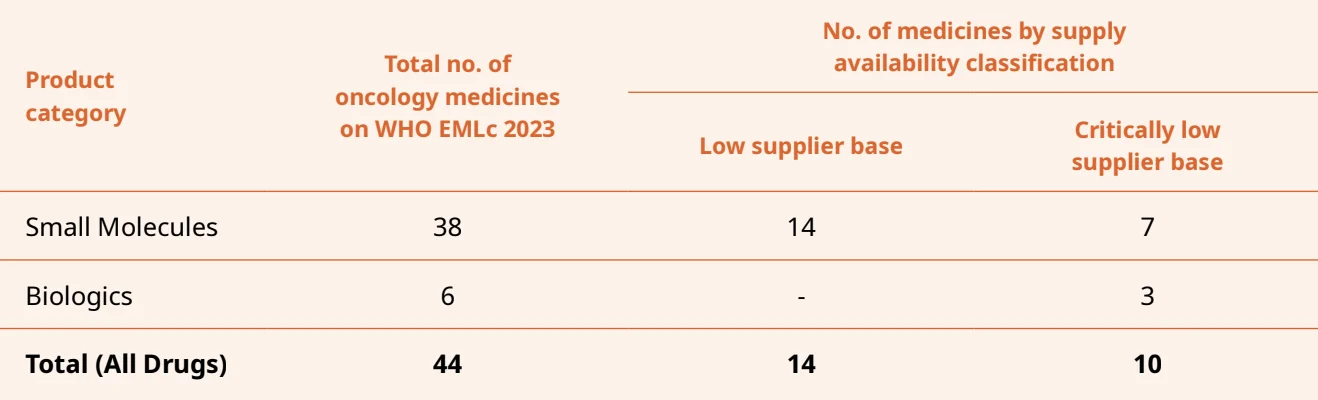
Supplier base of oncology medicines included in the 2023 WHO Model List of Essential Medicines for Children. Of 44 medicines assessed, 14 had a low supplier base and 10 had a critically low supplier base. Source: World Health Organization, 2026.
Medicines identified among those with particularly constrained quality-assured supply include vincristine, asparaginase, pegaspargase, dactinomycin, mercaptopurine and several other essential cancer treatments.
This creates an unusual problem. Although many childhood cancer medicines are older generic treatments, relatively small paediatric markets, fragmented purchasing, uncertain demand and limited commercial incentives can make them unattractive for manufacturers.
A small number of suppliers can leave health systems vulnerable to manufacturing disruptions, shortages and price volatility.
WHO identifies asparaginase, dactinomycin, etoposide, filgrastim, rituximab, ifosfamide, methotrexate, pegaspargase and vincristine among priority medicines for market-shaping efforts.
Medicine quality presents another threat
Availability alone is not enough if the medicines reaching patients cannot be trusted.
The report cites a 2025 investigation in which nearly one in five oncology medicines tested across four countries in sub-Saharan Africa was found to be substandard or falsified.
The investigation assessed several commonly used cancer medicines, including cisplatin, oxaliplatin, methotrexate, doxorubicin, cyclophosphamide, ifosfamide and leucovorin.
WHO describes a cycle in which medicine shortages and affordability pressures can push purchasers toward less reliably quality-assured sources. Weak regulatory oversight, limited post-market surveillance and supply-chain vulnerabilities may further increase the risk that substandard or falsified medicines reach patients.
The problem can be particularly serious in oncology, where medicines may require sterile manufacturing, controlled storage conditions or precise preparation.
The Global Platform has already reached more than 5,400 children
The strategy builds on the Global Platform for Access to Childhood Cancer Medicines, established in 2021 through a partnership between WHO and St. Jude Children’s Research Hospital, with UNICEF and the Pan American Health Organization Strategic Fund serving as strategic partners and procurement agencies.
The initiative aims to create an uninterrupted supply of quality-assured medicines while also strengthening countries’ capacity to forecast demand, procure products, manage supply chains and safely administer cancer treatment.
The first shipments reached Ecuador, Jordan, Mongolia, Nepal, Uzbekistan and Zambia in February 2025. The Republic of Moldova received its first shipment in February 2026.
By June 2026, approximately 1.7 million standard units of medicines had been delivered to 31 facilities, benefiting more than 5,400 children.
The Global Platform is also expanding, with additional countries expected to receive medicines and new countries being considered for participation.
Dr Carlos Rodriguez-Galindo, Executive Vice President of St. Jude Children’s Research Hospital and Director of St. Jude Global, said:
“No child should be denied a chance of survival because the medicines they need are unavailable, unaffordable, or out of reach.”
Ten interventions to change the market
At the centre of the 2026–2030 strategy are 10 interconnected interventions designed to address both the supply and demand sides of the childhood cancer medicines market.
The strategy is deliberately divided into three phases.
2026–2027: Stabilize supply and consolidate demand
The first phase focuses on the most immediate weaknesses in the market.
WHO and its partners plan to:
- broaden engagement and collaboration with manufacturers;
- expand the number of quality-assured suppliers, including through WHO prequalification;
- accelerate product registration in LMICs using regulatory reliance mechanisms:
- expand access to the Global Platform’s pooled procurement mechanism;
- explore volume guarantees and other tools that reduce manufacturers’ commercial risk; and
- publish global forecasts of demand for childhood cancer medicines.
WHO argues that improving demand forecasting and pooling purchases across countries could give manufacturers greater certainty about future orders while increasing purchasing power for governments.
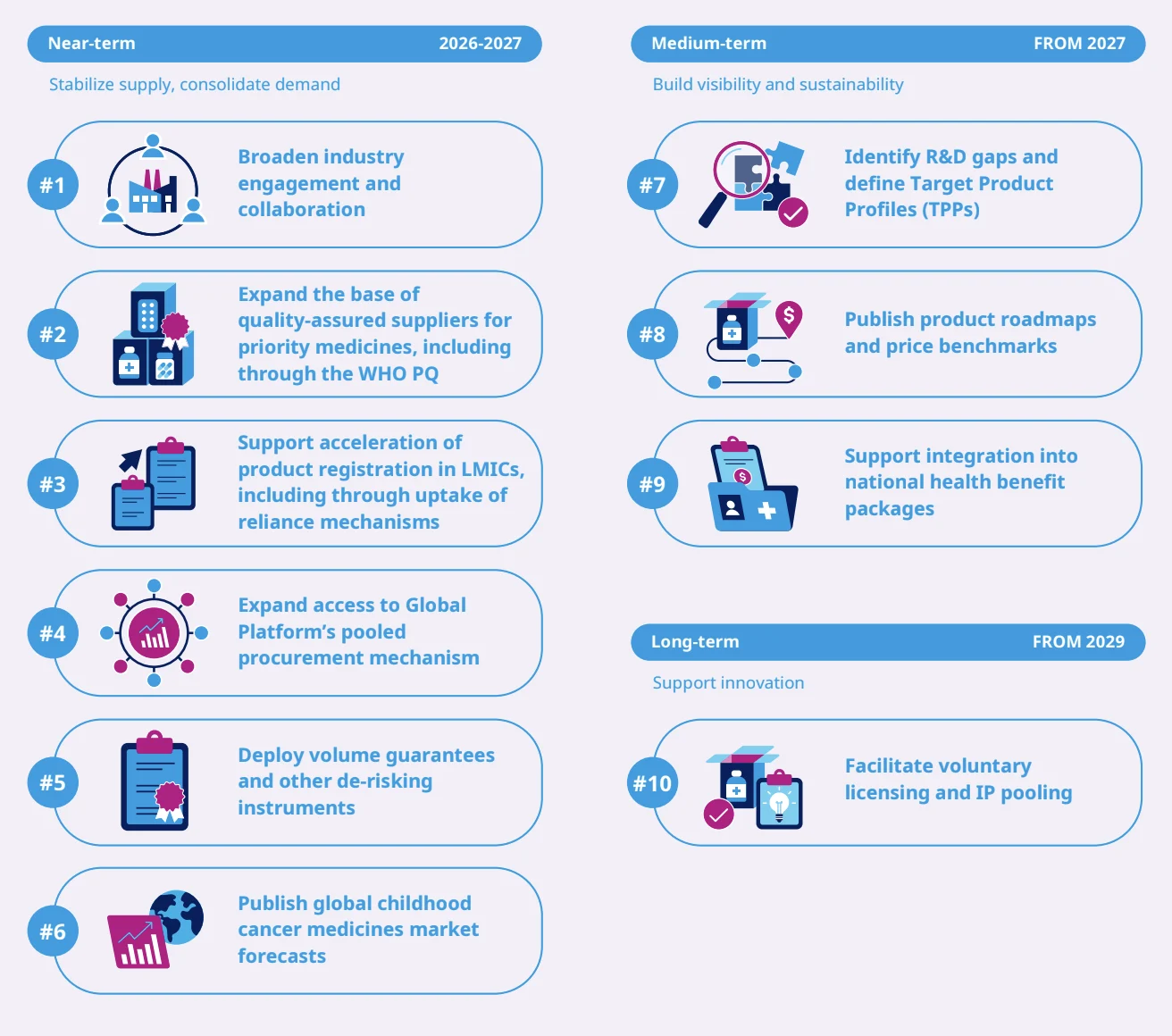
WHO’s 2026–2030 market-shaping strategy outlines 10 interconnected interventions across three implementation horizons: stabilizing supply and consolidating demand, building visibility and sustainability, and supporting innovation. Source: World Health Organization, 2026.
From 2027: building a sustainable system
Once supply and demand become more predictable, the strategy moves toward longer-term sustainability.
From 2027, WHO plans to identify research and development gaps and further define Target Product Profiles for child-friendly formulations.
Paediatric formulations remain an important unmet need. Oral cancer medicines designed primarily for adults may be difficult to dose accurately or administer safely to children, particularly in settings where formulation and storage options are limited.
The Global Platform also intends to publish product roadmaps and price benchmarks to make the childhood cancer medicines market more transparent.
Another major objective will be helping governments integrate essential childhood cancer medicines into national health benefit packages and publicly financed health systems.
The goal is to gradually move away from dependence on external subsidies and establish predictable domestic financing.
Countries participating in the Global Platform receive medicines fully subsidized for a defined period. Co-financing is then expected to increase over time, with domestic resources progressively supporting continued access.
From 2029: creating pathways to innovation
The final phase looks toward newer therapies.
From 2029, WHO proposes facilitating voluntary licensing and intellectual property pooling for selected on-patent childhood cancer medicines.
The report notes that innovative therapies often reach LMICs later because of affordability, intellectual property barriers, single-source supply and limited commercial incentives.
However, discussions with manufacturers and other stakeholders are expected to begin earlier, from 2027, because voluntary licensing arrangements and subsequent generic or biosimilar entry can take years to establish.
The strategy ultimately envisions the Global Platform transitioning from a market “fixer” toward a market “catalyst,” with governments taking increasing responsibility for sustainable access.
What could change for countries and manufacturers?
For governments, the proposed approach could mean a larger pool of quality-assured medicines, greater access to pooled procurement, more transparent prices and better information for forecasting and budgeting.
WHO also expects stronger use of regulatory reliance to reduce duplicated assessments and accelerate access to medicines that have already undergone rigorous evaluation.
Manufacturers, meanwhile, would receive clearer information about expected demand, priority products and future procurement opportunities.
The strategy proposes annual market forecasts, more predictable tenders, technical assistance for prequalification and registration, and, for selected fragile markets, possible volume guarantees designed to make continued production commercially viable.
The underlying idea is that a healthier market must work for both sides: countries need affordable, reliable products, while manufacturers need sufficient predictability to justify producing and registering them.
Childhood Cancer Awareness Month: beyond awareness
The release comes during Childhood Cancer Awareness Month, when attention traditionally turns to children and families affected by cancer.
The WHO findings add another dimension to that conversation.
For many childhood cancers, improving survival does not depend exclusively on discovering the next breakthrough therapy. It also depends on ensuring that medicines already known to work are available, affordable, quality-assured and able to reach children without interruption.
The report emphasizes that medicine procurement alone cannot be the final measure of success.
Alejandra Méndez, President-Elect of Childhood Cancer International, argues in the report that the impact of market-shaping efforts ultimately has to be assessed where care actually happens — including whether medicines reach children on time, whether treatment interruptions decline, whether families are protected from financial hardship and whether children outside major urban centres are also reached.
That distinction is particularly important during Childhood Cancer Awareness Month: awareness is not enough if effective treatment remains out of reach.
Aiming for at least 60% childhood cancer survival worldwide
The strategy supports the broader WHO Global Initiative for Childhood Cancer, established in 2018 to increase the overall five-year survival probability for children with cancer to at least 60% worldwide by 2030, while reducing suffering and averting preventable deaths.
WHO acknowledges that market shaping cannot close the survival gap on its own. Children also need timely diagnosis, trained healthcare professionals, appropriate referral pathways, functioning treatment centres, supportive care, adequate financing and stronger health systems.
But access to essential medicines remains a critical part of that equation.
The new 2026–2030 strategy is built around a simple premise: a medicine cannot save a child’s life merely because it exists. It has to be available, affordable, quality-assured, and delivered to the child who needs it, when they need it.
Read more news like this on OncoDaily.