





This edition of OncoGrants highlights 10 Cancer Research Grants and Fellowships Open to Researchers Worldwide, with application deadlines running from August through November 2026. The opportunities span multiple areas of oncology, including brain cancer, pancreatic cancer, ovarian cancer, thoracic oncology, cancer immunology, prevention, drug development, and international collaborative research.
The selection includes funding for researchers at different career stages, from postdoctoral fellows and early-career investigators to established scientists leading international and multidisciplinary projects. Several opportunities provide substantial research support, including the Cholangiocarcinoma Foundation Innovation Award, offering $750,000 for collaborative biomarker research, and the DoD Ovarian Cancer Academy Early-Career Investigator Award, providing up to $1.125 million.
International mobility and collaboration are also represented through programs such as the EACR–Worldwide Cancer Research Collaboration Fellowship, while the AACR–WCRF International–Prevent Cancer Foundation Fellowship provides two years of support for researchers working across basic, clinical, translational, and population-based cancer prevention research.
Whether you are developing an independent research career, exploring a new therapeutic strategy, building an international collaboration, or advancing a clinically relevant cancer research project, these OncoGrants offer funding opportunities for investigators working across the global cancer research community.
1. Robert L. Fine Cancer Research Foundation Research Grant 2026
The Robert L. Fine Cancer Research Foundation Research Grant supports innovative pancreatic cancer projects that translate laboratory discoveries into potential clinical advances.
The program is intended for focused projects that can be completed within a limited timeframe, including pilot and feasibility studies, self-contained research projects, and the development of new research methods or technologies. Projects consisting solely of clinical research are not eligible. (RLFCRF)
Eligibility Criteria:
- Principal Investigators must hold the rank of Assistant Professor or Associate Professor.
- Applicants must have received no more than one R01 or R01-equivalent award, including competitive renewals.
- Cross-disciplinary and multidisciplinary research teams are encouraged.
- International organizations may apply but must provide an IRS determination letter confirming recognition as a tax-exempt charitable organization under Section 501(c)(3) of the U.S. Internal Revenue Code.
- The research must focus on innovative basic or translational pancreatic cancer research.
- Solely clinical research projects are not supported.
Funding Details:
- The award provides USD 250,000 in direct costs over two years.
- Funding is paid in annual installments.
- Funding begins on January 1, 2027.
- Applicants must submit a detailed budget and budget justification.
Deadline:
- Full application deadline: August 31, 2026, at 5:00 p.m. Eastern Standard Time.
- No Letter of Intent stage is listed.
- Funding start date: January 1, 2027.
Further Information:
- Applications require a signed cover letter, five-page Research Strategy with Specific Aims, citations, up to two letters of support, and an institutional letter from the applicant’s Department Chair.
- Applicants must provide NIH-format biosketches for all investigators and a detailed budget with justification.
- Human-subjects projects must include an approved IRB protocol or a plan for obtaining the necessary approval; awarded funds will not be released until approval is in place.
- Applications should follow standard NIH formatting requirements, and program questions may be directed to the Foundation at grants@rlfcrf.org.
- Official program information and application details: Review the Robert L. Fine Cancer Research Foundation Research Grant page for the application portal, complete eligibility requirements, budget rules, and submission instructions.
2. Uncle Kory Foundation Seed Grant Program 2026
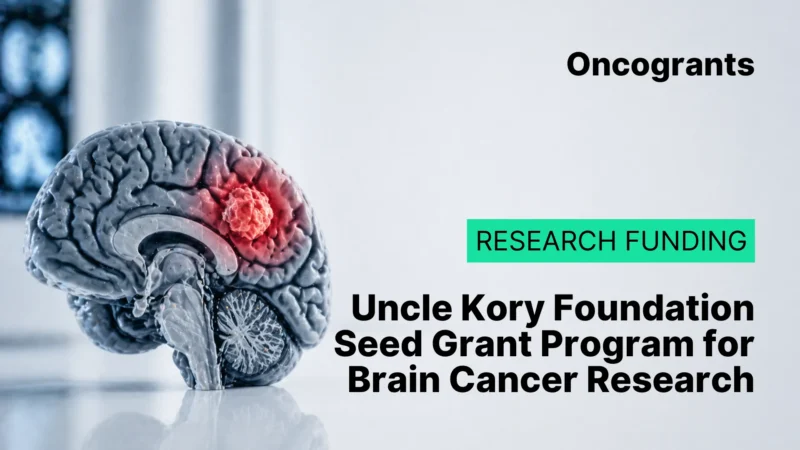
The Uncle Kory Foundation (UKF) Seed Grant Program 2026 is accepting applications to support innovative, early-stage brain cancer research.
The program is designed to help investigators generate preliminary data, launch new research initiatives, and advance promising projects toward larger external funding opportunities.
Researchers from eligible academic institutions worldwide can apply. Awards provide up to $50,000 for an initial one-year project, with the possibility of applying for a second year of funding of up to $50,000.
Eligibility Criteria
- The Principal Investigator must hold an independent faculty or research appointment, or an equivalent position at their institution.
- The PI must be authorized by their institution to serve as Principal Investigator on externally funded research grants.
- Applications are accepted from eligible academic institutions worldwide.
- There are no U.S. or Canadian citizenship requirements.
- Applications from industry, biotechnology companies, and other private organizations are not eligible.
- More than one investigator from the same institution may submit an application.
- Proposed research must be directly related to brain cancer.
Funding Details
- Funding: Up to $50,000
- Duration: 1 year
- Potential renewal: Investigators may apply for a second year of funding of up to $50,000, subject to satisfactory progress, submission of a renewal application, and available funding.
Deadline
- Application deadline: September 1, 2026
- Application opened: August 1, 2026
- Funding decisions: Approximately November 1, 2026
- Funding available: By January 15, 2027
Further Information
- Questions regarding the program may be directed to grants@unclekory.org.
- Official program page: View the official website.
- Online application: Apply for the Seed Grant. Open the application page
- Seed Grant FAQ: View eligibility and application guidance.
3. CRI Irvington Postdoctoral Fellowship
The Cancer Research Institute (CRI) Irvington Postdoctoral Fellowship is one of the most respected postdoctoral funding programs in cancer immunology, providing $243,000 over three years to support early-career scientists who aim to become independent leaders in cancer immunotherapy research. The fellowship supports innovative, mentored postdoctoral research at any non-profit research institution worldwide, and is open to applicants from any country without citizenship restrictions. CRI explicitly welcomes fellows who are entering cancer research from adjacent fields such as immunology, molecular biology, or computational biology. Applications are now open for the September 1, 2026 cycle — the spring cycle (March 2, 2026) has passed.
Eligibility Criteria:
- Must hold a PhD, MD, or equivalent doctoral degree; degree does not need to be conferred prior to application, but must be conferred before the grant activates
- Must be within the first 5 years of postdoctoral research at time of application (with exceptions for documented career interruptions)
- Must be undertaking research in immunology or cancer immunology; project must have direct relevance to cancer immunotherapy
- Must have a designated Sponsor (postdoctoral mentor) at a non-profit research institution
- No citizenship or geographic restrictions — applicants from any country may apply, and research may be conducted at institutions worldwide
- Applicants who have held or are holding a major postdoctoral fellowship from another private source may still be eligible; check CRI guidelines
Funding Details:
- $243,000 total over 3 years (stipend + $4,000/year research allowance)
- Stipends are progressive; specific annual amounts confirmed in award letter
- Funds cover the fellow’s salary/stipend; the host institution holds the award
- No indirect costs allowed
Deadline
- September 1, 2026 at 12:00 PM (noon) Eastern Time
- Applications submitted via ProposalCentral
- Award notifications approximately 5 months after the submission deadline
Where to Go for Further Information
- Program overview and full guidelines.
- Application portal: ProposalCentral.
- Contact: grants@cancerresearch.org
4. EACR–Worldwide Cancer Research Collaboration Fellowship 2026
The EACR–Worldwide Cancer Research Collaboration Fellowships are a new initiative supporting international research visits that develop from connections made at the EACR Congress 2026, held in Budapest from June 8–11, 2026. The program is jointly supported by the European Association for Cancer Research (EACR) and Worldwide Cancer Research.
Successful applicants can receive up to €3,500 to continue a newly established collaboration through an in-person research visit. The fellowship may be used to exchange expertise and techniques, undertake a focused short-term research project, or build the foundations for a future collaborative grant proposal.
Eligibility Criteria:
- The fellowship must arise from a new research connection made at the EACR Congress 2026 in Budapest.
- Both collaborating researchers must have attended EACR Congress 2026, held June 8–11, 2026.
- At least one of the two researchers must have no more than 8 years of postdoctoral research experience at the time of submission.
- The fellowship must support an in-person research visit between the collaborating researchers.
- The proposed visit must last a minimum of two weeks; the program does not specify a maximum duration.
Funding Details:
- Maximum fellowship: Up to €3,500.
- The award is intended specifically to enable an international collaborative research visit, rather than provide salary or long-term project funding.
Deadline:
- Application deadline: September 3, 2026
- Applications must be submitted by email to the EACR.
- The official page does not specify a submission time or time zone in the information currently indexed.
- Current status: Open
Further Information:
- Official program information and application details: Visit the EACR Collaboration Fellowships page for the latest eligibility requirements, funding conditions, application guidance, and deadline.
- Funding partnership: The fellowship is jointly supported by the European Association for Cancer Research and Worldwide Cancer Research to encourage international cancer research collaboration following EACR Congress 2026.
- Research visit requirements: Visits must last at least two weeks. European-based researchers may visit laboratories worldwide, while researchers based outside Europe must undertake their fellowship visit at a European laboratory.
- Funding conditions: Up to €3,500 may be requested for travel, accommodation, and research expenses; salary, food and drink, conference attendance, and retrospective funding are excluded.
- Application submission: Applications should be emailed to Catherine Burns, EACR Programmes and Membership Officer, at catherine.burns@eacr.org by September 3, 2026.
5. Cholangiocarcinoma Foundation Innovation Award 2027
The 2027 Cholangiocarcinoma Foundation (CCF) Innovation Award supports ambitious, collaborative research focused on Biomarkers for the Early Diagnosis of Cholangiocarcinoma.
The award seeks multi-institutional projects identifying, refining, or evaluating blood-based, bile-based, imaging-based, or other biomarkers with the potential to improve early detection and ultimately patient outcomes. The 2027 RFP states that this opportunity is made available with support from the Julienne Morriss Callaway Memorial Research Fund.
Eligibility Criteria:
- Applicants may hold an MD, PhD, PharmD, DVM, or equivalent research qualification.
- Applicants may be based at academic, medical, or research institutions anywhere worldwide.
- Proposals must involve a multi-center collaboration of at least two institutions/sites.
- Previous recipients of CCF grants are eligible to apply.
- Not every collaborator is required to have previous experience in cholangiocarcinoma research.
- There are no applicant restrictions based on age, gender, race, disability, nationality, or country of residence.
Funding Details:
- The award provides a total funding commitment of USD 750,000.
- The RFP states that funding will be distributed in annual installments of USD 250,000.
- One Innovation Award is expected to be made.
- Salary and benefits of grant recipients may be included.
- Institutional indirect costs and overhead are not permitted.
Deadline:
- Letter of Intent deadline: September 4, 2026, at 11:59 p.m. U.S. Eastern Time.
- LOI outcome/invitations to submit a full application: September 25, 2026.
- Invited full application deadline: October 28, 2026.
- Scientific merit review: November 20, 2026.
- Award notification: November 30, 2026.
- Earliest project start date: June 1, 2027.
Further Information:
- Eligible biomarker research may investigate blood-based biomarkers, bile-based biomarkers, imaging-based biomarkers, or biomarkers derived from other biospecimens such as stool or saliva.
- LOIs must include a two-page research summary covering the project, specific aims, rationale, scientific approach, significance, and innovation; a one-page reference list; and an NIH biosketch or CV of up to three pages for each collaborator.
- Applications should demonstrate potential impact on patient outcomes, hypothesis-driven aims, appropriate statistical rigor, feasibility within the award period, and meaningful development of an Early Career Researcher. Note: the 2027 RFP describes a three-year USD 750,000 funding commitment but separately lists the research focus period as June 1, 2027–May 31, 2029; applicants should confirm the intended project duration with CCF.
- Official program information and application details: Visit the Cholangiocarcinoma Foundation research funding page and submit applications through ProposalCentral. The Foundation’s general Innovation Award information also confirms funding of USD 750,000 over three years.
- Download the official program document: Download the 2027 CCF Innovation Award Call for Letters of Intent.
6. DoD Ovarian Cancer Academy Early-Career Investigator Award
The Ovarian Cancer Academy Early-Career Investigator Award, offered through the U.S. DoD CDMRP under the FY26 Ovarian Cancer Research Program, is a mentored career-development “academy” award created to develop the next generation of ovarian cancer researchers. It pairs a defined research project with structured mentoring and professional development, supporting early-career investigators as they establish independent research programs. The program announcement (HT942526OCRPOCAECI) was released May 4, 2026, with applications submitted through eBRAP.
Eligibility Criteria:
- Open to early-career investigators, from post-training through junior faculty.
- The exact career-stage window is defined in the Program Announcement and should be confirmed prior to applying.
- U.S. and international applicants are generally eligible under CDMRP application instructions.
Funding Details:
- Award amounts, mentoring structure, and period of performance are specified in the FY26 OCRP Program Announcement (HT942526OCRPOCAECI); confirm current figures via eBRAP before applying.
Deadline:
- Letter of Intent due: September 15, 2026 (5:00 p.m. ET).
- Full application due: October 1, 2026 (11:59 p.m. ET).
- Program announcement released: May 4, 2026.
Where to Go for Further Information:
- DoD Ovarian Cancer Research Program (Program Announcement HT942526OCRPOCAECI).
- Letter of Intent and full application submitted via eBRAP.
7. AACR–WCRF International–Prevent Cancer Foundation Cancer Prevention Research Fellowship
The AACR–World Cancer Research Fund International–Prevent Cancer Foundation Cancer Prevention Research Fellowship supports postdoctoral and clinical research fellows conducting mentored research in primary cancer prevention.
The fellowship is intended to advance research that prevents cancer before it starts by identifying, reducing, or interrupting cancer risk factors and the earliest biological processes involved in cancer initiation. Eligible projects may involve basic, clinical, translational, or population sciences research.
Eligibility Criteria:
- Applicants must hold a PhD, MD, MD/PhD, or equivalent doctoral degree in a relevant field.
- Applicants with a medical degree must have completed either their most recent doctoral degree or medical residency—whichever occurred later—within the five years preceding the grant start date.
- Applicants cannot be pursuing another doctoral degree when the grant begins.
- Applicants cannot be employees or subcontractors of a U.S. federal government entity or for-profit private company.
- Applicants cannot concurrently hold another AACR grant.
- There are no citizenship or geographic restrictions, but applicants must have sufficient work authorization to complete the fellowship term.
Funding Details:
- The fellowship provides USD 130,000 over two years.
- Funding primarily supports the fellow’s salary and benefits while completing a mentored primary cancer prevention project.
- Up to 50% of the award may support non-personnel expenses, including laboratory supplies, equipment, publication costs, and other direct research expenses.
Deadline:
- Application deadline: September 22, 2026, at 1:00 p.m. U.S. Eastern Time.
- Decision notification: November 2026.
- Grant term: December 1, 2026–November 30, 2028.
Further Information:
- Projects must directly address primary cancer prevention through risk reduction, exposure modification, prevention of cancer-related infections, or interruption of biological processes involved in cancer initiation.
- Projects focused mainly on screening, early detection, surveillance, diagnosis, established cancer treatment, or management of precancerous lesions are not central to the program unless clearly connected to a primary prevention objective.
- Each recipient must attend an AACR Grantee Recognition Event to formally accept the fellowship.
- Applications must be completed online through ProposalCentral; applicants should carefully review the official Program Guidelines and Application Instructions before submitting.
- Eligibility questions may be directed to the AACR Research and Grants Administration team at grants@aacr.org.
8. Cancer Research UK Therapeutic Catalyst Awards 2026
The Cancer Research UK Therapeutic Catalyst supports academic researchers seeking to translate promising laboratory discoveries into new cancer therapeutics. Delivered in collaboration with Cancer Research Horizons, the scheme combines grant funding with access to experienced drug-discovery scientists to help researchers validate therapeutic targets, assess druggability, identify potential therapeutic hits, and advance early treatment concepts.
The 2026 program now offers two funding routes: the Target Award, providing up to £250,000 over 12–18 months, and the Early Therapy Award, providing up to £350,000 over 18–24 months. Applications are open globally to eligible academic researchers working on adult cancers.
Eligibility Criteria:
- Applicants may be academic researchers based at any university or research institute worldwide.
- Applicants should have their own laboratory and/or conduct independent research.
- Projects must have strong therapeutic potential and a clear opportunity to benefit cancer patients.
- The current Therapeutic Catalyst is focused on approaches for adult cancers using antibody-based therapeutics or small-molecule approaches, across the range of formats within these modalities.
- Projects should be capable of reaching an important developmental inflection point within the proposed award period, positioning the work for subsequent drug discovery, licensing, partnering, or additional funding.
- Childhood cancer therapeutic projects are not submitted through this route; Cancer Research UK operates a separate Childhood Cancer Therapeutic Catalyst.
Funding Details:
- The Therapeutic Catalyst currently includes two award mechanisms:
- Target Award
Funding: Up to £250,000
Duration: 12–18 months - Early Therapy Award
Funding: Up to £350,000
Duration: 18–24 months - Grant Amount: Up to £350,000 per project
Deadline:
- Applications are reviewed three times per year, with review rounds in February, June, and October.
- Next Expression of Interest deadline: September 25, 2026.
- The September deadline is the remaining 2026 submission date currently listed by Cancer Research UK.
- The Expression of Interest stage is currently open, with the next deadline on September 25, 2026. Because the EOI is mandatory, researchers interested in the
- 2026 round should submit this first-stage application rather than attempting to proceed directly to a full proposal.
Further Information:
- Official program information and application details: Visit the Cancer Research UK Therapeutic Catalyst page for current funding amounts, eligibility requirements, scientific remit, deadlines, review criteria, and application instructions.
- Cancer Research KI partnership information: Researchers can also review the Cancer Research KI Therapeutic Catalyst page for information about the KI–Cancer Research Horizons partnership and the Therapeutic Catalyst initiative.
- Cancer Research Horizons funding opportunities: Explore the Cancer Research Horizons funding portfolio for Therapeutic Catalyst, Childhood Cancer Therapeutic Catalyst, Data Catalyst, Translation Fund, and related translational opportunities.
- Application portal: Expressions of Interest are submitted through Cancer Research UK’s Flexi-Grant grant-management system; the application link is available through the official Therapeutic Catalyst page.
- Program contact: Researchers are encouraged to discuss potential projects with Cancer Research Horizons before applying. Contact the Therapeutic Translation team at therapeutic.translation@cancer.org.uk.
9. IASLC Career Advancement Grant 2026
The IASLC Career Advancement Grant supports and facilitates the career advancement of mid-career professionals within the thoracic oncology field by bridging the gap between early-career funding opportunities and more advanced support mechanisms. Covering the full spectrum of lung cancer and thoracic malignancy research — prevention, diagnosis, treatment, and all related aspects — it encourages multidisciplinary and global research proposals. Applicants from underrepresented specialties and low- and middle-income economies are highly encouraged to apply. No LOI is required; direct application is submitted through the IASLC online grants portal.
Eligibility Criteria:
- Applicant (MD, DO, PhD, PharmD, or equivalent) must be a mid-career professional within 6–15 years from initial faculty appointment
- At the beginning of the grant term, may not hold an independent major award valued at $250,000 or more annually
- Must be a current IASLC member in good standing
- Open to candidates worldwide; applicants from LMICs and underrepresented specialties especially encouraged
- Cannot have received tobacco industry funding
Funding Details:
- Funding amount confirmed active; specific quantum not publicly listed — contact foundation@iaslc.org for current award value
- One-year grant supporting research costs
Deadline:
- October 15, 2026
Where to go for further information:
10. Marie Skłodowska-Curie Actions (MSCA) Postdoctoral Fellowships 2026
The Marie Skłodowska-Curie Actions (MSCA) Postdoctoral Fellowships 2026 support highly qualified postdoctoral researchers undertaking advanced training and research mobility across borders. Open to all disciplines, including oncology and cancer research, the programme aims to enhance creative and innovative potential while fostering career development through international, interdisciplinary, and intersectoral experiences. Fellows can pursue either a European Fellowship hosted in an EU or Associated Country, or a Global Fellowship involving an outgoing phase outside Europe followed by a mandatory return phase. MSCA PFs are among the most prestigious and competitive fellowships worldwide.
Eligibility Criteria:
Applicants must:
- Hold a PhD degree at the time of application
- Be of any nationality
- Have no more than 8 years of postdoctoral research experience
- Comply with MSCA mobility rules
- Propose a research project aligned with the host institution’s expertise
- There are no discipline restrictions; oncology and cancer research projects are fully eligible.
Funding Details:
- Living allowance: up to ~€5,990 per month (country-corrected)
- Mobility allowance and family allowance (if applicable)
- Research, training, and networking costs
- Total 2026 call budget: €399.05 million
- Duration:European Fellowship: 12–24 months
- Global Fellowship: 24–36 months
Deadline:
- Call opens: 9 April 2026
- Application deadline: 9 September 2026
Where to go for further information:
- Call page.
- Application portal: EU Funding & Tenders Portal