
Sergio Cifuentes-Canaval, Medical Oncologist at Las Américas Auna Clinic, shared on X:
“New review in Expert Opin Drug Metab Toxicol: practical considerations for the safe use of pembrolizumab or durvalumab plus gemcitabine and cisplatin in advanced biliary tract cancer.
Why we wrote it: KEYNOTE-966 and TOPAZ-1 mostly enrolled patients with ECOG 0-1 and adequate organ function. In routine practice, biliary obstruction, stents, cholangitis, hepatic or renal dysfunction and frailty are common, and they make adverse event attribution difficult.
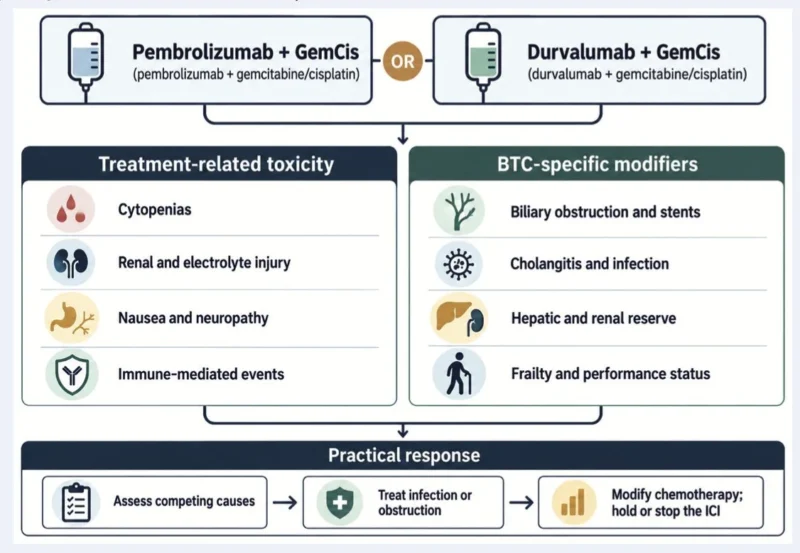
What the evidence shows: There is no head-to-head comparison of the two checkpoint inhibitors. We found no safety advantage for either. In KEYNOTE-966, median OS was 12.7 vs 10.9 months (HR 0.83). Grade 3-4 treatment-related events were similar (70% vs 69%), with more immune-related events on pembrolizumab (22% vs 13%). KEYNOTE-966 allowed gemcitabine beyond 8 cycles, TOPAZ-1 did not. This is a cumulative exposure consideration, not proof of greater toxicity from the inhibitor.
The central problem is attribution. Fever, abnormal liver tests, dyspnea, diarrhea or AKI may reflect chemotherapy, immunotherapy, infection, obstruction or progression.
CTCAE grades magnitude, not context: the same grade can mean very different things in a patient with a stent.
We propose a sequence: identify the dominant pattern, exclude reversible causes first (obstruction and infection), review timing and concomitant drugs, and only then assign a probable cause. With a cholestatic pattern or fever, rule out obstruction, stent dysfunction and cholangitis before starting steroids. With a hepatocellular pattern and no obstruction, consider immune-mediated hepatitis.
We also outline a three-tier pretreatment risk stratification (standard, increased, high risk). In the high-risk tier, we suggest correcting reversible problems before offering full-dose triplet therapy.
Limitations: this is a narrative review without meta-analysis. The attribution framework and risk tiers are expert opinion and not prospectively validated. Gaps remain for persistent high bilirubin, ECOG 2 or higher, cirrhosis, frailty and recurrent cholangitis.
No funding and no competing interests declared. Thanks to my colleagues: Enes Erul and Akhil Santhosh.”
Title: Practical considerations for the safe use of pembrolizumab or durvalumab plus gemcitabine and cisplatin in advanced biliary tract cancer
Authors: Enes Erul, Sergio Cifuentes-Canaval, Emir Sokolović, Akhil Santhosh, Luis Gabriel Parra-Lara, Fernando Sabino Marques Monteiro, Raffaella Massafra, Oronzo Brunetti, Francesco Ciccimarra, Gerardo Cazzato, Antonella Daniele, Chiara Paciolla, Pinar Kubilay Tolunay, Alessandro Rizzo.
Read the Full Article
You may also be interested in:
- Sergio Cifuentes-Canaval: ctDNA Surveillance in High-Risk ER+/HER2- Early Breast Cancer
- KEYNOTE-585 FLOT Cohort: Perioperative Pembrolizumab in Resectable Gastric and GEJ Cancer