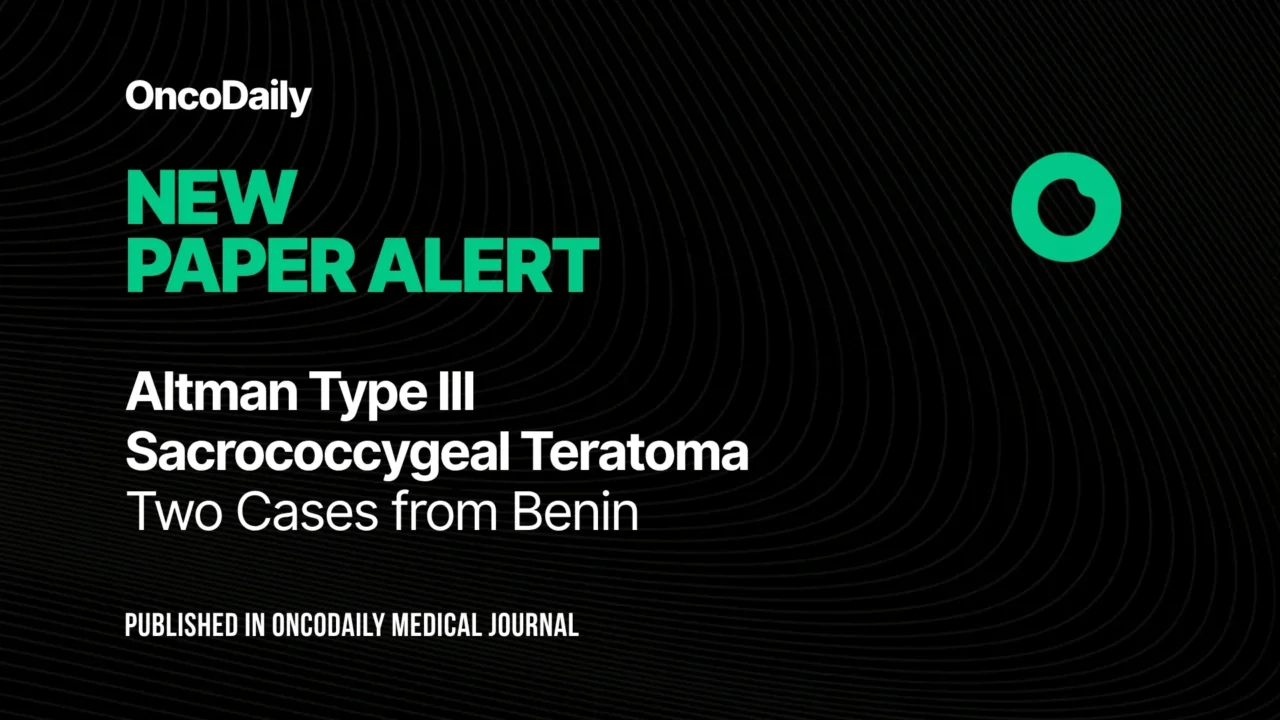
A recent paper published in OncoDaily Medical Journal reports the management of two children with Altman type III sacrococcygeal teratoma (SCT) in Benin, highlighting the challenges of treating large tumors with substantial pelvic involvement in resource-limited settings.
Both children presented after delayed diagnosis and required complex surgical management. Although their tumors differed in pathology and previous treatment, complete resection with coccygectomy was ultimately achieved in both cases.
The report demonstrates how imaging, pediatric surgery, oncology, pathology, and multidisciplinary decision-making can be combined to individualize treatment for complex sacrococcygeal teratomas.
Integrated Management of Endo- and Exo-pelvic Sacrococcygeal Teratomas (Altman type III): Report of Two Cases
Authors: Yassegoungbe Monsoia Gildas, Bognon Gilles Modeste Alain, Mpiana Ntumba Max, et al.
Published in: OncoDaily Medical Journal, Volume 3, Issue 2, 2026
DOI: 10.69690/ODMJ-011-0826-7849
What Is Sacrococcygeal Teratoma?
Sacrococcygeal teratoma is a congenital germ cell tumor arising in the region of the coccyx. It is considered the most common congenital germ cell tumor in fetuses and newborns, with an estimated incidence of approximately 1 in 35,000 to 40,000 live births.
The anatomical extent of SCT is commonly described using the Altman classification. Type III tumors have both external and pelvic components, with a substantial proportion of the tumor located inside the pelvis.
This internal extension can make surgery particularly challenging because the tumor may lie close to the rectum, bladder, urinary tract, and pelvic nerves. Children diagnosed late may develop symptoms related to compression of these structures, including constipation and urinary retention.
Two Altman Type III Sacrococcygeal Teratoma Cases
The authors reported two girls, aged 15 months and 18 months, who were treated for Altman type III SCT in Benin. Neither tumor had been diagnosed prenatally.
Case 1: Chemotherapy Before Surgery
The first patient was a 15-month-old girl who presented with a large sacrococcygeal mass and developed intermittent constipation and urinary retention.
CT imaging showed extensive pelvic involvement, with the tumor extending close to several pelvic structures. The anatomy made immediate surgery particularly difficult.
Biopsy findings were compatible with an immature teratoma and included AFP-positive tumor cells that raised concern for an associated yolk sac tumor component, despite an age-appropriate serum AFP level of 10 ng/mL.
Following multidisciplinary review, the patient received four cycles of etoposide, ifosfamide, and cisplatin (VIP) before surgery.
After chemotherapy, imaging showed tumor regression and improved separation from surrounding pelvic structures. This allowed complete excision through a posterior surgical approach, including removal of the coccyx.
A postoperative wound infection and partial dehiscence were managed successfully.
At 20 months of follow-up, AFP remained within the normal range, and there was no reported recurrence, urinary dysfunction, or sphincter dysfunction.
Case 2: Definitive Surgery After Previous Incomplete Resection
The second patient was an 18-month-old girl whose sacrococcygeal mass had initially been noticed shortly after birth.
She had previously undergone surgery at another center, but the coccyx had not been removed, and no histopathological examination had been performed. She later presented with wound infection and urinary retention.
CT identified residual Altman type III disease involving both the pelvic and external regions. The tumor compressed the rectum and bladder outlet, while the coccyx remained in place. No metastatic disease was detected.
A multidisciplinary team recommended definitive surgery. Surgeons first used laparoscopy to mobilize the pelvic portion of the tumor, followed by a posterior approach to remove the remaining tumor and coccyx.
Pathological examination showed a mature teratoma without an immature component, and complete resection was achieved.
At 9 months of follow-up, AFP remained normal, and no early evidence of recurrence was reported, although continued surveillance is required.
Why Is Coccygectomy Important in Sacrococcygeal Teratoma?
One of the central messages of the paper is the importance of removing the coccyx together with the tumor.
Sacrococcygeal teratomas are closely associated with the coccygeal region, and leaving residual tumor tissue or preserving the coccyx has been associated with a higher risk of recurrence. The authors cite reports describing recurrence rates of up to 30–40% following incomplete resection or coccyx preservation.
The experience of the second patient illustrates this issue: after an earlier operation without coccygectomy, persistent disease required another, more extensive surgical procedure.
Individualizing Treatment for Complex Sacrococcygeal Teratoma
The two cases also demonstrate that patients with the same anatomical SCT classification may require different therapeutic strategies.
In the first case, the combination of difficult pelvic anatomy and concern for a malignant germ cell component led the multidisciplinary team to use chemotherapy before surgery.
In the second case, mature histology and the absence of metastatic disease supported surgical treatment, while laparoscopy helped address the substantial intrapelvic portion of the tumor.
The report therefore emphasizes that decisions should consider not only Altman classification, but also tumor histology, anatomical relationships, previous treatment, resectability, and the child’s overall clinical condition.
Managing Pediatric Tumors in Resource-Limited Settings
The cases also draw attention to challenges surrounding the treatment of congenital and pediatric tumors in settings where specialized resources may be limited.
Neither child had received a prenatal diagnosis. According to the authors, barriers such as inconsistent access to antenatal screening, advanced imaging, specialized pediatric surgery, pathology services, and long-term tumor-marker monitoring can contribute to delayed diagnosis and treatment.
MRI may offer detailed anatomical assessment of SCT, but when access is limited, CT can play an important role in defining pelvic extension and planning surgery.
The authors highlight greater centralization of complex cases, multidisciplinary tumor boards, improved specialist training, and stronger referral pathways as potential ways to improve care for children with these tumors.
Read more New Paper Alerts on OncoDaily.