Miguel Bronchud, Co-Founder and Director of Clinical Research at BO REAL BioTech, shared on LinkedIn:
“More drugs is better? Even in mismatch Repair deficient colorectal cancers?
A combination of mFOLFOX6, bevacizumab, and atezolizumab may prolong progression-free survival (PFS) over atezolizumab monotherapy in patients with mismatch repair-deficient/microsatellite instability-high (dMMR/MSI-H) metastatic colorectal cancer in the first-line setting, according to findings from the phase III NRG-GI004/SWOG S1610 COMMIT trial.
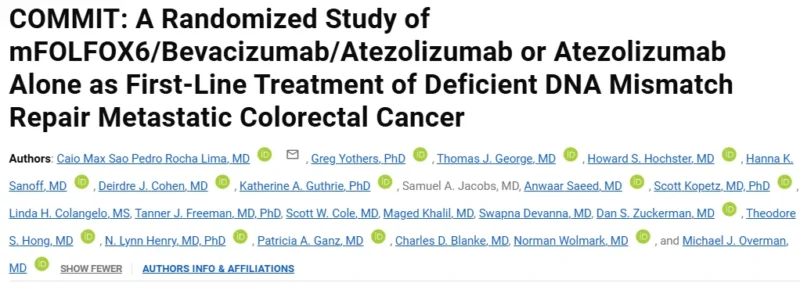
Title: COMMIT: A Randomized Study of mFOLFOX6/Bevacizumab/Atezolizumab or Atezolizumab Alone as First-Line Treatment of Deficient DNA Mismatch Repair Metastatic Colorectal Cancer
Authors: Caio Max Sao Pedro Rocha Lima, Greg Yothers, Thomas J. George, Howard S. Hochster, Hanna K. Sanoff, Deirdre J. Cohen, Katherine A. Guthrie, Samuel A. Jacobs, Anwaar Saeed, Scott Kopetz, Linda H. Colangelo, Tanner J. Freeman, Scott W. Cole, Maged Khalil, Swapna Devanna, Dan S. Zuckerman, Theodore S. Hong, N. Lynn Henry, Patricia A. Ganz, Charles D. Blanke, Norman Wolmark, Michael J. Overman.
Read The Full Article.
Lars Henrik Jensen, of the University Hospital of Southern Denmark, Vejle Hospital, Vejle, noted that since the study did not compare current first-line standards, its findings cannot be considered practice-changing but rather as hypothesis-generating.
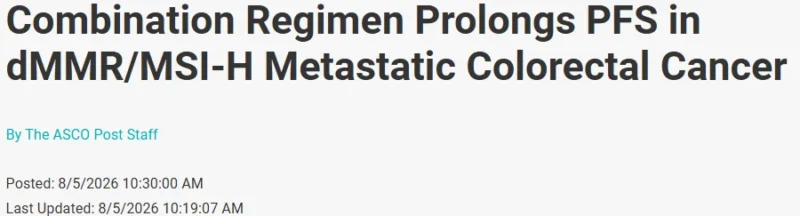
Title: Combination Regimen Prolongs PFS in dMMR/MSI-H Metastatic Colorectal Cancer
Read The Full Paper.
The study showed not only longer progression-free survival, but also a dramatic reduction in the number of patients whose disease progressed as their best response to treatment.
‘These results may help inform future treatment strategies for this patient population.’
And question the validity of immune therapy alone?
The three-arm, prospective, open-label phase III trial randomly assigned patients with dMMR/MSI-H metastatic colorectal cancer to receive either mFOLFOX6 with bevacizumab; atezolizumab monotherapy; or mFOLFOX6, bevacizumab, and atezolizumab in a 1:1:1 ratio.
Based on results from the KEYNOTE-177 trial, the mFOLFOX6 and bevacizumab arm was closed after 20 patients were enrolled, and the remaining arms continued with a revised sample size of 100 patients.
The primary endpoint was not overall survival but progression-free survival in the intent-to-treat population.
At a median follow-up of 46 months, the median progression-free survival in the triplet arm was 24.5 months (95% confidence interval [CI] = 10.1 to not estimable) compared with 5.3 months (95% CI = 2.2–18.2) for the monotherapy arm (hazard ratio [HR] = 0.42; 95% CI = 0.22–0.80; P = .0068).
At 12 months, the progression-free rates were 66.7% and 35.1% for the combination and monotherapy arms, respectively, and 24 months, the rates were 53.7% and 31.6%.
The objective response rate was 86.1% with mFOLFOX6, bevacizumab, and atezolizumab compared with 46% with atezolizumab monotherapy and the disease control rates at 12 months were 64.7% and 32.4%, respectively.
Grade 3 or higher adverse events were observed more frequently in the combination arm (34 vs 18 patients).
Clinical trials like COMMIT are interesting.”
You can also read: ESMO 2026 Guideline: Redefining the Management of Metastatic Colorectal Cancer