
Gilberto Lopes, Chief of the Division of Medical Oncology at the Sylvester Comprehensive Cancer Center, shared on X:
“New study on something our patients experience but we do not always measure:
Lung cancer stigma.
Among 850 patients with lung, breast, colorectal or prostate cancer, people with lung cancer reported higher stigma – especially internalized shame and social isolation.
Weighted contrast analysis:
- overall stigma p=0.001
- internalized shame p<0.001
- social isolation p=0.002
Effect sizes were small – important context.
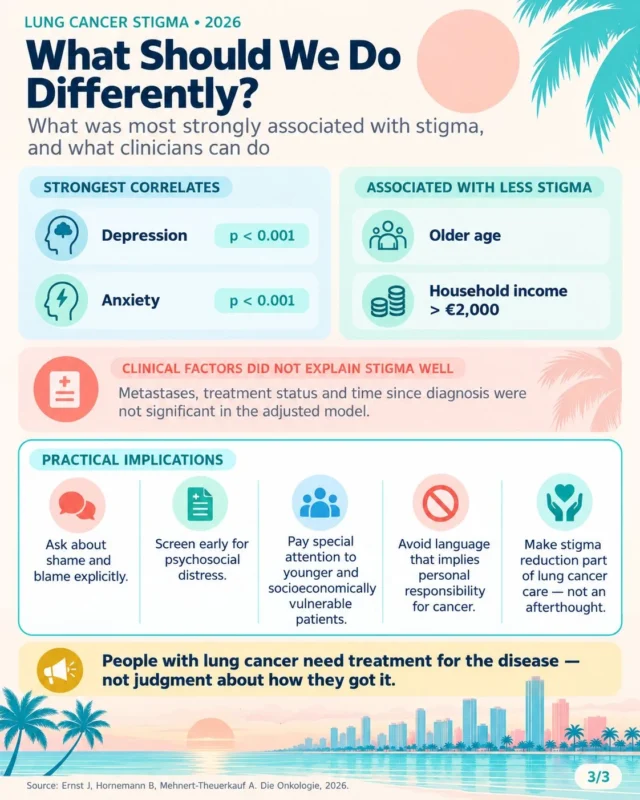
What tracked most strongly with stigma? Not metastases. Not treatment status. Not time since diagnosis.
The strongest correlates were depression and anxiety. The social context matters too.
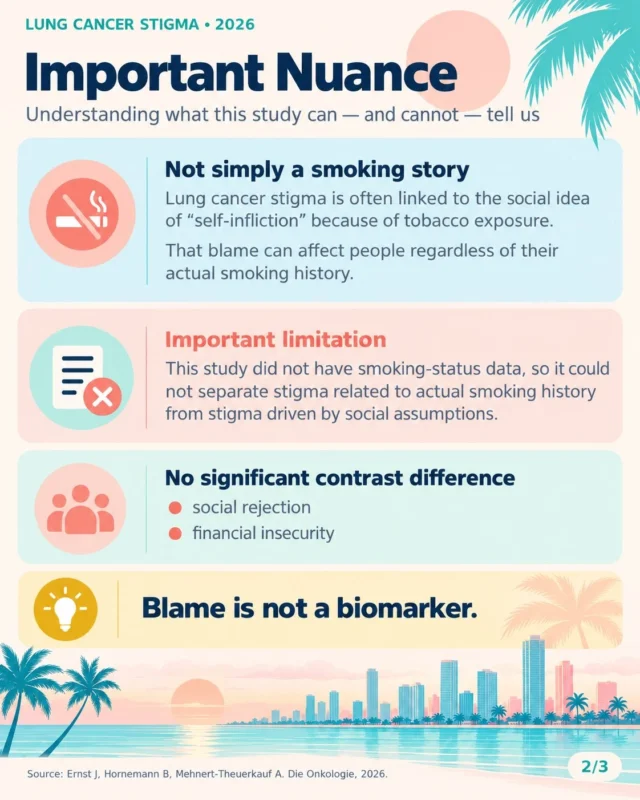
Lung cancer is still often linked to the idea that patients are somehow ‘to blame’ because of smoking – even when that assumption is wrong.
Important limitation: smoking-status data were not available.
So the study cannot separate stigma linked to actual smoking history from stigma driven by social assumptions.
Clinical implication:
Ask about shame and blame. Screen for distress. Avoid language implying personal responsibility. Make stigma reduction part of lung cancer care. Blame is not a biomarker.
People with lung cancer need treatment for the disease – not judgment about how they got it.”
Title: Perceived stigmatization due to lung cancer: a contrast analysis compared to breast, colorectal, and prostate cancer
Authors: Jochen Ernst, Beate Hornemann, Anja Mehnert-Theuerkauf.
Read the full article.
You may also be interested in: What Changes in Lung Oncology After ESMO 2026? Survival Breakthroughs, ADC Competition, and a New Era of Precision Treatment