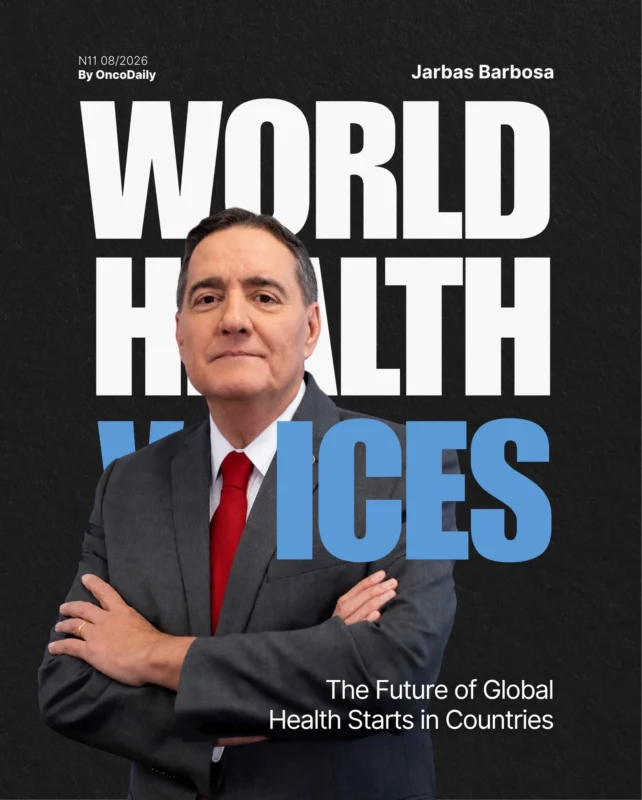
From growing up as a doctor’s son in Pernambuco to leading the Pan American Health Organization, Jarbas Barbosa has spent his career asking one question: What can we do differently? Today, as global health searches for a new architecture, he argues for stronger countries, stronger regions—and a WHO focused on the things only a global organization can do.
Medicine was part of Jarbas Barbosa’s life from the beginning.
“My father was a doctor, so I could see the good work that he provided in small villages when I was a child,” he recalls.
“In my early years, I always considered being a doctor.”
He briefly considered other careers, including law, but eventually chose medical school. For a time, pediatrics seemed to be his future.
“I wanted to be a pediatrician, an infectious disease pediatrician.”
Then he encountered epidemiology and public health.
“It’s kind of a cliché, but I think it makes sense. As an individual doctor, you can save one life. As a public health professional, you can implement things and support policies that will benefit thousands, hundreds of thousands of people.”
“Maybe it is an ambition to make a difference in people’s lives.”
That ambition would take him from Pernambuco to Brasília, from Brazil’s ministry and national regulatory authority to Washington, D.C., and ultimately to the leadership of PAHO and the WHO Regional Office for the Americas.
Throughout that journey, one question repeatedly guided him:
“What will I do differently in this position?”
What Will I Do Differently?
Dr. Barbosa began as coordinator of the HIV/AIDS program in his home state of Pernambuco.
Then he and a group of young public health professionals were invited to help lead the health system in Olinda, at a time when Brazil was beginning to decentralize its national health system.
“Being in a municipality at that time was very challenging and very interesting.”
Two years later, he became Pernambuco’s Secretary of Health. Two years after that, he moved to Brasília, eventually holding several senior national positions.
At the same time, he completed his master’s degree and PhD.
The challenge became learning how to connect evidence with leadership.
“How could I combine better the knowledge, the scientific evidence, my technical background, but also develop managerial skills that are very important to lead a transformative process?”
That thinking became central to his career.
“In all the positions that I served, the first question was: what will I do differently in this position? What will be the most important change that I will implement? What will be my strategy? What are the allies? What are the bottlenecks? What are the barriers?”
“I always think about how to change, how to be innovative, how to be flexible, how to adapt—and how to promote real change.”
“Regulation Is Not a Barrier”
One of Dr. Barbosa’s biggest challenges came when he was asked to lead Brazil’s National Health Regulatory Agency.
“In public health, sometimes we are very conservative,” he says. “We try to repeat the same activities, the same programs, the same interventions that we have been implementing for 10 or 20 years.”
When Brazil’s president and minister of health asked him to lead the regulatory authority, Jarbas Barbosa asked why.
“They told me, ‘Because you organized very well the area of health surveillance. It’s a very successful one. So it’s time for you to take another challenge.’”
Brazil was debating how to modernize licensing, pharmacovigilance, inspections and other regulatory processes.
Dr. Barbosa approached the job with a simple principle.
“Regulation is not a barrier. It’s an enabling function that aims to facilitate the access of the population to high-quality, safe and effective products.”
“The idea is not to think about the barriers that we are building, but how we can make the process more efficient, reduce the time and improve the quality of the service that we are providing.”
PAHO and a Different Global Health Architecture
PAHO occupies a unique place in global health.
It predates WHO and remains an independent international organization within the Inter-American system, with its own constitution and membership. Since 1949, it has also served as the WHO Regional Office for the Americas.
“We are at the same time an independent organization that integrates the Inter-American system. We have our own constitution. We have our own membership. Our decisions are made here in the Americas.”
“At the same time, we are very proud to be the WHO Regional Office for the Americas.”
PAHO was never absorbed into WHO.
“PAHO was not diluted into WHO. Never. It remained as an independent organization that has two roles.”
For Jarbas Barbosa, this structure may offer lessons far beyond the Americas.
“I do believe that this model—to have a strong regional office that is closer to the countries, that can work together with the countries, that can build national capacities—probably is a model that could be useful in this debate that we have nowadays about the global health architecture.”
He points to institutions such as Africa CDC.
“Regional organizations like PAHO, like Africa CDC and others, can complement the important role that WHO has to play.”
But complementarity is the key.
“There are some things that you cannot do regionally. Establishment of standards, norms, technical guidance need to be centralized in a global organization like WHO.”
Other functions, however, should happen closer to countries.
“I don’t think it makes sense to have teams in Geneva go to a country to support the response to a measles outbreak, or a program to reduce maternal mortality, or to implement activities to eliminate malaria.”
“These are much better performed in a more efficient way if we have stronger regional offices that are working together, well coordinated with WHO.”
At the same time:
“The world needs very strong global governance to respond to pandemics, to bring countries together, to advance the public health agenda, to establish norms, standards, scientific and technical guidance.”
“It’s not a competition. I think about complementarity.”
“What are the roles that only WHO headquarters can perform? We need to strengthen them. But at the same time, what are the roles that are better performed from the regional offices and from the country offices?”
“Establishing a better alignment between the country, the region and the global governance will be very important.”
Forty Years of Buying Together
One of the clearest examples of regional cooperation is PAHO’s pooled procurement mechanism.
“We are the only region that has a permanent pooled procurement mechanism that has been working for more than 40 years now.”
For middle-income countries, Dr. Barbosa says, this is particularly important.
“Our Member States have to purchase their own vaccines.”
Negotiating alone would leave many countries at a disadvantage.
“If they had to negotiate individually with the producers, probably we would have several different immunization schedules in the region because some countries probably would not be able to purchase the HPV vaccine or the pneumococcal vaccine alone.”
By bringing regional demand together, PAHO strengthens countries’ negotiating power.
But Dr. Barbosa emphasizes that the mechanism is not simply about purchasing.
“It’s part of our technical cooperation.”
PAHO works with countries to forecast demand, prevent shortages, reduce waste, improve logistics and train healthcare workers.
“The pooled mechanism allows the country to get, in general, the better price in the world for high-quality vaccines.”
And the model has expanded.
“We offer not only vaccines. We expanded this to other areas—medicines, medical devices, laboratory diagnostic kits.”
“And more recently, we moved also to high-cost medicines for cancer treatment.”
Other regions are paying attention.
“This really is, I think, a unique experience that now other regions want to learn from us.”
As countries graduate from mechanisms such as Gavi, he argues, regional procurement becomes even more important.
“If they do this alone, they will pay much higher than if they do this together in a regional pooled procurement mechanism.”
Why has the model not been replicated more widely?
“For the other regions to have a similar mechanism, they will need to have more autonomy.”
“You cannot do that if, to make the purchasing process, you need to rely on Geneva. This clearly needs to be regionalized.”
Africa CDC, he says, has already have an agreement with PAHO to learn from the experience.
“The strengthened country offices will allow us to be more effective”
Another feature Jarbas Barbosa believes others can learn from is PAHO’s strong country presence.
“The country office is not only a diplomatic representation of PAHO and WHO.”
“They implement regional priorities, but they also have a very productive dialogue with the health authorities to work on the national priorities that are established.”
For Dr. Barbosa, strong country offices are essential if international institutions want to produce real results.
“The strengthened country offices will allow us to be present and will allow us to be more effective at protecting the public health gains and, at the same time, advancing the public health agenda.”
The United States, Argentina—and the PAHO Bridge
The withdrawal of major countries from WHO has created a difficult moment for multilateral health cooperation.
But PAHO’s independent status creates an important distinction.
“The U.S. is out of WHO, but it’s not out of PAHO,” Dr. Barbosa says.
The same applies to Argentina.
“I hope that they will change their minds in the future and they come back to WHO, because nobody is really safe if all the countries are not working together on early detection, response and coordination actions to prevent public health threats.”
Both countries continue working through PAHO.
The United States, Dr. Barbosa stresses, contributes far more than financing.
“They have some of the most important public health agencies in the world. The U.S. CDC has several collaborating centers based there. They provide a lot of technical support.”
Argentina also remains deeply involved in regional cooperation, including work on vaccine production.
“Of course, I hope that the U.S. and Argentina change their minds and come back to WHO.”
“It’s very important for all the other countries—and even for them.”
In the meantime, PAHO can remain a bridge.
Public Health Needs Anthropology Too
For young people considering public health, Dr. Barbosa believes traditional training is no longer enough.
“Nowadays, I think that more than ever, we need more professionals working in the health sector.”
The challenges are becoming more complex: aging populations, expensive new technologies, health system efficiency and the growing difference between lifespan and healthy lifespan.
“We increased life expectancy more than healthy life expectancy.”
“We are providing more years to people, but not healthy years, as we are supposed to do.”
Young professionals still need the foundations.
“You need to develop your skills, to know the traditional public health disciplines, like epidemiology, planning and statistics.”
But they also need to understand people.
“It’s very important to develop some skills like anthropology, sociology, politics, economics.”
Because many barriers are invisible.
“A person from an Indigenous population goes to a health center and doesn’t understand what they are saying and doesn’t feel respected.”
“These are the kind of invisible barriers that a public health professional needs to be able to identify and to propose strategies to overcome.”
Technology Is Not Enough
Dr. Barbosa points to Suriname as an example of why implementation matters.
The country became the first in the Amazon Basin to eliminate malaria.
But it was not because Suriname possessed technology unavailable elsewhere.
“Other countries in the Amazon Basin have the same tools.”
The difference was how they were used.
“We worked together with the Ministry of Health to use the new tools that we have for malaria control, like rapid tests and short treatment, in a way that was accessible to communities that were far from the health centers.”
“This is not only to have the new technology, or new diagnostic tests, or the new treatment, but also how to use it and take into account the reality of the community.”
“I Really Love When Someone Changes My Mind”
“I learned a lot from the people that came before me.”
And just as importantly:
“I learned a lot with the teams that I have worked with.”
“Listening to people that work with you is crucial, because several times they can tell you, ‘No, this is not the best way to do this. I think that we can have a different way.’”
Then comes perhaps the most revealing line of our conversation.
“I really love when someone changes my mind.”
“Someone shows me that we can do one intervention, one problem, in a different way—and we can be more effective if we adopt this change.”
“You Need to Be Humble”
What, after decades in public health leadership, does Jarbas Barbosa consider his key to success?
“First, you need to have an open mind.”
“And I think that you need to be humble.”
“We need to get good data, good information, good intelligence. This is crucial.”
But evidence alone does not guarantee results.
“It’s not only about having a policy, but about the implementation.”
Global health, he says, too often treats implementation almost as an afterthought.
“Sometimes we take it for granted. If I have a good policy, a good program, the implementation is only an asset.”
“No.”
“Implementation is crucial.”
“And it requires a lot of science—and art.”
One Region, Two Extremes
Few regions illustrate health inequality as dramatically as the Americas.
“We have at the same time the richest country in the world, the U.S., and a country that is struggling with very complex issues like Haiti.”
But inequalities also run deeply within countries.
“Some groups, some populations, really have barriers to access not only health, but education, social and economic development.”
For Dr. Barbosa, equity therefore has to be built into every intervention.
“Every policy, every program that we are implementing in the Americas, we need to take this into account.”
“We really need to identify what are the vulnerable groups, why they are not having access to the traditional strategies, and what are the measures that we need to implement to overcome these barriers.”
He also challenges the assumption that middle-income countries no longer need international support.
“In the past, they thought, ‘OK, they are middle-income countries. They don’t need to receive international support.’”
“And this is not true.”
When countries graduate from international financing mechanisms, the transition can be abrupt.
“When a country graduates from Gavi and needs to put 50% of the vaccines that they need from one year to another year, this is a huge challenge.”
Dr. Barbosa is clear that this should not become a competition between regions.
“Latin America and the Caribbean are not competing with Africa. Africa has different and very specific needs.”
Instead, countries can learn from one another.
“What we can do in this region is show that some interventions can really work in complex and vulnerable situations.”
“What we are doing here in the Americas on cervical cancer elimination, on the elimination of TB, HIV, malaria, neglected tropical diseases, on strengthening primary health care, telehealth, digital transformation and regional production capacity—they really can show the way.”
“And at the same time, we learn a lot from their own experience.”
Who Should I Interview Next?
I end with the question I ask almost every guest.
Who should I interview next?
Dr. Barbosa thinks for a moment.
“We have so many interesting people in the world.”
Then comes his suggestion.
“I don’t know if you have already interviewed Jean Kaseya from Africa CDC.”
Not yet.
But perhaps it is the natural continuation of this conversation.
Because the future Dr. Barbosa describes will not be built only in Geneva.
It will depend on strong global governance, strong regional institutions and countries capable of turning policy into reality.
And on leaders willing to keep asking the question that has followed him throughout his career:
What can we do differently?
Interview by Gevorg Tamamyan, Editor-in-Chief of OncoDaily and World Health Voices