





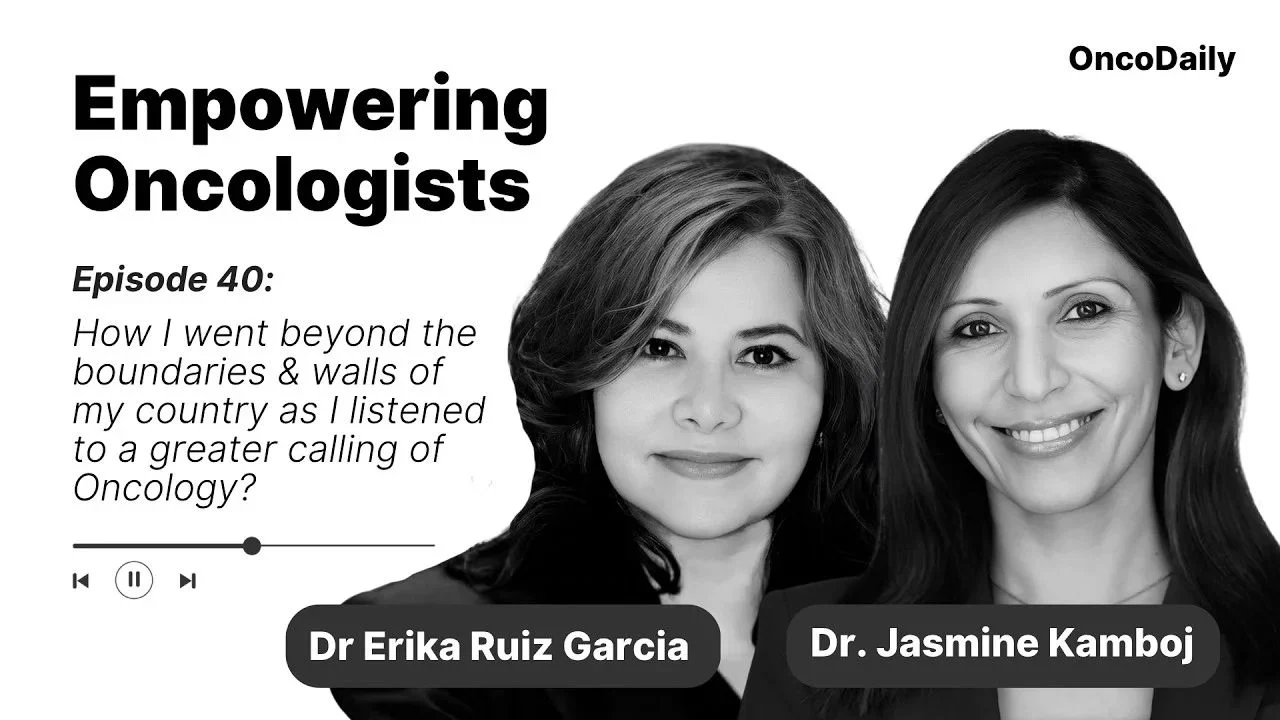
Interview by Jasmine Kamboj
Medical Oncologist and Hematologist at Mayo Clinic
Podcast Editor and Host of the ‘Empowering Oncologists’ podcast at OncoDaily
“Go for it. Go for what you want to do.”
A story that will resonate with so many oncologists in the world, so many women and so many trainees who are still figuring out if there is a right decision they missed or a right path that they cannot afford to take. Dr. Erika Ruiz García’s open conversation about “becoming” has answers for everyone everywhere.
For her, becoming a better oncologist has never meant learning medicine alone.
“If you want to be a good physician, you need to know more than medicine,” she says. “You need to have that sense of humanistic way so you can be more empathetic with patients.”
It is a sentence that captures much of her story – a career built not only through oncology, research, and leadership, but through culture, exposure, mentorship, language barriers, unexpected turns, and a persistent belief that physicians must see beyond their own institutions, cities, and countries.
Dr. García is the Chief Academic Officer and Chief of the Translational Medicine Laboratory at the Instituto Nacional de Cancerología in Mexico City – “the NCI Mexico,” as she explains. She is also the ASCO Education Program Chair-Elect for 2025–2026, a GI oncologist, researcher, mentor, editor, and global oncology leader.
But when she speaks about her journey, she does not describe it as linear. It began in Mexico City, moved through France and New York, returned to Mexico, and eventually expanded into ASCO, ESMO, academic leadership, translational research, and mentorship.
“All my career, I have been here in Mexico City,” she says. “But I was on third year of the residency when I said, hey, come on, I have to go outside. I need to see other cultures, other ways of treating cancer patients.”
The Need to Go Outside
García’s first plan was Canada. But, as often happens in life and medicine, unexpected opportunities control you.
“Sometimes new doors that open suddenly,” she says, “… and it was easier for me to go to France.”
Getting there was not simple. She did not have a sponsor in Mexico. She needed funding. She needed to find a fellowship that would accept her.
“It took me a lot of time, like three years,” she says. “But in those years, I did a master, I worked as an oncologist and also I learned French. And so, it was so great to have that opportunity to live in other continents with different ways of thinking.”
Looking back, she sees that period not as a delay, but as preparation. France gave her more than exposure to new cancer treatments and technologies. It gave her a broader way of seeing people. She met young physicians from different parts of the world. She was not only reading about differences in cultures and mentality; she was living inside it.
For García, this mattered deeply because oncology is not only a technical field. Cancer care takes place inside families, cultures, fears, financial realities, and human stories.
“Having a deeper culture, reading, seeing art – that gives you a part that a human needs… to understand all things that happen with cancer patients.”
From Breast Cancer to GI Oncology
“I was in love on breast cancer in those days in France,” she says.
But when she returned to Mexico, the only available position at NCI Mexico was in gastrointestinal oncology.
“For me, it was like a shock,” she says. “Because all my networking, all my knowledge was on breast.”
At that moment, she had a choice. A choice many young oncologists will face during their career.
“I said, well, I have two options. I can go and look for other institutions to work in, or I can stay here and accept the challenge to be a GI oncologist.”
She stayed.
“I don’t know why, but if this door is opening, I have to take this chance. I started my own career in GI in 2009,” she says. “And I can tell you now, after 15 years being a GI oncologist, that it has been the best decision of my life.”
Part of the reason is equity.
“In the whole world, especially low-medium income countries, there is a lot of help for those breast cancer patients,” she says. “And it’s not the same for the GI patients. I’m pushing forward to help all these vulnerable patients,” she says. “And there is a lot of GI over there, more than breast.”
Now, the field she entered unexpectedly has become central to who she is.
“Now I can tell you with all honesty that I love to be a GI oncologist. Taking that risky chance, changing paths form breast to GI… I can tell you now, after 15 years being a GI oncologist, that it has been the best decision of my life.”
Doing Small Things Well Will Get You to The Big
García’s academic path has included more than 100 peer-reviewed publications and work in leading journals. She has served in editorial roles, including as editor of the textbook Translational Research and Onco-Omics Applications in the Era of Cancer Personal Genomics, and on the editorial board of ESMO Gastrointestinal Oncology.
When asked how she reached these roles, she does not describe a single breakthrough moment. She describes work.
“I have been invited because of my work,” she says. “I truly believe that if you have a task, you need to do it. It doesn’t matter if it’s a small task or a big one, you need to be committed to it. I’m so committed to do the things that I am supposed to do, that finally people can trust me. Because of the small work that I did before with all these coauthors, they said, yes, Erika, let’s do it.”
It is a quiet but important lesson in academic growth: reputations are often built before the major invitation arrives.
Mentorship Without Having Had a Formal Mentor
One of the striking parts of García’s story is that she became a mentor partly because she did not have a formal one herself.
“I was very lucky because I didn’t have a formal mentor,” she says. “I have to mention that.”
Her mentoring philosophy came instead from observation. In France, and later during an observership at Memorial Sloan Kettering in New York, she met people whose behavior shaped her.
“I met a lot of very extraordinary people. And I saw the behavior of all of them, how they were so worried about not only residents, but also the undergraduate students.”
She noticed the curiosity of young people.
“There is a lot of richness in all these young people,” she says. “When you can talk with them and see their eyes, these young eyes that they want to discover, they are so curious.”
Because she had to discover many things on her own, she decided that others should not have to do the same.
“I didn’t have someone to tell me, you can do this, you can do that,” she says. “I had to discover by my own. I made mistakes, and then I recovered… I decided that I have to help the new people.”
Her message to students and fellows is clear: do not allow your world to become too small.
“They need that someone open their eyes towards outside of your city,” she says. “It’s not just your country. Your city is not the whole thing in the box. You need to go outside.”
For García, going outside is not only about prestige or training abroad. It is about perspective. It helps physicians understand privilege, limitations, creativity, and service.
“You need to compare,” she says. “You need to see that you have a lot of privilege, that maybe others do not… Even though we don’t have all the drugs available, or all the technologies, there’s other ways you can help people,” she says. “You need to be exposed to uncontrolled environments.”
Ideas Matter More Than Grammar
García’s global work with ASCO and ESMO began, in part, with curiosity.
“In 2017, I applied to be a volunteer,” she says. “Because I didn’t have a real mentor, I didn’t know I could. It was because of my curiosity.”
Then, in 2018, invitations came from both ASCO and ESMO. ASCO invited her to contribute to GI guidelines. ESMO invited her to serve as a GI professor.
“In both scenarios, for sure, I was surprised,” she says. “I didn’t know exactly how it was going to be, but I take the challenge, and I put a lot of passion.”
She also understood that coming from Mexico meant she had to prove herself differently.
“When you do not belong to European or to America, you have to demonstrate that you can do things,” she says. “It comes with your country.”
She names what many international physicians know but may not always say openly.
“If I were French, or English, or American, it could be a little bit easier,” she says. “But when you are from Mexico, from other parts of Latin America, from Africa, from India, you need to give more of you, so people can trust you.”
Her answer was discipline.
“It was like a stair, where I did the first step, and then suddenly, there was another invitation for the second, and suddenly another invitation for the third step, and so on.”
Language was also a challenge. But she refused to let it define her contribution.
“I’m not very fluent in English,” she says. “But I say, okay, but I have a brain, and I have ideas, and I see patients, and I also know the needs.”
That line may be one of the most powerful messages of the conversation.
“I have ideas, I know needs.”
Advice to Her Younger Self
“I would tell my younger self that I need to try so that my dreams can come true,” she says. “It was my first time to be alone in another country. But I think that it doesn’t matter. We all are afraid of something in some time of our life.”
Her advice is not to wait until fear disappears.
“You need to go forward,” she says. She also returns to character.
“You need to be a good human. You need to help others.”
Along the way people should not derail your mission.
“You’re going to meet a lot of people, good and bad people, and also a mix of them,” she says. “But if you really put your objectives very clear, it doesn’t matter who you find in the way.”
Her final instruction to her younger self is simple:
“Go for it. Go for what you want to do.”
The Art of Medicine
Outside oncology, García loves cooking, travel, and art. Her favorite book, she says, was Gone with the Wind, which she read when she was young.
“Maybe because I was so romantic,” she says. “Well, I’m very romantic.”
“That book had different meanings for me,” she says. “One, it was the romance… but the other part was these unfair things that happen to underserved populations.”
Asked about a favorite leader, she names Angela Merkel.
“For me, she was a regular woman, a very clever one, but regular,” García says. “And that’s very important. She got an objective and it was to take her country in a better shape,” she says. “And she got it.”
Asked about Mexico City food, García does not choose a formal restaurant. She chooses tacos.
“Mexico is very rich in food,” she says. “But what I really enjoyed are the different tacos.”
Asked about travel, she refuses to name only one country. For García, the point of travel is not checking off destinations. It is absorbing the full environment.
“What I want to take of that place is the surroundings, the nature, the people, the food,” she says. “I love all, it doesn’t matter if it’s beach or mountains. I just want to see everything.”
Would She Choose Oncology Again?
At the end of the conversation, García is asked whether, if she could relive her life, she would become an oncologist again.
“Yes,” she says.
As a young person, the choice was not obvious. She loved art and design. She also loved being with patients.
“I like to be with patients. I like to help them,” she says. “Even though I know that many of our patients are not going to be cured, I like to be with them and give them some hope or other ways of looking their disease.”
Her father helped her decide.
“He told me, well, Erika, I know you like art, but think if there is a pandemic, the physician is the only one who’s going to have work, not the art people,” she recalls. “And also he told me, you can do art in your free time.”
So, she chose medicine. Just like that, did many of us…
“And now I can tell you it has been also another great decision of my life,” she says. “Because I can do both.”
For García, oncology itself contains art.
“The art of medicine, the art of oncology implies the art, the humanistic things,” she says.
And perhaps that is the best way to understand her story. A physician from Mexico who went to France because she needed to see beyond her own environment. A breast cancer fellow who became a GI oncologist because an unexpected door opened. A researcher who had to overachieve and built trust by doing small tasks well in order to build bigger things. A mentor who helps others because she had to find her own way. A global oncologist who reminds the field that ideas and hard work matter more than anything else with what you can present yourself.
“I have a brain, and I have ideas, and I see patients, and I also know the needs,” she says.
That may be the essence of her message to the next generation: go outside, learn widely, return with purpose, and never underestimate what your own perspective can contribute.
Do not allow your world to become too small.
Article written by Elen Baloyan, MD
Editor-in-Chief of OncoDaily Magazine