





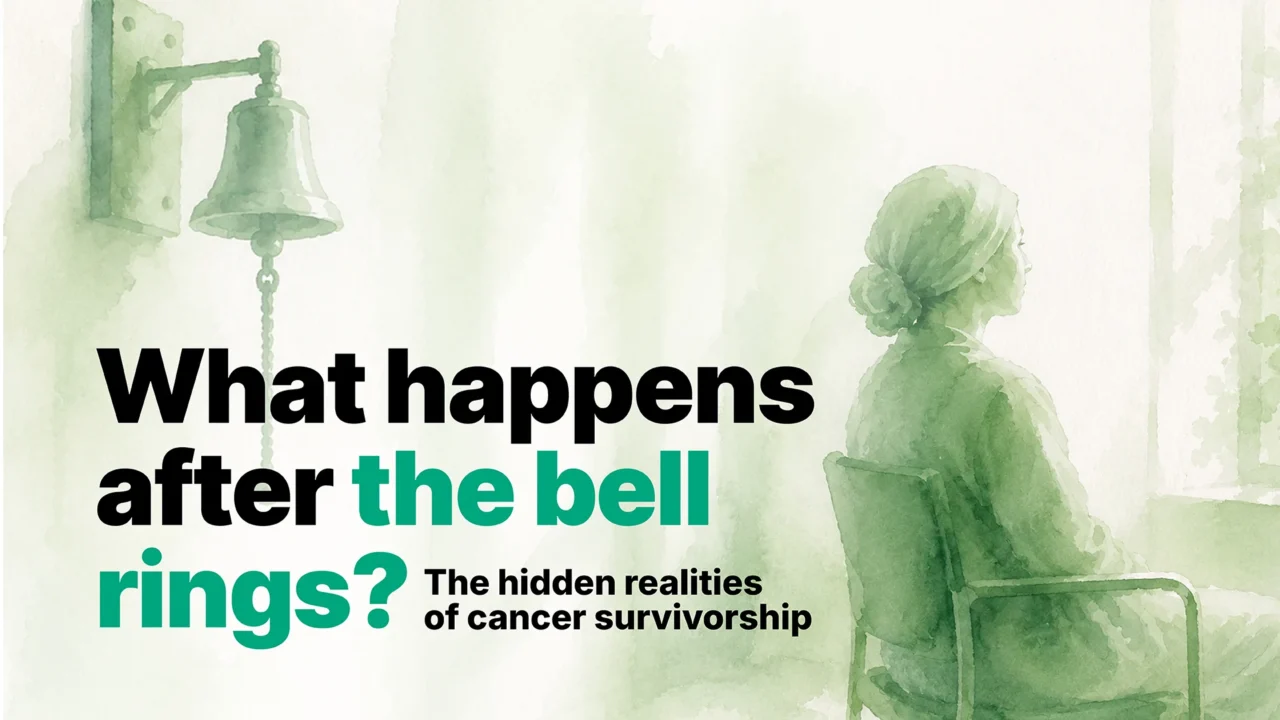
“Ringing the bell is not the end of the story, but the beginning of a new one.”
Alejandra Méndez
The celebration lasts only a few minutes. There are hugs, applause, tears, and photographs. The final chemotherapy infusion is complete. The bell rings through the hospital corridor, marking what everyone has been waiting for months, sometimes years. But once the applause fades and patients walk out of the hospital doors, a different journey begins.
For decades, oncology has focused heavily on survival. Every new therapy, every improvement in early detection, and every increase in survival rates has moved the field forward. But as more people live longer after treatment, a new question has begun to demand equal attention.
What happens after the bell rings?
The end of treatment is often portrayed as the finish line, a moment of celebration marking the return to normal life. Yet surviving cancer is increasingly recognized as something far more complex than simply completing treatment.
When Experience Becomes Expertise
Few people understand this better than Alejandra Méndez, whose own lived experience has shaped her advocacy for patients and families around the world. When her eldest son, Pablo, was just two years old, he was diagnosed with an aggressive form of cancer and went on to endure three separate relapses during his childhood.
Driven by that experience, the Harvard Extension School and Catholic University of Chile graduate shifted her focus from education and communications to global health advocacy. Today, she serves as the Vice President of Childhood Cancer International (CCI) and the director of the Nuestros Hijos Foundation, working to ensure every child has an equitable chance to survive. Recognized as one of Chile’s 100 Leading Women in 2023 for her social service, Méndez Risopatrón actively collaborates with the International Society of Pediatric Oncology and the My Child Matters expert committee, supporting the global push to achieve a 60% survival rate for childhood cancer by 2030.
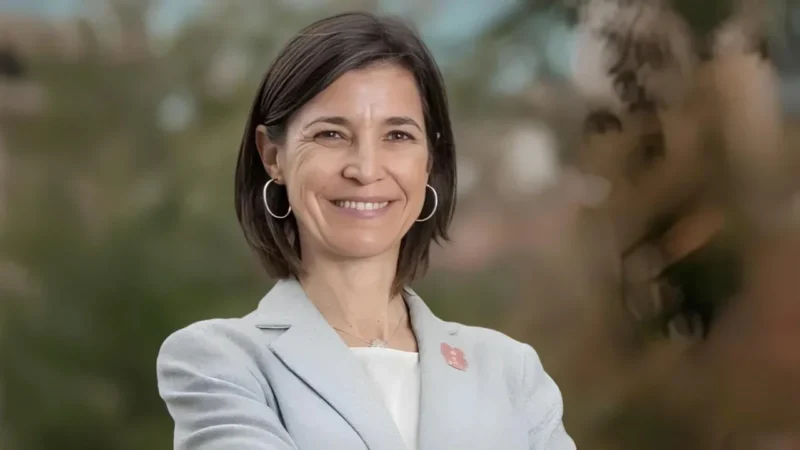
“Childhood cancer is treated in hospitals, but it’s lived within families. So we, people with a lived experience, sometimes see things that the system cannot see,” she says.
That perspective becomes the foundation of her philosophy. Cancer is not simply a disease managed by physicians and hospitals. It is an experience lived by children, parents, siblings, partners, caregivers, and survivors long after active treatment has ended.
“We experience the fear, the barriers, the uncertainty, the financial pressure, the emotional burden, but also the hope, the resilience, and the power of support,” she explains. “Our lived experience is a type of expertise.”
This philosophy challenges traditional healthcare models where patients are consulted only after systemic decisions have already been made. Méndez notes that while clinical data and scientific protocols are fundamental, they are incomplete without human reality. “We may not have learned in a laboratory or in a classroom,” she notes, “but we learned in the hospital sitting beside a child in the bed with cancer.”
True patient-centered care requires moving beyond simple consultations toward a true partnership. “Consultation is important, but it’s not enough,” mentions Méndez.
“We need to move from asking us [survivors], ‘What happened to you?’ to ‘How can we design this better together?’”
Her message is not that science is insufficient. Rather, it is incomplete without the voices of those living the reality behind the data.
“I think that data is essential, of course. Science is essential,” Méndez says. “But lived experience humanizes the data. Data tells us what’s happening; lived experience helps us understand what it means in real life.“
That distinction lies at the heart of modern survivorship care. With this framework in mind, the article explores the real-world experiences of both physicians and survivors.
The Invisible Toll of Long-Term Toxicities
Scientific literature is increasingly confirming what survivors have long described. As summarized by Dr. Muna Al-Khaifi, a family physician, researcher, and GP Oncologist at Sinai Health who leads the Cancer Survivorship Program at William Osler Health System, survivorship represents a distinct phase of cancer care rather than simply the absence of disease. Having completed specialized fellowships in Women’s Health and Breast Diseases, alongside a Master of Public Health, she has dedicated her career to improving post-treatment care.

“I have met many breast cancer survivors who continue to suffer long after active treatment ends,” Dr. Al-Khaifi notes, explaining the motivation behind her work. “Once treatment stopped, they entered a completely unfamiliar world. Feeling their anxieties, uncertainties, and fears made me realize that we must do more to help our patients.”
Driven by this clinical reality, her research shows that although treatment may end, many individuals continue to experience significant physical, psychological, cognitive, social, sexual, and financial consequences that require ongoing multidisciplinary care. In one large study, 83% of cancer survivors reported experiencing at least one long-term or late treatment-related effect, with the most commonly reported being fatigue (59.2%), sleep disturbances (41.5%), hot flashes (39.2%), peripheral neuropathy (38.0%), and pain (36.6%), highlighting that survivorship extends far beyond routine surveillance for recurrence.
Méndez observes these exact patterns playing out dynamically within families. Because these side effects significantly impede an individual’s independence, relationships, and education, comprehensive rehabilitation must be given the same priority as the primary clinical treatment.
Preserving the Future: Oncofertility
Fertility preservation stands out as one of the most time-sensitive challenges in survivorship care. For young adults and children facing a sudden diagnosis, long-term decisions regarding future parenthood must be processed within a matter of days. “I think that we need to protect the child’s future,” Méndez stresses. “Being able to be a biological parent can be so important.”
The structural logistics of this timeline require immense speed. “Usually you get the diagnosis, and within a week you’re starting chemo or radiation,” Méndez notes. “So it’s important to understand that it needs to be done very shortly, immediately after the diagnosis.”
Survivorship begins before the first chemotherapy infusion, not after the last one.
Dr. Muna Dr. Dr. Al-Khaifi highlights why these early conversations are essential. Breast cancer survivors younger than 40 have a 46% higher relative risk of infertility than women in the general population. This concern grows more pressing as the global prevalence of breast cancer in women under 40 has climbed from 37 to 49 cases per 100,000.
As more young adults survive cancer, preserving reproductive health has become an important component of comprehensive oncology care. Current international guidelines consistently recommend discussing fertility preservation before treatment begins and ensuring timely referral to fertility specialists, with embryo and oocyte cryopreservation remaining the standard approaches for women.
Méndez has channeled this urgency into legislative action in Chile, advocating for a statutory framework guaranteeing that every young patient is fully informed, referred to oncofertility specialists, and supported through state-funded cryopreservation. “We are hoping, and I think this year we’ll finally pass the law,” she says, adding that “hopefully this will also mean that other countries will also take that model.”
Financial Toxicity and Re-entering Society
The systemic burdens of cancer continue to grow financially long after clinical remission is achieved. Dr. Al-Khaifi’s review emphasizes that financial toxicity plagues 35% to 79% of cancer survivors, severely limiting their subsequent access to follow-up care, adherence to medications, rehabilitation services, psychosocial support, and overall quality of life.
Méndez highlights that society often penalizes survivors long after they leave the hospital ward. Survivors frequently encounter “financial discrimination that gives them difficulty accessing insurance, loans, or even employment after that,” she points out. For this reason, her advocacy extends to passing public policies that protect families from economic devastation and grant parents paid leave during treatment. “So this is not just a medical issue, It’s also an issue of rights, information, equity, and future choices in life,” Méndez emphasizes.
The situation is heavily amplified in low- and middle-income countries (LMICs), where survivorship care may be fragmented and constrained by limited healthcare infrastructure, workforce shortages, and restricted access to specialized services.
Dr. Al-Khaifi presents stark numbers: LMICs average just 1.3 physicians and 2.5 nurses per 1,000 population, compared with 3.1 physicians and 10.9 nurses per 1,000 population in high-income regions.
In these resource-constrained settings, Méndez observes that a lack of housing or transport frequently forces families into treatment abandonment. Every year, 20,000 to 30,000 children die because of abandoned treatment: preventable deaths caused by systemic, financial failures rather than a failure of love.
“Treatment abandonment or low treatment adherence is not a failure of the families; it’s a failure of the system, right? ” says Méndez.
To combat this, Dr. Al-Khaifi outlines that cost-effective strategies, such as leveraging mobile health technologies, expanding primary care involvement, and training community health workers, can significantly expand access.
“Efforts to reduce financial toxicity and strengthen survivorship care delivery are essential to achieving equitable, accessible, and patient-centered cancer care for all survivors, regardless of geographic location or socioeconomic status,” urges Dr. Al-Khaifi.
Navigating Psychosocial Realities and “Scanxiety”
The emotional scars of cancer do not fade when the physical tumors disappear. One of the most prevalent yet unspoken psychological weights is the ongoing fear of cancer recurrence (FCR). Dr. Al-Khaifi notes that nearly half of all survivors live with moderate fear, while 20% to 30% suffer from severe, clinically significant FCR that substantially impacts their daily functioning and quality of life. This distress predictably intensifies around routine medical checkups, creating a documented state of emotional duress widely known as “scanxiety.”
Méndez emphasizes that healthcare facilities must actively expect and address these mental health needs, referencing her early observations on how the system handles emotional vulnerability. “We know what it means to be waiting for results, the barriers that we face… and what kind of support truly makes a difference for us.”
Similarly hidden is the profound impact of cancer therapies on sexual health. Dr. Al-Khaifi points out that sexual dysfunction affects up to 90% of women and 40%-85% of men following cancer treatment. Survivors commonly suffer from vaginal dryness, dyspareunia, erectile dysfunction, decreased libido, and challenges with intimacy and relationships. Yet, due to cultural taboos, embarrassment, or stigma, patients rarely bring it up. Shockingly, 86% of cancer survivors reported that their healthcare provider was unable to adequately address their sexual health concerns, highlighting a significant gap in survivorship care.
Rethinking Success in Cancer Care
As oncology looks to the future, global standards should shift from simply tracking survival measures to actively protecting survivors’ quality of life. “The WHO and Childhood Cancer Initiative gave this challenge of getting a 60% survival rate for childhood cancer by the year 2030,” Méndez notes. “And this is extremely important.” But she believes what needs to be done is to pivot to a new challenge now.
“We need to make sure what kind of life these children survive into,” she asserts. “They must not only survive or ring the bell. They must be able to live a full, healthy, dignified life after cancer.”
Re-entering professional and social spaces remains an uphill battle. Al-Khaifi points out that while approximately 63.5% of working-age cancer survivors return to work within one year of their diagnosis, nearly 30% experience unemployment, often related to persistent fatigue, treatment-related cognitive impairment, physical limitations, or a lack of workplace accommodations.
As Méndez summarizes beautifully:
“Success is not only completing treatment. Success is a child returning to school, a survivor receiving long-term follow-up, a family not being destroyed financially, a young person having access to mental health support, a survivor being able to plan a future, a family feeling that they are not alone.”
To turn this vision into a standard global reality, survivors and families must be recognized as active partners in healthcare design. “We need to be involved from the beginning in policy design, research, clinical care models, health system planning, and even in designing hospitals themselves,” she says.
“Governments, health systems, clinicians, researchers, civil society, families, survivors, we must work together. And very importantly, people with lived experience must be at the table where decisions are made,” concludes Méndez.
Featuring Dr. Muna Al-Khaifi and Alejandra Méndez
Based on interview Gvantsa Khizanishvili
Article by Mariam Harutyunyan, Deputy Managing Editor, OncoDaily,
Associate Editor, OncoDaily Magazine