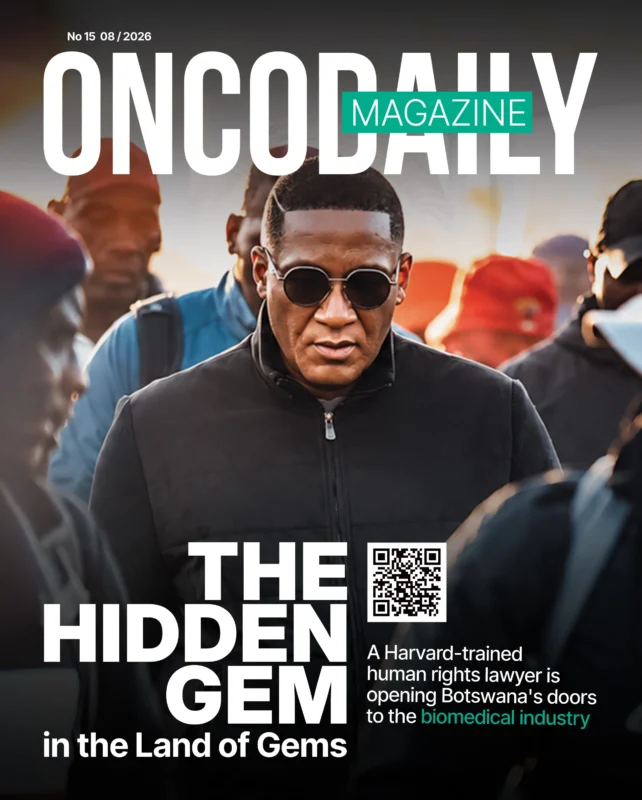
Before I flew to Botswana, I knew four things about the country.
The capital is Gaborone. The population is around 2.5 million. There is a national philosophy called Botho — serving others with humility and respect for persons. And there are diamonds.
That was the extent of it. So I did what I always do before a country I do not know: I read. And the more I read, the more I realized how little the world knows about a place that has quietly become one of the most interesting stories in global health.
A democracy that works
For 58 years, one party governed Botswana. In the last election, the opposition won.
Then something happened that should be ordinary and is not: power transferred. Calmly. Without crisis. The way it happens in the oldest democracies in the world.
The man who won is President Advocate Duma Boko — a human rights lawyer, a Harvard alumnus, and a candidate who lost twice before he won on his third attempt. That detail matters more than it looks. Persistence is not a personality trait in politics; it is a strategy. It tells you what a leader does when the result does not go his way.
Botswana is also consistently among the least corrupt countries on the continent, one of the safest, and one of the most beautiful. These are not small things. They are the preconditions for everything else in this article.
“The most candid letter by a sitting leader I have ever read”
Before the trip, while preparing for my meeting with the President, I came across an open letter he had published in The Guardian. I expected a political statement. Instead, I found one of the most candid reflections I have read from a sitting head of state about the failure of his own health system.
In August 2025, Botswana ran out of medicines. Hypertension drugs. Diabetes drugs. Cancer drugs. TB drugs. Dressings and sutures. Elective surgeries were suspended. The President declared a national public health emergency and put the military in charge of distribution.
The cause was not a mystery. Diamond revenues collapsed. Donor funding was cut. A supply chain that had looked solid for decades turned out to be resting on a single commodity price.
What the President wrote about it was this: patients went without treatment not because health workers failed them, but because the system did.
I want to sit with that sentence for a moment, because it is the whole argument of my professional life, written by someone else.
The knowledge existed. The medicines existed. The health workers were there, trained and willing. What failed was delivery. What failed was access. What failed was the system that connects a proven therapy to the person who needs it.
This is not a Botswana problem. This is the problem — in oncology, in cardiovascular disease, in every field we cover at OncoDaily. Children with cancer who would have an 85% chance of cure are not dying because science has failed them. They are dying because they were never diagnosed, or the drug never arrived, or the family went bankrupt trying.
What the President told me
When we met, he did not talk about the crisis as a misfortune. He talked about it as information.
“We need to build a stronger system, and we can. For a long time, as a country, we relied on diamonds. But our real diamonds, our gem, is our people and our country.
Africa must not be left behind. We have 1.5 billion people. We can and must be self-sufficient. It should not be that we rely on medications from outside. We must rely on ours — we must start our own production, we must solve the problem of pharmaceuticals, and we will.
We have the best democracy. Now we must create the best healthcare system.”
I have heard versions of this sentiment in many capitals. I have rarely heard it with this specificity, or from someone who has just lived through the failure that makes it urgent.
Saturday is for funerals
On the plane, I was reading a book by that title. I got to the middle and had to stop for a while.
It describes a Botswana where HIV was cutting through an entire generation, where weekends were organized around burials, where life expectancy fell below fifty. It is a difficult book, and it is recent history — not ancient history.
And here is what has happened since. Life expectancy has climbed back by roughly two decades. Botswana has advanced to gold-tier status on the path to eliminating mother-to-child transmission of HIV — a distinction very few countries anywhere have earned.
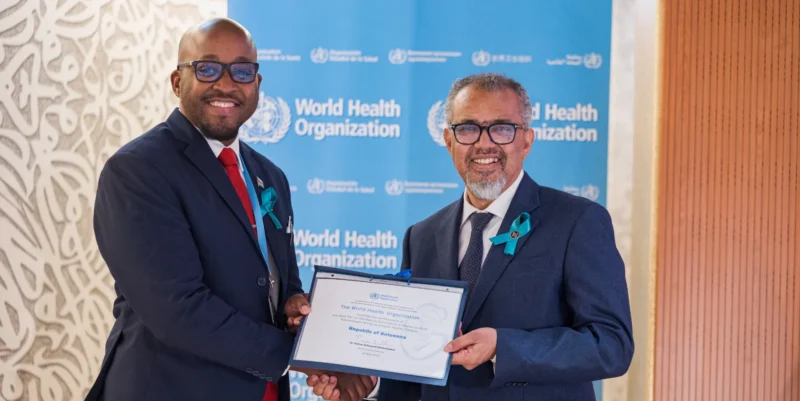
The Minister of Health of Botswana Dr. Stephen Modise receives a certificate from WHO Director-General Dr Tedros Adhanom Ghebreyesus. May 2025. WHO/Pierre Albouy
The same country. The same people. One generation.
That is what resilience actually looks like: not the absence of catastrophe, but the capacity to get up afterward. When a country tells me it intends to build the best health system in Africa, I look at its track record before I decide whether to believe it. Botswana’s track record is that it has already done something harder.
A small moment at a diplomatic reception
On my last day, there was a diplomatic reception — a farewell for the departing EU Ambassador. I happened to be there. The speeches were genuinely warm, which is rarer at these events than you would think.
But one detail stayed with me. When the Vice President stood to acknowledge the honored guests, he named the leader of the opposition.
Nobody in the room seemed to find this remarkable. I did. I have worked in many countries where that would be unthinkable — where the opposition is an enemy to be managed rather than a part of the nation to be acknowledged.
That is Botho in practice. And I wish more countries would learn this culture.
What Botswana is offering
This is the part I want the industry and academic leaders reading this to understand clearly.
Botswana is not asking for charity. It is opening a door.
In my conversations there, the message was consistent: the country is ready to host pharmaceutical and biomedical production. It is ready to become a regional and global hub for research, development, and clinical trials. It is prepared to support serious partners with tax incentives, with land, with regulatory engagement, and with something harder to manufacture than any of these — political stability, low corruption, rule of law, and a government that answers the phone.
For a company weighing where to establish African manufacturing or research capacity, that combination is not common. Most of the conversation about African pharmaceutical sovereignty focuses on the size of the need. Botswana is offering something more useful: a safe place to start.
The market logic is straightforward. A continent of 1.5 billion people currently imports the overwhelming majority of the medicines it consumes. That dependency was exposed in 2025 in Botswana, and it will be exposed again elsewhere. Whoever builds the local capacity first will not be doing anyone a favor. They will be early.
Why this is our cover story
Three reasons.
First, many of the executives and academic leaders who read OncoDaily are exactly the people who decide where facilities get built and where trials get run. You should know that this opportunity exists, that the need is enormous, and that the welcome is real.
Second, OncoDaily’s mission is to be a space for everyone, from everywhere. We have millions of readers across the world. Most of them have never seen Botswana. They should.
Third — and this is why I wrote it myself rather than assigning it — Botswana is now a live test of the argument that many of us have been making for years: that the binding constraint in global health is not knowledge but delivery, access, and equity. A country has said this out loud, from the top, after paying the price for it. If it succeeds, the argument stops being rhetoric and becomes a model. That deserves more than a news item.
The land of gems
The diamonds built Botswana. They funded the schools and the clinics and the roads, and then the price fell and the medicines ran out, and the country learned what it had actually been standing on.
The President is right about where the real gem is. It was never in the ground.
It is in a people who lived through an epidemic that devastated a generation and rebuilt their life expectancy. In a democracy that handed over power without breaking. In a Vice President who names the opposition leader among the honored guests. In a head of state who was willing to write down, in a foreign newspaper, that his system failed — and then to say what he intends to do about it.
Botswana is the hidden gem in the land of gems.
The doors are open. I would encourage the industry to walk through them.
P.S. If anyone reading this is interested in exploring this opportunity, please feel free to reach out to me directly, and I would be happy to connect you with the President’s team.
By Dr. Gevorg Tamamyan, Editor-in-Chief, OncoDaily