


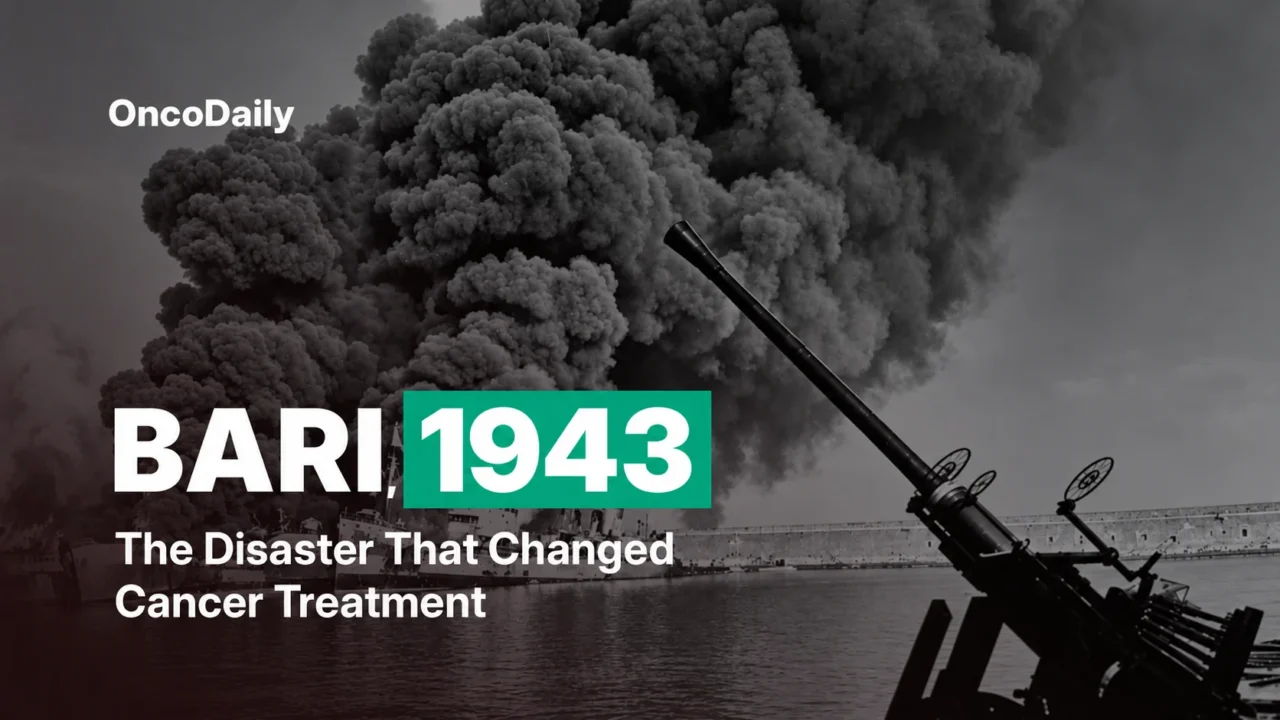
How a secret cargo, a wartime catastrophe and an unexpected medical observation became part of the story of modern chemotherapy.
The Night Bari Burned
On the evening of December 2, 1943, the port of Bari in southern Italy was crowded with Allied ships carrying fuel, ammunition, food and medical supplies for troops advancing through Italy. The city had been captured only months earlier and had become an important Allied supply hub. Shortly after 7 p.m., German bombers appeared overhead. Within minutes, ships and dockside facilities were burning, ammunition was exploding and fuel had spread fire across the water.
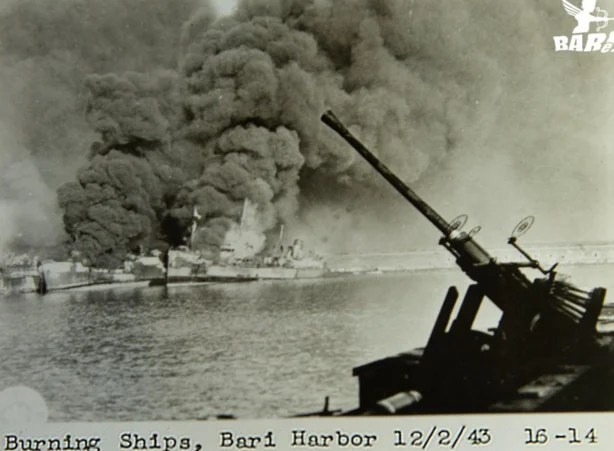
Among the vessels was the American Liberty ship SS John Harvey. Hidden in its hold was a highly classified cargo: roughly 2,000 bombs containing sulfur mustard. The weapons had been sent to the Mediterranean as a precaution in case Germany used chemical weapons first. Their presence was known to very few people in Bari, including many of the physicians who would soon be treating casualties.
When the John Harvey was hit, mustard agent was released into the harbor and mixed with seawater and oil from damaged ships. Sailors who jumped into the water to escape the fires were soaked in the contaminated mixture; others inhaled mustard vapor. At first, many appeared to be casualties of a conventional bombing. Then painful eye injuries, blistered skin and respiratory symptoms emerged. In the following days, physicians noticed something else: in some patients, white blood cell counts were falling dramatically.
A Clue Hidden in the Blood
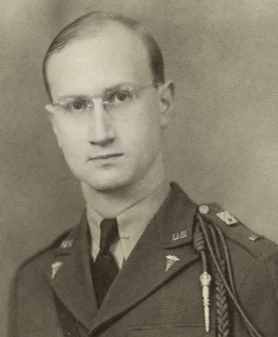
The unusual pattern drew the attention of Lt. Col. Stewart Francis Alexander, a U.S. Army physician trained in chemical warfare medicine who was sent to Bari to investigate. Some men developed profound leukopenia as their bone marrow – the tissue responsible for producing new blood cells – was severely damaged. Mustard exposure was affecting some of the body’s most rapidly renewing cells.
The finding added to an observation already emerging from chemical research: mustard compounds could be especially damaging to tissues whose cells divide rapidly. That raised an important medical question. If this destructive effect could be controlled, could a related compound be used against rapidly dividing malignant cells? Alexander documented what had happened in Bari, but researchers elsewhere were already investigating that possibility.
The Treatment That Changed the Question
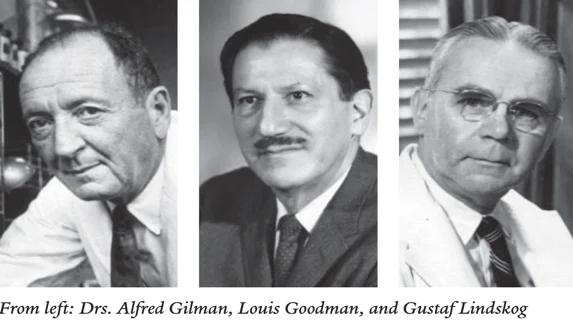
At Yale, pharmacologists Louis Goodman and Alfred Gilman were studying chemical warfare agents under a secret wartime program. Their experiments showed that nitrogen mustards, chemical relatives of sulfur mustard, could cause lymphoid tumors in animals to shrink. Working with Yale surgeon Gustaf Lindskog, they moved from animal experiments to a patient with advanced cancer in 1942.
The patient is remembered in the medical literature simply as J.D. He was 47 and had advanced lymphosarcoma. Surgery and radiation had failed to control the disease, leaving physicians with few options.
Doctors administered a nitrogen mustard compound known as HN2, later called mechlorethamine. Within days, the masses began to soften and then shrink. For physicians accustomed to treating cancer primarily with surgery or radiation, the implication was striking: a drug travelling through the bloodstream could reach cancer in several parts of the body.
The response did not last. The tumors returned, subsequent treatments became less effective and the disease eventually became resistant. Nitrogen mustard also suppressed the bone marrow. J.D. was not cured, but his response provided evidence that widespread cancer could respond to systemic drug treatment. The Yale findings remained secret during the war and were published in 1946.
The timing matters. J.D. had received nitrogen mustard in 1942, before the Bari disaster. Bari therefore did not create chemotherapy. Instead, it became part of a broader and more difficult history in which the biological effects of mustard compounds were being seen under profoundly different circumstances: deliberately in laboratory research and catastrophically in people exposed during war.
From One Drug to an Entire Field
The story did not end with nitrogen mustard. In 1947, pediatric pathologist Sidney Farber treated children with acute leukemia using aminopterin, an antifolate, and in 1948 reported temporary remissions. At the time, childhood leukemia was considered essentially incurable and care was largely supportive. Farber’s results offered something that had scarcely existed before: evidence that a drug could push childhood leukemia into remission.
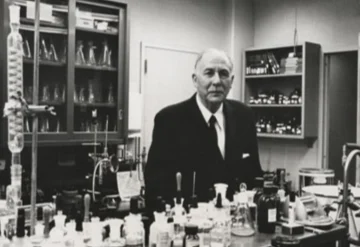
Farber’s contribution went far beyond a single drug. He became a major advocate for children with cancer and for sustained investment in cancer research. He also helped advance a model of pediatric cancer care that brought clinical treatment, research and support for families together.
His work did not grow directly from the Bari disaster; it represented another branch of the emerging field of systemic cancer therapy, driven by deliberate research aimed at helping patients.
Over the following decades, researchers moved from individual agents to combinations of drugs with different mechanisms. By the 1960s and 1970s, combination regimens were producing durable remissions and, in selected cancers, cures – transforming diseases such as childhood acute lymphoblastic leukemia, Hodgkin lymphoma and testicular cancer.
What Bari Left Behind
Bari should first be remembered for what it was: a human tragedy. Mustard agents were weapons designed to harm, and the sailors, soldiers and civilians exposed that night had no choice in what happened to them. Wartime secrecy compounded the disaster by leaving many physicians unaware of the chemical exposure they were treating.
The fact that medical knowledge was later drawn from what happened does not turn Bari into a scientific milestone. It is indeed unfortunate to think, that scientific discovery is not always created from good intentions of improving human life, but from circumstances created to destroy it. But the history of chemotherapy is much larger than Bari. It includes Goodman and Gilman’s deliberate research, J.D.’s experimental treatment, Farber’s work with children with leukemia, and generations of scientists and clinicians who continued searching for better ways to treat cancer.
Today we hope for peace that will allow researchers to create much more effective, safer novel drugs intended to help those who need it the most, whenever they needed and wherever they reside.
by Marine Marachlian, MD
Medical Writer and Editor, OncoDaily