





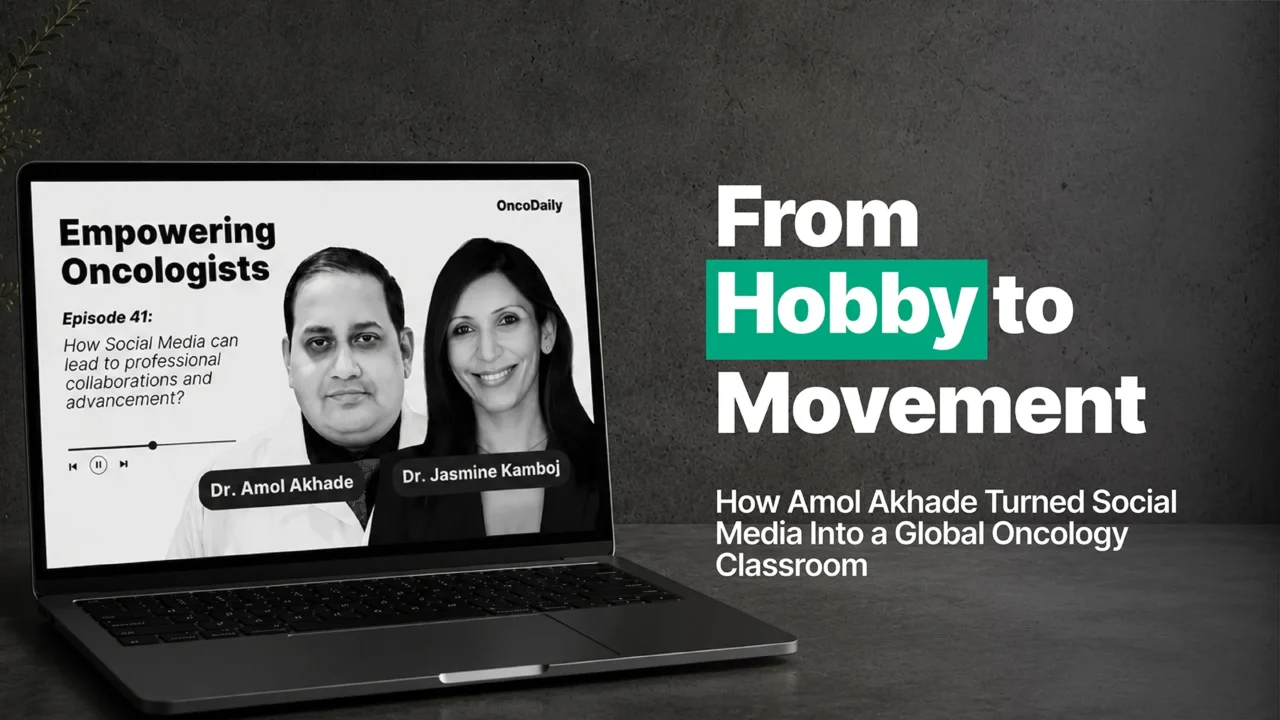
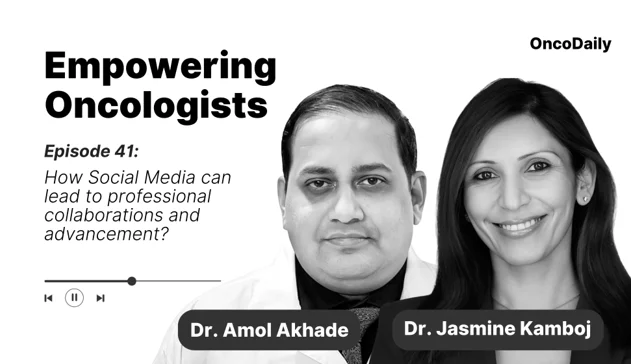
Interview by Jasmine Kamboj
Medical Oncologist and Hematologist at Mayo Clinic
Podcast Editor and Host of the ‘Empowering Oncologists’ podcast at OncoDaily
“It started as a hobby, and now it has become a bad habit.”
Dr. Amol Akhade laughs as he says it. But the joke only tells part of the story.
What began during the COVID-19 pandemic as casual engagement on social media has evolved into something much larger: an international network of oncologists discussing clinical trials, sharing conference updates, analyzing evidence, and finding ways to adapt cancer care to the realities of low- and middle-income countries.
For Akhade, a medical oncologist practicing in Mumbai, social media is no longer merely a communication tool. It has become a bridge between continents, institutions, and healthcare systems.
“We are trying to be a part of this global oncology movement,” he says, “we are trying to make the cancer data available, accessible, so that the outcomes of our patients become better.”
The Community Oncologist With a Global Outlook
India is a vast country with a rapidly growing medical system. The government has created major healthcare programs, such as the Ayushman Bharat Yojana, to help more people get medical treatment. The country has also expanded its National Cancer Grid to connect different specialized cancer hospitals together.
Despite these positive steps, the hurdles remain incredibly high. India is one of the three countries with the highest number of cancer deaths in the world, alongside China and the United States. In 2022 alone, India lost more than 900,000 lives to cancer. One of the biggest reasons for this high number is time. More than 80% of cancer cases in India are detected at very advanced stages. When cancer is caught late, it is much harder to treat.
Furthermore, a large portion of the population lives in rural or underserved areas. For these families, getting to a modern hospital requires traveling long distances, missing work, and spending money they do not have. Affordability is a constant struggle.
Akhade trained at two of India’s most respected institutions: KEM Hospital and Tata Memorial Hospital, before entering community practice. Today, he serves as a medical oncologist at Fortis Hospital Mumbai, focusing primarily on breast and gastrointestinal cancers.
Yet over the years, another passion emerged. Akhade developed a deep interest in global oncology, specifically in analyzing international clinical trial data. To connect with that broader scientific world, he became, in his words, “a bit more active on social media.”
The phrase is characteristically understated. His online presence has connected him…
His online presence has connected him with oncologists across the world, allowing him to participate in conversations that once occurred largely within academic centers or international meetings.
For Akhade, this matters because access to information has historically been uneven.
Building a Global Oncology Community: How a Hobby Became a Movement
For many years, the biggest barrier to fair cancer care was a lack of access to information. If a doctor in India or another low-income country wanted to learn about the newest medical data, they usually had to attend massive oncology conferences like the American Society of Clinical Oncology (ASCO) meeting or the European Society for Medical Oncology (ESMO) meeting. Attending these events requires thousands of dollars for flights, hotels, and tickets, not to mention the complicated process of getting international visas. For a busy community doctor, leaving patients for a week to travel across the world is often impossible.
If social media started as a hobby, it has since become a community.
“We have made a WhatsApp group called OncoWisdom,” he says. “Almost 900 oncologists are part of this group across the world.”
Inside the group, members discuss clinical cases, share original articles, review conference updates, and debate new evidence.
The goal is straightforward.
“A lot of our oncologists are not able to attend these meetings in person,” Akhade says. “So through this social media initiative, we are trying to bring that data close to our oncologists.”
The hope is that clinicians can then determine what is relevant, what is feasible, and what can improve patient outcomes in their own environments.
“We discuss and analyze it and decide what can be implemented in our setting,” he says, “so that ultimately the outcomes of our patients become better.”
The impact of this simple chat group has been immense. Podcast host Dr. Jasmine Kamboj pointed out during the interview just how meaningful this shift is, noting that what started as a hobby has now become a movement that is helping bridge gaps and helping folks who are not able to attend conferences in person.
Dr. Kamboj also noted that this problem is not unique to India. Even inside a wealthy nation like the United States, many doctors work completely alone in remote areas, such as rural towns, Alaska, or Hawaii. These doctors face the same professional isolation. Social media acts as an equalizer for everyone, ensuring that a doctor in a small, remote village has the same access to new medical knowledge as a doctor working at a top university hospital.
The Three Challenges of Global Oncology
Having access to information is a great start, but Dr. Akhade emphasizes that information by itself is not enough to cure a patient. Akhade often thinks about cancer care through a practical framework. According to him, there are three challenges from the global oncology standpoint for practicing cancer care in low-resource settings.
The first challenge is access. For many oncologists in resource-limited settings, simply obtaining the latest information used to be difficult. Scientific breakthroughs presented at major conferences often took time to reach clinicians working far from academic hubs.
Social media, he believes, has dramatically changed that.
“Getting the data from the higher-income countries on major conferences to a country like us was a difficult issue,” he recalls. “Now with the advent of social media and online meeting attendance, the gap has narrowed.”
But access alone is not enough. The second part of the framework requires critical clinical thought.
“The next challenge is the data evaluation,” he says. “Our oncologists are also getting into this mode of analyzing the data and filtering it out so as to tailor to the needs of our people.”
And then comes the hardest step: implementation. Many therapies that produce impressive results in clinical trials remain inaccessible to patients because of cost, infrastructure, or healthcare system limitations.
“The insurance coverage is only 40 to 50 percent,” Akhade notes. “The rest of the people spend from out of their pocket.”
As a result, not every innovation can simply be imported and adopted unchanged.
“Not everything can be implemented,” he says.
Closing the Information Gap and the Access Gap
Even when new therapies receive regulatory approval in the United States, access elsewhere is not always immediate. Akhade acknowledges that some FDA-approved drugs take time to reach India, while others may never be launched in the country.
“There is a gap,” he says. “Some of those drugs are not easily available, and some of the companies choose not to launch these drugs in India.”
Yet he believes the situation is gradually improving. More drugs are reaching India faster than before, and pharmaceutical companies have increasingly introduced patient-assistance programs to improve affordability.
Importantly, Akhade connects this challenge to the broader role of communication and knowledge-sharing. Access to a drug may still be delayed, but access to the evidence behind it no longer has to be. One of the reasons he values social media is that it allows oncologists in lower-resource settings to follow emerging data in real time, evaluate whether new findings are relevant to their patients, and begin discussing how those advances might eventually be adapted and implemented locally. As he puts it, “The first challenge was access to data, which social media is now taking care of,” he says.
This distinction between access to information and access to treatment runs throughout Akhade’s view of global oncology. The first gap is narrowing rapidly. The second remains a work in progress.
Adapting Evidence, Not Just Consuming It
One of the themes running through Akhade’s work is the idea that oncology evidence should not only be disseminated but also adapted.
“The data that is presented in the high-income countries needs to reach the low-income countries,” he says. “And not just has to reach. It has to get analyzed.”
That analysis often raises difficult questions. Can treatments tested in wealthy healthcare systems realistically be delivered elsewhere? Can costs be reduced without sacrificing effectiveness? Can protocols be modified to fit local realities? For Akhade, these questions are central to global oncology. He points to India’s growing interest in low-dose immunotherapy as one example.
“A lot of immunotherapy trials have excellent results,” he says, “but our patients cannot have access to them.”
Rather than accepting that limitation, researchers have begun exploring alternative dosing strategies.
“We have a movement called low-dose immunotherapy,” he explains, “in which we modify those drugs, and we utilize them with low dose or ultra-low dose, and that also is showing results.”
For him, this is where innovation becomes meaningful: not merely generating data, but finding ways to make that data useful for patients who might otherwise never benefit from it.
Research in a System Built Around Patient Volume
For all the progress India has made in oncology, Akhade is candid about one of the biggest barriers to producing more homegrown research: time.
“Unfortunately, the research is not a top priority for oncologists as well as the oncology practice in our country,” he says. “We have a lot of patients. Our clinical practice is quite busy.”
While major academic centers such as Tata Memorial Hospital and AIIMS conduct important studies, many oncologists struggle with limited funding, especially for investigator-initiated research, and a lack of protected research time. Akhade contrasts this with models more common in some academic systems elsewhere.
“We do not have this concept of doing clinical work only on certain days of the week and then doing the research and the remaining days of the week,” he says.
Still, he sees reasons for optimism. “Slowly things are changing,” he says. “Slowly, the research is also getting prominence. Slowly, the funding is also becoming better.” He hopes that more original research will increasingly emerge from India and other parts of the Global South.
Why Collaboration Matters
When asked what organizations such as ASCO can do to improve cancer care globally, Akhade returns to a single word: connection.
“They should connect the oncologists from countries like the United States or prominent European institutions with oncologists from countries like India,” he says.
He believes meaningful collaboration begins not with policy statements but with relationships.
“When this one-to-one connect happens,” he says, “the knowledge gap will be further bridged, the thought exchange will occur, and probably the collaborative projects, the collaborative studies will sustain more.”
For him, the future of oncology is not defined by geography. The future is defined by how effectively people learn from one another.
Advice for the Next Generation
Akhade views social media not as a distraction, but as an educational platform.
“Social media is the window to the world,” he says. “Now it has become so prominent that you can connect with any other oncologist across any part of the world and exchange your thoughts, analyze the data, and give ideas for collaborations.”
The opportunities available today, he argues, did not exist when he was training.
“It was not there for us, say around 15 years back, but now, because of social media,” he says. “I think the world has become smaller, closer, and people are getting connected.”
Even physicians who cannot travel internationally can still participate in global conversations. His message is simple:
“Be present on social media, be active, and use it wisely.”
Akhade wishes he had started using social media much sooner to help doctors worldwide share and understand cancer data. Moving forward, he promises to stay active every day by posting updates and keeping the conversation going, guided by a simple rule: “I should not give up.” For him, the most important thing is to never stop building this global network to help patients.
Why Oncology?
Near the end of the conversation, Akhade is asked whether he would choose oncology again if given the chance to relive his life. His answer comes without hesitation.
“Always.”
He describes oncology as a field defined by constant learning and rapid scientific progress, but also by the profound reality of treating agonizing, complex diseases.
“And there you are,” he says. “You’re doing a very important role.”
Then he offers perhaps the most memorable line of the interview.
“An oncologist is the last man standing between a sure-shot death and a better life.”
It is a dramatic statement, but one that reflects how he sees the profession: not simply as a specialty, but as a responsibility.
And if there is another life? Drawing on his love of the Mahabharata, Akhade smiles.
“Next birth again,” he says, “medical oncologist.”
Article by Mariam Harutyunyan
Deputy Managing Editor, OncoDaily