





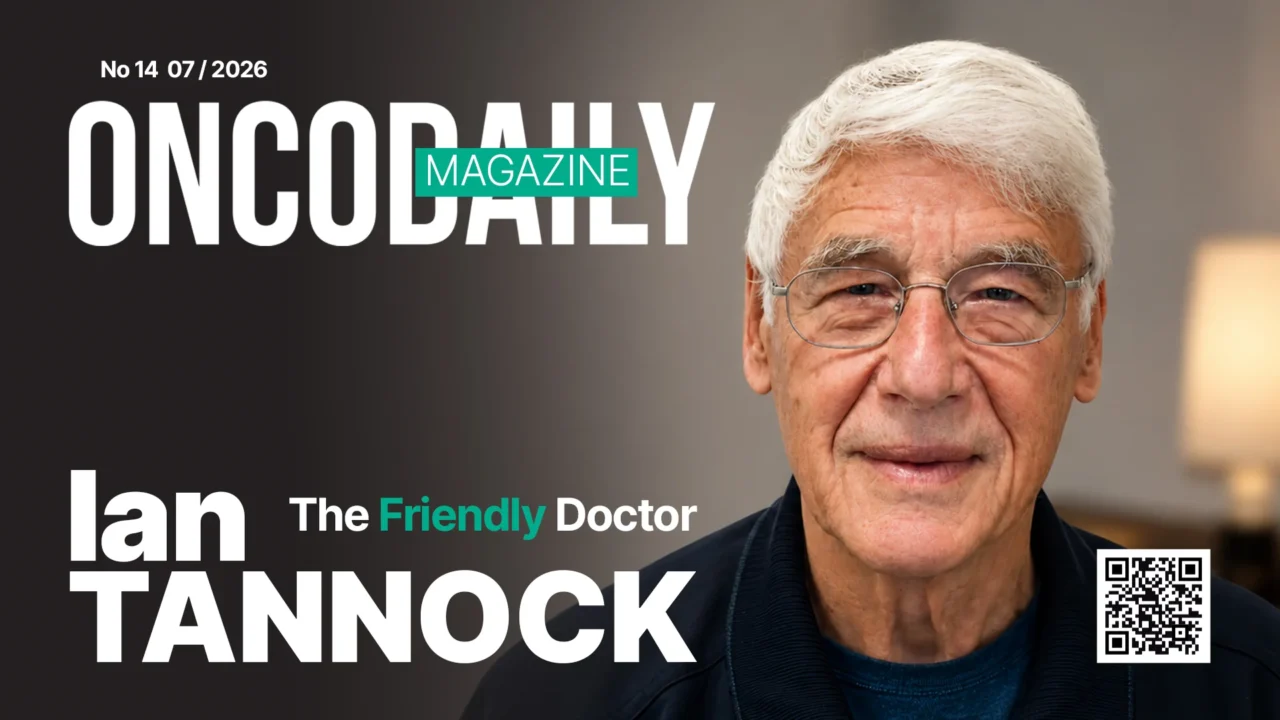
There are people in oncology who are remembered for discovering a drug, leading a trial, changing a guideline, or building a program. And then there are people who change the way others think.
Dr. Ian Tannock has changed the thinking of many oncologists, including me, who today are devoted to making sure cancer care is optimal for patients.
When I met him a few months ago at the CReDO workshop, the first thing I thought was, ‘Wow, he is very kind, humorous, and comforting.’ Friendly, one would say. We indeed became friends, and proudly, I am one of the lucky ones who can now also call him a mentor.
And through this article, you’ll get to know him a bit better and understand the mindset in which each one of us makes oncology better – not by a clinical trial or an FDA approval alone.
When I began by asking him to introduce his background – where he was born, how he grew up, how he decided to become an oncologist, and whether he always knew he wanted medicine – he smiled.
“That’s a lot of questions,” he said.
And then he began, not with a grand childhood dream of becoming a doctor, but with something much more aware.
“I did not always know that I wanted to do medicine,” he said. “In fact, when I was in high school, I happened to be quite good at mathematics, and being a typical lazy teenager, I did what was easy for me.”
He was born in England, grew up there, and went to Cambridge University. He initially studied mathematics, then switched to physics.
“During the first year at Cambridge, I became aware that maths didn’t lead to any sort of career that I was interested in. So, I switched to physics, which was relatively easy to do. I had then thoughts of doing medicine, but that would have meant giving up a university place and having no guarantee that I would get into medical school. So, I did math and physics, and then I did a PhD at the Institute of Cancer Research in London, which had a medical scientific background.”
His PhD was in medical biophysics, studying growth kinetics of tumors in experimental animals using thymidine autoradiography, a technique that had been developed around that time. After that, he was offered a position at MD Anderson in Houston as a postdoctoral fellow. It was there, while working in the lab and interacting with clinicians, that he made the “adult” decision, knowing, not thinking, that he wanted to become a medical doctor.
Because of his scientific background, he completed medical school in three years at the oldest medical school in the States – University of Pennsylvania. Oncology then became a natural continuation of the work he had already been doing in experimental cancer research. Colleagues expected him to go into radiation oncology, but his attention moved elsewhere.
“I decided that the major problem with cancer was metastatic disease,” he said. “So I instead trained in internal medicine and medical oncology.”
He came to Toronto as an intern, older than most interns at the time, and eventually joined the staff at Princess Margaret Hospital, now Princess Margaret Cancer Centre. Apart from a sabbatical year in France, he spent his career there.
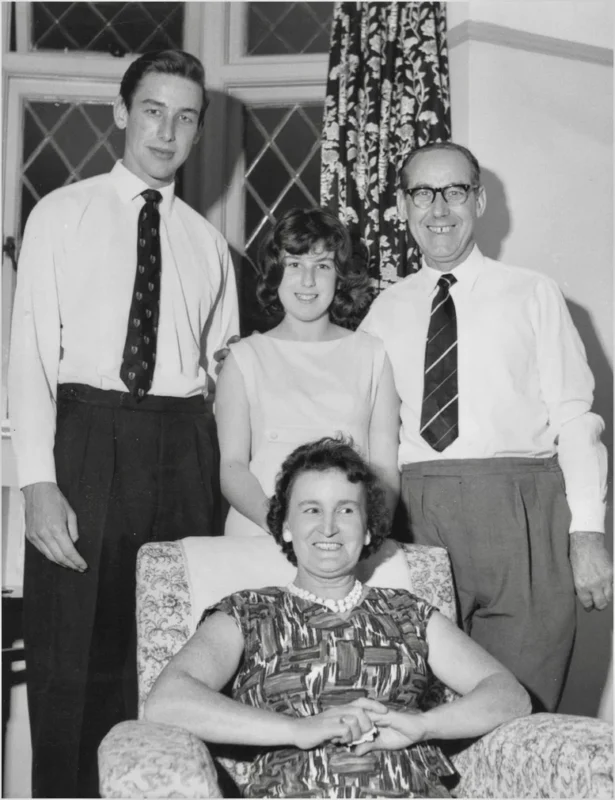
Ian Tannock with his parents and sister
The Beginning of a Critical Eye
When Dr. Tannock started in oncology, the field was living through a time of great enthusiasm. Some cancers that had once been fatal were becoming curable with systemic therapy. Testicular cancer, Hodgkin lymphoma, lymphomas, and childhood leukemias were changing the way oncologists imagined the future.
“There was a prevalent attitude that we’ve defeated testis cancer and lymphomas, and it’s only a matter of time before the same thing will happen where we can readily cure common cancers like breast, lung, and colorectal cancer,” he said. “And that, of course, didn’t happen.”
What troubled him was not the optimism itself. It was the lack of criticism around the evidence.
“When I was a young oncologist, and I looked at the results of clinical studies, I was struck by people being not very critical about what they were finding,” he said. “I did start to write some critical articles around that time.”
One of those articles appeared in the very first issue of the Journal of Clinical Oncology. It was critical of the way trials were being conducted and how claims were being made.
Cancer of the Big Toe
One of the most memorable examples of his work is the famous “Cancer of the Big Toe” paper.
When I asked him about it, he immediately laughed.
“I got lots of frequent flyer miles out of that article,” he said.
The idea came from disappointment. Even in respected journals, he saw papers using methods of reporting that made treatments look better than they really were.
“One way, of course, is to take some real papers and to criticize them,” he said. “But you’ll soon make a lot of enemies that way.”
So instead, he and a younger colleague created a hypothetical clinical trial. The disease was cancer of the big toe, which, as he pointed out, barely exists. The treatment regimen was called CABOOM.
They reported the same fabricated data in two different ways. In one version, biased methods made the treatment look beneficial. In another, more appropriate analysis showed no benefit. Then they explained how different reporting methods could lead to completely different conclusions from the same dataset.
“The article had three parts,” he said. “It had a paper suggesting benefit, a paper suggesting there was no benefit, and then an analysis of why you could come to different conclusions based on the same data set.”
“It’s probably the only paper that’s ever been accepted where the authors stated in the submission letter that every piece of data was fabricated,” he said. “We even had false journal references like references to the ‘New Scotland Journal of Medicine’ as a parody. The paper was accepted, and of course, it got a lot of publicity because it was highly unusual.”
It was satire, but it had a serious purpose. It showed how easily the language and structure of a paper can influence what readers believe. And it did so in a way people remembered.
“I have in my possession photographs that people sent me of patients who actually had a cancer of their big toe. I think a couple of them were metastatic cancers from cancer of the kidney. And people have encouraged me to do a follow-up on that, maybe looking at adjuvant therapy but we haven’t got around to doing that.”
I hope he does.
“That was the first of a number of papers that led to some critical analyses of how clinical trials were being reported in the literature,” he said. “I do think things have got better, but there’s still a long way to go.”
What Oncology Still Gets Wrong About Progress
Dr. Tannock points to signs of progress, including the recent work from Common Sense Oncology on guidelines for the design, analysis, and reporting of clinical trials.
“I think it’s quite possible to write critical articles,” he said. “The problem is that it often falls on rather deaf ears.”
Several biases still appear (maybe even more than before) in modern trials, but the bigger change, in his view, is who controls the trial agenda.
When he was a young oncologist, most randomized phase III trials that changed practice were conducted by cooperative groups: SWOG, ECOG, EORTC, the Canadian Trials Group, and others. These were largely academic groups asking clinical questions.
Over time, that changed.
“Over the last 30 or 40 years, gradually, the funding and organization of clinical trials has been taken over by pharmaceutical companies,” he said. “It’s not that pharmaceutical companies haven’t developed some good drugs. Obviously, they have,” he said. “We have drugs like trastuzumab. We have immunotherapy and others.”
But he also makes the central conflict very clear. When profit becomes the priority on the agenda, doing the best clinical trial is not always concordant.
A trial may be positive. A drug may be approved. A guideline may include it. But that does not automatically mean the treatment provides meaningful benefit to patients.
“I think it is recognized, at least by many oncologists, that there are a variety of biases that are used in clinical trials, such as the use of inappropriate control groups that are not the current optimal standard of care, the use of endpoints that are stated as surrogate endpoints, but they’re not actually very good surrogate endpoints for what you want to do, which is to improve either survival or its quality for your patients.
There is failure to provide optimal care at the end of a trial, whose endpoint might be progression-free survival, which is one of those commonly used endpoints that doesn’t predict survival that well.
And factors like informative censoring, where patients drop out; they don’t drop out at random, and that can create biases in the analysis of trials. Others have written about how spin can influence how trials are viewed.
…We have a lot of drugs out there that can be prescribed that have not improved survival or its quality for patients,” he said. “And I think that’s a great pity.”
Critical appraisal and clinical trial interpretation should be core pillars of oncology training… medical training.
“I think the only way it could be fixed is through education. There are quite a number of people out there who are fairly critical, but many oncologists just go with the stream.”
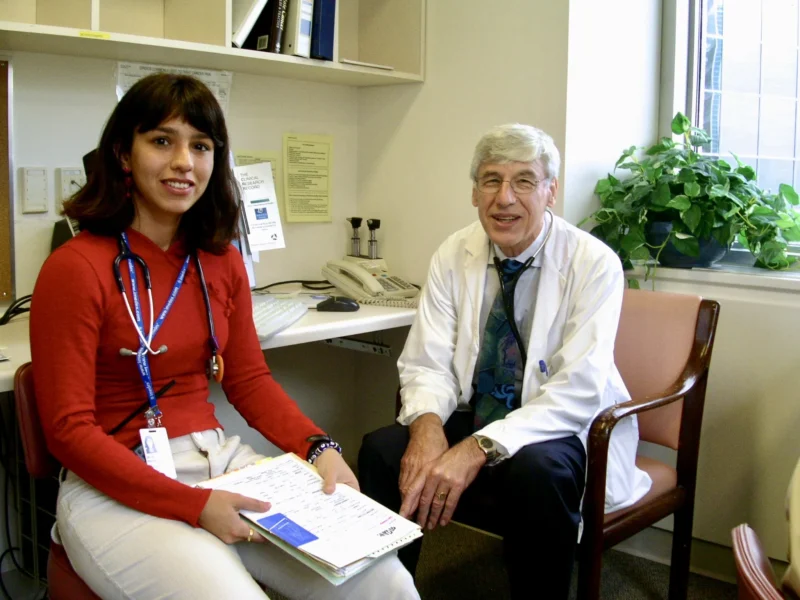
Prof. Ian Tannock and Rachel Riechelmann in clinic in 2005
When Effective Drugs Do Not Reach Patients
One of the most important parts of our conversation was access.
Even when drugs are truly effective, they often do not reach the people who need them. This is especially true in low- and middle-income countries, but as Dr. Tannock pointed out, even high-income countries are not immune.
“Drugs have become obscenely expensive,” he said. “I remember when I led the trial of docetaxel for prostate cancer, we thought the drug was extremely expensive when it cost about 2000 US dollars for a three-weekly injection. Now that’s actually cheap compared with most of the drugs that can easily run to 10, 15,000 US dollars a month,” he said.
That kind of pricing makes treatment inaccessible in many parts of the world. And even in the United States, where there is no public healthcare system, many patients do not receive optimal treatment.
So how much scientific progress is really progress?
“There’s no easy answer to that,” he said.
But he mentions important research happening today in India, studying lower doses of drugs that still show effectiveness.
“Many of the drugs that have been developed are used at much higher doses than are needed for their effectiveness,” he said. “And this is particularly true of immunotherapy.
There’s been the Delhi study using lower dose nivolumab. And just published in the Annals of Oncology, a study in triple negative breast cancer showed that pembrolizumab, instead of being used at 200 milligrams every three weeks, 50 milligrams every six weeks gave very similar results to the trial using higher doses. That type of research is helping.”
Still, cost is only one part of the issue.
“Doing research in low- and middle-income countries isn’t just a function of the cost of drugs,” he said. “You also need the structure and the ability of the clinicians, oncologists and support staff to do the research in those countries.”
It is a common misconception that LMICs do not need research and that providing basic care should be prioritized instead. This has been the strategy for too long. But if even basic care in HICs is not accessible everywhere, maybe investing in a research environment and clinical researchers who question the status quo and build care appropriate for their settings will be the route to improving basic care?
Trials That Asked What Patients Actually Felt
When Dr. Tannock began working in genitourinary oncology, the field looked very different. Today, GU sessions at ASCO can fill large rooms. Back then, he said, the audience could be 30 people in a room built for 100.
He became interested in prostate cancer, particularly metastatic prostate cancer in older men. And he focused on the problem that mattered most to them.
“The biggest problem for men with metastatic prostate cancer is bone pain,” he said.
So instead of only asking whether tumors shrank, his first trials asked whether patients’ pain improved. He and Canadian colleagues studied mitoxantrone and prednisone compared with prednisone alone, with pain improvement as the endpoint.
“We found a significant difference in pain control,” he said.
That trial led to mitoxantrone becoming the first chemotherapy drug approved by the FDA and EMA for prostate cancer. More importantly, it was approved on the basis of a quality-of-life endpoint.
“It’s one of only two trials that I’m aware of where a quality-of-life endpoint, a pain control endpoint, was used for licensing a drug,” he said.
Later, this work helped lead to the large docetaxel trial in metastatic prostate cancer.
“The company that was marketing docetaxel approached me about helping them design a trial to compare docetaxel with mitoxantrone. Two of their medical staff came from Paris to Toronto and we spent two days in an office in the hospital writing the initial protocol for the TAX-327 trial. It was a large trial, 1000 patients or so, comparing two schedules of docetaxel with mitoxantrone.”
The endpoint was overall survival, but pain control and quality of life were still included.
Docetaxel became the preferred chemotherapy treatment for castrate-resistant prostate cancer and remains so even many years later.
But the lesson he draws from this story is not only about docetaxel. It is about how a major trial can begin with a very practical question.
“That all came about from the original idea of doing a simple trial,” he said.
A simple trial, but not a small idea: can we reduce pain for men with metastatic prostate cancer?
Mentorship and the Next Generation
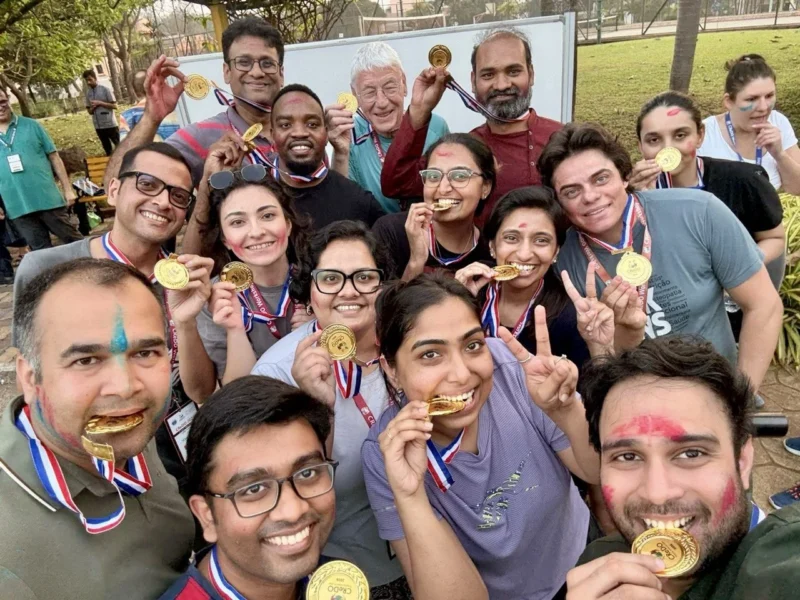 Prof. Ian Tannock and mentees at the CReDO 2026 workshop in India
When I asked what keeps him invested in young oncologists, his answer was very direct and very satisfying for me.
“Interacting with young people like yourself is, I find, a very pleasant thing to do,” he said.
I might have set him up for that answer.
“I think it’s very rewarding if I can have a small part to play in helping young people to advance their careers,” he said, “and particularly to develop their careers as critical people who really do have in their minds improving outcomes for patients.”
His advice to young oncologists is practical. Find a mentor. Find a research niche that is not overcrowded. Do not simply jump on a bandwagon.
“You build a research career not by starting with doing a large randomized trial,” he said. “You build a research career by answering simple questions.”
He used to keep a notebook where he wrote ideas that came to him in clinic.
“How many phase II trials that give positive results lead to phase III?” he said. “To what extent are drug interactions a problem?”
These are not glamorous questions at first glance. But they are answerable, useful, and connected to real practice.
It may be one of the best pieces of advice for young researchers. Start taking notes.
What He Would and Would Not Do Again
Many physicians doubt their career choice at least once in their lifetime. I wondered if Dr. Tannock did too.
“No, I don’t think I ever considered quitting medicine,” he said, with almost too much certainty.
But there were roles that fit him less well. He led the Department of Medical Oncology at Princess Margaret for several years, and although he helped grow the department, he does not describe administration as his natural strength.
“When you lead a department, you get caught up in all sorts of committees and other administrative things,” he said. “That really isn’t my strength.
I think my strength is much more in teaching and mentoring and doing clinical research.”
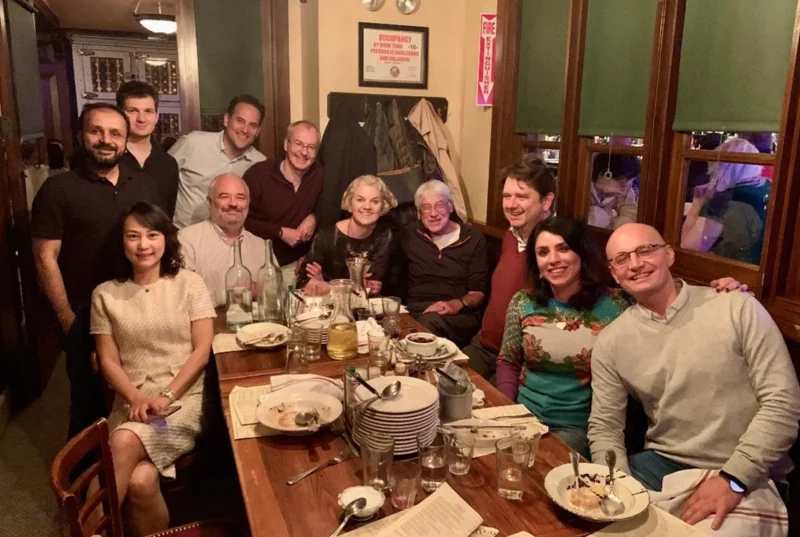 Prof Tannock and his former fellows
After stepping down from leadership, he returned to the things he enjoyed and felt he did best. He also became deeply involved internationally: EORTC, Institut Curie, ASCO, ESMO, the European School of Oncology, and clinical trial courses in different countries, often in low- and middle-income settings.
He has now retired from active clinical practice, but not from teaching, writing, or pushing oncology toward better standards, luckily.
Hope, But Not Blind Hope
When I asked what makes him hopeful for oncology, he gave perhaps the most Ian Tannock answer possible.
“Well, you’re assuming that I am hopeful,” he said.
It was funny, but also honest. I could’ve predicted it.
He does see reasons for hope. Immunotherapy has changed outcomes for some patients. Antibody-drug conjugates are promising in several areas. There are drugs and strategies that truly help patients.
But his hope is not in technology alone. It is also in people and movements trying to make oncology more honest and more patient-centered.
“I’m encouraged by a number of people who are doing research to try and improve the access to effective drugs for the world’s population,” he said.
He is also encouraged by Common Sense Oncology, where people have come together voluntarily to promote treatments that matter to patients.
“We really have to push for strategies that can both improve outcomes and spread those improved outcomes more widely,” he said. “And I think as more and more people become involved with that, we can influence editors of journals and so on. The Lancet Oncology has always been very much on side, the editor of which is David Collingridge. And we’re beginning to see this with some other journals, like the Journal of Clinical Oncology…
The current president of ASCO, Eric Small, whom I know well, because we were GU oncologists, has it very much in mind to improve cancer treatment everywhere. His speech at this year’s ASCO was superb.”
Books, Films, Walking, and Being “Friendly”
Isn’t the best part of life human interaction? And isn’t it even better to bond over art and creativity with someone else? So, I asked.
“Well, I read a fair bit. I used to be quite a cinema buff. I liked going to the movies and particularly some of the older French movies with my wife. We do a lot of hiking. That may get more difficult as we get older, but fortunately I’m quite fit. I used to run with friends. I have a group of friends, a group of older men, but we’re fairly active old men and we walk. With this group of friends this afternoon, we will go to a pub together and watch the World Cup semifinal.”
He was cheering for England, in case you were wondering, as Canada was eliminated. Of course, by now you know, Spain won the Cup.
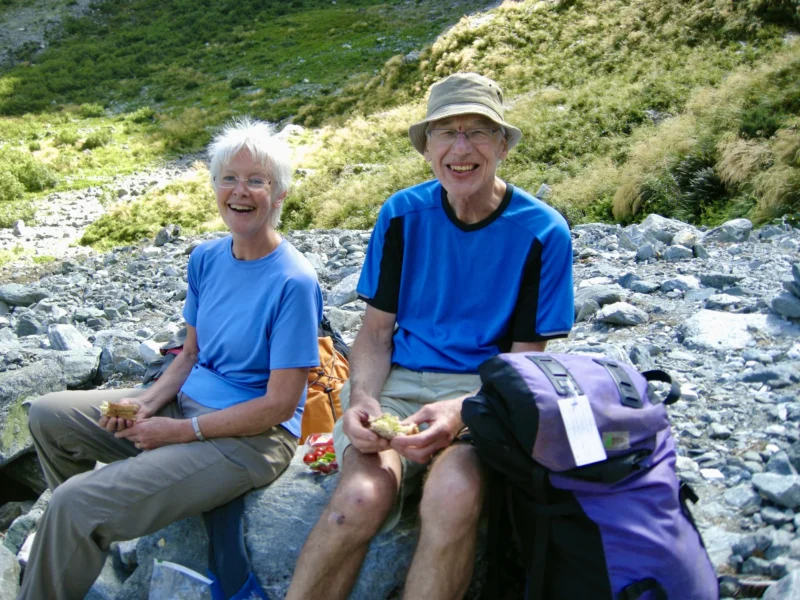 Ian Tannock and his wife Rosemary hiking in 2011
On music, he grew up with the Beatles and the Rolling Stones, enjoys Eric Clapton and Cat Stevens, and goes to symphony and opera in Toronto.
“I still think the Beatles are some of the best songwriters that we’ve ever known,” he said. I was hoping he would say that I was his favorite musician (although I love his music taste). I was kind of heartbroken, I won’t lie.
When I asked him how he would like to be described in one word, he paused and then chose:
“Friendly.”
It fits.
Tolerance and the World Beyond Oncology
At the end, I asked him a difficult question: what can unite the world?
“Oh my gosh,” he said. “I’m not sure that anything can unite the world given the vagaries of human nature.”
But then he gave one word: tolerance.
He spoke about Toronto, where he lives, and described taking the subway with his wife and grandson after a birthday evening. The city, he said, felt like “a United Nations.”
“There were people getting on the subway of your age group,” he said. “Every color, every racial origin, and all very friendly together.”
That, for him, is part of what makes Canada one of the nicer countries in the world.
But he is not blindly optimistic about the world. He spoke about wars, political divisions, and the fact that, compared with 10 years ago, he does not think the world has become better. That’s not the type of thing I like to hear, but it is very hard to argue otherwise these days.
When I asked whether we should still hope that it will, he answered carefully.
“I think we can hope that it will,” he said. “But whether the evidence is suggesting that’s happening, I don’t know.”
Again, even hope had to meet evidence with him. I do hope that it will, and I think, in fact, that it will, because that is what I can do to make sure that it is where I am headed as a person.
And then, just when the conversation could have ended on a heavy note, it became light again.
I did tell him I was hoping his favorite music artist would be me.
“The only time I’ve seen you as a musician is when you sang at the end of CReDO,” he said.
It wasn’t my brightest moment, so I told him that was not enough.
He did say that he needed to hear some of my music.
“And then maybe you will become my favorite artist.”
Deal.
Dr. Ian Tannock has spent his career asking oncology to be more careful with its claims, more honest with its data, and more loyal to patients than to excitement. He has also spent much of that career helping younger oncologists learn how to ask better questions.
Perhaps that is one of the most important forms of mentorship: not giving someone the answer, but teaching them how to see when the answer is not good enough.
“You build a research career,” he said, “by answering simple questions.”
Simple questions, in his hands, have changed the way oncology thinks.
by Elen Baloyan, MD
Editor-in-Chief of OncoDaily Magazine
Managing Editor, OncoDaily