





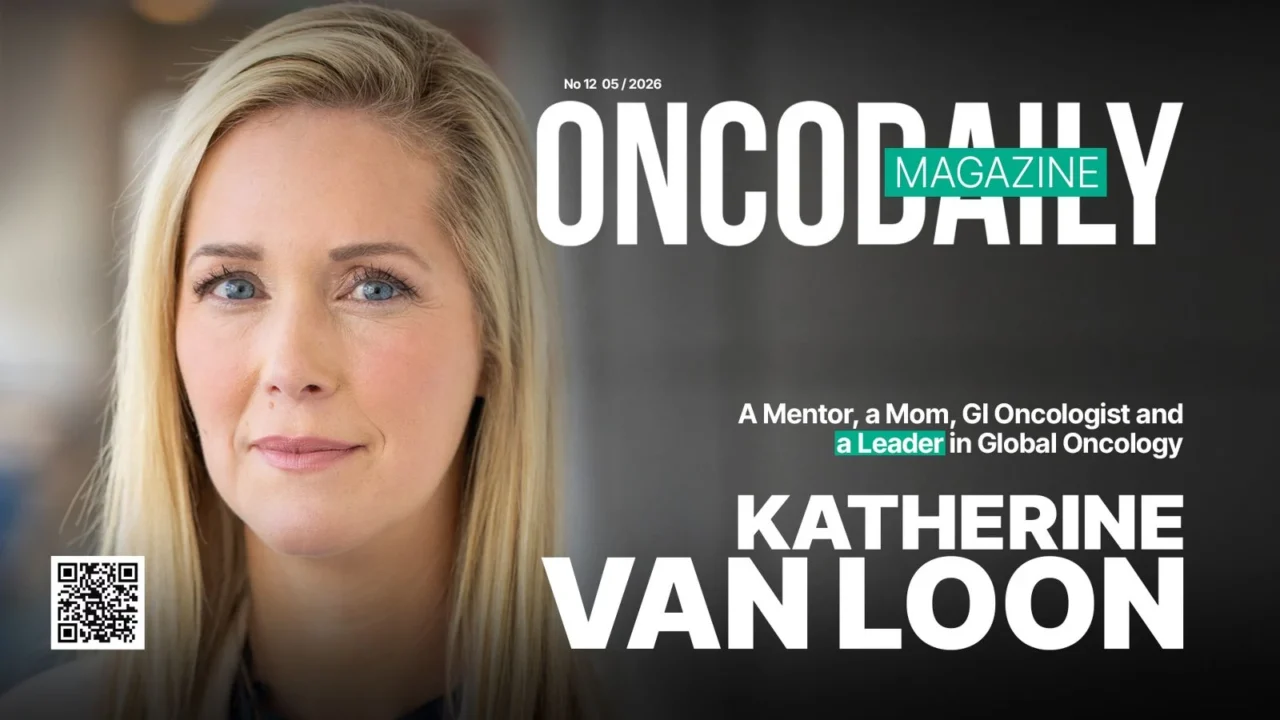
From HIV clinics in South Africa to gastrointestinal oncology at UCSF, from mentoring first oncologists in East Africa to leading JCO Global Oncology, Katherine Van Loon has built a career around one conviction: the hardest problems in cancer care can be solved, but only through patience, partnership, and local leadership.
“Solutions to disparities in oncology are best informed by data and context-appropriate research.”
By 6 a.m., Dr. Katherine Van Loon’s day has often already begun across continents. Before the school lunches, breakfast, and the drive to her daughter’s school, there may be a call with a mentee in Africa. Then she pivots into the rest of the day: patients, program building, editorial leadership, clinical decisions, global oncology work, and the responsibilities of home.
“Every day feels like a whirlwind, starting at 6 a.m. to 7 p.m., and wearing a whole bunch of different hats along the way.”
That image – not a carefully staged portrait, but a rapid sequence of obligations that all matter – may be the most honest way to enter her story. Dr. Van Loon is a professor and gastrointestinal medical oncologist at UCSF, Director of the Global Cancer Program at the UCSF Helen Diller Family Comprehensive Cancer Center, and Editor-in-Chief of JCO Global Oncology. But the titles alone do not explain the pattern of her career. The clearer thread is urgency: the urgency of patients in front of her, the urgency of inequity, and the urgency of mentoring people who may become the first oncologists in their countries.
The Summer That Changed the Path
Dr. Van Loon did not move toward medicine in a straight line. She was pre-med at Duke, but after an intense undergraduate experience, she questioned whether medical school was the right path. A piece of advice stayed with her:
“If there is anything else you can imagine doing besides being a doctor, do that.”
She turned first toward public health. During her master’s degree, she felt, for the first time, that she was truly thriving as a student. For her dissertation, she traveled to South Africa in 2001 to study informed consent for HIV trials. The timing was historic and painful. South Africa was still in the recent aftermath of the fall of apartheid; HIV was threatening to overtake the continent; and President Thabo Mbeki’s denialism around HIV and antiretroviral therapy would later be linked to hundreds of thousands of preventable deaths.
For Dr. Van Loon, the experience was not abstract. Locals asked her a question she could not easily answer.
“Many of the people I interviewed for my study asked me, ‘But what are you going to do for us right now?’ The issues felt urgent and pressing, and I realized I had no skill to offer. As a researcher, I was there collecting information, and I felt I had nothing to give.”
Before that summer, she had been drafting applications to public health PhD programs. By the end of it, her direction had changed. From South Africa, she mailed her medical school applications.
“I realized that I personally couldn’t be ‘just a researcher’ working in an African setting.”
Why Oncology, and Why GI Cancer?
“Oncology combines a high-acuity and intellectually demanding form of medicine with the rewards of in-depth, long-term relationships with patients.”
Gastrointestinal oncology, in particular, offered breadth and intensity. It required knowledge across specialties and the ability to manage complex disease in real time. At UCSF, she found a clinical home in one of the country’s leading GI oncology programs and was mentored by Dr. Alan Venook, whom she credits not only for his expertise but for his way of leading.
“He taught me that people are inspired to work hard when a leader is passionate and deeply invested in the growth and success of members of the team.”
Another early influence was Dr. Paul Volberding, an oncologist who became central to the HIV response in San Francisco. When Dr Van Loon interviewed for fellowship at UCSF in 2008, she did not yet see a clear professional path in global oncology. Volberding did.
“When I met him in 2008, I had no direct line of vision into a path forward in both oncology and global health, but he was already convinced it was where we were headed.”
Building Before the Path Exists
For much of her early faculty career, Dr Van Loon’s global oncology work lived in the margins. Her funded research focused on domestic clinical outcomes and healthcare delivery in the United States. Global oncology was the work she did at night, on weekends, and after the official workday had ended.
“The work that I was most passionate about did not have a clear path forward.”
She describes those early global projects as the “high-risk, high-reward” part of her portfolio. The tension was real: how could she build a credible academic career while pursuing work that did not yet have reliable funding or institutional support?
A pivotal moment came when mentors recognized that her dual path was not going to be sustainable. She was balancing clinical care, young children, domestic grants, and global projects. They arranged a meeting with Dr. Alan Ashworth, then the new president of the UCSF Helen Diller Family Comprehensive Cancer Center, and asked her to make the case for global oncology as a cancer center priority.
She began presenting. Six slides in, Ashworth stopped her.
“He said, ‘Yes, absolutely. This is truly a priority and we need to make it a priority for Helen Diller Cancer Center… and who is going to lead it?’”
She was six months pregnant, three years into her faculty position, and the opportunity was overwhelming. It was also unprecedented: few cancer centers at the time had identified global oncology as a formal priority initiative. She said yes.
“That was definitely an opportunity that was not well-timed for me personally. But I knew that this was what we were fighting for and I had to say yes.”
The Clinic and the World
Dr Van Loon does not describe herself as either a clinician who does research or a global health researcher who treats patients. She rejects the binary.
“I don’t think it’s either-or. I think I am both.”
Still, she keeps the two worlds distinct when she sits with a patient. She knows that even basic resources are not available to many clinicians and patients around the world but she is privileged to have access to extraordinary resources at UCSF. But in the exam room, her responsibility is to the person in front of her.
“When I am sitting with an individual patient, I really do have to take off my public health hat and think about the doing the best thing, even when N=1.”
This is one of the tensions of global oncology: the clinician must fight for systems, but the patient cannot be reduced to a system-level argument.
The Inequity That Frustrates Her Most
Asked what inequity in cancer care frustrates her most, Dr Van Loon does not hesitate: access to therapeutics. Many cancer drugs that are considered essential are still inconsistently available, and even when they exist in-country, pricing and lack of coverage can place treatment outside reach.
“Even some of the cancer drugs on the WHO Essential Medicines List are not regularly available… Patients are put into very precarious financial situations where they are forced to spend their family savings or solicit community donations. Patients risk taking their families into bankruptcy to pursue treatments, sometimes without clear understanding of what the goals of treatment may be.”
East Africa, Esophageal Cancer, and Bidirectional Learning
One of the central examples in Van Loon’s global oncology work is esophageal cancer in East Africa.
“Working on a cancer that is rare here in the United States but incredibly prevalent in some geographic hotspots around the world offered an opportunity to enrich our understanding of this disease. But it’s imperative that we find the research questions in the local priorities.”
That work began with understanding the epidemiology of esophageal cancer along the eastern corridor of Africa. Over time, it evolved into clinical care initiatives. Her team has partnered with Boston Scientific on deployment and training for esophageal stents in five countries to palliate obstruction. They are also leading the EsophoCap study, using an esophageal cytosponge to identify methylation patterns that may inform early detection in high-risk populations.
This is where her long-range strategy becomes visible. Early in building the UCSF Global Cancer Program, she faced disagreement about whether research should be a priority when clinical care needs were so urgent. She understood the concern. But she also believed that sustainable solutions required knowing the burden, disease characteristics, and local context.
“I was told we shouldn’t lead with research, because the need for clinical capacity-building was too urgent. Looking back, I do think taking the long-road approach and developing a research emphasis was a strategic decision. In order to solve complex problems, we need to understand what the problems are, the disease burden, disease characteristics, and what solutions can be applied in the local context. This can only be achieved with research.”
Against Helicopter Science
Van Loon is clear about what global oncology should not be.
“The traditional helicopter science paradigm is a high-income country researcher who comes into a resource-constrained setting, has a question, obtains and takes specimens out of the country, answers a question that may or not have any clinical relevance, and publishes it. That is what I am trying to avoid.”
The principles of her program are direct. Research questions should originate from local clinicians and international partners. External resources can support the work when needed, but every project should include some element of local capacity building.
“The questions are generated by our local clinicians and international partners and are specific to local context. Training and mentoring local researchers is critical to ensure that the research is clinically relevant and that it is going to be sustainable.”
The Human Side of Global Oncology
As Editor-in-Chief of JCO Global Oncology, Dr Van Loon is interested not only in data but in the human stories behind the field. She points especially to the journal’s Art of Global Oncology section, which allows narratives from around the world to capture the lives of patients, clinicians, families, and communities.
At the same time, she believes the field must move beyond only describing gaps. For years, global oncology literature has documented the burden, the problem, and the disparities. That work remains important, but the next phase must be more intervention-focused.
“I am hoping that we are shifting to clinical impact and generation of data that will change how oncology is being practiced in resource-limited settings… We should be shifting now toward implementation science, clinical trials, and quality improvement studies that are going to have direct impact on clinical practice.”
Mentorship as Legacy
If Van Loon’s career is built around systems, it is also built around people. She speaks about mentorship not as a formal obligation, but as one of the clearest measures of impact. Her leadership values – impact, empowerment, and family – helped her understand that enabling others might create more change than building a narrow research empire of her own.
“When I reflected deeply on what I wanted to achieve over the course of my career, I realized I would achieve far more in enabling others to be successful in their research careers.”
In Tanzania, she worked with oncology trainees who were preparing to become the first oncologists in their countries. Many left their families for years of training, then returned home to build something that had not existed before. Watching them grow into national and international leaders changed how she defines success.
“Many of these individuals have gone on to become international thought leaders and much needed leaders in their countries. Quite frankly, that’s far more impact than I could have ever created by focusing exclusively on my own grant portfolio.”
Her view of mentorship is also deeply practical. In some cultures, she has found, a mentor may be seen mainly as a supervisor or someone who checks off milestones. She pushes for something more bidirectional and transparent, where mentees are empowered to manage up, communicate deadlines, and ask clearly for what they need.
“A good, healthy mentor-mentee relationship takes into account all of the personal aspects and demands the mentee is facing. It requires transparency and open communication. When it works well, it becomes a longterm investment in that relationship both personally and professionally.”
Leadership development became an important part of that mission. Through WomenLift Health, she learned to recognize her own leadership strengths – collaboration, trustworthiness, listening, and the ability to bring people together across cultures – even when those strengths did not match the traditional patriarchal model of academic leadership.
What Keeps Her Going
The hardest part of the work, she says, is still clinical care which also keeps her going.
“Sitting with patients in crisis is incredibly difficult, and often very exhausting. But knowing that patients and their families develop trust in the care that they’re getting is incredibly meaningful and important to me.”
The patient who made the impossible visible
While every patient story stands unique and has a special meaning for her, one patient remains especially vivid.
“He arrived in his forties expecting a routine conversation about adjuvant therapy for stage III colon cancer. But when he unwrapped his scarf, I saw visible adenopathy in his neck. He had widely metastatic disease. After multiple lines of failed chemotherapy, he became one of the first patients I enrolled in a KEYNOTE study for mismatch repair-deficient metastatic colorectal cancer.”
The timing etched him into her memory. He was the last patient she saw before giving birth to her daughter. She consented him for the study, went home from clinic, and went into labor that night.
“I mark that patient’s survival after enrollment in that trial by my daughters age. She is ten now. These are the cases when you think this is impossible, but it becomes possible. And that’s what keeps me going.”
The Long View
Global oncology can be overwhelming. Van Loon remembers sitting beside a mentor in Tanzania who noticed she kept sighing. He told her, with a mix of humor and concern, that people who sigh a lot die young. She laughs at the memory, but the point was serious: the scale of inequity can feel daunting, even unsolvable.
What gives her perspective is her first global health experience in HIV. She saw a moment when antiretrovirals were unavailable and publicly disputed. She subsequently saw HIV become, in many settings, a chronic disease. That history has become a source of discipline.
For young oncologists in low-resource settings, her message is neither simplistic optimism nor resignation. It is persistence, broken into manageable pieces.
“The disparities we face in oncology are stark. Many have said it’s a problem that is too complex and too expensive to solve. But I try to remember that most complex problems are solvable through step-wise progression and a collaborative approach. It won’t be completely solved in my lifetime, but ultimately, I hope that tackling the smaller pieces will contribute to a larger solution.”
The Future She Wants
Looking ahead, Dr Van Loon sees two global priorities clearly: improved access to early diagnosis and improved access to therapeutics. She also believes that clinical trials focused on innovation and cost-effectiveness may create reverse innovation – lessons from resource-constrained settings that help high-income countries manage rising cancer care costs.
When asked what single decision could affect global cancer care, her answer is blunt.
“The pharmaceutical companies need to alter their pricing structure for our global community.”
It is a statement that brings the conversation back to patients – to those who need treatment, to families facing impossible costs, and to clinicians trying to practice oncology when the standard of care is visible but financially unreachable.
Hope, Nature, and the Quote on Her Desk
If she was not an oncologist, she would be mom to Adam and Madeline.
“Being a mom is a full-time job. It’s a very fulfilling one, but it’s also my hardest one. There is no training or education that prepares you for this journey. My kids don’t realize it yet, but I like to think that am mentoring them too.” – she says.
Outside oncology, Dr Van Loon finds recovery in nature. The ocean and skiing – vast, open settings – give her space to breathe. When asked about favorite musician, Dr Van Loon’s priorities became clearly reflected in her answer – family, resilience and impact.
“I will probably never be forgiven by my ten-year old daughter if I don’t say Taylor Swift! But I do think she is an inspirational artist who has demonstrated remarkable resilience by facing public scrutiny and coming at on top. She has faced personal hardships and turned them into artistic triumphs and incredible success. In terms of my favorite Taylor Swift songs – I Can Do It with a Broken Heart, The Man, and Change, in no particular order” (said with a sly grin).
She admits, with humor, that she has not read a book cover to cover since her older son, Adam, was born and that her family would confirm her inability to stay awake through a full movie. But one book still stands out: Nelson Mandela’s Long Walk to Freedom.
Mandela’s example – sacrifice, resilience, humility, reconciliation after adversity – remains a daily reference point. On her desk sits a framed quote that, for her, belongs as much to global oncology as to any political struggle:
“It always seems impossible until it’s done.”
Her own legacy, she says, will not be measured only by publications, grants, or traditional academic benchmarks. Increasingly, she sees it in the people she has mentored and the leaders they become.
“I am less defined now by traditional academic benchmarks, and more by seeing the success of my mentees, which is the most rewarding and will be the ultimate metric of my career success.”
And what keeps her hopeful? She does not answer with policy, science, or institutional strategy first. She answers with patients.
“…My patients. The fact that they find grace, resilience, and hope in the darkest moments of their lives really gives me no option except to remain hopeful.”
By Elen Baloyan, MD, Editor-in-Chief of OncoDaily Magazine