
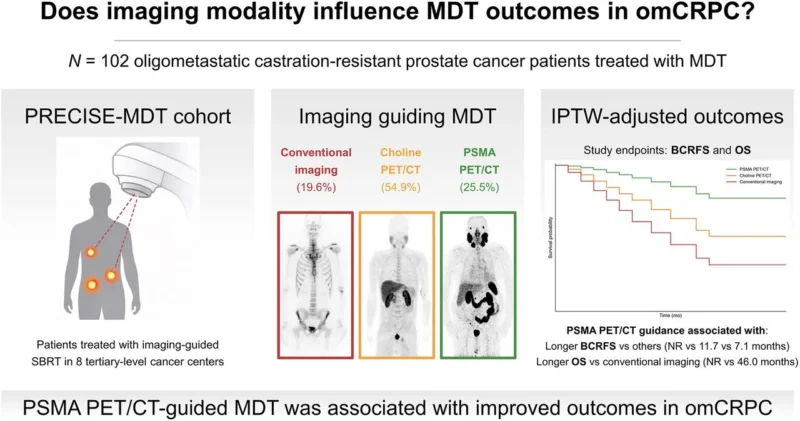
An updated analysis of the PRECISE-MDT cohort has found that metastasis-directed therapy guided by prostate-specific membrane antigen PET/CT was associated with longer biochemical recurrence–free survival and improved overall survival in patients with oligometastatic castration-resistant prostate cancer.
The study, published in the Journal of Nuclear Medicine, evaluated 102 patients with oligometastatic castration-resistant prostate cancer who underwent stereotactic body radiation therapy as metastasis-directed therapy. Investigators compared outcomes according to the imaging modality used for treatment planning: conventional imaging, choline PET/CT, or PSMA PET/CT.
The findings suggest that more sensitive imaging may have an important role in selecting and targeting metastatic lesions in this difficult stage of prostate cancer. However, the researchers emphasized that the retrospective design does not establish a causal benefit from PSMA PET/CT guidance.
Why Imaging Matters in Castration-Resistant Disease
Metastasis-directed therapy has become an increasingly important strategy for selected patients with oligometastatic prostate cancer. By treating a limited number of metastatic lesions with stereotactic body radiation therapy, clinicians may delay disease progression and postpone changes in systemic treatment.
However, the imaging methods used to identify those lesions vary substantially across clinical practice. Conventional imaging, choline PET/CT, and PSMA PET/CT can reveal different disease burdens, potentially influencing which patients are selected for local treatment and how comprehensively visible metastases are targeted.
This question is particularly relevant in castration-resistant prostate cancer, a biologically complex disease state marked by tumor heterogeneity and evolving patterns of PSMA expression.
Inside the Updated PRECISE-MDT Cohort
The analysis included 102 patients with oligometastatic castration-resistant prostate cancer from the multicenter PRECISE-MDT cohort.
Metastasis-directed therapy was guided by:
- Conventional imaging in 20 patients (19.6%)
- Choline PET/CT in 56 patients (54.9%)
- PSMA PET/CT in 26 patients (25.5%)
Most patients were receiving androgen deprivation therapy at the time of metastasis-directed therapy. Some patients also received androgen receptor signaling inhibitors or chemotherapy.
The primary endpoints were biochemical recurrence–free survival and overall survival. Investigators used inverse probability of treatment weighting to adjust for differences in clinical and disease characteristics across the imaging groups, including PSA level, metastatic burden, disease grade, systemic therapy, and year of imaging.
A Marked Difference in Biochemical Recurrence
Biochemical recurrence occurred in 95.0% of patients whose metastasis-directed therapy was guided by conventional imaging, compared with 78.6% of those in the choline PET/CT group and 42.3% of those in the PSMA PET/CT group.
PSMA PET/CT guidance was associated with significantly longer biochemical recurrence–free survival.
Median biochemical recurrence–free survival was not reached in the PSMA PET/CT group, compared with:
- 11.7 months with choline PET/CT guidance
- 7.1 months with conventional imaging guidance
The difference was statistically significant for PSMA PET/CT compared with choline PET/CT (P = 0.031) and conventional imaging (P = 0.002).
These findings remained consistent in a sensitivity analysis using trimmed inverse probability weighting.
Overall Survival Also Favored PSMA PET/CT
At the time of analysis, investigators recorded 36 deaths across the cohort.
Deaths occurred in:
- 50.0% of patients in the conventional imaging group
- 41.1% of patients in the choline PET/CT group
- 11.5% of patients in the PSMA PET/CT group
Patients who received PSMA PET/CT-guided metastasis-directed therapy had significantly longer overall survival than those treated using conventional imaging guidance.
Median overall survival was not reached in the PSMA PET/CT group, compared with 45.97 months in the conventional imaging group (P = 0.036).
The overall survival difference between PSMA PET/CT and choline PET/CT did not reach statistical significance (P = 0.065).
Secondary Outcomes Did Not Separate Clearly
Despite the biochemical recurrence and overall survival findings, the study did not identify statistically significant differences among imaging groups for several secondary endpoints.
These included metastasis-free survival, time to systemic therapy change, and composite progression-free survival.
Median metastasis-free survival was:
- 8.2 months with conventional imaging
- 21.0 months with choline PET/CT
- 11.4 months with PSMA PET/CT
Median time to systemic therapy change was:
- 11.0 months with conventional imaging
- 27.6 months with choline PET/CT
- 12.7 months with PSMA PET/CT
Composite progression-free survival was also not significantly different among the three groups.
Better Detection, Better Targeting, or Better Selection?
The investigators noted that the survival advantage associated with PSMA PET/CT could reflect several possible factors.
PSMA PET/CT may improve the detection of metastatic lesions that remain occult on conventional imaging. More accurate imaging could also allow clinicians to target all visible disease more completely during stereotactic body radiation therapy.
At the same time, the findings may partly reflect differences in patient selection, disease characteristics, systemic therapy, or other factors that cannot be fully addressed in a retrospective cohort.
The authors stressed that the results should be interpreted as an association rather than proof that PSMA PET/CT guidance directly improves survival.
Building on Earlier Evidence
The updated PRECISE-MDT analysis adds to growing interest in metastasis-directed therapy for oligometastatic castration-resistant prostate cancer.
The authors referenced the phase 2 ARTO trial, which showed that combining metastasis-directed therapy with androgen receptor signaling inhibition improved progression-free survival compared with systemic therapy alone in selected patients with oligometastatic castration-resistant disease.
They also highlighted the MEDCARE study, which suggested that treating all PSMA-positive lesions may be important when using metastasis-directed therapy in patients with oligoprogressive castration-resistant prostate cancer.
Together, these findings reinforce the importance of disease detection, lesion selection, and complete treatment coverage when considering local therapy in advanced prostate cancer.
A Real-World Study With Important Limitations
The study has several limitations, including its retrospective and observational design, relatively small sample size, and potential for selection bias.
Although the analysis used inverse probability weighting to adjust for important clinical variables, residual confounding could not be excluded. The investigators also noted variation in systemic therapies, restaging schedules, and treatment histories across the cohort.
Still, the study provides multicenter real-world data in a setting where prospective evidence remains limited.
The updated PRECISE-MDT cohort supports the clinical relevance of PSMA PET/CT for planning metastasis-directed therapy in oligometastatic castration-resistant prostate cancer and highlights the need for prospective trials to clarify whether advanced imaging can directly improve long-term outcomes.
Written by Nare Hovhannisyan, MD
Stay informed with more articles like this on OncoDaily