






Yan Leyfman, Medical Oncologist, Co-Founder and Executive Director of MedNews Week, shared on LinkedIn:
“CAR T-cell expansion may help identify patients at risk for delayed neurotoxicity after cilta-cel.
CAR T-cell expansion has long been linked to treatment efficacy, but its relationship with toxicity has been less clear. A new multicenter study suggests that the degree of CAR T-cell expansion differs substantially between approved BCMA-directed products and may help identify patients at higher risk for delayed neurotoxicity.
Using a standardized flow cytometry assay in 90 patients with relapsed/refractory multiple myeloma, investigators found that ciltacabtagene autoleucel (cilta-cel) produced significantly greater CAR T-cell expansion than idecabtagene vicleucel (ide-cel) (median peak 106 vs. 49 cells/μL).
The clinical implications differed by product:
- Ide-cel: Higher CAR T-cell expansion was associated with better treatment responses.
- Cilta-cel: Greater expansion was not associated with improved efficacy but was strongly linked to an increased risk of delayed neurotoxicity, including ICANS and delayed movement disorders such as Parkinsonism.
To identify a clinically practical biomarker, investigators evaluated absolute lymphocyte count (ALC) in a larger multicenter cohort of 532 patients. Peak ALC closely mirrored CAR T-cell expansion during the first month after infusion.
Notably:
- Peak ALC ≥3,000/μL, or
- ALC ≥2,500/μL with a rapid twofold daily increase
Identified patients at higher risk for delayed neurotoxicity following cilta-cel, with 81% sensitivity and 59% specificity.
These findings suggest that routine laboratory monitoring may provide an inexpensive and widely available surrogate for CAR T-cell expansion, allowing earlier identification of patients who may benefit from closer neurologic surveillance or preemptive intervention.
While prospective validation is still needed, this study highlights an important concept: more CAR T-cell expansion is not always better. In cilta-cel, excessive expansion may reflect a higher risk of immune-mediated neurotoxicity, underscoring the importance of balancing potency with safety as CAR T-cell therapies continue to evolve.”
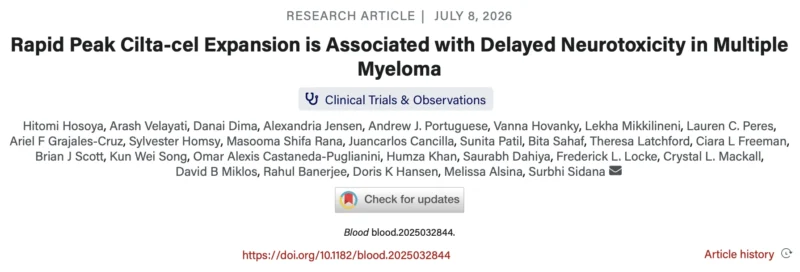
Title: Rapid Peak Cilta-cel Expansion is Associated with Delayed Neurotoxicity in Multiple Myeloma
Authors: Hitomi Hosoya, Arash Velayati, Danai Dima, Alexandria Jensen, Andrew J. Portuguese, Vanna Hovanky, Lekha Mikkilineni, Lauren C. Peres, Ariel F. Grajales-Cruz, Sylvester Homsy, Masooma Shifa Rana, Juancarlos Cancilla, Sunita Patil, Bita Sahaf, Theresa Latchford, Ciara L. Freeman, Brian J. Scott, Kun Wei Song, Omar Alexis Castaneda-Puglianini, Humza Khan, Saurabh Dahiya, Frederick L. Locke, Crystal L. Mackall, David B. Miklos, Rahul Banerjee, Doris K. Hansen, Melissa Alsina, Surbhi Sidan
Other posts featuring Yan Leyfman on OncoDaily.