






Ranjit Manchanda, Co-Lead of Screening Prevention and Epidemiology Unit, Wolfson Institute of Population Health at Queen Mary University of London, shared on LinkedIn:
“Delighted to see our paper out in E Clinical Medicine.
The PRESCORES study was undertaken across 25 NHS trusts in England, Scotland and Wales, and is the first study anywhere to directly measure quality of life in women who have had a preventive hysterectomy for Lynch syndrome.
Women who carry the faulty gene associated with Lynch syndrome have a high lifetime risk of womb cancer, along with an increased risk of bowel and ovarian cancer. Many choose to have a risk-reducing hysterectomy to prevent cancer developing.
Title: Health-related quality of life after risk-reducing hysterectomy (PRESCORES): a cross-sectional study
Authors: Samuel George Oxley, Milly Lake, Amanda Dibden, Tia Whenham, Xia Wei, Lea Mansour, Ashwin Kalra, Subhasheenee Ganesan, Jacqueline Sia, Michail Sideris, Caitlin Fierheller, Margarida Kurzer, Rachel Perfect-Lake, Jyotsna Pundir, Ruth Armstrong, Janos Balega, Ishita Bhatnagar, Michela Cicchetti, Cecilia Compton, Jacqueline Cook, Rosemarie Davidson, Lesa Dawson, Sadaf Ghaem-Maghami, Helen Hanson, Rachel Harrison, Rachel Hart, Alison Kraus, Fiona Lalloo, D Gareth Evans, Terri P. McVeigh, Kevin Monahan, Laura Monje-Garcia, Esther Moss, Alex Murray, Kai Ren Ong, Myfanwy Rawson, Dimitra Repana, Adam N. Rosenthal, Neil Ryan, Lyndall Sarkies, Saba Sharif, Lucy Side, Kate Simon, Tracy Smith, Joyce Solomons, Vishakha Tripathi, Amy Watford, Mark Willett, Adam Brentnall, Rosa Legood, Ranjit Manchanda
Read The Full Article
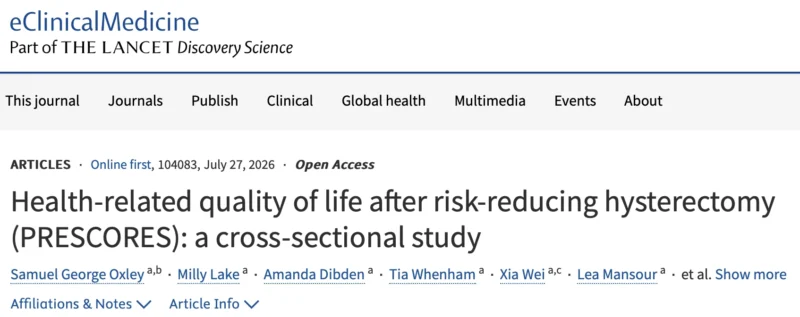
This largest study of its kind shows that this surgery is linked to a small drop in quality of life for younger women, but makes no difference for women who have already been through the menopause.
- 1,120 women with Lynch syndrome took part across the UK
- 529 had already had a preventive hysterectomy; 591 had not
- Quality of life was measured on a scale from 0 (equivalent to death) to 1 (perfect health)
- Younger, pre-menopausal women who had the surgery scored 0.041 points lower than similar women who hadn’t
- There was no meaningful difference in quality of life for post-menopausal women
‘The decision to have risk-reducing surgery is complex, and is guided by a woman’s perceived cancer risk, her fertility wishes, long-term health considerations and other personal factors. Women must weigh the clear benefits of cancer prevention against any potential impact on their quality of life.
We found that women under 51 with Lynch syndrome who had a preventive hysterectomy reported lower quality of life than similar women who hadn’t, but there was no difference in older women. Our findings will help women with Lynch syndrome make personalised, and at times difficult, decisions around cancer prevention. Pre-menopausal women having preventive hysterectomy need better, tailored multidisciplinary support.’
Grateful to all the study participants, the funders, all PIs, LSUK, stakeholders, and supporting patient charities.”