






Glen Clack, Chief Medical Officer at TheraCryf, shared on LinkedIn:
“A rum business in the liver…
It is not putting it too strongly to say that hepatocellular carcinoma has never been much of a fixture in the menopause debate.
A new Swedish cohort in the Journal of the National Cancer Institute proposes to change that: 217,878 women dispensed menopausal hormone therapy, 1,089,390 age-matched non-users, eighteen years of registry follow-up, and a hazard ratio for HCC of 0.46 (95% CI 0.30 to 0.72). Halve your liver cancer risk; spiffing.
Then one kicks the tyres. The whole edifice rests on 21 exposed cases. The oestrogen-only arm rests on eight. Twenty-one events across 1.6 million person-years is not so much a signal as a rumour with a confidence interval attached.
There is no dose-response. Across the three dosage bands, the adjusted hazard ratios wander upwards rather than down (1.00, 1.22, 1.12; P for trend 0.42). For a mechanism supposedly running through anti-inflammatory signalling at the oestrogen receptor, this is a spanner in the works.
The time course runs backwards
The apparent protection is largest within the first five years (HR 0.37) and weaker thereafter (0.53). Carcinogenesis is a slow business; a benefit that arrives promptly and then fades is the signature not of biology but of selection. And there is the delicate matter of who receives a prescription.
Women with liver disease do not get systemic MHT. The registries recorded cirrhosis in 0.1% of both groups and fatty liver disease in the same, figures so implausible that adjusting for them is decorative. Confounding by contraindication has not been excluded; it has been waved at politely from the far side of the room. Nor are the two groups quite the like-for-like pairing that age-matching implies.
Prior hysterectomy stood at 5.7% among users against 3.1% among non-users, very nearly double: not a nuisance variable to be adjusted away, but a marker of a whole gynaecological history, and of a cohort under closer medical observation than its comparator.
Two things in the paper’s favour
The intrahepatic cholangiocarcinoma result is flat (HR 0.99), which is what one wants from an internal control: a bias fond of healthy livers ought to have flattered that endpoint too. And the authors conclude that the evidence falls well short of anything that should change practice. The restraint is theirs and does them credit; it tends to evaporate somewhere between the discussion section and the report.
One further point for those of us who care about route. Exposure here is any systemic MHT, oral, transdermal or injected, pooled together by ATC code. The study is therefore silent on precisely the distinctions between molecule and route that do most of the real work in this field. Whatever this is evidence of, it is not evidence that your patch is hepatoprotective.
A defeasible finding, honestly reported, from an underpowered corner of a very large registry. File under interesting; do not prescribe.”
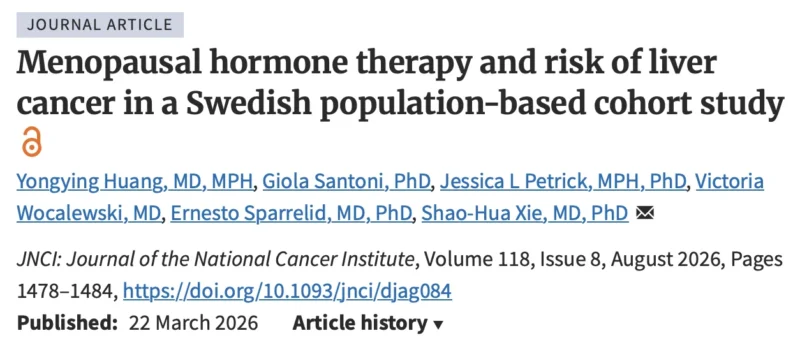
Title: Menopausal hormone therapy and risk of liver cancer in a Swedish population-based cohort study
Authors: Yongying Huang, Giola Santoni, Jessica L. Petrick, Victoria Wocalewski, Ernesto Sparrelid, Shao-Hua Xie
Read the Full Article
Other articles about hepatocellular carcinoma on OncoDaily.