






George Kumar, Senior Director at AstraZeneca, shared on LinkedIn:
“Cisproplatin (CPP): A Redox-Activatable Platinum Drug That Hits Cancer, Not the Kidneys.
Cisplatin has been a chemotherapy workhorse for decades – but its severe kidney and nerve toxicity often forces clinicians to limit the dose, and with it, the benefit.
Meet cisproplatin (CPP): a single Pt(IV) scaffold that combines cisplatin with probenecid in one redox-activatable molecule. The design is deliberately clever – CPP stays stable in serum and across physiological and acidic pH, but selectively releases its active components under the reducing conditions found inside tumor cells.
New Data:
- Superior potency across the full NCI-60 cancer cell panel, outperforming cisplatin.
- A dual mechanism: in its Pt(IV) state, CPP engages DNA noncovalently, then releases cisplatin-like Pt(II) upon reduction – driving cumulative cytotoxicity.
- In triple-negative breast cancer (TNBC) cells, CPP beat both cisplatin and simple cisplatin/probenecid mixtures at curbing growth and proliferation.
- In BALB/c mice, negligible overall toxicity and low neurotoxicity in a CIPN model.
- Reduced platinum accumulation in the kidneys and prolonged circulation on pharmacokinetic analysis.
The takeaway:
CPP behaves as a redox-activatable, dual-drug Pt(IV) platform that decouples strong anticancer activity from the classical dose-limiting toxicity that has held cisplatin back.
A promising step toward making platinum chemotherapy both more effective and more tolerable.”
Title: Cisproplatin: A Redox-Activatable Cisplatin-Probenecid Pt(IV) Conjugate with Broad NCI-60 Potency that Decouples Antitumor Efficacy from Dose-Limiting Toxicity and Suppresses CIPN
Authors: Kajol, Avinash Choudhury, Arka Banerjee, Prakash Shukla, Subhra Jyoti Panda, Rakesh Kumar Pathak.
Read the full article.
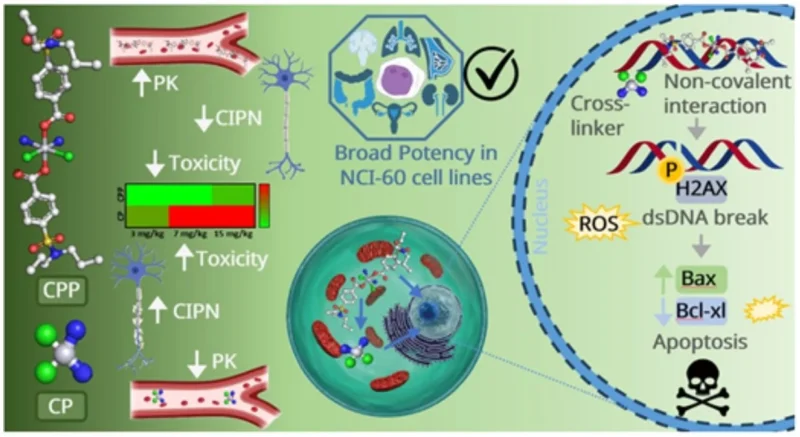 Figure Courtesy: J. Med. Chem. (2026). Rakesh Kumar Pathak. Indian Institute of Science Education and Research. India.