
Among the cytogenetic subgroups of multiple myeloma, t(11;14) stands out as a potential therapeutic target because of its increased dependence on BCL-2, providing a rationale for targeting this pathway with venetoclax. It’s also the most common primary translocation in myeloma, present in roughly 22% of patients.
Venetoclax had already shown activity in t(11;14)-positive relapsed/refractory myeloma, alone and in combination. But its path forward got complicated after the Phase III BELLINI trial: adding venetoclax to bortezomib-dexamethasone helped t(11;14)-positive patients, but caused excess mortality across the broader trial population. After that, biomarker selection was essential.
The Phase III CANOVA trial therefore focused exclusively on patients with t(11;14)-positive R/R MM, comparing venetoclax-dexamethasone with pomalidomide-dexamethasone.
Methods
CANOVA was a randomized, open-label, multicenter Phase III trial conducted across 111 sites in 20 countries. Adults with centrally confirmed t(11;14)-positive R/R MM were eligible after at least two previous lines of therapy. Patients had to have prior exposure to a proteasome inhibitor and either be refractory to lenalidomide or have relapsed within 6 months of stopping lenalidomide.
The primary endpoint was progression-free survival (PFS) assessed by blinded independent review. Key secondary endpoints included overall response rate (ORR), very good partial response (VGPR) or better, overall survival (OS), minimal residual disease (MRD) negativity at <10⁻⁵, and patient-reported measures of disease symptoms and physical functioning. Duration of response and safety were also assessed.
Study Design
A total of 263 patients were randomized 1:1 to:
- Venetoclax-dexamethasone: venetoclax 800 mg orally once daily plus dexamethasone.
- Pomalidomide-dexamethasone: pomalidomide 4 mg orally on days 1-21 of each 28-day cycle plus dexamethasone.
Dexamethasone was administered at 40 mg on days 1, 8, 15, and 22, reduced to 20 mg in patients aged 75 years or older. Treatment continued until disease progression, unacceptable toxicity, or discontinuation.
The study included a heavily pretreated population. Patients had received a median of three previous lines of therapy in the venetoclax arm and two in the pomalidomide arm. Nearly all were lenalidomide-refractory, while 79% and 72%, respectively, were refractory to both a proteasome inhibitor and an immunomodulatory drug.
CANOVA Did Not Meet Its Primary Endpoint
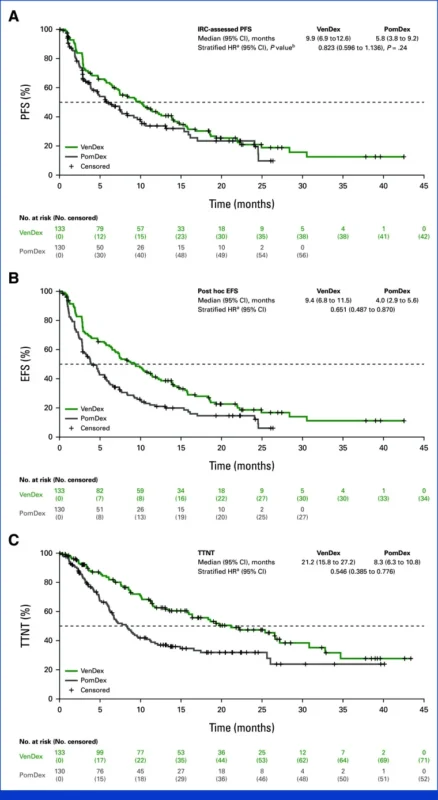
At a median follow-up of 24.9 months, median PFS was 9.9 months with venetoclax-dexamethasone vs 5.8 months with pomalidomide-dexamethasone. The difference, however, did not reach statistical significance (HR, 0.823; P=0.24). CANOVA therefore did not meet its primary endpoint.
The negative primary endpoint is important because several other efficacy measures favored venetoclax:
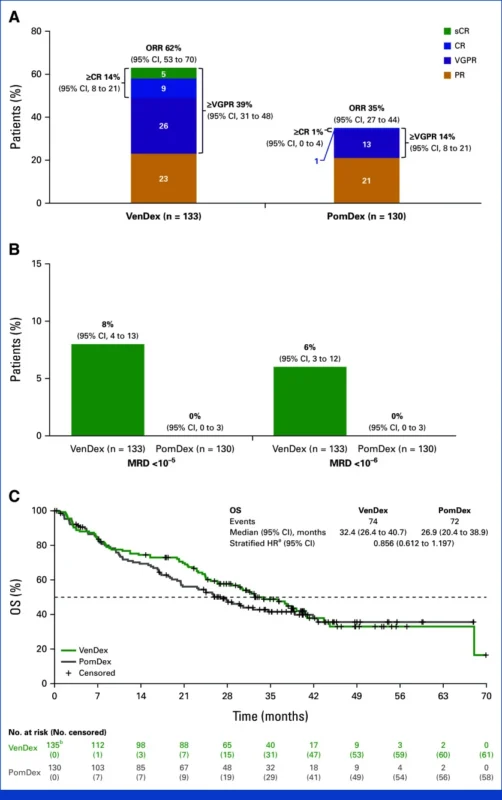
- ORR was 62% vs 35%
- VGPR or better was achieved in 39% vs 14%
- MRD negativity at <10⁻⁵ was reported in 8% with venetoclax-dexamethasone and 0% with pomalidomide-dexamethasone.
Median time to next treatment showed a wider separation at 21.2 vs 8.3 months. Disease symptoms and physical functioning also deteriorated later in the venetoclax arm. At the final OS analysis, median OS was 32.4 months with venetoclax-dexamethasone vs 26.9 months with pomalidomide-dexamethasone (HR, 0.856).
Why the PFS Result May Be More Complicated
One of the most relevant findings from the discussion was an imbalance in patients who started another anti-MM therapy before meeting International Myeloma Working Group criteria for progression. This occurred in 29 patients receiving pomalidomide-dexamethasone compared with eight receiving venetoclax-dexamethasone. Because these patients were censored in the PFS analysis, it was noted that PFS in the control arm may have been overestimated.
A post hoc event-free survival (EFS) analysis counted the start of a new anti-MM therapy as an event. Median EFS was 9.4 months with venetoclax-dexamethasone vs 4.0 months with pomalidomide-dexamethasone (HR, 0.651). This analysis supports the clinical activity seen across other endpoints, but it does not change the primary result: CANOVA was a negative trial for its prespecified PFS endpoint.
The open-label design may have contributed to this issue. Because both investigators and patients were already aware of venetoclax activity in t(11;14)-positive MM, treatment discontinuation and decisions to move to subsequent therapy may have differed between the two groups.
Safety and the Continuing Infection Signal
Grade ≥3 treatment-emergent adverse events occurred in 67% of patients receiving venetoclax-dexamethasone and 83% receiving pomalidomide-dexamethasone. Hematologic toxicity was more common with pomalidomide, including grade ≥3 neutropenia in 54% vs 19%. Diarrhea was more frequent with venetoclax but was rarely grade ≥3.
Infection remained an important concern with venetoclax. Overall and serious infection rates were similar between groups, but seven fatal infections occurred with venetoclax-dexamethasone and none with pomalidomide-dexamethasone. Patients with fatal infections had low baseline CD4+ T-cell counts, although the exploratory analysis was based on small numbers.
What Does CANOVA Mean for Venetoclax in MM?
CANOVA did not demonstrate a statistically significant PFS benefit for venetoclax-dexamethasone over pomalidomide-dexamethasone in t(11;14)-positive R/R MM. Even so, venetoclax produced higher and deeper responses, greater MRD negativity, and longer time to next treatment, with numerically longer PFS and OS. Differential censoring complicated interpretation of the PFS analysis, and fatal infections remained a big concern.
These results support continued development of BCL-2 inhibition in t(11;14)-positive myeloma, but not routine adoption of the venetoclax-dexamethasone doublet on the strength of CANOVA alone.
Earlier studies have already shown high response rates when venetoclax was combined with carfilzomib or daratumumab, suggesting that its role may ultimately be stronger as part of a biomarker-directed combination.