
Bone disease is one of the most common sources of morbidity in multiple myeloma (MM). Osteolytic lesions can lead to pathologic fractures, spinal cord compression and the need for surgery or radiotherapy. Bone-modifying agents (BMAs), including bisphosphonates and denosumab, prevent these skeletal-related events (SREs) and are recommended for patients on therapy for active MM, but their use remains inconsistent in practice.
A retrospective cohort study from Johns Hopkins Hospital compared BMA use by race and assessed how differences in BMA use relate to skeletal outcomes. African American (AA) patients received BMAs less often and at lower intensity than White patients, but their overall incidence of postdiagnostic SREs was not significantly higher. Among AA patients who had an SRE around the time of MM diagnosis, subsequent skeletal events were more frequent, without a corresponding increase in BMA treatment intensity.
The Study Population
The study included 350 patients with newly diagnosed MM treated at Johns Hopkins between 2016 and 2024: 149 self-identified AA patients and 201 White patients. All patients initiated first-line therapy at the institution. Investigators assessed BMA administration during the first year after diagnosis and characterized the incidence, timing, and severity of SREs.
SREs included pathologic fractures, spinal cord compression, or surgery or radiotherapy to bone because of myeloma involvement. Events occurring within 60 days before or after MM diagnosis were classified as peridiagnostic. Skeletal events clustered around diagnosis, and an early SRE identified a subgroup with a different subsequent risk pattern.
AA patients were younger at diagnosis than White patients, with a median age of 64 vs 68 years. The groups did not differ significantly in Revised International Staging System (R-ISS) stage, renal function, cytogenetic risk, or the prevalence and severity of lytic lesions at diagnosis. AA patients had greater socioeconomic deprivation. Triplet or quadruplet induction was used at similar rates in the two groups.
African American Patients Received Less BMA Therapy
At least one BMA dose was administered to 64% of AA patients compared with 77% of White patients (P=.013). Zoledronic acid was the predominant agent, used in 55% and 71%, respectively. BMA treatment was also more frequently delayed or withheld among AA patients (54% vs 42%), and the documented reasons did not differ significantly between groups.
Treatment intensity differed more. Among patients who received a BMA, AA patients received a median of five doses during the first year compared with seven among White patients (P<.001). More frequent treatment interruptions did not explain this, since they occurred at similar rates. One-year PFS was also similar between groups, which argues against better myeloma control as an obvious explanation for the lower BMA exposure.
After multivariable adjustment: AA race was associated with an odds ratio of 0.69 for receiving at least one dose. Socioeconomic status and dental health were also not independently associated with BMA initiation. A peridiagnostic SRE was the strongest identified predictor of receiving a BMA.
The disparity in treatment intensity persisted after adjustment. Among BMA-treated patients, AA patients received fewer doses than White patients (relative ratio 0.84), independent of socioeconomic status and previous SREs.
Similar Skeletal Event Rates Despite Lower BMA Use
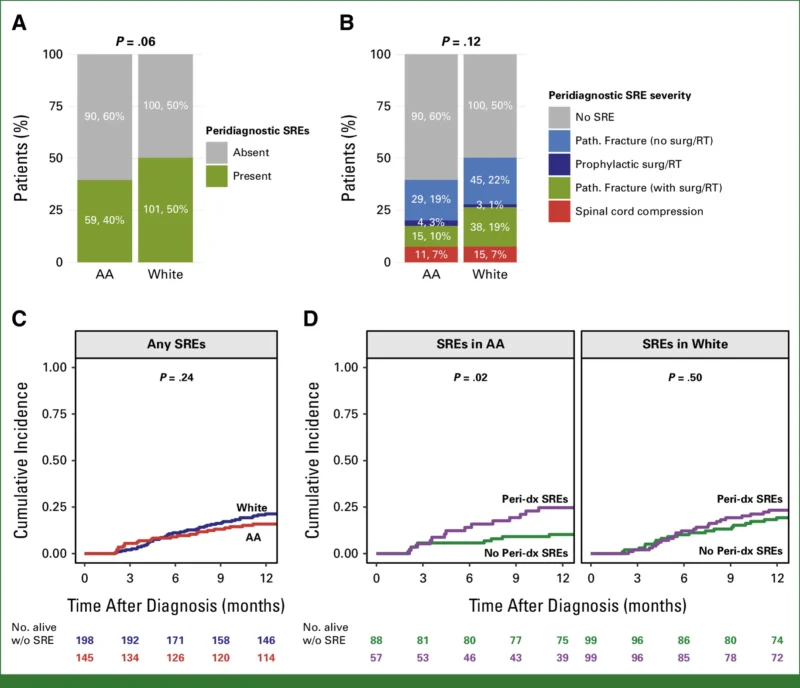
Most skeletal complications occurred around the time MM was diagnosed. Peridiagnostic SREs were observed in 40% of AA patients and 50% of White patients, and the severity of these events was similar between groups.
After the 60-day peridiagnostic period, the 1-year cumulative incidence of SREs was 16% among AA patients and 21% among White patients. The types of skeletal events also did not differ significantly. High-risk cytogenetics did not explain the pattern.
The absence of higher overall SRE incidence despite lower BMA exposure complicates a straightforward dose-response interpretation. It doesn’t show that lower-frequency BMA treatment is equally effective across racial groups.
The authors note that previous observational data have reported a similar pattern. They discuss possible biological differences in bone density, metabolism, or osteoclast activity, drawing parallels with racial differences in skeletal outcomes reported in osteoporosis and solid tumors. These mechanisms were not measured in the current study and remain hypotheses.
Early Skeletal Events Identified a Higher-Risk Subgroup
Among AA patients, those who experienced an SRE during the peridiagnostic period had a 1-year SRE incidence of 25% vs 10%. Among White patients, corresponding rates were 23% and 19%.
BMA treatment did not appear to intensify to the same degree after these early events. Among patients with a peridiagnostic SRE, 46% of AA patients received at least four BMA doses during the first year vs 76%. Among White patients, the proportion receiving at least four doses increased from 47% in those without an early SRE to 76% in those with one. Among AA patients, the corresponding increase was not statistically significant.
Whether intensifying BMA therapy after an early SRE would reduce recurrent events can’t be determined from this retrospective analysis.
Could BMA Dosing Be More Individualized?
If one population received fewer doses without a detectable increase in overall 1-year SRE incidence, uniform high-frequency administration may not be necessary for every patient.
The findings are not evidence for reducing BMA therapy according to race. Race is an imprecise proxy for biological, environmental, socioeconomic, and health-care factors, and the study was not designed to establish an optimal dosing schedule.
In this cohort, an SRE near diagnosis appeared considerably more informative than race alone for identifying AA patients at risk of another event. Prospective work is needed to evaluate early SRE status as a guide to BMA intensity and risk-adapted dosing without overtreating lower-risk patients.
Limitations
The analysis was retrospective and single-center, which limits generalizability. With only 350 patients and relatively few recurrent SREs, the time-to-first-event analysis may underestimate the total burden of repeated skeletal complications.
Residual confounding is possible. Socioeconomic status was estimated with the Area Deprivation Index from residential ZIP codes, which can’t capture household-level differences. ECOG performance status and formal transplant eligibility were unavailable, and chart-based data can’t capture every clinical reason for delaying, withholding, or modifying BMA therapy.
Patients were not randomized to different dosing schedules, so the study can’t establish whether lower BMA intensity caused subsequent skeletal events among AA patients with an early SRE.
Reference
- Irimia, R. M., Goularte, V., Balev, M., et al. (2026). Racial disparities in the management of myeloma bone disease: A retrospective cohort study. Journal of Clinical Oncology: Oncology Practice. doi: 10.1200/OP-25-00935.
You can also read: