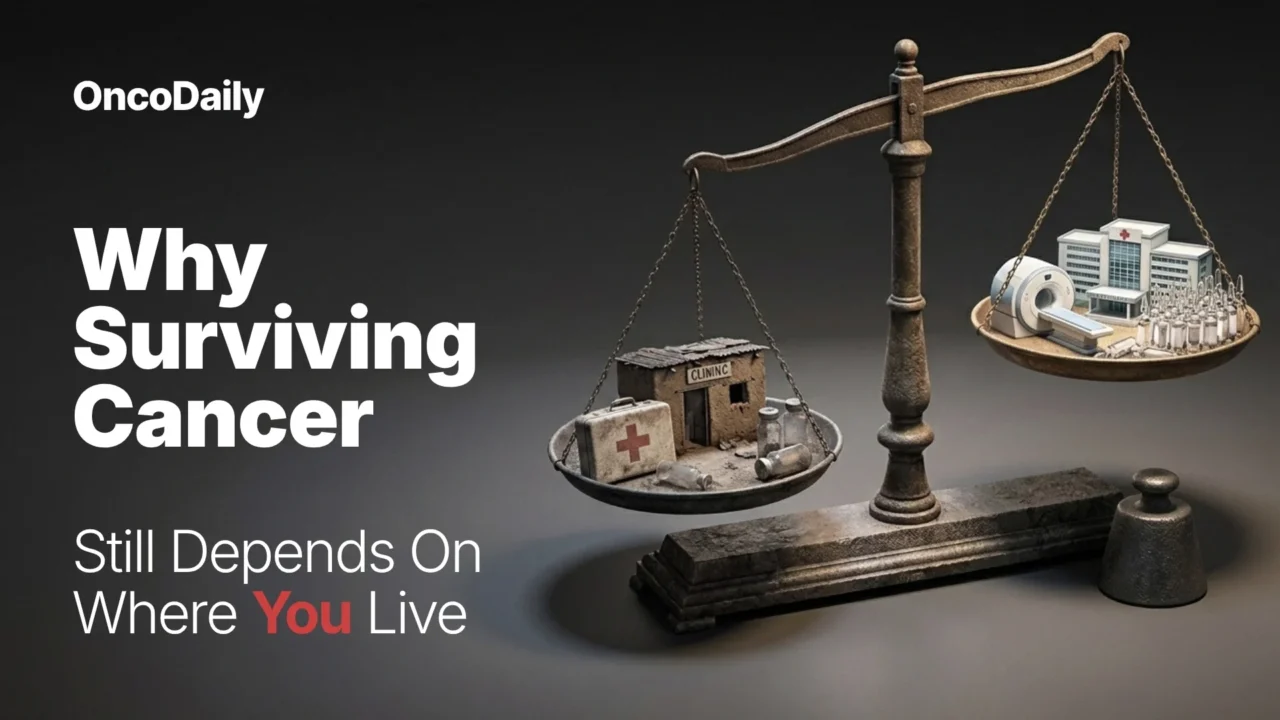
Cancer survival has improved in many parts of the world. But a new World Health Organization report shows that the benefits of earlier diagnosis and better treatment remain deeply unequal.
In high-income countries, five-year net survival for breast cancer reached 86% in 2010-14. The equivalent figures were 77% in lower-middle-income countries and 75% in upper-middle-income countries, according to data presented in the WHO’s Global Status Report on Cancer 2026. The report says survival for breast, colorectal and childhood cancers now exceeds 80-90% in some high-income settings, reflecting advances in early detection, timely diagnosis, treatment and supportive care.
But these averages hide large differences between and within countries. What happens after a diagnosis often depends on how early the cancer is found, whether treatment is available nearby and what the patient can afford.
The WHO describes cancer as a “near-universal life experience”, with consequences that extend beyond hospitals to employment, household finances and the design of health services. In high-income countries, it estimates that people can expect to be affected twice during their lifetime, once as a patient and once as a caregiver.
Prevention has advanced, but coverage remains uneven
Tobacco control shows that cancer prevention can work. Global tobacco use fell by about 27% between 2010 and 2025, a decline the WHO links to measures introduced under its Framework Convention on Tobacco Control, including taxes, advertising restrictions and health warnings. But the world narrowly missed its target of a 30% reduction by 2025.
Infections are another major preventable cause. They were linked to about 10% of new cancer cases in 2022, down from approximately 16% in 2008. Despite this decline, infections remain the second-largest modifiable cause of cancer after tobacco. The principal risks include human papillomavirus (HPV), hepatitis viruses and Helicobacter pylori.
Vaccination offers one of the clearest opportunities. The report says that 165 countries, or 85% of WHO Member States, had included HPV vaccination in their national schedules by 2026. Yet population-weighted coverage with at least one dose was only 31%, far below the target of fully vaccinating 90% of girls by age 15.
But including a service in national policy does not necessarily mean it reaches the people who need it.
When cancer policies do not reach patients
About 90% of the national cancer control plans reviewed by the WHO included early detection for breast and cervical cancer. Only a minority, however, explicitly described a structured route from suspected cancer to diagnosis. Fewer still included measurable deadlines or detailed plans for implementation.
The consequences can be seen in the stage at which breast cancer is found. In 91% of high-income countries with available data, more than 60% of breast cancers were diagnosed at stages I or II. Only 28% of low- and middle-income countries reached the same benchmark.
Obtaining a diagnosis can itself be difficult. Citing the 2021 Lancet Commission on Diagnostics, the report says nearly 47% of the world’s population has little or no access to basic services such as pathology and diagnostic imaging. Primary care in low- and middle-income countries is particularly underserved, while shortages of trained staff and inadequate or poorly maintained equipment create further barriers.
Access to radiotherapy is similarly unequal. Twenty-three low- and middle-income countries with populations of more than one million had no active radiotherapy facility, leaving about 197 million people without access to the treatment in their own country.
Distance adds another obstacle. Globally, an estimated 76% of people live within two hours of a radiotherapy center. But the figure ranges from 93% in high-income countries to just 17% in low-income countries. Radiotherapy was also the least reimbursed cancer treatment in national health-benefit packages in low-income countries, with coverage reported in only 19–25% of them. About half of the national cancer plans reviewed did not include an explicit radiotherapy strategy.
Essential cancer medicines also remain unevenly available. For 20 priority medicines assessed by the WHO, reported availability ranged from 9% to 54% in low- and lower-middle-income countries, compared with 68% to 94% in high-income countries.
Evidence on treatment completion remains limited. Studies of selected cancers and countries found completion rates ranging from below 5% to 70% in low- and middle-income countries. The report also identifies catastrophic out-of-pocket spending, medicine shortages and fragile supply chains as continuing barriers.
The cost does not end at the hospital door
Cancer can reshape a family’s life long after an appointment or course of treatment has ended.
Between 2024 and 2025, the WHO ran an online survey in 10 languages on the physical, emotional, social and financial effects of cancer. It received responses from 4,262 people, of whom 3,975 completed at least one outcome measure.
Those respondents came from 116 countries; 47% were from low- and middle-income countries. The group included 1,505 people who had been diagnosed with cancer and 2,470 reporting on the experience of a relative or loved one.
Among respondents with cancer, 69% reported fatigue and 55% reported pain of varying severity. Depression was reported by 25% of patients and 20% of relatives or caregivers. Anxiety affected 22% and 17.8% respectively, while about one in 10 in each group reported post-traumatic stress.
Caregiving created pressures of its own. About 30% of relatives reported at least one form of strain, including exhaustion, isolation or damage to their own health. Among relatives who were unemployed for health reasons, more than half attributed this to their caregiving responsibilities.
For many respondents, the financial consequences were severe. Drawing on its survey and a systematic review, the report says approximately 45-60% of people diagnosed with cancer experience catastrophic health expenditure. It links this burden to impoverishment, food insecurity and disruption to children’s education.
One survey respondent from Nigeria said the cost of treatment was more than three times his monthly salary. His savings were exhausted within four months, followed by the sale of his family’s farm and other property.
“The cancer did not only invade my body; it invaded the walls of our home…”
he said.
When innovation leaves patients behind
Global spending on cancer medicines reached an estimated $252 billion in 2024, while an estimated $20 billion–$50 billion is invested in cancer research and development each year.
That investment has produced major advances. The report says immunotherapy has helped raise five-year survival in clinical trials for advanced non-small-cell lung cancer from about 5-10% before 2015 to 20-30% today. Precision testing, therapeutic vaccines and liquid biopsies are also changing how some cancers are detected and treated.
But research priorities remain uneven. An analysis of $24.5 billion in cancer research funding between 2016 and 2020 found that 41.2% went to cancer biology and 19.6% to drug treatment. Psychosocial research received 5%, while research classified as global health received 0.5%.
The imbalance is also visible in clinical trials. The WHO’s analysis identified 206 cancer trials in low-income countries, compared with 82,288 in high-income countries. The report says 90% of trials remain based in high-income settings, although those countries account for 36% of new cancer cases.
This matters because a treatment developed and tested mainly in well-resourced systems may be difficult to use elsewhere. Immunotherapy, for example, depends on accurate diagnostic tests, trained staff and reliable supply chains. Without those foundations, the report warns, investment may benefit only a small number of patients.
At the same time, some of the most basic care remains out of reach. An estimated 73.5 million people needed palliative care in 2021, but only 14% were receiving it by 2025. Cancer was the largest single reason for needing such care, accounting for 28% of the total.
The inequality is even greater for children. Of those needing palliative care, 98% live in low- and middle-income countries and almost half live in Africa.
Other support is also limited. Psychosocial care, nutrition, rehabilitation and symptom management are often underfunded or poorly integrated into national cancer plans. Only 43% of national health-benefit packages included home-based palliative care, while 46% included psychological, social and spiritual care.
New treatments can transform survival, but they depend on trained staff, laboratories, medicines and other services. Investing in innovation will have limited effect if these foundations are missing.
How can access be improved?
WHO sets out three changes needed to reduce inequalities in cancer care. Countries need stronger health systems with sustainable financing and trained staff. People must be protected throughout the cancer journey, from prevention and diagnosis to treatment, palliative care and support after cancer. Progress should also be measured through survival, function and quality of life, rather than policies and services alone.
Seven recommendations outline how this could be achieved. Cancer services should be included in national health systems and universal health coverage, with national cancer plans linked to funding and implementation. Governments are also encouraged to improve access to essential medicines, develop treatment guidelines and invest in the cancer workforce.
Patients, survivors, caregivers and families should be involved in decisions about cancer policy and services. WHO also calls for better public information and stronger social protection, including sickness benefits, disability support and protection against discrimination.
The final recommendations focus on cancer data, international coordination and research. Countries should collect and publish clearer data, while organizations working on cancer should align their priorities and avoid fragmented programs. Research and innovation should respond more closely to public health needs, particularly in low- and middle-income countries.
These measures depend on one another. Screening has limited value if a positive result is not followed by diagnosis. Early diagnosis may not improve survival if surgery, medicines or radiotherapy are unavailable. Treatment is not fully accessible if its cost leaves a family unable to afford food, housing or other essentials. There is no single approach that will work in every country. Cancer burdens, health systems and available budgets differ. But the same questions can be asked everywhere. Is cancer being detected earlier? Can patients obtain and complete treatment? Are families protected from financial hardship?
New treatments will continue to change cancer medicine. For millions of people, however, the immediate challenge is gaining access to vaccines, diagnostic tests, pain relief and treatments that already exist. Where someone lives still shapes their experience of cancer. It should not decide whether they survive it.
Written By Evelina Khachaturova