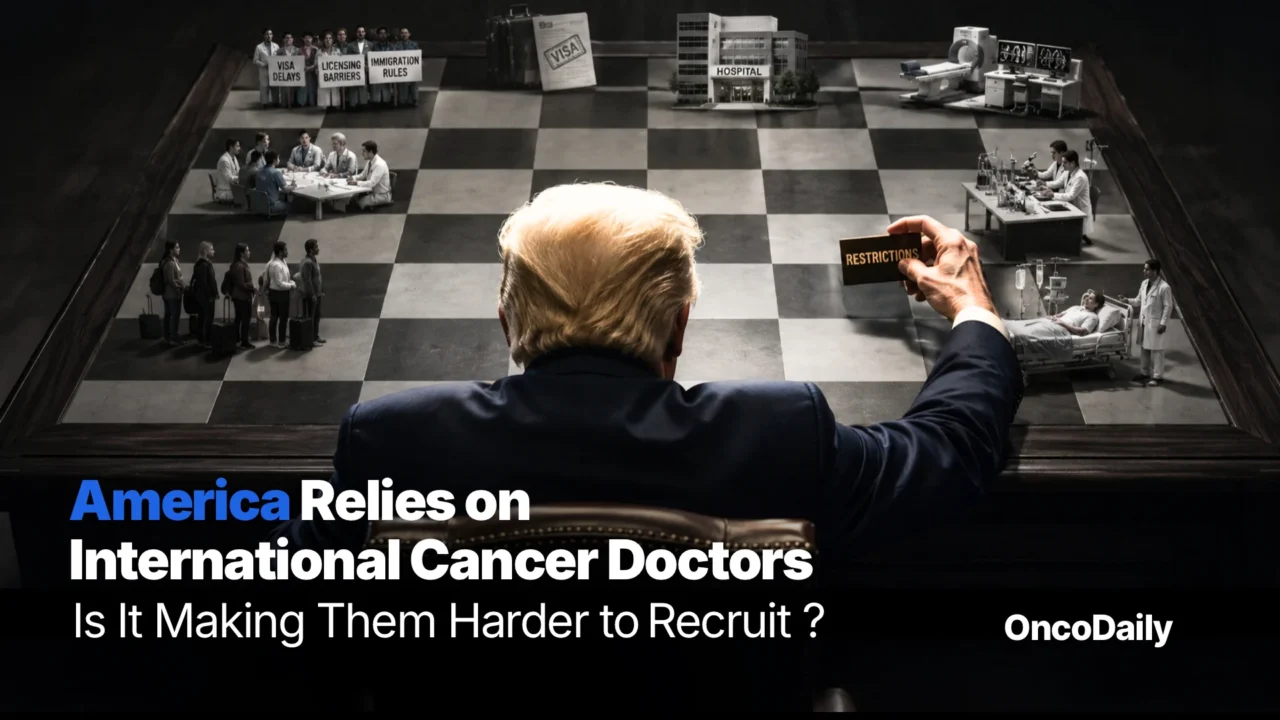
MD Anderson Cancer Center in Houston has spent decades building an international workforce of doctors and scientists. A new Texas restriction has made that recruitment process less predictable.
On January 27, Texas Governor Greg Abbott directed public institutions of higher education and state agencies controlled by gubernatorially appointed heads to freeze new H-1B visa petitions unless they received written permission from the Texas Workforce Commission. The restriction is due to remain in place until May 31, 2027, when the next regular session of the Texas Legislature ends.
Abbott said the measure was intended to prevent abuse of the visa system and ensure that publicly funded positions were filled by Texans first.
It is not an absolute ban. Institutions can request permission to sponsor a new international worker, but they must demonstrate that the position is essential, explain why it cannot be filled by an existing employee or Texas contractor, identify what uniquely qualifies the proposed recruit, and document their efforts to find a Texan or another person already authorized to work in the United States.
By July 17, no affected public university or state agency had sought permission for a new petition, according to a Texas Workforce Commission spokesperson quoted by the Texas Tribune.
MD Anderson said it was complying with the directive and awaiting further guidance about future recruitment. It did not answer questions from the Tribune about whether the measure had affected hiring, research, clinical trials, or patient care.
A cancer center built with international talent
Records obtained by the Texas Tribune listed about 277 MD Anderson employees sponsored through the H-1B program. According to the Tribune’s review, most of the positions were directly connected to cancer research or treatment.
The institution filed 853 H-1B petitions between 2020 and 2025, including 564 new petitions and 289 renewals. Annual filings increased from 91 in 2020 to more than 160 in each year from 2023 through 2025.
That international recruitment has accompanied substantial public investment in cancer research. Texas voters created the Cancer Prevention and Research Institute of Texas in 2007 with an initial commitment of $3 billion. Another $3 billion was approved in 2019, bringing the total authorized investment to $6 billion. MD Anderson researchers have received more than $745 million from the institute, or about 18% of all CPRIT awards, according to the Texas Tribune’s analysis.
Between 2020 and 2025, the center also received nearly $847 million from the National Cancer Institute and led U.S.-based higher education institutions in NCI funding in each of those years. Texas has invested billions in building a globally competitive cancer sector while introducing new controls on one of the routes through which that sector recruits international expertise. The country’s reliance on international physicians extends far beyond Texas.
The places with the greatest need
National projections show oncology capacity approaching overall demand, but the figures conceal large regional shortages.
A 2025 analysis by the American Society of Clinical Oncology found that 68% of Americans age 55 and older lived in counties where medical and hematology oncology coverage was considered at risk of being insufficient. More than half of U.S. counties had no medical or hematology oncologist in 2024, although those counties contained about 11% of the population age 55 and older.
Workforce projections show a sharp regional divide. Nationally, the oncology workforce is projected to have enough capacity to meet approximately 93% of demand by 2037. Metropolitan areas could meet 102% of projected demand, while nonmetropolitan communities may be able to meet only 29%.
The shortage is not limited to oncology. The Association of American Medical Colleges projects a national shortage of up to 86,000 physicians by 2036, driven partly by population growth, aging, and the number of doctors approaching retirement. That estimate applies to all physicians, not oncologists alone.
A separate federal model from the Health Resources and Services Administration projected a shortage of 187,130 full-time-equivalent physicians by 2037, with greater shortfalls outside metropolitan areas.
The two estimates should not be combined because they use different data, assumptions, and modeling methods. Both, however, point to an uneven distribution of doctors across the country.
How much oncology depends on international doctors
International medical graduates already account for approximately one-quarter of practicing physicians in the United States, according to the American Medical Association.
A study presented at the 2025 meeting of the American Society of Clinical Oncology reported that international medical graduates represented nearly half of the medical oncology workforce in the federal dataset it examined. The researchers used December 2024 provider data and identified oncologists by their reported primary specialties.
The study covered one federal provider dataset rather than every practicing oncologist. Within that dataset, international graduates were disproportionately represented in rural communities but were less likely than U.S. graduates to work at the main campuses of National Cancer Institute-designated cancer centers.
Restrictions on international recruitment could have a greater impact on communities already struggling to attract specialists, although not every internationally trained doctor works in a rural or underserved area.
A complicated route into American medicine
International physicians commonly use two visa routes: J-1 and H-1B. Foreign physicians may complete their residency or fellowship on a J-1 exchange visa. They are generally required to return to their home country for two years before becoming eligible for certain other U.S. immigration statuses.
Some can obtain waivers from that requirement. Under the Conrad 30 program, eligible physicians can obtain a waiver by agreeing to work full-time for at least three years in a qualifying shortage area or in a position serving a medically underserved population.
H-1B visas allow an American employer to sponsor a highly skilled professional for a particular position. Because the authorization is connected to a sponsoring employer, moving to another hospital can require a new petition, while processing delays or denials may affect when and where a doctor is able to work.
For international oncologists, visa rules can affect whether they accept an academic position, move to another hospital, pursue research, or work in a community with few specialists. Visa uncertainty can also make long-term planning more difficult for doctors and their families.
Hospitals hesitate over recruitment
According to AAMC News, a Greater New York Hospital Association survey found that 25% of responding hospitals had paused, deferred, or limited recruitment of physicians requiring H-1B sponsorship. Those hospitals employed about 1,100 medical residents and 800 attending physicians on H-1B visas.
One source of uncertainty was a $100,000 payment requirement introduced in 2025 for certain first-time H-1B petitions for workers applying from outside the United States. The measure did not apply to every H-1B petition or to most existing visa holders.
Medical organizations warned that the additional cost could deter hospitals and smaller practices from recruiting international physicians, particularly in rural and underserved communities.
A federal judge struck down the payment requirement on June 8, 2026, ruling that it amounted to an unauthorized tax. The decision was temporarily paused while the government sought a stay, allowing the requirement to remain in effect for several weeks.
On July 24, a federal appeals court rejected the administration’s request to keep the lower court’s ruling on hold. Immigration authorities could therefore no longer collect the $100,000 payment while the appeal continued.
The dispute is not over. On August 24, the administration released a proposed regulation that would establish an additional $103,265 fee for cap-subject H-1B petitions, including those covered by the advanced-degree exemption. The proposal has not become a final rule.
A bipartisan bill introduced in the House of Representatives would exempt physicians and other health care workers from the $100,000 payment requirement and prevent additional H-1B charges above those already established in immigration law.
The H-1Bs for Physicians and the Healthcare Workforce Act has been supported by the Association of American Medical Colleges and the American Medical Association. Its introduction does not mean that it has become law.
Immigration is only part of the shortage
Visa policy is only one part of America’s cancer workforce problem. The number of residency and fellowship positions, hospital finances, professional burnout, and the concentration of specialists in major cities also affect whether patients can find care close to home.
Not every internationally trained physician works in an underserved community. H-1B physicians are employed by major urban research centers as well as smaller hospitals. Even so, international medical graduates account for about one-quarter of practicing U.S. physicians and nearly half of the medical oncology workforce examined in one recent study.
That makes immigration policy part of cancer policy.
The immediate consequences of the Texas restriction remain unclear. MD Anderson did not say whether it had affected recruitment, research, clinical trials, or patient care. Any effect could emerge gradually if hospitals delay recruitment or take longer to fill positions.
As America’s population ages and demand for cancer care grows, the need for specialists will increase, including in communities that already struggle to attract them. Repeated changes to immigration rules could make recruitment less predictable for hospitals and international candidates.
Written by Evelina Khachaturova