Imagine being told you have cancer.
Suddenly, life becomes a series of urgent decisions. There are scans to arrange, treatments to consider and appointments to keep. Alongside the medical questions come practical ones. How will you get to the hospital? Can you afford to take time off work? Who will look after your children while you’re receiving treatment? It feels like an intensely personal experience. Yet many of the decisions shaping that journey were made years before you ever stepped inside a clinic. Every year, representatives of all 194 WHO Member States gather at the World Health Assembly in Geneva to make decisions that shape public health around the world. Between annual assemblies, WHO’s 34-member Executive Board helps prepare the agenda and oversee the organization’s work. Most people will never hear about these meetings. Yet decisions made there help determine where cancer services are available, which medicines are funded and who is eligible for screening.
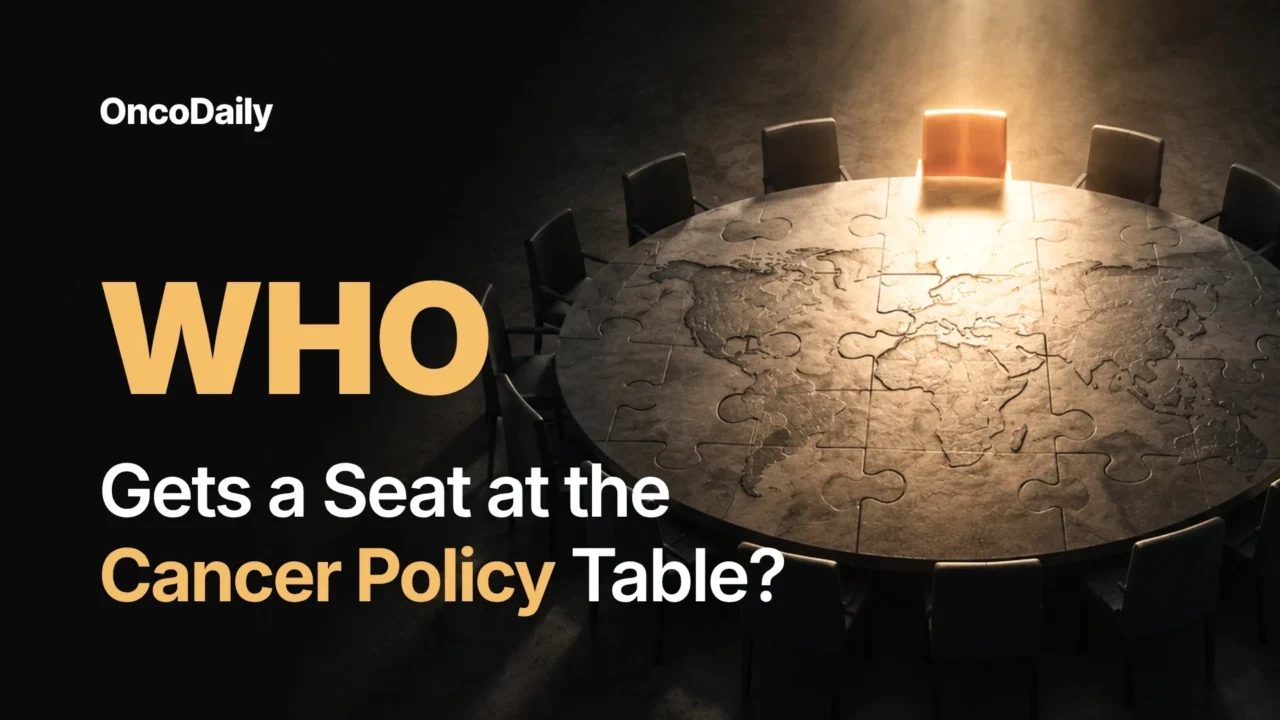
So who gets a seat at those tables?
The answer varies from country to country, but the people around the table are often remarkably similar. Cancer policies are usually developed by government officials, oncologists, surgeons, epidemiologists, public health specialists, health economists and senior healthcare administrators. Together, they decide which medicines are funded, how screening programmes operate, where specialist services are provided and how limited healthcare budgets are allocated. Their expertise is indispensable. These are complex decisions that rely on scientific evidence, economic modelling and public health data. Yet expertise does not always capture experience.
Whose Voices Are Missing?
Consider a patient whose nearest specialist center is several hours away. On paper, chemotherapy may be available to everyone. In practice, travelling for treatment every few weeks may mean taking unpaid leave, paying for fuel or accommodation, or depending on relatives for transport. A screening program may appear successful nationally while failing to reach people in remote communities.
These are realities that rarely appear in statistics alone. Cancer outcomes are shaped not only by biology but also by geography, income and social circumstances. Someone living in a major city may reach a specialist hospital within an hour. Someone in a rural area may spend an entire day travelling for treatment. Families on lower incomes often face costs that do not appear in healthcare budgets, including transport, childcare and lost earnings. Language barriers, disability and discrimination can make accessing care even more difficult for some communities.
If these experiences are absent from policy discussions, decisions risk reflecting the needs of those who already face the fewest barriers while overlooking those with the greatest challenges.
This does not mean patients should make policy instead of doctors or scientists. Rather, it recognizes that different forms of expertise belong around the same table. Researchers understand clinical evidence. Policymakers understand how health systems operate. Patients understand what those systems are actually like to navigate. Their experiences can expose problems that data alone may overlook.
That is why the World Health Organization has increasingly argued that health systems should be designed with patients, not simply for them. In 2024, WHO Member States reinforced that principle by adopting a resolution calling for “regular and meaningful social participation” in health decision-making, recognizing that people affected by disease should help shape policies rather than simply respond to them after decisions have already been made.
How does this work in practice?
One of the clearest examples of this approach can be found in England. The National Institute for Health and Care Excellence (NICE), the independent body that develops guidance for the NHS in England, makes recommendations on new medicines and health technologies through four independent Technology Appraisal Committees. Members are appointed through an open recruitment process for three-year terms and come from a range of backgrounds, including the NHS, academia, life sciences and pharmaceutical industries, as well as patient and caregiver organizations. Although the committees seek evidence from healthcare professionals, manufacturers, government bodies, patients and caregivers, their recommendations are made independently.
Patients are not simply consulted after decisions have been drafted. NICE requires all of its advisory committees to include at least two lay members—patients, caregivers or members of the public who contribute alongside clinicians, researchers and health economists. Their role is to point out issues that clinical trials and economic models cannot fully capture, from the day-to-day impact of treatment to the practical challenges of navigating the healthcare system.
NICE argues that involving patients makes its guidance more relevant to the people most affected by its recommendations.
The idea is spreading beyond England. In Australia, Cancer Australia has made consumer involvement a central part of national cancer control. People affected by cancer are encouraged to contribute not only to improving services, but also to shaping research, policy and strategic planning. The aim is simple: decisions are stronger when they are informed by both professional expertise and the experiences of those living with the disease.
Norway has taken a different route. Its national cancer strategy places growing emphasis on patient-centered care, encouraging shared decision-making between patients and healthcare professionals and using patients’ experiences to improve the quality of cancer services.
Beyond a Seat at the Table
Patients are sometimes invited onto advisory panels or asked to complete consultations after key decisions have already been made. In health policy, this is often described as tokenism, which means offering people a seat at the table without giving them meaningful influence over the conversation.
Genuine participation looks different. It means involving patients from the outset: identifying priorities, shaping policies and helping evaluate whether those policies improve people’s lives in practice, not just in theory. Patient advocates often summarize this idea in a single phrase: “Nothing about us without us.” Originally associated with the disability rights movement, it has become a guiding principle for many health organizations seeking more inclusive decision-making.
The argument is becoming more important as cancer care evolves. Advances in diagnosis and treatment mean that more people are living with and beyond cancer in many countries. As survival improves, policy is no longer concerned solely with treating disease. It must also address rehabilitation, mental health, returning to work and the long-term quality of life of survivors.
Building Better Cancer Policy
Building better cancer policy does not mean replacing scientific expertise with personal experience. It means recognising that good policy depends on both. Clinical evidence shows what works. Patients reveal whether those solutions work in everyday life, whether they reach the people who need them most and what barriers still remain.
Cancer policy will always depend on science, evidence and difficult choices about limited resources. But if those choices are meant to improve people’s lives, perhaps the people living those lives should have more than a token place in the conversation.
Written By Evelina Khachaturova