
The last week of July brought together important updates across GU Oncology, with expert posts covering prostate cancer, bladder cancer, urothelial carcinoma, renal cell carcinoma, metastatic hormone-sensitive prostate cancer, muscle-invasive bladder cancer, non-muscle-invasive bladder cancer, and radiotherapy.
This week’s selection includes updates on adaptive salvage radiotherapy in prostate cancer, cystectomy-sparing strategies in muscle-invasive bladder cancer, cretostimogene for BCG-unresponsive non-muscle-invasive bladder cancer, induction ipilimumab plus nivolumab followed by chemoradiotherapy in stage II/III MIBC, and real-world platinum chemotherapy outcomes in the post-EVP era.
Other posts highlight FDA approval of Pluvicto in PSMA-positive metastatic hormone-sensitive prostate cancer, surgical management of PSMA PET-positive nodal disease, WHO/ISUP grading in renal cell carcinoma, whole-pelvic SBRT versus conventional IMRT in high-risk localized prostate cancer, and current evidence and practice considerations for antibody-drug conjugates in urothelial carcinoma.
Together, these posts reflect the continued evolution of GU oncology across bladder preservation, radioligand therapy, molecular imaging, radiation oncology, pathology, antibody-drug conjugates, real-world evidence, and multimodal treatment strategies.
Luca Nicosia — Associate Professor at the University of Brescia; Staff Physician, Department of Advanced Radiation Oncology, Ospedale Sacro Cuore Don Calabria | Italy
“New paper out in Clinical and Translational Radiation Oncology.
Excited to share early results from DART-PHASER, a prospective clinical trial on daily adaptive salvage radiotherapy in prostate cancer, using 55–59 Gy in 20 fractions with Ethos.
The Ethos system generates two plans every day: a scheduled plan, with dose recalculated on the daily CT, and an AI-adapted plan, fully reoptimized on the daily anatomy. The clinician then selects the best plan before treatment.
Across the first 840 fractions in 42 patients, the adapted plan was chosen 837 out of 840 times.
Key findings:
• Better target coverage: prostate bed PTV V95% was 98.5% with the adapted plan versus 92.1% with the scheduled plan
• Better rectal sparing: V52.8 Gy was 12.8% versus 16.9%; mean dose per fraction was 1.42 versus 1.54 Gy
By comparing both plans against the approved offline reference plan, the scheduled plan showed a systematic bias of –7.5% for target coverage and +5.4% for rectal V52.8 Gy versus the reference.
The adapted plan essentially restored agreement with the reference, with bias around 0% and up to 6 times less variability, confirming that daily adaptation helps keep treatment on target day after day.
On safety, there were no grade ≥3 side effects. End-of-treatment grade 2 gastrointestinal and genitourinary side effects remained low, and pelvic nodal irradiation was the only factor associated with diarrhea.
These are encouraging early data for AI-driven daily adaptation in postoperative salvage radiotherapy. Longer follow-up is needed for the safety primary endpoint.
Proud of the whole team at the Advanced Radiation Oncology Department, IRCCS Sacro Cuore Don Calabria, for making this happen.”
Andrea Necchi, MD, FASCO — Director of the Strategic Program of Research in Genitourinary Tumors | Italy
“Cystectomy can be spared in selected patients with muscle-invasive bladder cancer and complete response following neoadjuvant therapy.”
James Burke —MD, Chief Medical Officer at KaliVir Immunotherapeutics | United States
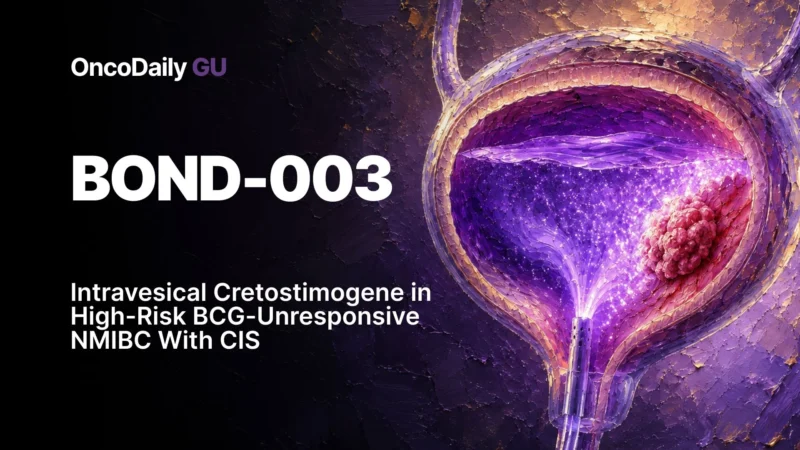
“Excited to share the publication of BOND-003, a phase 3 study of cretostimogene, also known as CG0070, for the treatment of BCG-unresponsive non-muscle-invasive bladder cancer.
As published in The Lancet Oncology, the primary endpoint of complete response rate was 75%. This was further supported by a duration of response of at least 27.9 months, which had not been reached at the time of publication, a low rate of progression to muscle-invasive disease at 3.6%, and a high rate of bladder preservation at 81% at 24 months.
Intravesical administration also proved quite tolerable, with the most common adverse events being transient grade 1–2 urinary frequency, urgency, and bladder spasm, and no grade 3 or higher adverse events related to cretostimogene.
In total, the study provides the basis for a new standard of care for BCG-unresponsive NMIBC and represents highly encouraging data for an oncolytic virus.
I am very grateful to have had the opportunity to lead the clinical program from first-in-human studies to pivotal phase 3 registration-directed studies.
Congratulations and thanks to our academic partners who believed in the therapeutic potential of this agent, in particular Drs Li, Uchio, Tyson, Lamm, and Steinberg, who contributed significantly not only to patient enrollment and treatment but also intellectually to the design and analysis of the study.
Thanks also to the entire team at CG Oncology, and most of all to the patients and their families who entrusted us with their care.
We look forward to final BLA submission in Q4 of this year and potential FDA approval thereafter.”
Enrique Grande — Medical Oncologist; Director of the Cancer Program at Quirónsalud Madrid | Spain
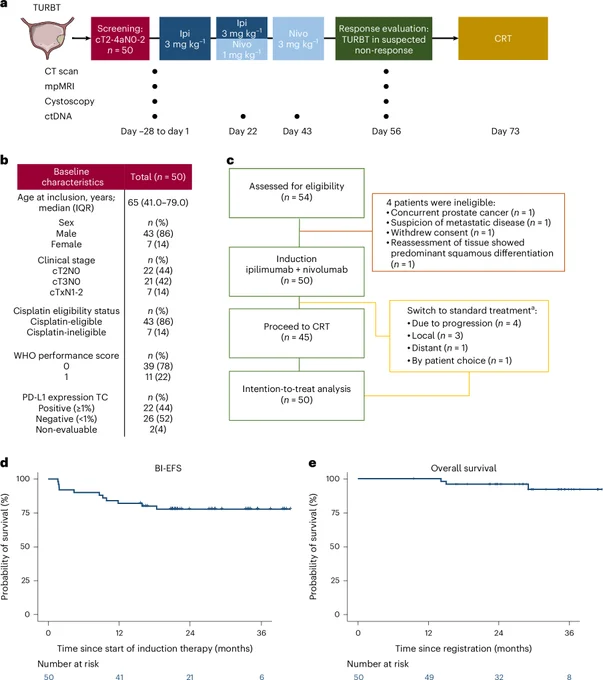
“INDIBLADE: ipilimumab plus nivolumab induction followed by chemoradiotherapy in stage II/III muscle-invasive bladder cancer.
The study included 50 patients.
Key findings:
• 2-year bladder-intact EFS: 78%
• 2-year OS: 96%
• ctDNA clearance after induction was a strong predictor of bladder-intact EFS, with HR 8.3”
Sara Coca Membribes — Medical Oncologist; GU Oncology Clinical Research Fellow at Barts Cancer Institute | United Kingdom
“Important real-world data in the emerging post-EVP era: ORR was 49% with platinum chemotherapy, published in ESMO Open.
A total of 74% of patients received carboplatin with similar outcomes, which is reassuring given that post-EV neuropathy may limit cisplatin use.
Avelumab was used in 20% of patients, and prospective trials are testing ICI rechallenge.”
Jack Shuang Hou — Biotech Executive; Diagnostics Executive; Oncology, AI-Biology and IVD Commercialization | United States
“Novartis announced that the FDA has approved Pluvicto, lutetium Lu 177 vipivotide tetraxetan, in combination with androgen deprivation therapy and an androgen receptor pathway inhibitor for PSMA-positive metastatic hormone-sensitive prostate cancer.
The approval expands Pluvicto across PSMA-positive metastatic prostate cancer and brings radioligand therapy earlier in the disease journey.
The approval is supported by the phase 3 PSMAddition trial. Pluvicto plus standard of care reduced the risk of progression or death by 28% at the primary analysis, with HR 0.72, improving to a 33% reduction in the updated analysis, with HR 0.67, while showing a positive overall survival trend, with HR 0.80, as follow-up continues.
Introducing PSMA-targeted radioligand therapy earlier represents an important shift toward precision treatment before resistance develops.
With multiple U.S. radioligand manufacturing sites operational or under construction, Novartis has built infrastructure to support broader delivery and growing clinical demand.
This approval represents more than a label expansion. It signals that radioligand therapy is moving from late-line rescue treatment toward frontline precision oncology.
As PSMA imaging, targeted radionuclides, and manufacturing capacity continue to mature, radiopharmaceuticals are rapidly becoming a foundational pillar alongside surgery, systemic therapy, and immunotherapy in solid tumor care.”
Andrea Cosenza — MD; Urology Resident at Ospedale San Raffaele | Italy
“I am pleased to share our new paper, published in Current Urology Reports.
We summarize the current evidence on the surgical management of PSMA PET-positive nodal disease at primary staging and discuss which patients might still be considered for surgery.
Importantly, miN1 disease should not automatically preclude surgery.
PSMA PET findings should instead be integrated with other clinical and disease features to guide surgical selection within multimodal care.
Grateful to all coauthors for the collaboration.”
Liang Cheng — Vice Chair; Professor of Pathology and Surgery (Urology); Director of Anatomic Pathology and Molecular Pathology at Warren Alpert Medical School of Brown University; Associate Director at Legorreta Cancer Center | United States
“How should renal cell carcinoma be graded using the World Health Organization/International Society of Urological Pathology grading system?
A recent publication in Histopathology by Drs. Gladell Paner, Mahul B. Amin, Jung Woo Kwon, and Holger Moch provides a comprehensive and timely review of this important topic.
The review summarizes the validation, practical application, and ongoing controversies surrounding the WHO/ISUP grading system for clear cell and papillary renal cell carcinoma.
Key topics include intratumoral grade heterogeneity, interpretation of multinucleated cells, spindle cell and sarcomatoid differentiation, rhabdoid change, grading in needle biopsies and multifocal tumors, and challenges specific to papillary renal cell carcinoma.
The review also examines emerging evidence supporting the prognostic value of reporting the extent of sarcomatoid differentiation and high-grade components, while highlighting areas that require further validation.
In addition, the review explores innovative grading strategies, including incorporation of tumor necrosis into grading and novel architecture- and pattern-based risk assessment models, which may further improve prognostic stratification beyond the current WHO/ISUP system.
Importantly, the authors provide practical guidance for surgical pathologists while identifying key knowledge gaps that will help shape future research and further refine renal tumor grading.”
Darren Poon — Associate Director for Comprehensive Oncology Center, Hong Kong Sanatorium & Hospital | Honorary Clinical Associate Professor, The Chinese University of Hong Kong | GU Oncologist | Hong Kong
“Hot off the press in the Red Journal, IJROBP.
I am delighted to share the publication of our randomized phase 2 SRAM trial evaluating whole-pelvic stereotactic body radiotherapy versus conventional IMRT for high-risk localized prostate cancer.
‘Acute Toxicity and Quality of Life With Stereotactic Body Radiation Therapy Versus Conventional Fractionated Intensity Modulated Radiation Therapy to the Prostate and Pelvis in High-Risk Prostate Cancer: A Randomized Phase 2 Trial.’
This is, to our knowledge, the first randomized trial directly comparing pelvis-inclusive SBRT with conventional IMRT in men with high-risk prostate cancer, addressing a long-standing evidence gap beyond prostate-only SBRT.
Key findings:
• Grade ≥2 GI toxicity: 8.3% with SBRT vs 39.0% with IMRT; p<0.0001
• Grade ≥2 GU toxicity: 23.3% vs 36.1%
• Better early patient-reported quality of life, with less deterioration in bowel and urinary symptoms during treatment
• Faster recovery in the acute phase, supported by both EPIC and IPSS patient-reported outcomes
Whole-pelvic radiotherapy remains an important component of treatment for many men with high-risk prostate cancer, yet concerns regarding toxicity have limited wider adoption of ultrahypofractionation.
Our findings demonstrate that once-weekly 5-fraction whole-pelvic SBRT is feasible and may substantially reduce acute gastrointestinal toxicity while maintaining comparable genitourinary safety, with the added advantages of improved patient convenience and a dramatically shorter treatment course.
Together with the recently reported PACE-NODES and PRIME phase 3 studies, the accumulating evidence strongly suggests that pelvis-inclusive SBRT is rapidly emerging as a future direction for radiotherapy in high-risk prostate cancer.
The ongoing maturation of oncologic outcomes and long-term toxicity data will further define its role in future standards of care.
This work would not have been possible without the tremendous dedication of our patients, research team, radiation therapists, physicists, nurses, collaborators, and co-investigators. Thank you to everyone who contributed to this journey.”
Shilpa Gupta — GU Oncologist and Clinical Trialist at Cleveland Clinic | United States
“Delighted to share our latest review in JCO Oncology Practice on current evidence and practice considerations for antibody-drug conjugates in urothelial carcinoma, in a truly explosive novel ADC era.
Congratulations to Samer Salem and Kainat Warraich on leading this work.”

Find out 10 Must-Read Posts in GU Oncology from the third week of July on OncoDaily.