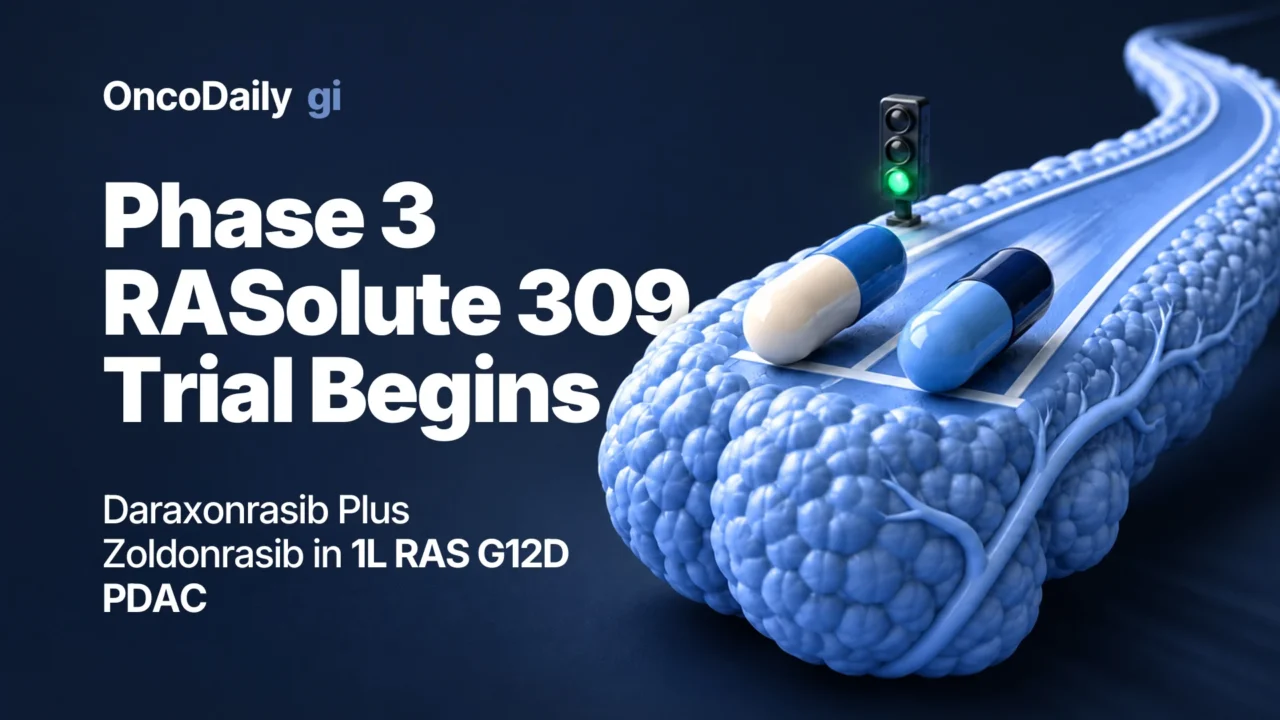
On October 5, 2026, Revolution Medicines announced that it had begun treating patients in RASolute 309 (NCT07805954), a global Phase 3 clinical trial evaluating RASONQUE (daraxonrasib) plus zoldonrasib as first-line treatment for adults with metastatic RAS G12D pancreatic adenocarcinoma (PDAC).
The study is comparing the RAS(ON) inhibitor doublet with gemcitabine plus nab-paclitaxel in patients with metastatic disease harboring the RAS G12D alteration.
Alan Sandler, MD, Chief Development Officer of Revolution Medicines, said:
“RAS G12D is the most common RAS variant in PDAC. In preclinical studies, the combination of RAS(ON) multi-selective and G12D-selective inhibitors achieved deeper and more sustained suppression of RAS signaling than either agent alone, accompanied by greater tumor control. Likewise, initial clinical data showed that RASONQUE plus zoldonrasib delivered compelling antitumor activity in patients with previously treated metastatic PDAC, with a manageable safety and tolerability profile. In the context of the unmet need in this patient population, these findings informed the design of the first-line RASolute 309 trial in patients with PDAC. RASolute 309 is the first Phase 3 study evaluating a RAS(ON) inhibitor doublet approach and it marks an important milestone in our efforts to advance a range of potential treatment options for patients with RAS-driven cancers across tumor types and treatment settings.”
RASolute 309 Study Design and Methods
RASolute 309 (NCT07805954) is a global, randomized, open-label Phase 3 clinical trial evaluating RASONQUE plus zoldonrasib versus gemcitabine and nab-paclitaxel as first-line treatment in adults with metastatic RAS G12D PDAC.
The trial has two primary endpoints:
- Progression-free survival
- Overall survival
Key secondary endpoints include progression-free survival, objective response rate, duration of response, safety and tolerability, pharmacokinetics, and patient-reported outcomes. According to Alan Sandler, MD, RASolute 309 is the first Phase 3 study evaluating a RAS(ON) inhibitor doublet approach.
Why Combine RASONQUE and Zoldonrasib?
The combination is designed to pair a RAS(ON) multi-selective inhibitor with a RAS(ON) G12D-selective inhibitor. According to Revolution Medicines, preclinical studies showed that combining the two approaches resulted in deeper and more sustained suppression of RAS signaling than either agent alone and was accompanied by greater tumor control.
The company also reported that initial clinical data with RASONQUE plus zoldonrasib showed antitumor activity in previously treated metastatic PDAC with what it described as a manageable safety and tolerability profile. These findings contributed to the development of the first-line RASolute 309 study.
Zoldonrasib and RAS G12D Targeting
Zoldonrasib is an investigational, oral, RAS(ON) G12D-selective covalent tri-complex inhibitor. The drug binds to cyclophilin A, creating a binary complex that subsequently binds to and inhibits the active oncogenic RAS(ON) G12D protein.
RAS G12D represents the most prevalent RAS mutation across RAS-driven cancers, accounting for approximately 29% of these cancers, according to data cited by Revolution Medicines. Approximately 61,000 new patients with RAS G12D cancers are estimated each year in the United States. No targeted therapy is currently approved specifically for patients with RAS G12D cancers.
Zoldonrasib is being evaluated both as monotherapy and in combination with other treatments, including RASONQUE and standard-of-care regimens in lung and gastrointestinal cancers.
RAS G12D in Pancreatic Cancer
Pancreatic adenocarcinoma remains one of the most challenging malignancies to treat. According to Revolution Medicines, approximately 55,000 people are diagnosed with PDAC in the United States each year, while more than 50,000 die from the disease.
Because early-stage pancreatic cancer can cause few or no symptoms, approximately 80% of patients are diagnosed after the cancer has spread, when therapeutic options are more limited. The five-year relative survival rate for patients with metastatic PDAC is approximately 3% in the United States.
RAS alterations are central to the biology of pancreatic adenocarcinoma, and RAS G12D is the most prevalent RAS mutation subtype in PDAC, occurring in approximately 40% of patients.
Daraxonrasib Development in Metastatic PDAC
RASONQUE (daraxonrasib) is an oral, RAS(ON) multi-selective, noncovalent tri-complex inhibitor. In the United States, RASONQUE is FDA-approved for the treatment of adults with metastatic pancreatic adenocarcinoma who have received at least one prior systemic therapy or who are not candidates for multiagent systemic therapy. The drug is also being evaluated through a global Phase 3 registrational program in patients with PDAC and metastatic RAS-mutant non-small cell lung cancer.
From RASolute 302 to RASolute 309
The Phase 3 RASolute 302 trial (NCT06625320) evaluated daraxonrasib against investigator’s choice of chemotherapy in patients with previously treated metastatic PDAC.
Among patients with RAS G12-mutated tumors, median overall survival was 13.2 months with daraxonrasib versus 6.6 months with chemotherapy (HR 0.40). Median progression-free survival was 7.3 versus 3.5 months, while the confirmed objective response rate was 33.2% versus 11.8%, respectively.
Daraxonrasib also significantly delayed deterioration in cancer-related pain and global health status/quality of life compared with chemotherapy.
FDA Approval of RASONQUE
On August 26, 2026, the FDA approved RASONQUE for adults with metastatic pancreatic adenocarcinoma who had received at least one prior systemic therapy or were not candidates for multiagent systemic therapy, making it the first RAS-targeted therapy approved for pancreatic cancer. Outside the United States, RASONQUE remains investigational and has not been approved by any regulatory authority.

ESMO Guideline Recommendation
The clinical development of daraxonrasib has also been reflected in treatment guidelines. On August 19, 2026, ESMO published an Express Update to its Clinical Practice Guideline for pancreatic cancer in Annals of Oncology, incorporating the RASolute 302 findings into recommendations for metastatic PDAC.
ESMO recommends tumor molecular profiling at diagnosis in all patients with unresectable PDAC to identify clinically actionable alterations, including RAS G12 mutations [II, A; ESCAT I-A]. Based on the RASolute 302 results, the guideline also recommends daraxonrasib monotherapy after failure of chemotherapy in previously treated patients with RAS G12-mutated tumors and ECOG performance status 0–1 [I, A].
The recommendation was published one week before the FDA approved RASONQUE on August 26, 2026, for adults with metastatic pancreatic adenocarcinoma who had received at least one prior systemic therapy or were not candidates for multiagent systemic therapy.
Moving Into First-Line Treatment
RASolute 309 now extends the development of daraxonrasib into the first-line metastatic setting, combining the RAS(ON) multi-selective inhibitor with the RAS G12D-selective inhibitor zoldonrasib in adults with metastatic RAS G12D PDAC. The study is comparing the combination with gemcitabine plus nab-paclitaxel, with progression-free survival and overall survival as the dual primary endpoints.
Conclusion
Revolution Medicines has begun treating patients in RASolute 309, a global randomized Phase 3 study evaluating RASONQUE plus zoldonrasib versus gemcitabine and nab-paclitaxel as first-line treatment for metastatic RAS G12D pancreatic adenocarcinoma. The trial will evaluate progression-free survival and overall survival as dual primary endpoints in this molecularly defined patient population. RASolute 309 is the first Phase 3 trial evaluating a RAS(ON) inhibitor doublet approach and represents the next stage of clinical development for RASONQUE plus zoldonrasib in metastatic RAS G12D PDAC.
The full announcement is available from Revolution Medicines.

Find more videos on OncoDaily YouTube TV.