






Key takeaways
- The FDA granted Priority Review to RYBREVANT FASPRO for previously treated recurrent or metastatic head and neck squamous cell carcinoma.
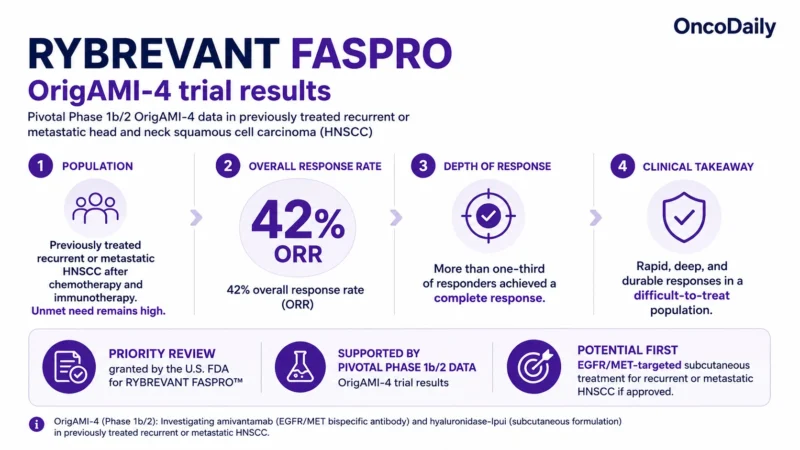
- The Phase 1b/2 OrigAMI-4 study reported a 42% overall response rate, with more than one-third of responders achieving a complete response.
- If approved, RYBREVANT FASPRO could become the first EGFR/MET-targeted subcutaneous treatment for recurrent or metastatic HNSCC.
Johnson & Johnson announced on July 30, 2026, that the US Food and Drug Administration granted Priority Review to a supplemental Biologics License Application for RYBREVANT FASPRO—amivantamab and hyaluronidase-lpuj—in adults with recurrent or metastatic head and neck squamous cell carcinoma.
The proposed indication covers patients whose disease has progressed after platinum-based chemotherapy and treatment with a PD-1 or PD-L1 inhibitor.
If approved, RYBREVANT FASPRO would introduce a subcutaneous dual-targeted treatment in this post-platinum, post-immunotherapy setting. The therapy targets EGFR and MET, two pathways associated with tumor growth and treatment resistance in head and neck cancer.
Why This Priority Review Matters
Treatment options remain limited for patients with recurrent or metastatic head and neck squamous cell carcinoma whose disease progresses after chemotherapy and immunotherapy.
Priority Review is granted to applications for therapies that may offer meaningful improvements in the treatment of serious conditions and generally shortens the regulatory review period. However, Priority Review does not mean that the therapy has been approved.
RYBREVANT FASPRO therefore remains investigational for recurrent or metastatic head and neck squamous cell carcinoma while the application undergoes regulatory assessment.
OrigAMI-4 Trial Supports the Application
The regulatory application is supported by results from the pivotal Phase 1b/2 OrigAMI-4 trial, NCT06385080, which evaluated subcutaneous amivantamab in patients with previously treated recurrent or metastatic head and neck squamous cell carcinoma.
In the monotherapy cohort, patients had previously received platinum-based chemotherapy and PD-1 or PD-L1 immunotherapy. Patients with HPV-associated oropharyngeal squamous cell carcinoma and those previously treated with an anti-EGFR therapy were excluded.
The study reported:
- An overall response rate of 42%
- Complete responses in more than one-third of responding patients
- Rapid, deep, and durable responses in a population with limited treatment options
The findings were presented at the 2026 American Society of Clinical Oncology Annual Meeting and published in the Journal of Clinical Oncology.
Read more: Explore amivantamab in recurrent or metastatic head and neck cancer after immunotherapy and chemotherapy on OncoDaily.
How Does RYBREVANT FASPRO Work?
RYBREVANT FASPRO combines amivantamab, a bispecific antibody targeting EGFR and MET, with hyaluronidase-lpuj to permit subcutaneous administration.
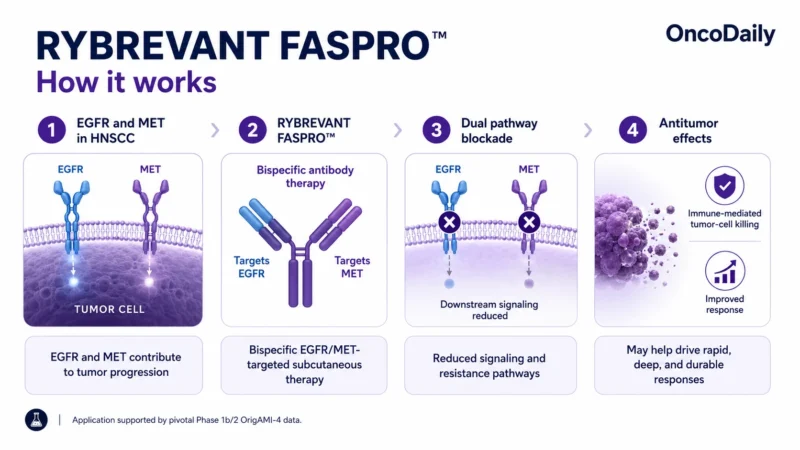
EGFR and MET overexpression is reported in a large proportion of head and neck squamous cell carcinomas and may contribute to tumor progression, treatment resistance, and poor clinical outcomes. By targeting both pathways and engaging immune-effector mechanisms, amivantamab is intended to directly inhibit cancer-cell signaling while supporting immune-mediated tumor-cell elimination.
How Was RYBREVANT FASPRO Administered?
In the OrigAMI-4 monotherapy cohort, RYBREVANT FASPRO was administered subcutaneously using weight-based dosing.
Patients received treatment weekly during the initial treatment period, followed by administration once every three weeks. The study’s primary endpoint was investigator-assessed objective response rate according to RECIST version 1.1.
What Remains Under Review
Although the response findings are encouraging, the regulatory review will determine whether the complete efficacy and safety evidence supports expanding the indication to recurrent or metastatic head and neck squamous cell carcinoma.
Important considerations include:
- Durability of response
- Overall safety and tolerability
- The balance between benefit and treatment-related risks
- The therapy’s potential role within the current treatment sequence
- Whether the available evidence is sufficient to support approval
The information currently available demonstrates clinical activity, but it does not establish that RYBREVANT FASPRO should become a standard treatment in this setting.
Current Approval Status
RYBREVANT FASPRO is already approved in multiple countries for selected indications involving EGFR-mutated non-small cell lung cancer.
Its use in recurrent or metastatic head and neck squamous cell carcinoma remains investigational and has not yet been approved.
The Bottom Line
The Priority Review for RYBREVANT FASPRO represents an important regulatory step for a potential new treatment option in recurrent or metastatic head and neck squamous cell carcinoma after platinum-based chemotherapy and PD-1 or PD-L1 inhibitor therapy.
The Phase 1b/2 OrigAMI-4 study reported notable antitumor activity, including a 42% overall response rate and complete responses in more than one-third of responding patients.
However, Priority Review is not approval. The regulatory decision will determine whether the efficacy, durability, and safety findings support introducing subcutaneous dual EGFR/MET targeting into clinical practice for this difficult-to-treat population.
Watch more: Explore recent treatment advances in head and neck cancer in Advances in Head and Neck Cancer with Dr. Paolo Bossi by OncoDaily.
Mirna Antabian, MD