
Key takeaways
- NBTXR3, also called JNJ-1900, is an investigational hafnium oxide nanoparticle radioenhancer.
- It is administered as a single injection directly into the tumor before radiotherapy.
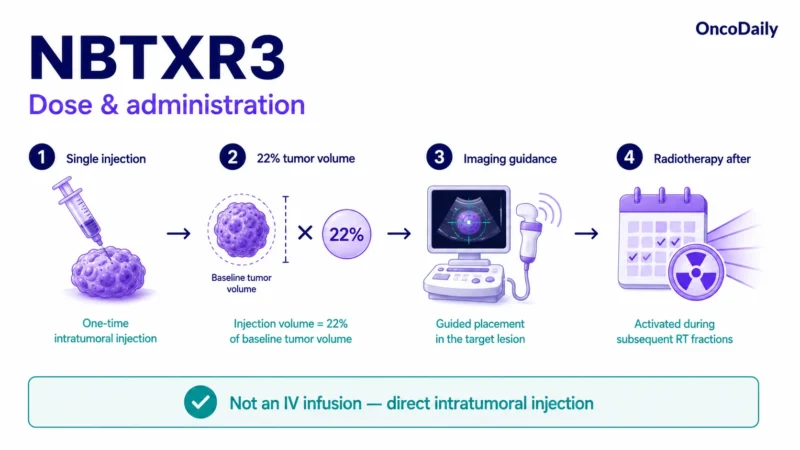
- The dose is calculated by tumor volume; the head and neck cancer program used an injection volume equal to 22% of the baseline tumor volume.
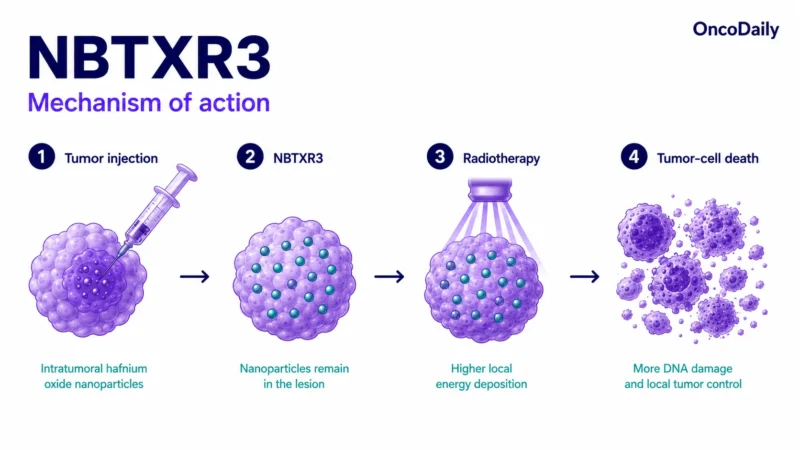
- When activated by ionizing radiation, NBTXR3 increases local energy deposition and DNA damage without increasing the prescribed radiation dose.
- Early head and neck cancer data showed encouraging tumor responses, but the study was nonrandomized and did not establish definitive benefit.
- The Phase 3 NANORAY-312 study is evaluating whether NBTXR3 improves outcomes in older, platinum-ineligible patients with locally advanced head and neck cancer.
- NBTXR3 remains investigational and is not approved by major regulatory authorities.
NBTXR3, also called JNJ-1900, is an investigational hafnium oxide nanoparticle radioenhancer designed to increase the effect of radiotherapy inside an injected tumor.
Unlike conventional systemic anticancer drugs, NBTXR3 is administered directly into the tumor through a single intratumoral injection. It is not FDA- or EMA-approved. Its leading program is the Phase 3 NANORAY-312 study in older, platinum-ineligible patients with locally advanced head and neck squamous cell carcinoma.
What Is NBTXR3?
NBTXR3 is a sterile suspension of functionalized crystalline hafnium oxide nanoparticles administered directly into a tumor before radiotherapy.
Hafnium has a strong capacity to absorb ionizing radiation. When radiotherapy reaches the injected nanoparticles, they increase the amount of energy deposited locally inside tumor cells. This produces additional DNA damage and cancer-cell death without increasing the prescribed radiation dose.
NBTXR3 does not target a specific mutation or biological receptor. Its activity depends mainly on:
- Successful distribution within the tumor
- Subsequent exposure to ionizing radiation
- Retention of the nanoparticles in the injected lesion
The product has also been referred to as Hensify, NBTXR3, and JNJ-90301900/JNJ-1900 in different development settings.
What Is The Dose Of NBTXR3?
The recommended dose used in the head and neck cancer expansion program was:
A single intratumoral injection with a volume equal to 22% of the estimated baseline tumor volume.
The required injection volume is therefore calculated individually from radiologic measurement of the target lesion rather than from body weight or body-surface area.
For example, a tumor with an estimated volume of 20 mL would correspond to an NBTXR3 injection volume of approximately 4.4 mL. This is only an illustration of the volume-based calculation; actual preparation and administration must follow the clinical-trial protocol.
How Is NBTXR3 Administered?
NBTXR3 is administered as a one-time intratumoral injection, not as an intravenous infusion.
The injection is performed directly into the selected primary tumor or metastatic lesion, generally with imaging guidance when required by the tumor location. Administration may involve ultrasound, CT, fluoroscopic, endoscopic, or other interventional guidance.
Radiotherapy begins after a protocol-defined interval once satisfactory nanoparticle distribution has been confirmed. NBTXR3 remains within the tumor and is activated during each subsequent radiotherapy fraction.
Public sources do not provide one universal procedure for:
- Needle type and gauge
- Number of injection tracks
- Injection speed
- Local anesthesia or sedation
- Post-injection observation
- Timing between injection and radiotherapy
These details depend on tumor location, injected volume, imaging guidance, and the clinical-trial procedure manual.
Read more: Explore the consensus guidelines for optimizing intratumoral and intranodal NBTXR3 injection in head and neck cancer on OncoDaily.
Does NBTXR3 Require An In-Line Filter?
No. NBTXR3 is not administered through an intravenous infusion line, so an in-line infusion filter is not used.
The product is injected directly into the tumor. The relevant technical considerations involve suspension handling, injection equipment, imaging guidance, and intratumoral distribution rather than IV filtration.
Is Premedication Required?
No universal systemic premedication regimen has been established for NBTXR3.
Depending on the tumor site and injection procedure, patients may receive:
- Local anesthetic
- Sedation
- Analgesia
- Antibiotic prophylaxis when clinically appropriate
- Procedure-specific supportive care
Premedication is therefore related mainly to the intratumoral procedure rather than to hypersensitivity prevention for an intravenous drug.
Are Dose Reductions Used?
Traditional dose reductions are generally not used because NBTXR3 is administered as a single intratumoral injection.
If the full planned volume cannot be safely delivered, the injected volume or distribution may be modified according to the procedure and study protocol. Once NBTXR3 has been injected, subsequent management focuses on radiotherapy delivery, treatment-related toxicity, and local complications rather than repeated drug-dose reduction.
What Is Known About NBTXR3 Pharmacokinetics?
NBTXR3 acts locally and is intended to remain within the injected tumor.
Because it is an inorganic nanoparticle suspension rather than a conventional circulating small molecule, standard pharmacokinetic measures such as plasma half-life, hepatic metabolism, and cytochrome P450 interactions are less central to its clinical use.
Imaging studies have demonstrated that the nanoparticles can remain visible within injected head and neck tumors and lymph-node lesions, allowing clinicians to evaluate distribution and retention.
Are Renal Or Hepatic Dose Adjustments Required?
No conventional renal- or hepatic-impairment dose adjustment has been established.
NBTXR3 is administered locally and is not dosed according to kidney or liver function. However, organ function, comorbidities, procedural safety, suitability for radiotherapy, and eligibility for accompanying systemic therapy remain important when selecting patients.
What Did Clinical Trials Show?
A Phase 1 dose-expansion study evaluated one intratumoral injection of NBTXR3 followed by radiotherapy in older or medically vulnerable patients with locally advanced head and neck squamous cell carcinoma who were ineligible for concurrent systemic therapy.
Among 56 treated patients, NBTXR3-related treatment-emergent adverse events occurred in approximately 16%. In the response-evaluable population, the objective response rate was approximately 82% in injected primary tumors and 80% across all assessed lesions. These findings were encouraging but came from a nonrandomized early-phase study.
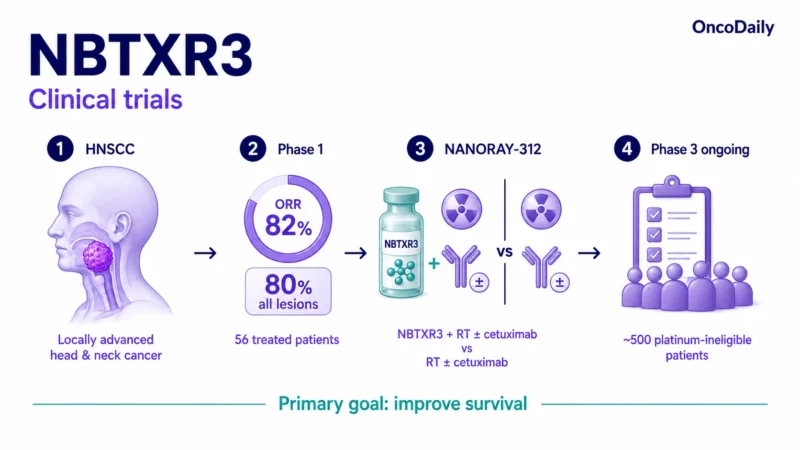
The global Phase 3 NANORAY-312 study is comparing:
- NBTXR3 plus radiotherapy, with or without cetuximab
- Radiotherapy alone, with or without cetuximab
The study focuses on older patients with untreated, locally advanced head and neck cancer who are not eligible for platinum chemotherapy. The primary objective is to determine whether adding NBTXR3 improves survival. Planned enrollment is approximately 500 patients.
NBTXR3 is also being investigated with radiotherapy and immune-checkpoint inhibitors in recurrent or metastatic head and neck cancer and in other solid tumors.
Watch more: Explore treatment developments for older patients with head and neck cancer in Head & Neck Cancer Breakthroughs in Elderly Patients by OncoDaily.
What Are The Side Effects Of NBTXR3?
Reported adverse effects and procedural complications include:
- Injection-site pain
- Local inflammation
- Tumor-site swelling
- Mucositis or stomatitis
- Dysphagia
- Fever
- Local bleeding
- Infection
- Radiotherapy-related skin and mucosal toxicity
Because NBTXR3 is administered directly into the tumor and followed by radiotherapy, it may be difficult to separate toxicity caused by the injection, the nanoparticles, the tumor location, and radiotherapy.
FAQ
Is NBTXR3 Approved?
No. NBTXR3 remains investigational. It has received FDA Fast Track designation for selected patients with locally advanced head and neck cancer, but Fast Track designation is not regulatory approval.
Is NBTXR3 Chemotherapy?
No. NBTXR3 is a nanoparticle radioenhancer activated by radiotherapy.
Is NBTXR3 An Infusion Or Injection?
NBTXR3 is administered as a single intratumoral injection directly into the tumor. It is not an intravenous infusion.
What Is The Main NBTXR3 Dose?
The recommended head and neck cancer dose is an injection volume equal to 22% of the estimated baseline tumor volume.
Does NBTXR3 Require An Infusion Filter?
No. It is injected directly into the tumor and does not use an IV infusion line.
What Cancer Is NBTXR3 Mainly Being Studied In?
Its leading Phase 3 program is in platinum-ineligible, locally advanced head and neck squamous cell carcinoma. It is also being studied in recurrent or metastatic head and neck cancer, lung cancer, and other solid tumors.