Key takeaways
- KT-333, also known as lirodegimod, is an investigational intravenous targeted protein degrader designed to remove STAT3.
- It was administered once weekly on Days 1, 8, 15, and 22 of each 28-day cycle.
- Phase 1 testing showed substantial STAT3 degradation in blood and tumor tissue.
- Early clinical responses included complete responses in classical Hodgkin lymphoma and STAT3-mutated natural killer-cell lymphoma, as well as partial responses in cutaneous T-cell lymphoma.
- The main reported adverse effects included stomatitis, fatigue, nausea, constipation, and arthralgia.
- No approved dose, commercial dose-reduction schedule, or renal or hepatic adjustment guidance was established.
- KT-333 is not approved, and further development beyond Phase 1 was not pursued without a partner.
KT-333 is an investigational targeted protein degrader designed to eliminate signal transducer and activator of transcription 3, or STAT3. It was studied in relapsed or refractory lymphomas, leukemias, and advanced solid tumors.
KT-333 is not approved by the US Food and Drug Administration or European Medicines Agency. Kymera Therapeutics completed enrollment and dose escalation in its Phase 1 study but decided not to continue the program beyond Phase 1 without a development partner.
What Is KT-333?
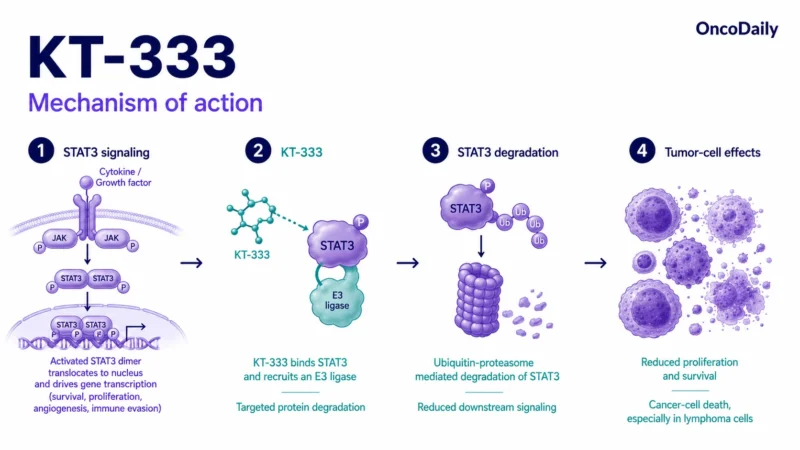
KT-333 is a first-in-class, intravenous heterobifunctional small molecule designed to selectively degrade STAT3.
STAT3 is a transcription factor involved in cancer-cell proliferation, survival, immune evasion, and inflammatory signaling. Persistent STAT3 activation occurs in several hematologic malignancies, particularly cutaneous T-cell lymphoma, peripheral T-cell lymphoma, natural killer-cell lymphoma, and classical Hodgkin lymphoma.
KT-333 simultaneously binds STAT3 and the von Hippel–Lindau E3 ubiquitin ligase. This interaction marks STAT3 for destruction through the ubiquitin–proteasome system rather than temporarily inhibiting its activity. Reduction of STAT3 also suppresses downstream JAK–STAT signaling and STAT3-regulated genes.
KT-333 has also been referred to as lirodegimod.
What Is The Dose Of KT-333?
No approved or recommended Phase 2 dose was established.
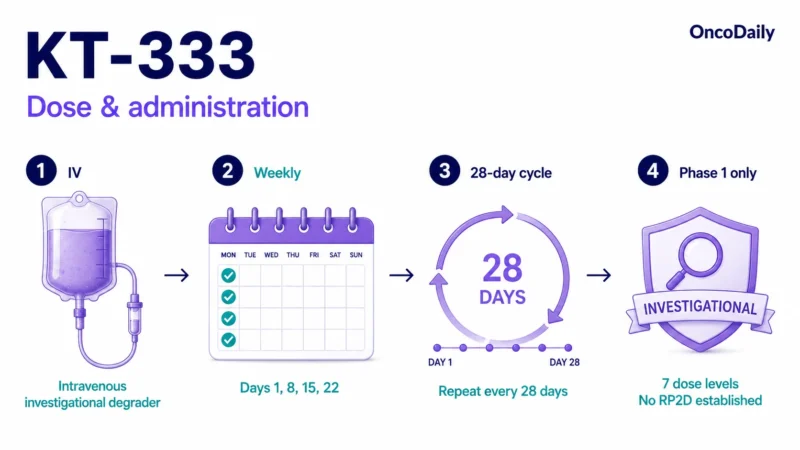
The Phase 1 study evaluated seven escalating dose levels, but the numerical doses assigned to each level were not consistently disclosed in public trial reports.
KT-333 was administered:
Intravenously once weekly on Days 1, 8, 15, and 22 of each 28-day cycle.
The study evaluated increasing exposure, STAT3 degradation, safety, pharmacokinetics, and preliminary antitumor activity. These were investigational regimens rather than approved dosing recommendations.
How Is KT-333 Administered?
KT-333 is administered intravenously in a clinical-trial setting.
Treatment was given once weekly during each 28-day cycle. Publicly available reports do not consistently provide:
- Infusion duration
- Required dilution solution
- Final infusion concentration
- Administration order
- Line-flushing procedure
- Storage limits after preparation
These details were governed by the clinical-trial protocol and investigational pharmacy manual.
Does KT-333 Require An In-Line Filter?
A universal in-line filtration requirement has not been publicly reported for KT-333.
Available abstracts and company disclosures do not identify a required filter type or pore size. Investigational sites were required to follow the study-specific pharmacy and administration instructions.
Is Premedication Required?
No standardized KT-333-specific premedication regimen has been publicly established.
Supportive medicines could be used according to individual symptoms, previous reactions, and protocol requirements. Public reports do not describe mandatory routine antihistamine, corticosteroid, or antipyretic premedication before every dose.
Are Dose Reductions Used?
The Phase 1 protocol used dose escalation to evaluate safety and tolerability across several dose levels.
Treatment interruption, dose modification, or discontinuation could be considered for clinically significant adverse events, including:
- Stomatitis
- Fatigue
- Arthralgia
- Nausea
- Serious nonhematologic toxicity
- Infusion-related or systemic reactions
Public reports do not provide a standardized commercial dose-reduction schedule because KT-333 was never approved.
What Is Known About KT-333 Pharmacokinetics?
KT-333 exposure increased with increasing dose.
In the Phase 1 trial, plasma concentrations approached exposure levels predicted to produce antitumor activity. Once-weekly administration was supported by the depth and duration of STAT3 degradation observed in blood and tumor tissue.
KT-333 achieved:
- Mean maximum STAT3 degradation ranging from approximately 70% at the lowest dose level to 95% at the highest
- Maximum degradation of up to 97.5% in peripheral blood mononuclear cells
- STAT3 reduction of up to 91% in cutaneous T-cell lymphoma biopsies
- Phosphorylated STAT3 reduction of up to 99% in tumor biopsies
Complete public values for terminal half-life, clearance, volume of distribution, metabolism, and elimination remain limited.
Are Renal Or Hepatic Dose Adjustments Required?
No validated renal- or hepatic-impairment dose recommendations have been established.
The Phase 1 study generally required adequate kidney, liver, and bone-marrow function. Patients with substantial organ impairment were not sufficiently represented to establish a safe dose-adjustment strategy.
What Did Clinical Trials Show?
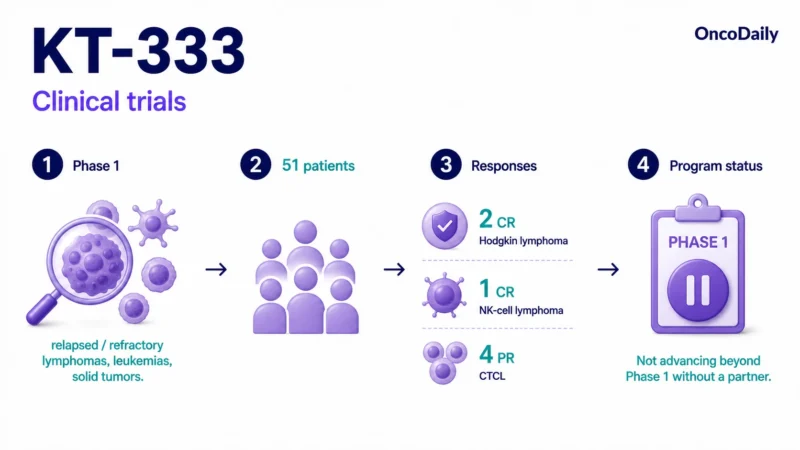
The Phase 1 NCT05225584 study evaluated KT-333 in adults with relapsed or refractory lymphomas, leukemias, and solid tumors.
As of July 2024, 51 patients had received KT-333 across seven dose levels.
Reported responses included:
- Two complete responses in classical Hodgkin lymphoma
- One complete response in STAT3-mutated natural killer-cell lymphoma
- Four partial responses in cutaneous T-cell lymphoma
- Stable disease in selected lymphoma, leukemia, and solid-tumor patients
The most common adverse events were stomatitis, fatigue, nausea, and constipation. Dose-limiting toxicities included grade 3 stomatitis, arthralgia, and fatigue.
The findings demonstrated that targeted protein degradation could substantially reduce STAT3 in humans and produce clinical responses in heavily pretreated patients. However, the study was small, nonrandomized, and designed primarily to assess safety and dose escalation.
Kymera subsequently shifted its resources toward immunology programs and decided not to advance KT-333 beyond Phase 1 without a partner.
What Are The Side Effects Of KT-333?
Reported adverse effects included:
- Stomatitis
- Fatigue
- Nausea
- Constipation
- Arthralgia
- Fever
- Hematuria
Treatment-related serious adverse events included grade 3 hematuria, grade 2 fever, and grade 3 stomatitis.
The safety profile remains incompletely characterized because only a small Phase 1 population received KT-333.
Read more about targeted protein degradation and emerging degrader platforms in oncology on OncoDaily.
FAQ
Is KT-333 Approved?
No. KT-333 remains investigational and has no FDA- or EMA-approved indication.
Is KT-333 Chemotherapy?
No. KT-333 is a targeted protein degrader designed to eliminate STAT3.
How Is KT-333 Given?
KT-333 is administered intravenously once weekly on Days 1, 8, 15, and 22 of a 28-day cycle.
Does KT-333 Require An Infusion Filter?
Public sources do not establish a universal filtration requirement. Trial-specific pharmacy instructions determined whether a filter was required.
Is KT-333 Still In Development?
Kymera completed the Phase 1 dose-escalation study but decided not to advance KT-333 beyond Phase 1 without a development partner.