Key takeaways
- BXCL701, also known as talabostat, is an investigational oral immune-modulating drug that inhibits DPP8/9 and related dipeptidyl peptidases.
- It is designed to increase inflammation within immunologically “cold” tumors and potentially improve response to checkpoint inhibition.
- The main studied regimen uses step-up dosing, beginning at 0.2 mg twice daily before increasing to 0.3 mg twice daily on treatment days.
- BXCL701 is commonly combined with pembrolizumab 200 mg every three weeks in clinical trials.
- Early studies showed responses in small cell neuroendocrine prostate cancer and exploratory activity in pancreatic cancer, but the data remain nonrandomized and preliminary.
- Hypotension, fatigue, dizziness, edema, nausea, and dehydration are important treatment-related adverse effects.
- BXCL701 is not approved, and no standard commercial dose, renal adjustment, hepatic adjustment, or dose-reduction schedule has been established.
BXCL701, also known as talabostat, is an investigational oral immune-modulating drug designed to convert immunologically “cold” tumors into more inflamed tumors that may respond better to immune-checkpoint inhibition.
Its leading clinical research has involved pembrolizumab in small cell neuroendocrine prostate cancer, metastatic castration-resistant prostate cancer, and pancreatic ductal adenocarcinoma. BXCL701 is not approved by the FDA or EMA. It received FDA Fast Track designation in 2024 for use with a checkpoint inhibitor in selected patients with metastatic small cell neuroendocrine prostate cancer.
What Is BXCL701?
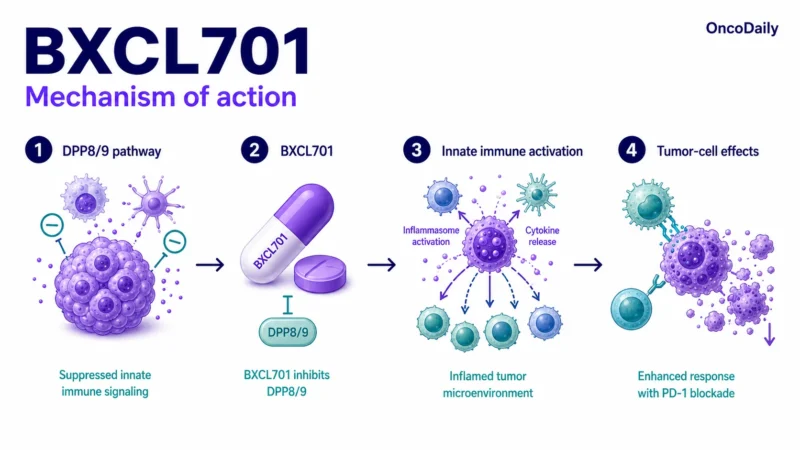
BXCL701 is an oral small-molecule inhibitor of dipeptidyl peptidases, particularly DPP8 and DPP9, with additional activity against DPP4/CD26 and fibroblast activation protein.
DPP8 and DPP9 normally restrain inflammasome activity. Their inhibition can activate inflammatory pathways, promote cytokine release, and trigger inflammatory cell death in selected immune and tumor cells. BXCL701 is therefore intended to stimulate innate immunity and subsequently support adaptive T-cell responses.
By modifying immune cells and the tumor stroma, BXCL701 may increase immune-cell infiltration and improve tumor recognition. This provides the rationale for combining it with pembrolizumab, a PD-1 inhibitor.
BXCL701 has also been known as:
- Talabostat
- Talabostat mesylate
- PT-100
- Val-boroPro
What Is The Dose Of BXCL701?
The principal regimen evaluated with pembrolizumab is a step-up schedule:
Cycle 1
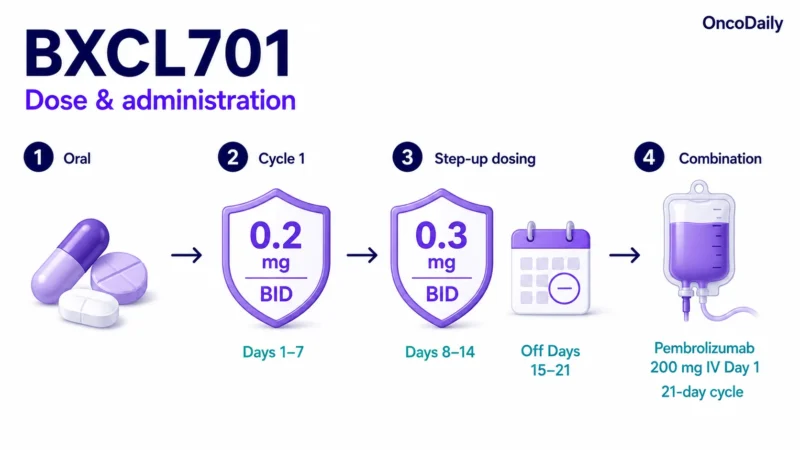
- BXCL701 0.2 mg orally twice daily on Days 1–7
- Then 0.3 mg orally twice daily on Days 8–14
- No BXCL701 on Days 15–21
Subsequent 21-day cycles
- BXCL701 0.3 mg orally twice daily on Days 1–14
- No BXCL701 on Days 15–21
Pembrolizumab is administered at 200 mg intravenously on Day 1 of each 21-day cycle.
The first-week lower dose is intended to reduce the risk of early hypotension and cytokine-related effects. Earlier cohorts evaluated total daily doses of 0.4 mg and 0.6 mg.
These are investigational clinical-trial doses, not approved prescribing recommendations.
How Is BXCL701 Administered?
BXCL701 is taken orally as tablets. It is not an infusion or injection.
The tablets are taken twice daily on the protocol-defined treatment days. Clinical-trial instructions specify that BXCL701 should not be taken on an empty stomach.
When BXCL701 is combined with pembrolizumab:
- BXCL701 is taken orally.
- Pembrolizumab is administered by intravenous infusion.
- Pembrolizumab infusion generally lasts approximately 30 minutes under the trial protocol.
Public sources do not provide commercial instructions for tablet storage, crushing, missed doses, or vomiting because BXCL701 remains investigational.
Does BXCL701 Require An In-Line Filter?
BXCL701 does not require an in-line filter because it is an oral medication.
No IV tubing, infusion bag, dilution, or flushing procedure is required for BXCL701 itself.
A separate in-line filtration requirement may apply to pembrolizumab, which should be prepared and administered according to its approved prescribing information and institutional procedures.
Is Premedication Required?
BXCL701 does not have a standard mandatory premedication regimen.
Because hypotension, dizziness, and fluid-related effects may occur, clinical protocols emphasize:
- Blood-pressure monitoring
- Adequate hydration
- Monitoring during the first treatment week
- Step-up dosing before reaching 0.3 mg twice daily
Premedication for pembrolizumab is not routinely required unless the patient has experienced a previous infusion reaction.
Are Dose Reductions Used?
Yes. Clinical-trial protocols allow treatment interruption, dose reduction, or discontinuation for toxicity.
Dose modification may be considered for:
- Symptomatic hypotension
- Dizziness or faintness
- Peripheral edema
- Dehydration or hypovolemia
- Significant cytokine-related symptoms
- Persistent grade 3 or higher toxicity
- Immune-related adverse events from the combination
Hypotension appears most likely during the first treatment week, which is why the step-up schedule begins at 0.2 mg twice daily.
Because BXCL701 has no approved label, exact restart and reduction criteria remain protocol-specific.
What Is Known About BXCL701 Pharmacokinetics?
BXCL701 is orally active and produces rapid pharmacodynamic inhibition of dipeptidyl peptidase activity.
Earlier clinical research found that doses of at least 0.3 mg produced near-complete inhibition of plasma DPP4/CD26 activity shortly after administration. Total daily doses of 0.4–0.6 mg produced strong target inhibition and cytokine changes, supporting the dose range used in later combination trials.
Complete public information regarding:
- Terminal half-life
- Oral bioavailability
- Metabolic pathways
- Clearance
- Accumulation
- Renal excretion
- Drug–drug interactions remain limited.
Are Renal Or Hepatic Dose Adjustments Required?
No validated dose-adjustment recommendations have been established for renal or hepatic impairment.
Clinical trials generally required:
- Creatinine clearance above approximately 40 mL/min
- Bilirubin no more than 1.5 times the upper limit of normal
- AST and ALT no more than three times the upper limit of normal, or five times normal in patients with liver metastases
These are trial-entry criteria rather than formal prescribing recommendations.
What Did Clinical Trials Show?
The Phase 1b/2 NCT03910660 trial evaluated BXCL701 plus pembrolizumab in metastatic castration-resistant prostate cancer with small cell neuroendocrine or adenocarcinoma features. The study is now listed as completed.
In the latest peer-reviewed analysis of 34 patients with small cell neuroendocrine prostate cancer:
Composite response rate was approximately 20%
Confirmed objective response rate was approximately 13%
Median duration of objective response was 9 months
Responses occurred in a heavily pretreated population, including patients previously exposed to platinum and taxane chemotherapy. However, the study was single-arm and did not establish superiority over another treatment.
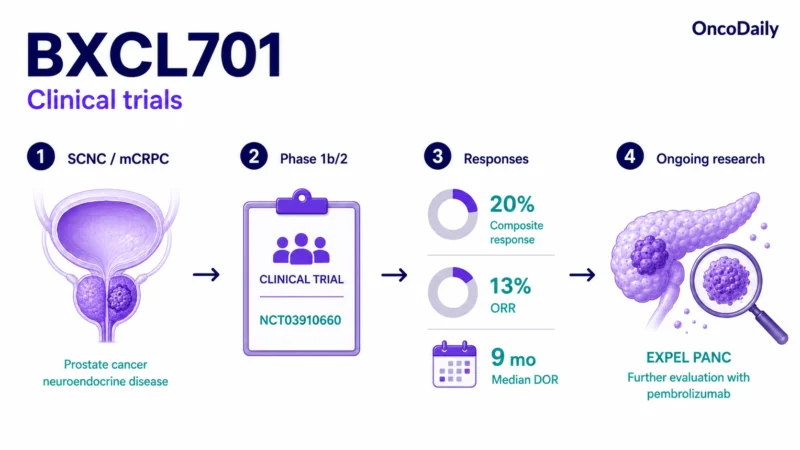
BXCL701 plus pembrolizumab has also been evaluated in second-line metastatic pancreatic ductal adenocarcinoma in the Phase 2 EXPEL PANC trial, NCT05558982. The same step-up BXCL701 schedule was used with pembrolizumab 200 mg every three weeks. The study is active but no longer recruiting.
Preliminary pancreatic cancer findings showed responses in a small proportion of patients and supported continued investigation of the combination. These results remain exploratory and require confirmation in larger randomized studies.
Watch more: Learn about BXCL701 plus pembrolizumab as a novel immunotherapy strategy for pancreatic cancer in OncoDaily’s interview with Benjamin Weinberg.
What Are The Side Effects Of BXCL701?
Reported BXCL701-related adverse effects include:
- Hypotension
- Fatigue
- Dizziness
- Peripheral edema
- Nausea
- Pruritus
- Reduced appetite
- Dehydration or hypovolemia
- Anemia
In the prostate cancer study, frequently reported treatment-related events included fatigue, hypotension, pruritus, dizziness, and nausea. Immune-mediated effects may also occur because pembrolizumab is usually administered with BXCL701.
Potential pembrolizumab-related immune toxicities include pneumonitis, colitis, hepatitis, nephritis, thyroid dysfunction, adrenal insufficiency, and severe skin reactions.
Read more: BXCL701 plus pembrolizumab in second-line advanced pancreatic cancer on OncoDaily.
FAQ
Is BXCL701 Approved?
No. BXCL701 remains investigational and has no FDA- or EMA-approved indication.
Is BXCL701 Chemotherapy?
No. BXCL701 is an oral innate immune activator and dipeptidyl peptidase inhibitor.
Is BXCL701 An Infusion Or Injection?
Neither. BXCL701 is an oral medication. Pembrolizumab, which is commonly studied with it, is given by intravenous infusion.
How Is BXCL701 Taken?
The commonly studied regimen begins with 0.2 mg twice daily for seven days, followed by 0.3 mg twice daily on Days 8–14. Later cycles use 0.3 mg twice daily on Days 1–14 of each 21-day cycle.
Does BXCL701 Require An Infusion Filter?
No. BXCL701 is taken orally and does not require an infusion filter.
What Cancer Is BXCL701 Mainly Being Studied In?
Its principal programs have involved small cell neuroendocrine prostate cancer, metastatic castration-resistant prostate cancer, and metastatic pancreatic ductal adenocarcinoma.