
Key takeaways
- Adavosertib is an investigational WEE1 kinase inhibitor that has not received FDA or EMA approval, and its clinical development has been discontinued.
- The drug targets the WEE1 checkpoint kinase, increasing replication stress and promoting cancer-cell death, particularly in tumors with TP53 alterations or other defects in cell-cycle regulation.
- Clinical trials demonstrated antitumor activity in recurrent uterine serous carcinoma, including objective response rates of approximately 26–29%, although progression-free survival remained modest.
- The most common toxicities were gastrointestinal and hematologic, including diarrhea, nausea, vomiting, anemia, neutropenia, and thrombocytopenia, often requiring dose interruptions or reductions.
- Adavosertib was also evaluated in combination with chemotherapy for ovarian cancer and other solid tumors, but increased toxicity and limited overall clinical benefit prevented regulatory approval and further development.
Adavosertib is an investigational oral WEE1 kinase inhibitor studied in uterine serous carcinoma, ovarian cancer, uterine carcinosarcoma, and other advanced solid tumors. It was designed to increase replication stress and prevent cancer cells from repairing damaged DNA before cell division.
Adavosertib is not approved by the US Food and Drug Administration or European Medicines Agency. AstraZeneca discontinued its clinical development, and the drug is no longer being advanced as an active development program.
Adavosertib Key Facts
- Drug class: WEE1 kinase inhibitor
- Other names: AZD1775 and MK-1775
- Administration: Oral capsules
- Main monotherapy dose: 300 mg once daily on Days 1–5 and 8–12 of a 21-day cycle
- Suggested lower dose: 250 mg on the same schedule
- Main cancers studied: Uterine serous carcinoma and ovarian cancer
- Approval status: Investigational
- Development status: Discontinued
What Is Adavosertib?
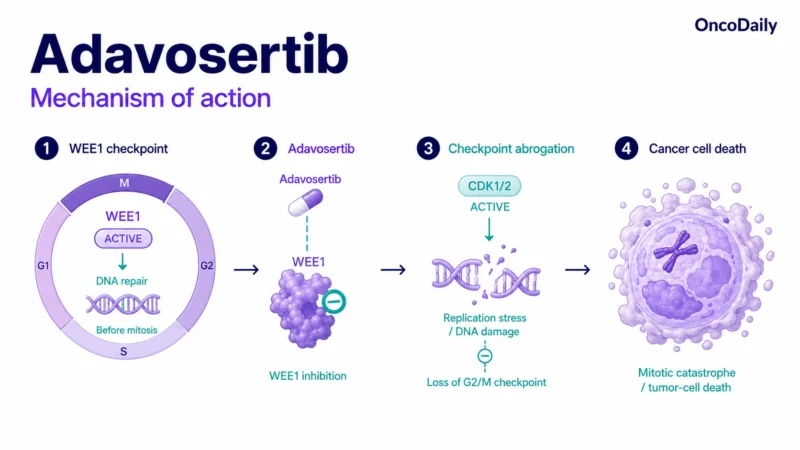
Adavosertib is an oral small-molecule inhibitor of WEE1, a kinase that regulates the S-phase and G2/M cell-cycle checkpoints.
WEE1 normally inhibits CDK1 and CDK2, allowing cells time to repair DNA damage before replication or mitosis. Adavosertib blocks this checkpoint, forcing cancer cells with damaged DNA to continue through the cell cycle. The resulting replication stress, DNA damage, and abnormal mitosis can lead to cancer-cell death.
This mechanism attracted particular interest in tumors with TP53 alterations, high replication stress, CCNE1 amplification, or other defects affecting cell-cycle regulation.
Adavosertib was previously known as AZD1775 and MK-1775.
What Is The Dose Of Adavosertib?
The principal monotherapy regimen evaluated in recurrent or persistent uterine serous carcinoma was:
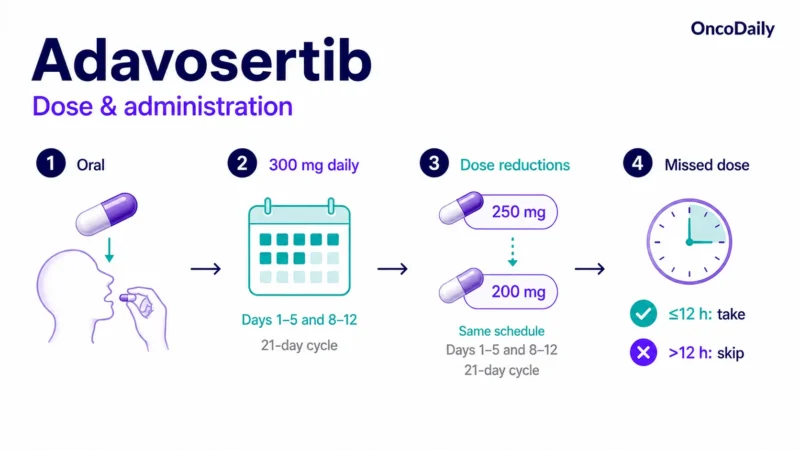
Adavosertib 300 mg orally once daily on Days 1–5 and 8–12 of each 21-day cycle.
The schedule included five treatment days, two days without treatment, another five treatment days, and at least nine days before the next cycle.
Because the 300 mg starting dose produced substantial toxicity and frequent dose modifications, later protocol assessments recommended 250 mg once daily on the same intermittent schedule for future monotherapy development.
Combination studies used different adavosertib doses and schedules with gemcitabine, carboplatin, paclitaxel, cisplatin, or other anticancer treatments. These regimens were investigational and are not approved prescribing recommendations.
How Is Adavosertib Administered?
Adavosertib is taken orally as capsules rather than administered by intravenous infusion or injection.
The capsules were taken with approximately 250 mL of water and could be taken with or without food in the ADAGIO clinical-trial protocol.
When a dose was missed, the protocol allowed the patient to take it within 12 hours of the scheduled time. A dose missed by more than 12 hours was skipped. When vomiting occurred after administration, the dose was not repeated, and treatment resumed at the next scheduled time.
Does Adavosertib Require An In-Line Filter?
Adavosertib does not require an in-line filter because it is administered orally.
No infusion bag, intravenous tubing, dilution solution, or line-flushing procedure is required for adavosertib itself. Separate preparation and filtration instructions may apply to intravenous chemotherapy administered with it.
Is Premedication Required?
Adavosertib does not have a standard drug-specific premedication regimen.
Antiemetics were commonly used because nausea and vomiting occurred frequently during clinical trials. Additional premedication depended on the chemotherapy or other anticancer agent combined with adavosertib.
Are Dose Reductions Used?
Yes. Clinical-trial protocols allowed dose interruption and up to two successive dose reductions.
In the ADAGIO study, the dose-reduction levels were:
- First reduction: 250 mg once daily
- Second reduction: 200 mg once daily
The treatment schedule remained Days 1–5 and 8–12 of each 21-day cycle. Dose re-escalation was not permitted.
Dose interruptions or reductions were considered for:
- Neutropenia
- Thrombocytopenia
- Anemia
- Diarrhea
- Nausea or vomiting
- Fatigue
- Infection or sepsis
- Persistent grade 3 or higher toxicity
Dose reductions were an important component of adavosertib treatment because gastrointestinal and hematologic toxicities frequently required treatment interruption or dose modification.
What Is Known About Adavosertib Pharmacokinetics?
Adavosertib is an orally bioavailable small molecule with dose-dependent systemic exposure.
Early monotherapy studies evaluated doses from approximately 200 to 400 mg once daily on intermittent schedules. Pharmacokinetic and tolerability findings supported intermittent administration rather than continuous daily treatment.
The drug’s public clinical-trial information does not provide approved guidance for terminal half-life, accumulation, metabolism, food effects, or clinically important drug interactions because adavosertib never received regulatory approval.
Are Renal Or Hepatic Dose Adjustments Required?
No validated renal- or hepatic-impairment dose recommendations were established.
Clinical trials generally required adequate kidney, liver, and bone-marrow function. Patients with clinically significant organ impairment were underrepresented or excluded, limiting conclusions about safe dosing in these groups.
What Did Clinical Trials Show?
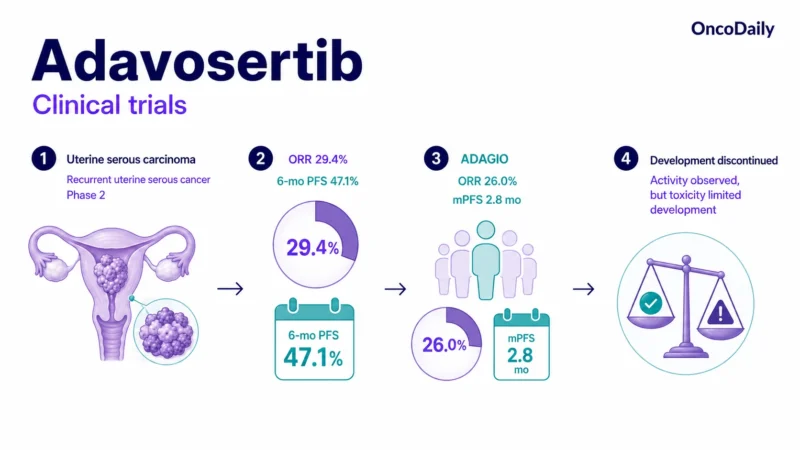
A single-center Phase 2 study evaluated adavosertib monotherapy in recurrent uterine serous carcinoma.
Among 34 evaluable patients:
- Objective response rate was 29.4%
- Six-month progression-free survival rate was 47.1%
- Median progression-free survival was 6.1 months
- Median duration of response was 9.0 months
These findings suggested meaningful antitumor activity and supported further testing in a larger study.
The international Phase 2b ADAGIO trial, NCT04590248, evaluated adavosertib in recurrent or persistent uterine serous carcinoma. Among 104 evaluable patients, the blinded independent central review objective response rate was 26.0%, median duration of response was 4.7 months, and median progression-free survival was 2.8 months.
The larger study confirmed some antitumor activity but also showed limited progression-free survival and substantial toxicity. The starting dose was not well tolerated, and adavosertib is no longer under clinical development.
Adavosertib was also studied with gemcitabine in platinum-resistant or platinum-refractory ovarian cancer, where the combination produced improved activity compared with gemcitabine alone but increased hematologic toxicity.
Watch more: Hear Joyce Liu, MD, MPH discuss Phase 2 results of adavosertib in recurrent uterine serous carcinoma.
What Are The Side Effects Of Adavosertib?
The most frequently reported adverse effects included:
- Diarrhea
- Nausea
- Vomiting
- Fatigue
- Anemia
- Neutropenia
- Thrombocytopenia
- Reduced appetite
- Abdominal symptoms
- Infection
Hematologic and gastrointestinal toxicity were the main limitations of adavosertib treatment. In the ADAGIO trial, the 300 mg dose led to frequent dose interruptions and reductions, contributing to the recommendation for a lower 250 mg starting dose in later monotherapy planning.
What Is the Current Status of Adavosertib?
Adavosertib is not approved and is no longer being actively developed by AstraZeneca. Although Phase 2 studies demonstrated antitumor activity in uterine serous and ovarian cancer, toxicity and limited durability prevented further development as a commercial treatment.
Read more: $15 Million NCI Grant Supports Research in Endometrial Cancer on OncoDaily.
FAQ
Is Adavosertib Approved?
No. Adavosertib is an oral targeted therapy that inhibits WEE1 kinase. It has been studied alone and with chemotherapy.
How Is Adavosertib Taken?
Adavosertib is taken orally. The best-known monotherapy regimen used 300 mg once daily on Days 1–5 and 8–12 of a 21-day cycle.
Does Adavosertib Require An Infusion Filter?
No. Adavosertib is an oral medication and does not require infusion equipment or an in-line filter.
What Cancer Was Adavosertib Mainly Studied In?
Its leading monotherapy program focused on recurrent or persistent uterine serous carcinoma. It was also investigated in ovarian cancer, uterine carcinosarcoma, and other solid tumors.