





Trifluridine/tipiracil: Understanding Its Mechanism, Dosing, and Clinical Role
Key takeaways
- Trifluridine/tipiracil (TAS-102) is an oral antineoplastic combination containing trifluridine and tipiracil.
- Trifluridine is incorporated into DNA, producing DNA dysfunction and contributing to cancer-cell death.
- Tipiracil inhibits thymidine phosphorylase, preventing rapid degradation of trifluridine and increasing its bioavailability.
- The standard dose is 35 mg/m² orally twice daily on Days 1–5 and 8–12 of a 28-day cycle.
- Tablets should be taken within 1 hour after the morning and evening meals.
- Major approved uses include metastatic colorectal cancer and metastatic gastric/gastroesophageal junction adenocarcinoma.
- In colorectal cancer, TAS-102 can be administered alone or with bevacizumab.
- The RECOURSE trial established its role in heavily pretreated metastatic colorectal cancer.
- The SUNLIGHT trial demonstrated improved survival with trifluridine/tipiracil plus bevacizumab compared with trifluridine/tipiracil alone.
- The TAGS trial demonstrated an overall-survival benefit in heavily pretreated metastatic gastric/GEJ cancer.
- Myelosuppression, particularly neutropenia, is the major toxicity.
- CBC monitoring is essential throughout treatment.
- TAS-102 provides a treatment option with a mechanism that differs from conventional 5-FU-based therapy.
Trifluridine/tipiracil, also known as TAS-102 and marketed as Lonsurf, is an oral antineoplastic combination containing the thymidine-based nucleoside analog trifluridine and the thymidine phosphorylase inhibitor tipiracil. It is used in previously treated metastatic colorectal cancer and metastatic gastric or gastroesophageal junction adenocarcinoma. In colorectal cancer, it can be administered alone or in combination with bevacizumab.
This article aims to review trifluridine/tipiracil’s mechanism of action, dose, administration, clinical uses, clinical-trial findings, pharmacokinetics, safety profile, and current approval status, with particular focus on its role in refractory gastrointestinal cancers.
Key Facts
- Generic name: Trifluridine/tipiracil
- Common name: TAS-102
- Brand name: Lonsurf
- Drug class: Nucleoside metabolic inhibitor + thymidine phosphorylase inhibitor
- Route: Oral
- Major indications: Metastatic colorectal cancer; metastatic gastric or gastroesophageal junction adenocarcinoma
- Standard dose: 35 mg/m² orally twice daily
- Schedule: Days 1–5 and Days 8–12 of a 28-day cycle
- Administration: Within 1 hour after morning and evening meals
- Key mechanism: Trifluridine is incorporated into DNA; tipiracil inhibits trifluridine degradation
- Major toxicities: Neutropenia, anemia, thrombocytopenia, fatigue, nausea, and diarrhea
- Important monitoring: CBC before treatment and on Day 15 of each cycle
- FDA approval: 2015; colorectal cancer indication later expanded to include combination with bevacizumab in 2023.
What Is Trifluridine/Tipiracil?
Trifluridine/tipiracil is an oral antineoplastic combination designed to deliver sustained exposure to trifluridine.
The two components have different but complementary roles.
Trifluridine
Trifluridine (FTD) is a thymidine-based nucleoside analog.
After intracellular phosphorylation, its metabolites become incorporated into DNA. This incorporation causes DNA dysfunction and contributes to cancer-cell death.
Although trifluridine can inhibit thymidylate synthase, evidence suggests that DNA incorporation is the principal cytotoxic mechanism with the oral TAS-102 regimen.
Tipiracil
Tipiracil (TPI) is a potent inhibitor of thymidine phosphorylase.
Thymidine phosphorylase rapidly degrades trifluridine. By inhibiting this enzyme, tipiracil increases the systemic bioavailability and exposure of trifluridine.
Therefore:
Trifluridine → antitumor activity
Tipiracil → prevents rapid trifluridine degradation
What Is the Mechanism of Action of Trifluridine/Tipiracil?
The mechanism of TAS-102 differs from conventional fluoropyrimidines such as 5-FU.
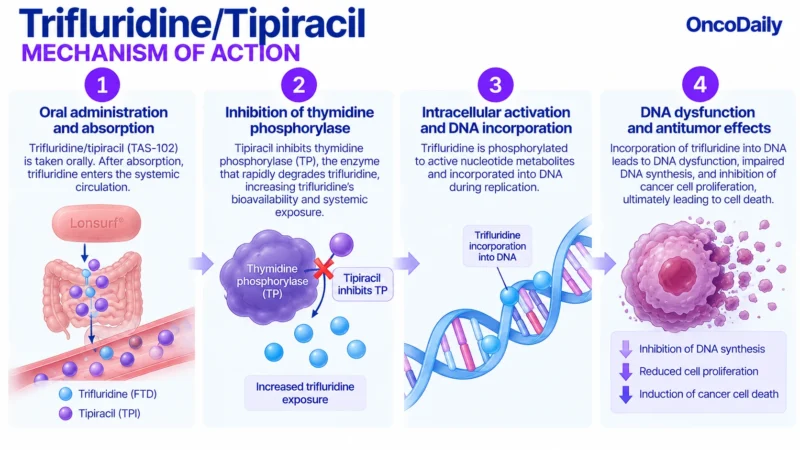
1. Oral Administration and Absorption
After oral administration, trifluridine enters the systemic circulation.
2. Tipiracil Blocks Trifluridine Degradation
Tipiracil inhibits thymidine phosphorylase, preventing rapid degradation of trifluridine.
This increases and prolongs trifluridine exposure.
3. Trifluridine Is Converted to Active Metabolites
Trifluridine undergoes intracellular phosphorylation to active nucleotide metabolites.
4. DNA Incorporation and Dysfunction
The active trifluridine metabolite is incorporated into DNA during replication.
This causes DNA dysfunction and strand damage, ultimately impairing cancer-cell proliferation and promoting cell death.
The pathway can be summarized as:
TAS-102 → tipiracil inhibits thymidine phosphorylase → increased trifluridine exposure → trifluridine phosphorylation → DNA incorporation → DNA dysfunction → impaired proliferation → cancer-cell death
What Is the Dose of Trifluridine/Tipiracil?
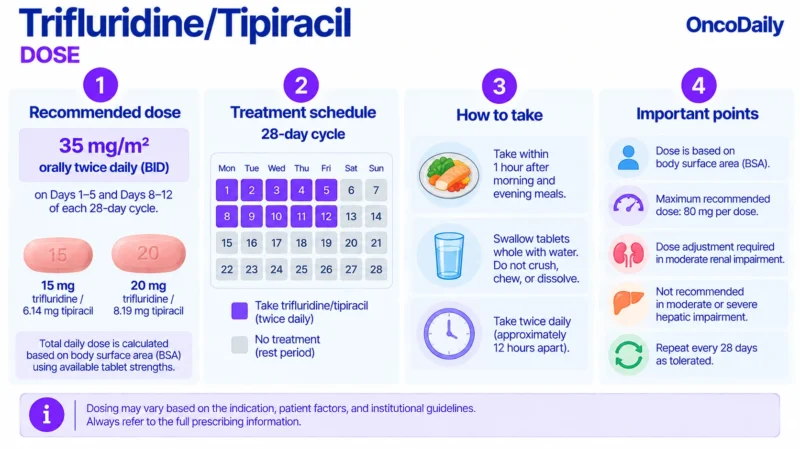
The recommended dose is:
35 mg/m² orally twice daily
on:
Days 1–5 and Days 8–12
of each:
28-day cycle.
The dose is based on body-surface area and is administered using the available tablet strengths:
- 15 mg trifluridine / 6.14 mg tipiracil
- 20 mg trifluridine / 8.19 mg tipiracil.
The maximum recommended dose is 80 mg per dose.
Treatment Schedule
- Days 1–5: Treatment
- Days 6–7: Rest
- Days 8–12: Treatment
- Days 13–28: Rest
The cycle is then repeated.
How Is Trifluridine/Tipiracil Administered?
Trifluridine/tipiracil is administered orally with food.
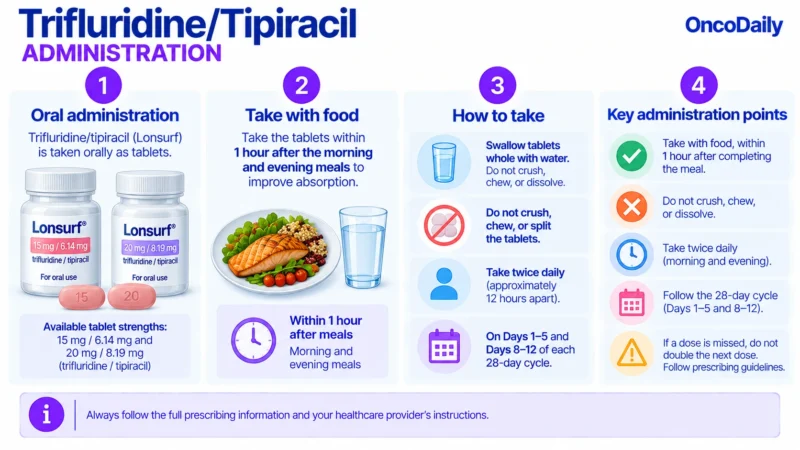
Patients should take the tablets:
- Twice daily
- After the morning and evening meals
- Within 1 hour after completion of the meal
- On Days 1–5 and 8–12 of each 28-day cycle.
The tablets should be swallowed with water and should not be crushed or chewed.
Does Trifluridine/Tipiracil Require an In-Line Filter?
No.
Trifluridine/tipiracil is an oral medication, so there is no IV infusion and no in-line filter requirement.
Does Trifluridine/Tipiracil Require Premedication?
There is no routine mandatory premedication requirement.
Antiemetic treatment may be considered according to the patient’s risk of nausea and vomiting and clinical circumstances.
Are Dose Reductions Used?
Yes.
Dose interruptions and reductions are commonly required, particularly because of hematologic toxicity.
Treatment should generally be withheld for severe myelosuppression and resumed at a reduced dose according to the prescribing information.
Dose reductions occur in 5 mg/m²/dose steps, with a maximum of three dose reductions.
Treatment should be discontinued if a patient cannot tolerate the minimum dose of:
20 mg/m²/dose twice daily.
What Is the Pharmacokinetic Profile of Trifluridine/Tipiracil?
The pharmacokinetics of TAS-102 depend heavily on the interaction between its two components.
Trifluridine alone has limited oral bioavailability because it is rapidly degraded by thymidine phosphorylase.
Tipiracil inhibits thymidine phosphorylase, substantially increasing trifluridine exposure. Pharmacokinetic studies demonstrated that the combination produces considerably greater trifluridine exposure than trifluridine alone.
Food also affects administration, which is why the tablets should be taken after meals.
The elimination half-life of trifluridine after repeated dosing is approximately 2 hours, while tipiracil has a longer half-life.
Does Trifluridine/Tipiracil Require Renal or Hepatic Dose Adjustment?
Renal Impairment
Renal function should be assessed before treatment.
For patients with moderate renal impairment, the recommended starting dose is reduced.
The FDA prescribing information recommends:
20 mg/m² twice daily
for patients with moderate renal impairment.
Patients with severe renal impairment have substantially higher exposure and require additional caution; treatment recommendations depend on the current product labeling.
Hepatic Impairment
Trifluridine/tipiracil is not recommended in patients with moderate or severe hepatic impairment, based on increased risk of toxicity and limited clinical data.
Patients with mild hepatic impairment should be monitored carefully.
What Are the Clinical Uses of Trifluridine/Tipiracil?
Metastatic Colorectal Cancer
This is one of the major established uses of TAS-102.
Lonsurf is indicated for adults with metastatic colorectal cancer who have previously received:
- Fluoropyrimidine-based chemotherapy
- Oxaliplatin
- Irinotecan
- Anti-VEGF therapy
- Anti-EGFR therapy when appropriate for RAS wild-type disease.
It can be used:
As monotherapy
or
In combination with bevacizumab.
The combination with bevacizumab was approved by the FDA in 2023 following the SUNLIGHT trial.
Metastatic Gastric Cancer
Lonsurf is also indicated for adults with metastatic gastric or gastroesophageal junction adenocarcinoma previously treated with at least two chemotherapy regimens that included:
- A fluoropyrimidine
- A platinum
- Either a taxane or irinotecan
- HER2-targeted therapy when appropriate.
The indication was supported by the phase III TAGS trial.
Gastroesophageal Junction Cancer
TAS-102 is also used in previously treated metastatic gastroesophageal junction adenocarcinoma, based on the TAGS study population and subsequent analyses.
Other Investigational Uses
Trifluridine/tipiracil has been investigated in other gastrointestinal malignancies, including pancreatic cancer, but these uses are not part of the current FDA-approved Lonsurf indications.
Watch more: LONSURF (trifluridine and tipiracil) – colorectal cancer
What Did Trifluridine/Tipiracil Clinical Trials Show?
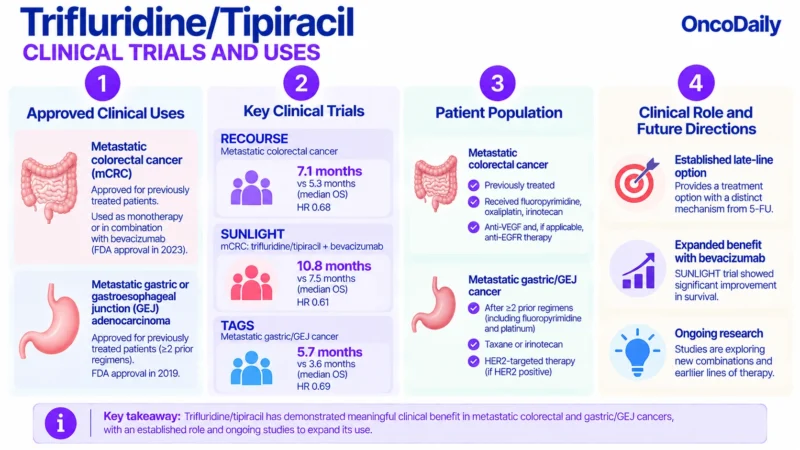
RECOURSE — Metastatic Colorectal Cancer
The landmark RECOURSE phase III trial enrolled patients with metastatic colorectal cancer that had progressed after standard therapies.
A total of 800 patients were randomized to trifluridine/tipiracil or placebo.
Median overall survival was:
7.1 months vs 5.3 months
with a hazard ratio for death of:
0.68
The study also demonstrated a progression-free survival benefit.
Neutropenia was the most frequent clinically significant adverse event.
The results established TAS-102 as an effective treatment option for heavily pretreated metastatic colorectal cancer.
SUNLIGHT — Trifluridine/Tipiracil + Bevacizumab
The SUNLIGHT phase III trial evaluated trifluridine/tipiracil plus bevacizumab compared with trifluridine/tipiracil alone in previously treated metastatic colorectal cancer.
The combination significantly improved:
Median overall survival: 10.8 vs 7.5 months
Median progression-free survival: 5.6 vs 2.4 months
The overall-survival hazard ratio was:
0.61
These results led to the FDA approval of Lonsurf plus bevacizumab in 2023.
TAGS — Gastric and Gastroesophageal Junction Cancer
The TAGS phase III trial evaluated trifluridine/tipiracil versus placebo in patients with heavily pretreated metastatic gastric or gastroesophageal junction adenocarcinoma.
Among 507 patients:
Median overall survival: 5.7 vs 3.6 months
Hazard ratio: 0.69
Trifluridine/tipiracil therefore demonstrated a statistically significant overall-survival benefit in this heavily pretreated population.
Is Trifluridine/Tipiracil FDA Approved?
Yes.
The FDA initially approved Lonsurf in 2015 for previously treated metastatic colorectal cancer.
The FDA subsequently expanded its role:
- 2019: Metastatic gastric and gastroesophageal junction adenocarcinoma after prior chemotherapy
- 2023: Lonsurf plus bevacizumab for previously treated metastatic colorectal cancer.
What Is the Current Clinical Role of Trifluridine/Tipiracil?
Trifluridine/tipiracil is an established later-line oral therapy for gastrointestinal cancers.
Its clinical role is particularly important because its mechanism is distinct from conventional 5-FU-based chemotherapy. The principal cytotoxic effect of oral TAS-102 is associated with trifluridine incorporation into DNA, while tipiracil maintains trifluridine exposure by inhibiting thymidine phosphorylase.
In metastatic colorectal cancer, the trifluridine/tipiracil plus bevacizumab combination has further expanded its role following the SUNLIGHT trial.
Read more: FLOWER Study: Trifluridine/Tipiracil Plus Bevacizumab in Later-Line mCRC on OncoDaily.
In gastric and gastroesophageal junction cancer, TAS-102 remains an option for patients whose disease has progressed after multiple prior treatment lines.
What Are the Major Side Effects of Trifluridine/Tipiracil?
Myelosuppression
The major toxicity is bone-marrow suppression.
Common hematologic abnormalities include:
- Neutropenia
- Anemia
- Thrombocytopenia
- Leukopenia
- Febrile neutropenia.
The FDA recommends obtaining CBCs before treatment and on Day 15 of each cycle, as well as when clinically indicated.
Gastrointestinal Toxicity
Common gastrointestinal adverse effects include:
- Nausea
- Diarrhea
- Vomiting
- Abdominal pain
- Decreased appetite.
Fatigue
Fatigue and weakness are commonly reported.
Fever
Pyrexia can occur during treatment.
Serious Infection
Severe neutropenia can increase the risk of:
- Febrile neutropenia
- Pneumonia
- Sepsis
- Other serious infections.
What Monitoring Is Required?
Monitoring should include:
- CBC with differential
- Platelet count
- Renal function
- Liver function
- Assessment for infection
- Assessment for bleeding
- Assessment for dehydration
- Assessment of gastrointestinal toxicity
- Treatment response.
CBC monitoring is particularly important because severe myelosuppression is one of the principal dose-limiting toxicities.