





Thioguanine: Understanding Its Mechanism, Dosing, and Clinical Role
Key takeaways
- Thioguanine (6-TG) is an oral purine analog antimetabolite.
- It is converted by HGPRT into active thioguanine nucleotides.
- These metabolites inhibit purine synthesis and nucleotide interconversion and become incorporated into DNA and RNA.
- The usual single-agent starting dose described in the FDA label is approximately 2 mg/kg/day.
- Thioguanine is primarily used in combination chemotherapy for acute nonlymphocytic leukemia/AML.
- The FDA-approved indication is remission induction and consolidation, not long-term maintenance.
- Myelosuppression is the most common major toxicity.
- Hepatic veno-occlusive disease and portal hypertension are important serious toxicities associated particularly with prolonged use.
- TPMT and NUDT15 deficiency can markedly increase the risk of severe myelosuppression.
- Thioguanine is administered orally as a 40-mg scored tablet.
- Historical clinical studies demonstrated activity when thioguanine was incorporated into multi-agent leukemia regimens.
Thioguanine, also known as 6-thioguanine (6-TG), is an oral purine analog antimetabolite used primarily as part of chemotherapy for acute myeloid leukemia (AML). It is converted intracellularly into thioguanine nucleotides that interfere with purine synthesis and are incorporated into DNA and RNA, producing antineoplastic effects.
This article aims to review thioguanine’s mechanism of action, dose, administration, clinical uses, clinical-trial findings, pharmacokinetics, safety profile, and current approval status, including its role in remission induction and consolidation of acute nonlymphocytic leukemia.
Key Facts
- Generic name: Thioguanine
- Also known as: 6-Thioguanine, 6-TG
- Brand name: Tabloid
- Drug class: Purine analog antimetabolite; thiopurine
- Route: Oral
- Dosage form: 40-mg scored tablet
- FDA-approved use: Remission induction and consolidation of acute nonlymphocytic leukemia
- Typical single-agent starting dose: Approximately 2 mg/kg/day
- Mechanism: Purine synthesis inhibition and incorporation into DNA/RNA
- Key enzyme involved: Hypoxanthine-guanine phosphoribosyltransferase (HGPRT)
- Major toxicities: Myelosuppression and hepatotoxicity
- Important monitoring: CBC, platelets, liver function, and clinical signs of hepatic toxicity
- Pharmacogenetic considerations: TPMT and NUDT15 deficiency can increase the risk of severe myelosuppression.
What Is Thioguanine?
Thioguanine is a synthetic guanosine analog and thiopurine antimetabolite.
It is structurally related to guanine and is closely related to mercaptopurine.
After entering cells, thioguanine is converted by HGPRT into thioguanine nucleotides. These active metabolites interfere with purine metabolism and can subsequently become incorporated into DNA and RNA.
Its antitumor activity appears to result from several complementary effects rather than from one single molecular target.
What Is the Mechanism of Action of Thioguanine?
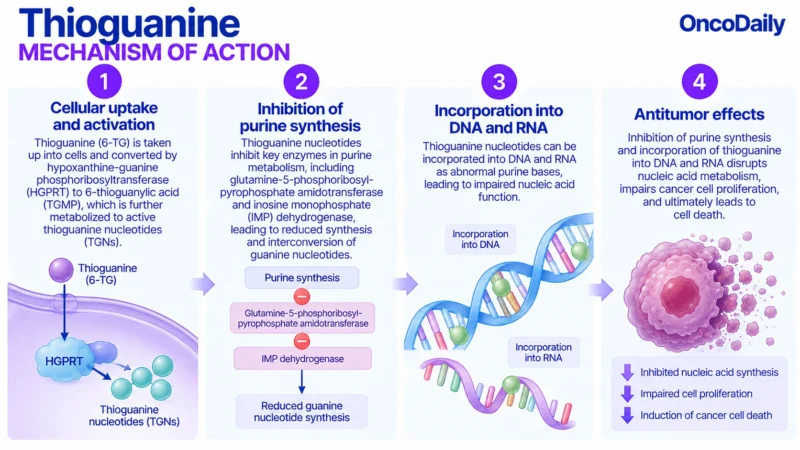
1. Cellular Activation
Thioguanine competes with hypoxanthine and guanine for HGPRT.
It is converted into:
6-thioguanylic acid (TGMP)
which is subsequently metabolized to additional active thioguanine nucleotides.
2. Inhibition of Purine Biosynthesis
Thioguanine nucleotides interfere with enzymes involved in purine metabolism.
TGMP inhibits:
- Glutamine-5-phosphoribosylpyrophosphate amidotransferase
- IMP dehydrogenase
This disrupts the synthesis and interconversion of guanine nucleotides.
3. DNA and RNA Incorporation
Thioguanine nucleotides can be incorporated into DNA and RNA as abnormal purine bases.
This incorporation contributes to disruption of nucleic-acid function and cellular proliferation.
4. Antitumor Effect
The combined effects produce a blockade of purine nucleotide synthesis and utilization, impairing the ability of rapidly dividing malignant cells to synthesize and maintain nucleic acids.
The mechanism can therefore be summarized as:
Thioguanine → HGPRT activation → thioguanine nucleotides → inhibition of purine synthesis + DNA/RNA incorporation → impaired nucleic-acid metabolism → cancer-cell death
Importantly, the FDA label notes that no single major site of action can be definitively assigned because several metabolic effects contribute to cytotoxicity.
Watch more: Anticancer Drugs (Part 5): Pharmacology of Mercaptopurine, Thioguanine, and Fluorouracil
What Is the Dose of Thioguanine?
Thioguanine dosing depends on the disease, treatment protocol, age, combination chemotherapy, and patient-specific toxicity.
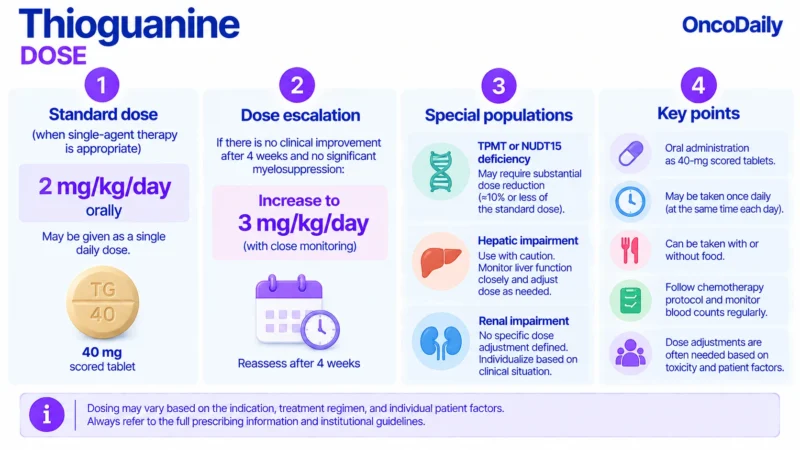
When single-agent treatment is appropriate, the FDA labeling describes an initial dose of approximately:
2 mg/kg/day orally
If there is no clinical improvement after 4 weeks and there is no significant leukocyte or platelet depression, the dose may be cautiously increased to:
3 mg/kg/day.
The total daily dose may be administered at one time.
In AML, thioguanine is commonly incorporated into multi-agent chemotherapy protocols, so protocol-specific dosing rather than the single-agent dose should be followed.
Pharmacogenetic Dose Considerations
Patients with homozygous TPMT or NUDT15 deficiency typically require substantial dose reduction.
The FDA label states that these patients may require approximately 10% or less of the standard thioguanine dose, with further adjustment according to tolerability.
How Is Thioguanine Administered?
Thioguanine is administered:
Orally as tablets
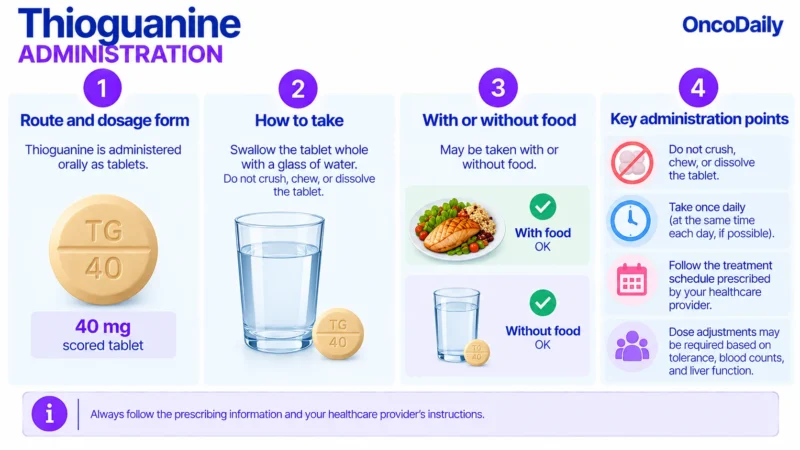
The current Tabloid formulation contains:
40 mg thioguanine per scored tablet.
The exact administration schedule depends on the chemotherapy protocol.
Unlike intravenous antineoplastic agents, thioguanine does not require:
- IV access
- Infusion
- An in-line filter.
Does Thioguanine Require an In-Line Filter?
No.
Thioguanine is administered orally, so an in-line infusion filter is not applicable.
Does Thioguanine Require Premedication?
No routine premedication is required.
Supportive treatment may be used according to the patient’s chemotherapy regimen and individual risk of nausea, tumor lysis, or other treatment-related complications.
Because hyperuricemia can occur from rapid tumor-cell destruction, hydration and uric-acid management may be considered when clinically appropriate.
Are Dose Reductions Used?
Yes.
Dose modification is particularly important for myelosuppression and in patients with TPMT or NUDT15 deficiency.
Patients with homozygous deficiency of either enzyme generally require substantial dose reductions, while heterozygous patients may require reductions according to toxicity.
Dose adjustment may also be required when thioguanine is combined with other strongly myelosuppressive agents.
What Is the Pharmacokinetic Profile of Thioguanine?
Oral absorption of thioguanine is incomplete and variable, averaging approximately 30% of the administered dose, with a reported range of 14%–46%.
The parent drug represents only a small fraction of circulating radioactivity after administration because thioguanine is rapidly metabolized.
More importantly, thioguanine is rapidly converted intracellularly to active metabolites whose effects persist after the parent compound has disappeared from plasma.
Following intravenous administration, the median plasma half-disappearance time has been reported as approximately 80 minutes, although the range is broad.
Does Thioguanine Require Renal or Hepatic Dose Adjustment?
Renal Impairment
The FDA label does not provide a standardized renal dose-adjustment table.
Because active metabolites persist intracellularly and toxicity is primarily hematologic and hepatic, treatment should be individualized according to the clinical situation and chemotherapy protocol.
Hepatic Impairment
Hepatic toxicity is a major concern with thioguanine.
Treatment should be withheld or discontinued when there is evidence of significant hepatic toxicity, toxic hepatitis, or biliary stasis.
Long-term continuous administration is specifically discouraged because of the risk of serious liver injury.
What Are the Clinical Uses of Thioguanine?
Acute Myeloid Leukemia
Thioguanine is FDA approved for:
Remission induction and remission consolidation treatment of acute nonlymphocytic leukemia, a historical term encompassing AML.
It is generally used as part of combination chemotherapy, rather than as a stand-alone induction regimen.
The FDA label specifically notes that reliance on thioguanine alone is seldom justified for initial remission induction because combination chemotherapy produces more frequent remission induction and longer remission duration.
Acute Lymphoblastic Leukemia
Thioguanine has been studied and used in selected ALL chemotherapy protocols, particularly historically and in pediatric settings.
However, its long-term continuous use as maintenance therapy is limited by its risk of hepatic toxicity, particularly hepatic veno-occlusive disease.
Chronic Myeloid Leukemia
Thioguanine has demonstrated activity in the chronic phase of CML, but the FDA label notes that other therapies have historically produced more objective responses.
Other Malignancies
The FDA label states that thioguanine is not effective for chronic lymphocytic leukemia, Hodgkin lymphoma, multiple myeloma, or solid tumors.
What Did Thioguanine Clinical Studies Show?
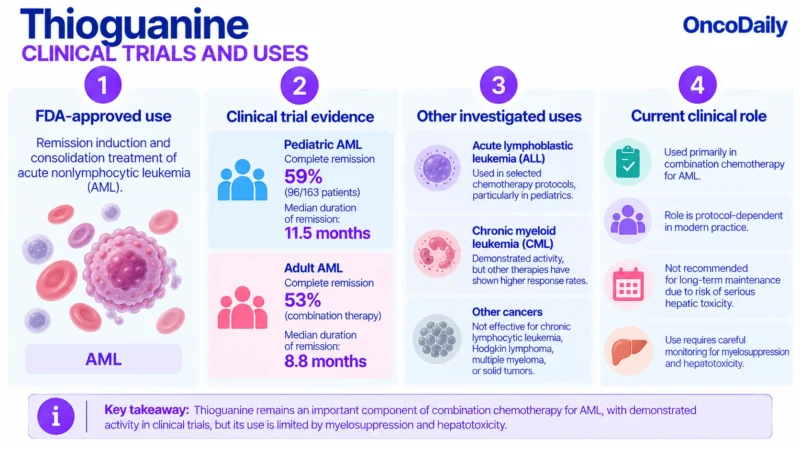
Pediatric Acute Nonlymphocytic Leukemia
In the FDA label, 163 previously untreated pediatric patients with acute nonlymphocytic leukemia received a multi-drug regimen containing:
- Thioguanine
- Prednisone
- Cytarabine
- Cyclophosphamide
- Vincristine.
Complete remission was achieved in 96 patients (59%).
The median duration of remission was 11.5 months.
Adult Acute Nonlymphocytic Leukemia
In previously untreated adults with acute nonlymphocytic leukemia, a combination of thioguanine and cytarabineproduced remission in 53% of patients in the clinical experience described in the FDA label.
The median duration of remission was 8.8 months with the subsequent multi-drug regimen.
These historical studies illustrate thioguanine’s role as a component of combination chemotherapy rather than as a modern single-agent AML treatment.
Is Thioguanine FDA Approved?
Yes.
The FDA-approved Tabloid formulation is indicated for remission induction and remission consolidation treatment of acute nonlymphocytic leukemias.
The current formulation is a 40-mg scored oral tablet.
Importantly, the FDA label states that thioguanine is not recommended for maintenance therapy or similar long-term continuous treatment because of the risk of serious hepatic toxicity.
What Is the Current Clinical Role of Thioguanine?
Thioguanine is an older oral thiopurine antimetabolite whose primary FDA-labeled role is within chemotherapy for acute nonlymphocytic leukemia.
Its use today is largely protocol-dependent, particularly in selected multi-agent leukemia regimens.
Its clinical role is limited by two major toxicities:
Myelosuppression
and
Hepatotoxicity, particularly with prolonged continuous exposure.
Pharmacogenetic variation involving TPMT and NUDT15 is also clinically important because reduced activity can substantially increase exposure to active thioguanine metabolites and the risk of severe myelosuppression.
Read more: Mercaptopurine: Mechanism of Action, Dose, Administration, Clinical Uses, and Side Effects on OncoDaily.
What Are the Major Side Effects of Thioguanine?
Myelosuppression
Myelosuppression is the most frequent adverse effect.
It can manifest as:
- Anemia
- Leukopenia
- Neutropenia
- Thrombocytopenia
- Pancytopenia.
Severe cytopenias can result in serious infection or bleeding.
Hepatotoxicity
Serious hepatic toxicity is a major concern, particularly with long-term continuous treatment.
Possible manifestations include:
- Hepatic veno-occlusive disease
- Portal hypertension
- Hyperbilirubinemia
- Hepatomegaly
- Ascites
- Splenomegaly
- Esophageal varices.
Gastrointestinal Toxicity
Reported adverse effects include:
- Nausea
- Vomiting
- Anorexia
- Stomatitis.
Hyperuricemia
Rapid tumor-cell lysis can produce hyperuricemia, particularly during treatment of leukemia. Hydration and appropriate uric-acid management may be required.
What Monitoring Is Required?
Monitoring should include:
- CBC with differential
- Hemoglobin/hematocrit
- Platelet count
- Liver function tests
- Bilirubin
- Assessment for hepatomegaly or splenomegaly
- Clinical assessment for bleeding and infection
- Consideration of TPMT/NUDT15 testing when severe or recurrent myelosuppression occurs.
The FDA label recommends frequent blood-count monitoring during therapy and suggests liver-function testing weekly when treatment is initiated and monthly thereafter, with more frequent monitoring in patients with pre-existing liver disease or concurrent hepatotoxic therapy.