





Teniposide: Mechanism of Action, Dose, Administration, Clinical Uses, and Side Effects
Key takeaways
- Teniposide is a topoisomerase II inhibitor related to etoposide.
- It stabilizes the topoisomerase II–DNA cleavage complex and prevents normal DNA re-ligation.
- The resulting accumulation of DNA strand breaks disrupts replication and transcription and can trigger apoptosis.
- The resulting accumulation of DNA strand breaks disrupts replication and transcription and can trigger apoptosis.
- Teniposide historically had an important role in refractory pediatric ALL.
- It has been incorporated into multidrug ALL regimens with agents such as cytarabine, methotrexate, asparaginase, vincristine, and corticosteroids.
- Severe myelosuppression is a major treatment-limiting toxicity.
- Teniposide is no longer routinely available in the United States, so its current clinical role is much more limited than that of etoposide.
Teniposide, also known as VM-26 and historically marketed as Vumon, is a semisynthetic podophyllotoxin derivative and topoisomerase II inhibitor closely related to etoposide. It was developed primarily for hematologic malignancies, particularly refractory childhood acute lymphoblastic leukemia (ALL), and has also been studied in lymphomas, CNS-directed leukemia therapy, and other malignancies. Teniposide is an FDA-approved active ingredient, but its commercial availability in the United States has been discontinued.
This article aims to review teniposide mechanism of action, dose, administration, pharmacokinetics, clinical-trial findings, safety profile, approval history, and current role in oncology.
Teniposide Key Facts
- Generic name: Teniposide
- Other names: VM-26; Vumon
- Drug class: Podophyllotoxin derivative; topoisomerase II inhibitor
- Route: Intravenous
- Historical FDA-labeled role: Combination induction therapy for refractory childhood acute lymphoblastic leukemia
- Relationship to etoposide: Structurally and pharmacologically related
- Main toxicity: Severe myelosuppression
- Other important risks: Hypersensitivity reactions, hypotension, gastrointestinal toxicity, mucositis, alopecia, and treatment-related secondary leukemia
- Current U.S. availability: Commercially discontinued
- Approval status: FDA-approved active ingredient, historically marketed as Vumon.
What Is Teniposide?
Teniposide is a semisynthetic podophyllotoxin derivative that inhibits DNA topoisomerase II.
It is structurally related to etoposide but contains a different glucoside substitution that alters some of its pharmacologic characteristics.
Teniposide was historically used as part of combination chemotherapy for refractory childhood ALL and was also studied in:
- Relapsed or refractory ALL
- High-risk ALL
- Non-Hodgkin lymphoma
- Selected CNS-directed leukemia strategies
- Other hematologic malignancies
- Selected solid tumors.
PubChem and historical U.S. labeling identify refractory childhood ALL as its principal labeled indication.
Teniposide Mechanism of Action
Teniposide inhibits topoisomerase II, an enzyme that creates temporary double-strand DNA breaks during replication and transcription.
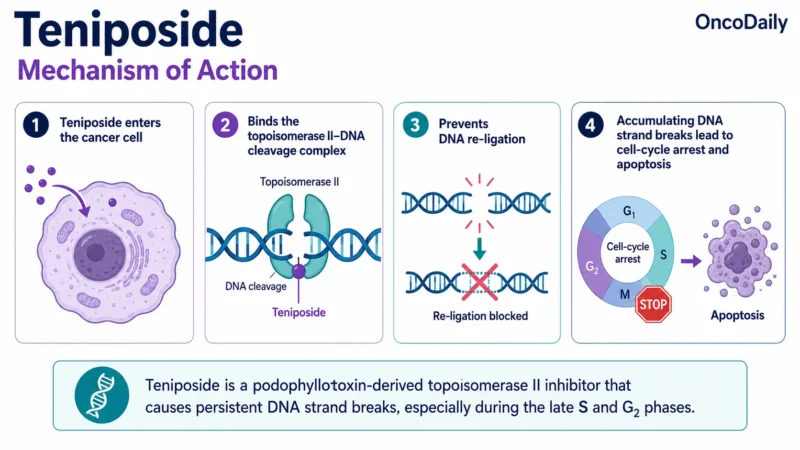
The mechanism can be summarized in four stages:
- Teniposide enters the cancer cell.
- It binds to the topoisomerase II–DNA cleavage complex.
- Teniposide stabilizes this complex and prevents normal DNA re-ligation.
- Accumulating DNA strand breaks interfere with replication and transcription, ultimately promoting cell-cycle arrest and cancer-cell death.
Like etoposide, teniposide is considered most active in proliferating cells and has strong activity during the late S and G2 phases of the cell cycle.
Watch more: Teniposide and Topoisomerase II Inhibitors
What Is the Dose of Teniposide?
Teniposide dosing is highly protocol-specific.
Because contemporary U.S. commercial availability is discontinued and most teniposide regimens originate from historical leukemia protocols, a single universal modern dosing schedule should not be presented as standard across diseases.
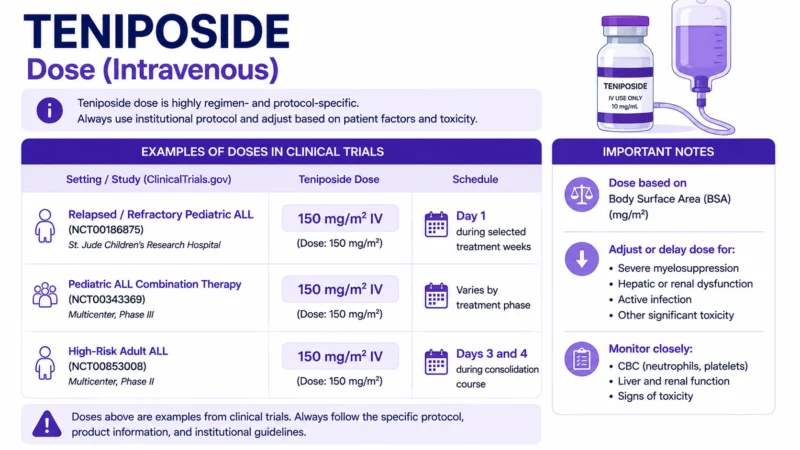
Examples from clinical studies include:
Relapsed or Refractory Pediatric ALL
In the St. Jude protocol registered as NCT00186875, teniposide was incorporated into multidrug therapy at:
150 mg/m² IV on Day 1
during selected treatment weeks, combined with cytarabine.
High-Risk Adult ALL
In NCT00853008, teniposide was administered during consolidation as:
150 mg/m² IV on Days 3 and 4
within a multiagent high-risk ALL regimen.
These examples illustrate why teniposide dosing should always be interpreted in the context of the specific leukemia protocol, rather than generalized across all settings.
How Is Teniposide Administered?
Teniposide is administered intravenously.
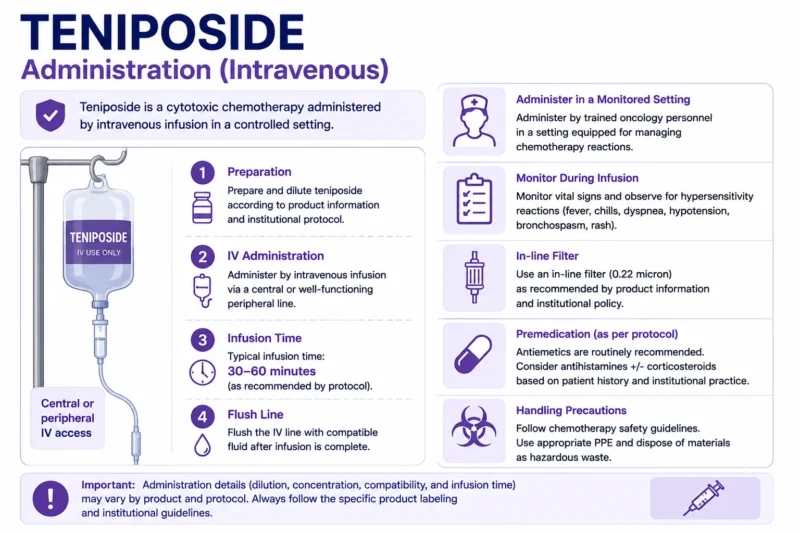
Because it is a cytotoxic chemotherapy with significant hematologic and hypersensitivity risks, administration should occur in a monitored oncology setting.
Important practical considerations include:
- IV administration by trained oncology personnel
- Careful monitoring during infusion
- Assessment for hypersensitivity or anaphylactoid reactions
- Regular complete blood counts
- Dose adjustment or treatment delay when severe cytopenias occur.
Exact dilution, infusion duration, compatibility, and preparation requirements should follow the specific product information or institutional protocol used for the available formulation.
Does Teniposide Require an In-Line Filter?
A universal modern in-line filter recommendation cannot be applied to all teniposide products because currently available formulations and regional product instructions differ.
If teniposide is used, the oncology pharmacy should follow:
- The specific manufacturer’s instructions
- Institutional chemotherapy standards
- Compatibility requirements of the formulation and infusion system.
Is Premedication Required?
Routine universal premedication is not necessarily required for every teniposide regimen.
However, teniposide can cause hypersensitivity and anaphylactoid reactions, so patients should be monitored during administration.
Supportive therapy may include:
- Antiemetics
- Antihistamines
- Corticosteroids
- Other supportive medications
depending on the complete treatment regimen and prior infusion history.
Are Dose Reductions Used?
Yes.
Dose modification may be necessary because of:
- Neutropenia
- Thrombocytopenia
- Severe infection
- Previous chemotherapy
- Reduced bone-marrow reserve
- Significant hepatic or renal dysfunction
- Serious hypersensitivity
- Other clinically important toxicity.
Patients with leukemia and Down syndrome have historically been considered particularly sensitive to myelosuppressive chemotherapy, and reduced initial dosing has been recommended in older teniposide references.
What Is Known About Teniposide Pharmacokinetics?
Teniposide is highly protein bound, with reported binding exceeding 99% in pharmacokinetic summaries.
Its disposition involves:
- Extensive plasma-protein binding
- Hepatic metabolism
- Renal and nonrenal elimination
- Distribution into tissues, with some CNS penetration described in clinical literature.
Because protein binding is high, changes in albumin and concurrent medications that alter protein binding or metabolism may affect exposure.
Are Renal or Hepatic Dose Adjustments Required?
There is no simple modern universal renal or hepatic dose-adjustment table that applies across all teniposide protocols.
Dose selection should take into account:
- Renal function
- Hepatic function
- Serum albumin
- Bone-marrow reserve
- Previous chemotherapy
- Other medications
- Protocol-specific toxicity criteria.
Historical leukemia protocols frequently adjusted treatment based primarily on hematologic recovery and overall toxicity.
What Did Teniposide Clinical Trials Show?
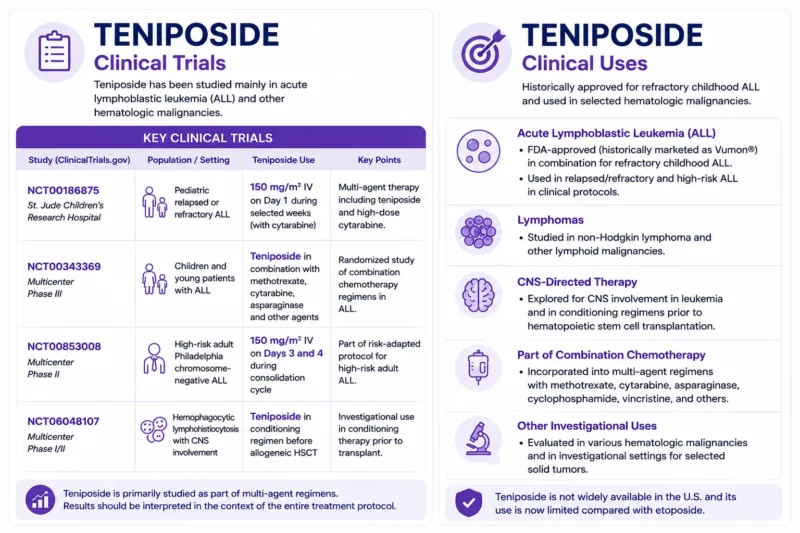
Pediatric Relapsed or Refractory ALL
The St. Jude study NCT00186875 evaluated intensive risk-directed therapy for pediatric patients with relapsed or refractory ALL.
Teniposide was incorporated with high-dose cytarabine during consolidation and continuation phases.
The study demonstrates how teniposide was used as part of a broader multiagent leukemia strategy rather than as a stand-alone treatment.
Childhood ALL Combination Therapy
NCT00343369 evaluated combination chemotherapy in young patients with ALL and incorporated teniposide along with:
- Methotrexate
- Cytarabine
- High-dose cytarabine
- Asparaginase
- Cyclophosphamide
- Other leukemia-directed agents.
High-Risk Adult ALL
NCT00853008 evaluated risk-adapted treatment for high-risk Philadelphia chromosome-negative adult ALL.
Teniposide was included in consolidation at 150 mg/m² IV on Days 3 and 4 during one treatment cycle.
Contemporary Investigational Use
Teniposide has also continued to appear in selected investigational protocols.
For example, NCT06048107 evaluates teniposide incorporated into a busulfan/cyclophosphamide conditioning strategy before allogeneic hematopoietic stem-cell transplantation in patients with hemophagocytic lymphohistiocytosis involving the central nervous system.
Is Teniposide FDA Approved?
Teniposide was FDA approved under the brand name Vumon for use in combination with other anticancer drugs for induction therapy of refractory childhood acute lymphoblastic leukemia.
However, this requires an important distinction:
Teniposide is an FDA-approved active ingredient, but its U.S. commercial availability is listed as discontinued.
Therefore, the article should not imply that Vumon is routinely available in current U.S. oncology practice.
What Is the Current Role of Teniposide?
Teniposide now has a limited contemporary role compared with historically.
Its most important historical use was in:
- Refractory childhood ALL
- Relapsed pediatric ALL
- High-risk leukemia protocols
- Selected lymphoma regimens.
Modern leukemia therapy has changed substantially with improved risk stratification, targeted therapy, immunotherapy, cellular therapy, and alternative chemotherapy combinations.
As a result, etoposide is encountered much more frequently than teniposide in current oncology practice, although teniposide continues to appear in selected regional and investigational protocols.
Read more: Explore current approaches to acute lymphoblastic leukemia in children on OncoDaily.
What Are the Side Effects of Teniposide?
Important adverse effects include:
- Neutropenia
- Leukopenia
- Thrombocytopenia
- Anemia
- Infection
- Nausea
- Vomiting
- Mucositis
- Diarrhea
- Alopecia
- Hypotension
- Hypersensitivity reactions
- Anaphylactoid reactions
- Hepatic toxicity
- Secondary malignancies.
Myelosuppression
Myelosuppression is the major dose-limiting toxicity of teniposide.
Patients receiving multiagent leukemia therapy may develop profound:
- Neutropenia
- Thrombocytopenia
- Anemia.
Complete blood counts should therefore be monitored closely throughout treatment.
Hypersensitivity Reactions
Teniposide can cause significant infusion-related hypersensitivity reactions.
Symptoms may include:
- Fever
- Chills
- Dyspnea
- Bronchospasm
- Tachycardia
- Hypotension
- Flushing.
Severe reactions require immediate discontinuation and appropriate supportive management.
Gastrointestinal Toxicity
Reported gastrointestinal effects include:
- Nausea
- Vomiting
- Diarrhea
- Mucositis
- Reduced appetite.
Secondary Leukemia
As with other topoisomerase II inhibitors, exposure to teniposide has been associated with therapy-related acute leukemia, particularly when used with other DNA-damaging chemotherapy.