





Pentostatin: Understanding Its Mechanism, Dosing, and Clinical Role in Leukemia
Key takeaways
- Pentostatin is a purine analog chemotherapy approved for adults with untreated or alpha-interferon-refractory hairy cell leukemia with active disease.
- It inhibits adenosine deaminase, leading to intracellular dATP accumulation, impaired DNA synthesis, and apoptosis.
- The standard dose is 4 mg/m² intravenously every two weeks.
- Pentostatin may be administered by IV bolus or infusion over 20–30 minutes.
- Clinical trials demonstrated high complete remission rates and prolonged disease control in hairy cell leukemia.
- Major toxicities include myelosuppression, infections, nephrotoxicity, hepatotoxicity, and neurotoxicity.
- Pentostatin should not be combined with fludarabine because of the risk of severe or fatal pulmonary toxicity.
Pentostatin (Nipent) is a purine analog and antimetabolite chemotherapy used primarily in the treatment of hairy cell leukemia (HCL). Unlike conventional nucleoside analogs that directly interfere with DNA synthesis through incorporation into DNA, pentostatin inhibits the enzyme adenosine deaminase (ADA), leading to the accumulation of toxic intracellular nucleotides and disruption of DNA synthesis. It is FDA-approved as a single-agent treatment for adults with untreated or alpha-interferon-refractory hairy cell leukemia who have active disease.
This article aims to review pentostatin’s mechanism of action, dose, administration, clinical uses, clinical-trial findings, pharmacokinetics, safety profile, and current clinical role, with particular attention to its effectiveness in hairy cell leukemia and its important immunosuppressive and renal toxicities.
Key Facts
- Generic name: Pentostatin
- Brand name: Nipent
- Other name: 2′-Deoxycoformycin (DCF)
- Drug class: Purine analog; antimetabolite
- Route: Intravenous (IV)
- Primary approved indication: Hairy cell leukemia
- Standard dose: 4 mg/m²
- Treatment cycle: Every 2 weeks
- Administration: IV bolus or infusion over 20–30 minutes
- Major mechanism: Inhibition of adenosine deaminase (ADA)
- FDA approval: October 11, 1991
- Major toxicities: Myelosuppression, infections, nephrotoxicity, hepatotoxicity, and neurotoxicity
- Important monitoring: CBC, renal function, liver function, and infection
- Key caution: Pentostatin should not be combined with fludarabine because of the risk of severe or fatal pulmonary toxicity.
What Is Pentostatin?
Pentostatin is a potent inhibitor of adenosine deaminase, an enzyme involved in purine metabolism.
It was originally isolated from fermentation cultures of Streptomyces antibioticus.
Adenosine deaminase is particularly active in lymphoid cells, with higher activity in T cells than in B cells.
Pentostatin blocks this enzyme, resulting in the accumulation of deoxyadenosine and its phosphorylated metabolites.
The accumulation of deoxyadenosine triphosphate (dATP) interferes with DNA synthesis and contributes to malignant-cell death.
Pentostatin has demonstrated substantial activity in hairy cell leukemia, where it can produce prolonged complete remissions.
What Is the Mechanism of Action of Pentostatin?
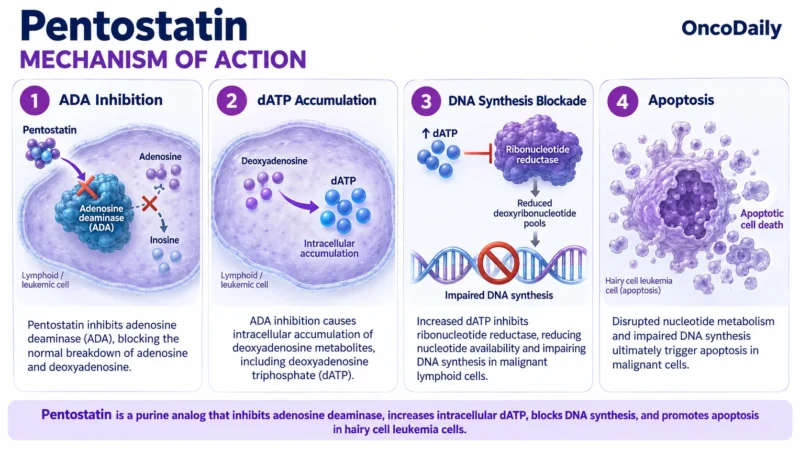
Pentostatin produces cytotoxic effects through several interconnected mechanisms.
1. Inhibition of Adenosine Deaminase
Pentostatin inhibits adenosine deaminase (ADA), an enzyme responsible for the metabolism of adenosine and deoxyadenosine.
This prevents the normal breakdown of these nucleosides.
2. Accumulation of Deoxyadenosine
ADA inhibition leads to increased intracellular concentrations of deoxyadenosine.
Deoxyadenosine undergoes phosphorylation to form deoxyadenosine triphosphate.
dATP
3. Inhibition of Ribonucleotide Reductase
Elevated intracellular dATP inhibits ribonucleotide reductase.
This reduces the availability of deoxyribonucleotides required for DNA synthesis.
4. Disruption of DNA and RNA Synthesis
Pentostatin interferes with DNA synthesis and can also inhibit RNA synthesis.
Increased DNA damage may further contribute to its cytotoxic activity.
5. Apoptosis
Disruption of nucleotide metabolism and DNA synthesis ultimately promotes apoptosis in malignant lymphoid cells.
The mechanism can be summarized as:
Pentostatin → ADA inhibition → deoxyadenosine accumulation → increased intracellular dATP → ribonucleotide reductase inhibition → impaired DNA synthesis → apoptosis.
The precise contribution of each mechanism to pentostatin’s clinical activity in hairy cell leukemia has not been fully established.
What Is the Dose of Pentostatin?
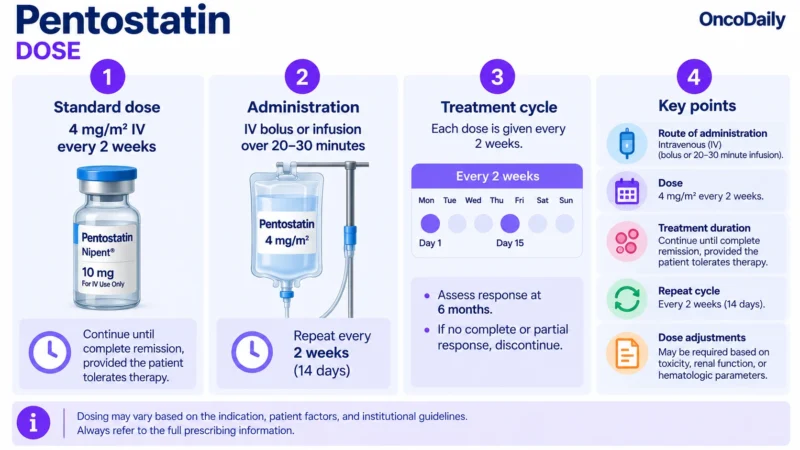
For adults with hairy cell leukemia, the FDA-recommended regimen is:
4 mg/m² IV every 2 weeks.
Pentostatin may be administered as an intravenous bolus injection or diluted and infused over 20–30 minutes.
Higher doses are not recommended because severe renal, hepatic, pulmonary, and central nervous system toxicities were observed in early dose-escalation studies.
Treatment Duration
Treatment is generally continued until complete remission is achieved, provided the patient continues to benefit and does not develop major toxicity.
The prescribing information recommends considering two additional doses after complete remission.
Patients should be assessed for treatment response at six months.
If no complete or partial response is achieved, pentostatin should be discontinued.
Patients achieving partial remission may continue treatment in an effort to achieve complete remission.
If the best response after 12 months remains partial remission, discontinuation is recommended.
How Is Pentostatin Administered?
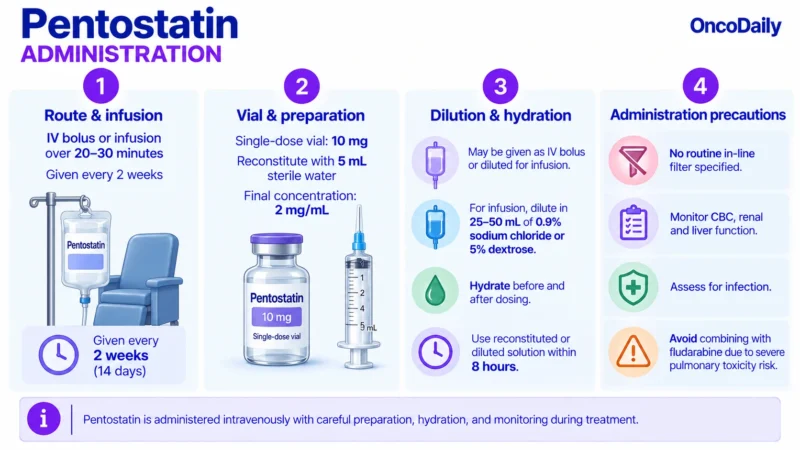
Pentostatin is administered intravenously.
For the standard hairy cell leukemia regimen:
4 mg/m² IV → bolus or 20–30-minute infusion → repeat every 2 weeks.
The commercially available formulation contains:
10 mg of pentostatin per single-dose vial.
Preparation and Dilution
The lyophilized powder is reconstituted with 5 mL of sterile water for injection.
The resulting concentration is:
2 mg/mL
The reconstituted solution may be administered by IV bolus or further diluted using:
- 0.9% sodium chloride
- 5% dextrose.
For infusion, the required dose may be diluted in 25–50 mL of compatible solution.
The reconstituted or diluted solution should be used within eight hours.
Unopened vials should be stored refrigerated at 2–8°C.
Hydration
Adequate hydration is important because pentostatin is primarily eliminated through the kidneys.
The US prescribing information recommends:
Before administration: 500–1,000 mL of 5% dextrose in half-normal saline or equivalent.
After administration: An additional 500 mL of 5% dextrose or equivalent.
Hydration should be individualized according to the patient’s cardiovascular and renal status.
Does Pentostatin Require an In-Line Filter?
No routine in-line filter is specifically required by the US prescribing information.
The reconstituted solution should be visually inspected for particulate matter and discoloration before administration.
Product-specific instructions and institutional chemotherapy procedures should be followed.
Does Pentostatin Require Premedication?
No specific routine premedication is mandatory.
However, supportive treatment is important because pentostatin can cause nausea, vomiting, immunosuppression, and renal toxicity.
Antiemetic Prophylaxis
Antiemetics may be administered according to the treatment protocol and individual patient risk.
Hydration
Intravenous hydration before and after pentostatin is recommended.
Infection Prophylaxis
Because pentostatin can cause substantial and prolonged immunosuppression, antimicrobial prophylaxis may be incorporated into treatment protocols.
Prophylaxis should be individualized according to the patient’s lymphocyte count, previous infections, and institutional guidelines.
Are Dose Reductions Used?
Yes.
Treatment interruption or discontinuation may be necessary for:
- Renal impairment
- Severe neutropenia
- Active infection
- Severe rash
- Neurologic toxicity
- Other significant adverse reactions.
For patients who begin treatment with an absolute neutrophil count above 500 cells/mm³, pentostatin should be temporarily withheld if the count falls below 200 cells/mm³ during treatment.
Treatment may resume when the neutrophil count returns to its pretreatment level.
The prescribing information does not recommend an automatic starting-dose reduction solely for disease-related anemia, neutropenia, or thrombocytopenia.
What Is the Pharmacokinetic Profile of Pentostatin?
Pentostatin is administered intravenously and undergoes substantial renal elimination.
Distribution
Plasma protein binding is low, approximately 4%.
Metabolism
Pentostatin acts primarily through inhibition of adenosine deaminase.
It does not require conversion into an active triphosphate metabolite in the same way as conventional purine nucleoside analogs.
Elimination
Approximately 90% of an administered dose is recovered in urine as unchanged pentostatin and/or metabolites measured by ADA-inhibitory activity.
The mean terminal plasma elimination half-life is approximately:
5.7 hours
In patients with significant renal impairment, the half-life may be substantially prolonged.
Does Pentostatin Require Renal or Hepatic Dose Adjustment?
Renal Impairment
Yes. Renal function is particularly important during pentostatin treatment.
The US prescribing information does not establish a standard dose for patients with creatinine clearance below 60 mL/min.
Patients with renal impairment should be treated only when the potential benefit justifies the potential risk.
The label reports that two patients with creatinine clearance of 50–60 mL/min achieved complete responses with a reduced dose of 2 mg/m². This observation does not establish a validated dosing recommendation.
Hepatic Impairment
There is no established universal dose-adjustment schedule for patients with hepatic impairment.
Pentostatin may cause elevated liver enzymes and severe hepatic toxicity, particularly at higher doses.
Patients with significant hepatic dysfunction require careful monitoring.
What Are the Clinical Uses of Pentostatin?
Hairy Cell Leukemia
Pentostatin’s principal clinical application is hairy cell leukemia.
It is approved for adults with untreated or alpha-interferon-refractory disease who require treatment because of clinically significant cytopenias or disease-related symptoms.
It can produce high complete remission rates and prolonged disease control.
Relapsed Hairy Cell Leukemia
Pentostatin may also be used in selected patients whose disease relapses after previous therapy.
The duration of the previous remission, prior treatment exposure, and availability of alternative therapies influence treatment selection.
Other Hematologic Malignancies
Pentostatin has also been investigated in other lymphoid malignancies, including:
- T-cell prolymphocytic leukemia
- Chronic lymphocytic leukemia
- Cutaneous T-cell lymphoma.
These are not FDA-approved indications for pentostatin.
What Did Pentostatin Clinical Trials Show?
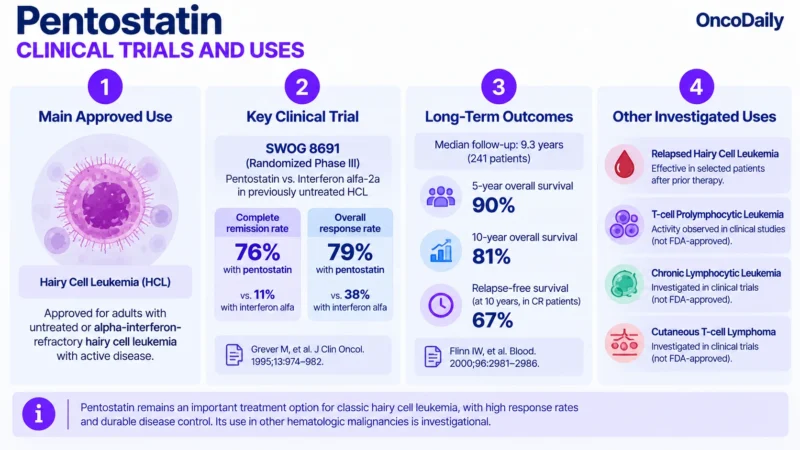
Pentostatin Versus Interferon Alfa in Hairy Cell Leukemia
The randomized intergroup SWOG 8691 study compared pentostatin with interferon alfa-2a in previously untreated hairy cell leukemia.
Among 313 eligible patients, 154 received pentostatin and 159 received interferon alfa.
Confirmed complete remission rates were:
- Pentostatin: 76%
- Interferon alfa: 11%.
Confirmed overall response rates were:
- Pentostatin: 79%
- Interferon alfa: 38%.
Pentostatin also produced longer relapse-free survival.
These results established pentostatin as an important treatment for hairy cell leukemia.
Long-Term Outcomes Following Pentostatin
A long-term analysis followed 241 patients treated with pentostatin, either initially or after failure of interferon alfa.
At a median follow-up of 9.3 years, estimated survival rates were:
- Five-year overall survival: 90%
- Ten-year overall survival: 81%.
Among patients achieving confirmed complete remission, estimated relapse-free survival was 85% at five years and 67% at ten years.
These findings demonstrated that pentostatin can produce durable disease control in hairy cell leukemia.
The survival estimates describe the followed population and should not be interpreted as a randomized comparison of overall survival between treatments.
Is Pentostatin FDA Approved?
Yes.
Pentostatin received FDA approval on October 11, 1991, under the brand name Nipent.
Its initial approval was for adult patients with alpha-interferon-refractory hairy cell leukemia.
The current US prescribing information includes single-agent treatment of adults with previously untreated or alpha-interferon-refractory hairy cell leukemia with active disease.
Pentostatin is not FDA-approved for CLL, T-cell prolymphocytic leukemia, or cutaneous T-cell lymphoma.
What Is the Current Clinical Role of Pentostatin?
Pentostatin remains an established treatment option for classic hairy cell leukemia.
Purine analogs, including pentostatin and cladribine, can produce durable remissions in patients requiring treatment.
Its clinical role includes:
- Initial treatment of selected patients with classic HCL
- Treatment of relapsed HCL
- Selected hematologic malignancy protocols.
Newer treatment strategies, including anti-CD20 antibodies and BRAF-directed therapies, have expanded therapeutic options for patients with relapsed or refractory disease.
Learn more about the signs, diagnosis, and treatment of hairy cell leukemia on OncoDaily.
Watch more: Highlights in Therapy: Hairy Cell Leukemia — Dr. Leslie Andritsos discusses emerging therapies, relapsed/refractory disease, and treatment-related side effects.
What Are the Major Side Effects of Pentostatin?
Pentostatin can cause substantial hematologic and nonhematologic toxicity.
Common adverse effects include:
- Nausea and vomiting
- Fever
- Fatigue
- Rash
- Pruritus
- Myelosuppression
- Infections
- Diarrhea
- Headache
- Elevated liver enzymes.
In patients receiving frontline pentostatin in the pivotal clinical-trial safety population, nausea and/or vomiting occurred in 63%, fever in 46%, rash in 43%, and fatigue in 42%.
The following sections review the clinically important toxicities in greater detail.
Myelosuppression
Pentostatin may cause bone-marrow suppression, particularly during the initial treatment cycles.
Common hematologic toxicities include:
- Neutropenia
- Anemia
- Thrombocytopenia
- Leukopenia.
Severe neutropenia may initially worsen in patients with progressive hairy cell leukemia.
Close monitoring of blood counts is essential.
Immunosuppression and Infections
Pentostatin can cause substantial and prolonged immunosuppression.
Patients may develop:
- Bacterial infections
- Viral infections
- Fungal infections
- Opportunistic infections.
Herpes zoster and pneumonia have been reported.
Patients with active infections should be carefully evaluated before treatment initiation.
Nephrotoxicity
Pentostatin may cause renal dysfunction and elevated serum creatinine.
Severe renal toxicity was observed at higher doses in early clinical studies.
Patients with pre-existing renal impairment are at increased risk because renal clearance is reduced.
Adequate hydration and renal-function monitoring are important during treatment.
Hepatotoxicity
Pentostatin can cause elevated liver enzymes and hepatic dysfunction.
Most liver-function abnormalities reported at the recommended dose were reversible.
Severe hepatic toxicity has been associated with higher doses.
Neurotoxicity
Pentostatin may cause neurologic adverse reactions, including:
- Confusion
- Dizziness
- Neuropathy
- Seizures
- Other central nervous system disturbances.
Treatment should be withheld or discontinued if clinically significant neurologic toxicity develops.
Gastrointestinal Toxicity
Common gastrointestinal side effects include nausea, vomiting, diarrhea, abdominal pain, and reduced appetite.
In frontline clinical studies, nausea and/or vomiting occurred in approximately 63% of patients.
Skin Toxicity
Pentostatin may cause rash, pruritus, and other dermatologic reactions.
Severe rash may require treatment interruption.
Rare serious reactions, including exfoliative dermatitis, have been reported after marketing.
Pulmonary Toxicity
Severe pulmonary toxicity has been reported with certain pentostatin-containing combinations.
Pentostatin should not be combined with fludarabine phosphate.
In a small study of refractory CLL, four of six patients receiving the combination developed severe or fatal pulmonary toxicity.
The US prescribing information includes this warning because of the potential for life-threatening complications.
Pregnancy and Reproductive Toxicity
Pentostatin may cause fetal harm and may impair fertility.
The US label recommends effective contraception for females of reproductive potential during treatment and for six months after the last dose.
Males with female partners of reproductive potential should use effective contraception during treatment and for three months after the last dose.
What Monitoring Is Required?
Monitoring should include:
- CBC with differential
- Platelet count
- Renal function
- Liver function
- Assessment for infection
- Neurologic assessment
- Assessment of hydration status
- Monitoring for disease response.
Because pentostatin is primarily eliminated through the kidneys, renal function should be assessed before every dose.