





Pemetrexed: Understanding Its Mechanism, Dosing, and Clinical Role
Key takeaways
- Pemetrexed is a multitargeted antifolate chemotherapy that inhibits TS, DHFR, and GARFT.
- It is administered intravenously at 500 mg/m² every 21 days in most approved adult indications.
- Folic acid and vitamin B12 supplementation are essential to reduce treatment-related toxicity.
- Pemetrexed is a major chemotherapy backbone for non-squamous NSCLC.
- It is also an established component of treatment for malignant pleural mesothelioma.
- KEYNOTE-189 established the major role of pemetrexed, platinum chemotherapy, and pembrolizumab in advanced non-squamous NSCLC without EGFR or ALK alterations.
- PARAMOUNT demonstrated the benefit of continuation maintenance pemetrexed.
- Renal function is critically important because pemetrexed is primarily renally eliminated.
- Pemetrexed should not be administered when creatinine clearance is below 45 mL/min.
- Major toxicities include myelosuppression, fatigue, gastrointestinal toxicity, rash, and renal toxicity.
Pemetrexed is an intravenous antifolate antimetabolite chemotherapy that inhibits several folate-dependent enzymes required for nucleotide synthesis. It is primarily used in non-squamous non-small cell lung cancer (NSCLC) and malignant pleural mesothelioma, where it remains an important component of combination treatment and maintenance strategies.
This article aims to review pemetrexed’s mechanism of action, dose, administration, clinical uses, pharmacokinetics, clinical-trial findings, safety profile, approval status, and current clinical role. Because pemetrexed can cause significant myelosuppression, renal toxicity, and mucosal toxicity, appropriate vitamin supplementation and clinical monitoring are essential during treatment.
Pemetrexed Key Facts
- Generic name: Pemetrexed
- Brand name: Alimta
- Drug class: Antifolate antimetabolite
- Administration: Intravenous
- Main cancers: Non-squamous NSCLC and malignant pleural mesothelioma
- Mechanism: Inhibits multiple folate-dependent enzymes involved in DNA and RNA synthesis
- Key targets: Thymidylate synthase, dihydrofolate reductase, and glycinamide ribonucleotide formyltransferase
- Typical dose: 500 mg/m² IV every 21 days
- Key supportive therapy: Folic acid and vitamin B12 supplementation
- Common combinations: Platinum chemotherapy, pembrolizumab, and other systemic therapies depending on disease setting
- Major toxicities: Myelosuppression, fatigue, nausea, mucositis, rash, diarrhea, and renal toxicity
- Important limitation: Not recommended when creatinine clearance is below 45 mL/min
- FDA status: FDA approved for several NSCLC and mesothelioma treatment settings
What Is Pemetrexed?
Pemetrexed is a multitargeted antifolate chemotherapy that interferes with folate-dependent pathways required for cancer-cell proliferation.
Unlike antifolates that primarily inhibit a single enzyme, pemetrexed inhibits several enzymes involved in purine and pyrimidine synthesis. Its major intracellular targets include thymidylate synthase (TS), dihydrofolate reductase (DHFR), and glycinamide ribonucleotide formyltransferase (GARFT).
This multitargeted activity decreases the availability of nucleotides needed for DNA and RNA synthesis, ultimately disrupting replication and leading to cancer-cell death.
Pemetrexed is particularly important in non-squamous NSCLC, where it can be combined with platinum chemotherapy and immune-checkpoint inhibition or used as maintenance therapy after initial treatment.
It is also a foundational component of systemic treatment for malignant pleural mesothelioma, most commonly combined with cisplatin.
Pemetrexed Mechanism of Action
Pemetrexed enters cells through reduced folate transport systems and folate-binding protein transport mechanisms. Once inside the cell, it undergoes polyglutamation, which increases intracellular retention and enhances inhibition of its target enzymes.
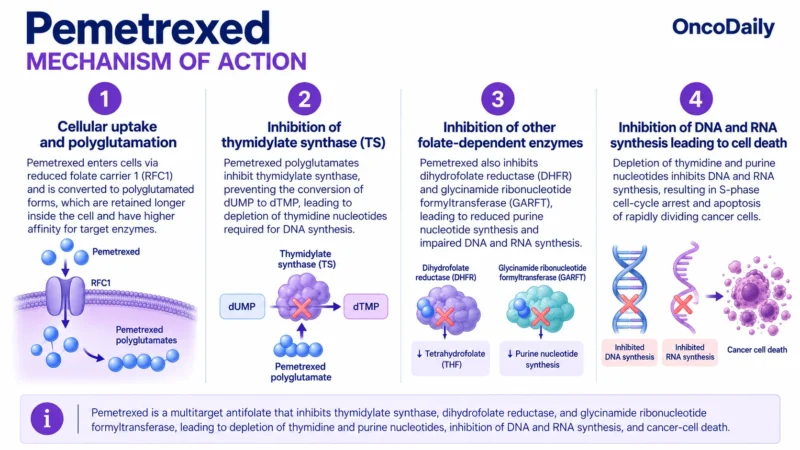
The principal targets are:
Thymidylate Synthase
Inhibition of thymidylate synthase decreases production of thymidine nucleotides required for DNA synthesis.
Dihydrofolate Reductase
Inhibition of DHFR disrupts regeneration of tetrahydrofolate cofactors required for nucleotide biosynthesis.
Glycinamide Ribonucleotide Formyltransferase
GARFT inhibition interferes with de novo purine synthesis, further reducing the nucleotide pool required for DNA and RNA production.
The overall pathway can be summarized as:
Pemetrexed → intracellular uptake → polyglutamation → inhibition of TS/DHFR/GARFT → impaired nucleotide synthesis → DNA/RNA disruption → cancer-cell death
The cytotoxic effect is particularly relevant in rapidly proliferating tumor cells that have high requirements for nucleotide synthesis.
What Is the Dose of Pemetrexed?
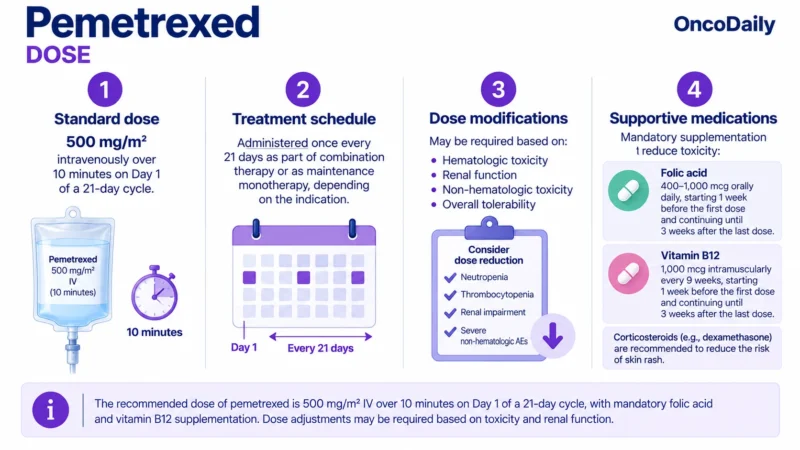
The standard recommended pemetrexed dose for most approved adult indications is:
500 mg/m² IV on Day 1 of a 21-day cycle.
The dose is generally administered once every three weeks and may be continued according to the treatment setting and clinical response.
For malignant pleural mesothelioma, pemetrexed is typically administered with cisplatin.
For non-squamous NSCLC, pemetrexed may be administered with platinum chemotherapy, with pembrolizumab-containing regimens, or as maintenance therapy depending on the disease setting.
Dose modifications may be required for:
- Myelosuppression
- Renal impairment
- Severe mucositis
- Other significant treatment-related toxicity.
Pemetrexed should not be administered when creatinine clearance is below 45 mL/min because of increased systemic exposure and toxicity.
How Is Pemetrexed Administered?
Pemetrexed is administered intravenously, generally as a short infusion over approximately 10 minutes.
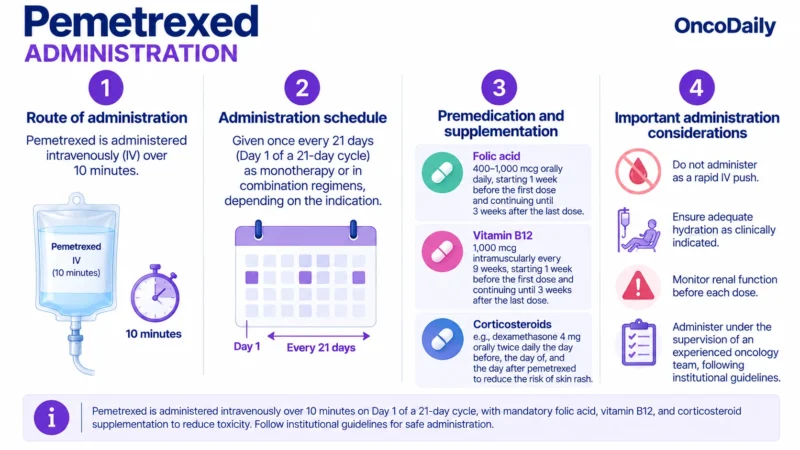
The recommended dose is diluted and administered through an appropriate IV line according to the prescribing information and institutional chemotherapy procedures.
Pemetrexed is administered on Day 1 of each 21-day cycle.
For patients receiving combination therapy, the sequencing of pemetrexed with platinum chemotherapy or immunotherapy follows the specific treatment protocol.
Appropriate laboratory monitoring should be performed before each cycle.
Does Pemetrexed Require an In-Line Filter?
There is no universal requirement for an in-line filter for routine pemetrexed administration.
Preparation and administration should follow the applicable product information and institutional pharmacy protocol.
The major administration considerations are correct reconstitution and dilution, appropriate IV access, vitamin supplementation, and monitoring for treatment-related toxicity.
Is Premedication Required?
Yes. Folic acid and vitamin B12 supplementation are essential when administering pemetrexed.
Patients should begin:
Folic acid 400–1,000 micrograms orally once daily
before the first dose of pemetrexed and continue supplementation throughout treatment and for 21 days after the final dose.
Patients should also receive:
Vitamin B12 1 mg intramuscularly approximately every 9 weeks
with the first injection administered 7 days before the first pemetrexed dose.
If vitamin B12 was not administered before treatment, it should be given as soon as possible.
Corticosteroid Premedication
Dexamethasone is commonly administered to reduce the incidence and severity of cutaneous reactions associated with pemetrexed.
The prescribing information recommends:
Dexamethasone 4 mg orally twice daily for 3 consecutive days, beginning on the day before pemetrexed administration.
If an alternative corticosteroid is used, an equivalent regimen should be selected according to clinical practice.
Are Dose Reductions Used?
Yes.
Pemetrexed dose modification is primarily guided by hematologic and nonhematologic toxicity.
Treatment should generally be withheld until:
- ANC is ≥1,500 cells/mm³
- Platelet count is ≥100,000 cells/mm³
- Creatinine clearance is ≥45 mL/min
- Clinically significant nonhematologic toxicity has recovered to an acceptable level.
Dose reductions may be necessary following severe:
- Neutropenia
- Thrombocytopenia
- Febrile neutropenia
- Mucositis
- Severe diarrhea
- Other grade 3–4 toxicities.
Patients who experience recurrent severe toxicity despite dose modification may require permanent discontinuation.
What Is Known About Pemetrexed Pharmacokinetics?
Pemetrexed demonstrates approximately dose-proportional pharmacokinetics across the recommended dose range.
After intravenous administration, pemetrexed has a relatively large volume of distribution and is approximately 81% plasma-protein bound.
The drug undergoes limited hepatic metabolism and is eliminated predominantly through the kidneys by glomerular filtration and active tubular secretion.
The terminal half-life is approximately 3.5 hours in patients with normal renal function.
Because renal elimination is the major route of clearance, renal impairment can substantially increase systemic exposure and toxicity.
This is why renal function must be assessed before each treatment cycle.
Are Renal or Hepatic Dose Adjustments Required?
Renal Impairment
Renal function is particularly important with pemetrexed.
Pemetrexed should not be administered when creatinine clearance is below 45 mL/min.
Patients with reduced renal function have increased pemetrexed exposure and a higher risk of severe myelosuppression and other toxicities.
Creatinine clearance should therefore be calculated before each cycle rather than relying solely on serum creatinine.
Concomitant medications that interfere with renal tubular secretion should also be considered.
Hepatic Impairment
Pemetrexed undergoes limited hepatic metabolism, and mild-to-moderate hepatic dysfunction does not generally require a predefined dose adjustment.
However, patients with clinically significant hepatic abnormalities should be monitored carefully because pemetrexed is commonly administered in combination with other potentially hepatotoxic therapies.
What Are the Clinical Uses of Pemetrexed?
Non-Squamous Non-Small Cell Lung Cancer
Pemetrexed is one of the most important chemotherapy agents used in non-squamous NSCLC.
It can be used:
- With cisplatin or carboplatin
- With pembrolizumab and platinum chemotherapy
- As maintenance therapy following platinum-based induction
- In selected patients with advanced or metastatic disease.
Pemetrexed is generally not recommended for squamous NSCLC, where its activity is substantially less favorable.
Read more: Lung Cancer: Types, Symptoms, Diagnosis, and Treatment on OncoDaily
Malignant Pleural Mesothelioma
Pemetrexed combined with cisplatin is an established systemic treatment for malignant pleural mesothelioma.
The combination became a major therapeutic standard after demonstrating improved survival and disease-control outcomes compared with cisplatin alone.
Maintenance Therapy in NSCLC
Pemetrexed also has an important role as continuation maintenance therapy after initial platinum-based chemotherapy in patients with advanced non-squamous NSCLC who have not experienced disease progression.
Watch more: Pemetrexed for Advanced NSCLC — OncLive — a discussion of incorporating pemetrexed into treatment for advanced NSCLC based on clinical-trial evidence.
What Did Pemetrexed Clinical Trials Show?
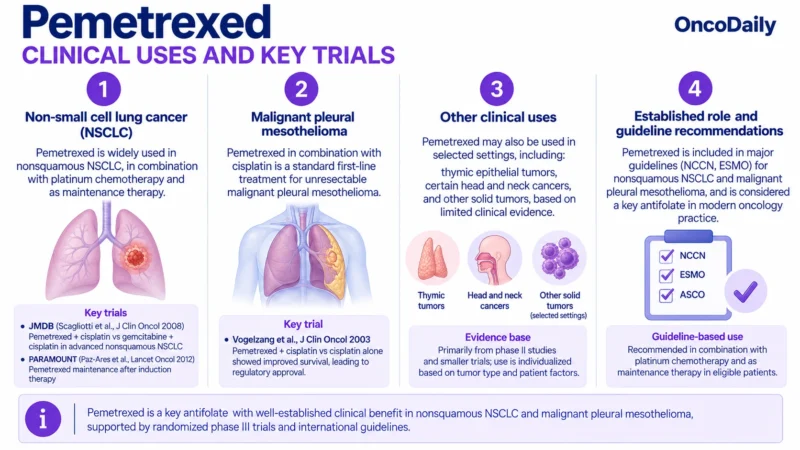
Pemetrexed Plus Cisplatin in Malignant Pleural Mesothelioma
The pivotal phase III trial comparing pemetrexed plus cisplatin with cisplatin alone enrolled 448 patients with malignant pleural mesothelioma.
The combination demonstrated:
- Median overall survival: 12.1 months vs 9.3 months
- Median time to progression: 5.7 months vs 3.9 months
- Response rate: 41.3% vs 16.7%
for pemetrexed plus cisplatin versus cisplatin alone.
The results established pemetrexed plus cisplatin as a major systemic treatment option for malignant pleural mesothelioma.
Pemetrexed Plus Cisplatin in Advanced Non-Squamous NSCLC
A pivotal phase III study compared pemetrexed plus cisplatin with gemcitabine plus cisplatin in 1,725 patients with previously untreated advanced NSCLC.
Overall survival was similar in the overall population, establishing pemetrexed/cisplatin as a non-inferior regimen.
Importantly, prespecified histologic analyses demonstrated a clinically meaningful advantage for pemetrexed/cisplatin in non-squamous histology, while gemcitabine/cisplatin performed better in squamous disease.
This study helped establish pemetrexed as a preferred chemotherapy backbone for non-squamous NSCLC.
PARAMOUNT: Maintenance Pemetrexed
The phase III PARAMOUNT trial evaluated continuation maintenance pemetrexed after induction therapy with cisplatin plus pemetrexed in patients with advanced non-squamous NSCLC.
Continuation pemetrexed significantly improved progression-free survival compared with placebo.
The study supported continuation maintenance pemetrexed as an important treatment strategy for patients who have responded to or remained stable after first-line pemetrexed-based therapy.
KEYNOTE-189: Pemetrexed, Platinum, and Pembrolizumab
The KEYNOTE-189 phase III study evaluated pembrolizumab plus pemetrexed and platinum chemotherapy versus chemotherapy alone in patients with previously untreated metastatic non-squamous NSCLC without EGFR or ALK genomic alterations.
The addition of pembrolizumab produced substantial improvements in:
- Overall survival
- Progression-free survival
- Objective response rate.
Long-term follow-up confirmed the durable benefit of the pembrolizumab-containing regimen.
This trial helped establish pemetrexed + platinum + pembrolizumab as a major first-line treatment platform for advanced non-squamous NSCLC without targetable EGFR or ALK alterations.
Pemetrexed in Previously Treated NSCLC
Pemetrexed was also evaluated against docetaxel in patients with previously treated advanced NSCLC.
The phase III study demonstrated similar overall survival between the two treatments, while pemetrexed was associated with a more favorable toxicity profile, particularly with lower rates of severe neutropenia and febrile neutropenia.
Is Pemetrexed FDA Approved?
Yes.
Pemetrexed is FDA approved for several oncology indications, including:
- Unresectable malignant pleural mesothelioma, in combination with cisplatin
- Locally advanced or metastatic non-squamous NSCLC, in combination with platinum chemotherapy
- Maintenance treatment of non-squamous NSCLC following platinum-based chemotherapy
- Locally advanced or metastatic non-squamous NSCLC after prior chemotherapy, as a single agent.
Pemetrexed is also approved in combination with pembrolizumab and platinum chemotherapy for appropriate patients with metastatic non-squamous NSCLC according to the applicable labeling and treatment setting.
What Is the Current Role of Pemetrexed?
Pemetrexed remains a core chemotherapy platform for non-squamous NSCLC.
Its importance is particularly evident in modern chemoimmunotherapy, where pemetrexed is frequently combined with platinum chemotherapy and pembrolizumab in patients without actionable EGFR or ALK alterations.
It also remains an established option for continuation maintenance therapy after initial pemetrexed-containing chemotherapy.
In malignant pleural mesothelioma, pemetrexed plus platinum-based chemotherapy remains an important systemic treatment approach, although treatment algorithms increasingly incorporate immune-checkpoint inhibitors and other emerging strategies.
The continued relevance of pemetrexed reflects its combination of antitumor activity, predictable administration every three weeks, and a manageable toxicity profile when appropriate vitamin supplementation and monitoring are used.
What Are the Side Effects of Pemetrexed?
Common adverse effects include:
- Fatigue
- Nausea
- Vomiting
- Anorexia
- Myelosuppression
- Anemia
- Neutropenia
- Thrombocytopenia
- Rash
- Diarrhea
- Constipation
- Stomatitis
- Renal toxicity.
Myelosuppression
Bone-marrow suppression is one of the most important toxicities of pemetrexed.
Patients may develop:
- Anemia
- Neutropenia
- Thrombocytopenia
- Febrile neutropenia.
Folic acid and vitamin B12 supplementation substantially reduce the severity of hematologic and gastrointestinal toxicity.
Fatigue
Fatigue is among the most commonly reported adverse effects and can become cumulative with repeated treatment cycles.
Gastrointestinal Toxicity
Pemetrexed can cause:
- Nausea
- Vomiting
- Diarrhea
- Constipation
- Anorexia
- Stomatitis or mucositis.
Antiemetic prophylaxis should be considered according to the complete treatment regimen and individual patient risk.
Skin Reactions
Cutaneous reactions, including rash, can occur.
Dexamethasone premedication reduces the incidence and severity of these reactions.
Renal Toxicity
Renal toxicity is particularly important because pemetrexed is primarily eliminated through the kidneys.
Patients with reduced renal function can develop substantially higher drug exposure and increased toxicity.
Pemetrexed should not be administered when creatinine clearance is below 45 mL/min.
Hepatotoxicity
Transient elevations in liver enzymes may occur.
Patients receiving pemetrexed in combination with immunotherapy, platinum chemotherapy, or other systemic treatments require appropriate liver-function monitoring.