





Mitoxantrone: Understanding Its Mechanism, Dosing, and Clinical Role in Leukemia and Prostate Cancer
Key takeaways
- Mitoxantrone is a synthetic anthracenedione and topoisomerase II inhibitor.
- It is FDA-approved for adult acute nonlymphocytic leukemia, palliative treatment of advanced hormone-refractory prostate cancer, and selected forms of multiple sclerosis.
- Standard AML induction uses 12 mg/m² IV daily on Days 1–3 with cytarabine for seven days.
- Mitoxantrone must be diluted before administration and given intravenously.
- Major toxicities include myelosuppression, cardiotoxicity, infections, extravasation injury, and secondary leukemia.
- Cardiac function should be assessed before treatment, and cumulative exposure is particularly important.
Mitoxantrone is a synthetic anthracenedione chemotherapy and topoisomerase II inhibitor used in selected hematologic and solid-tumor settings. Its principal oncology indications include acute nonlymphocytic leukemia in adults and palliative treatment of pain associated with advanced hormone-refractory prostate cancer. Mitoxantrone is also FDA-approved for selected forms of multiple sclerosis.
This article reviews mitoxantrone’s mechanism of action, dose, administration, clinical uses, clinical-trial findings, pharmacokinetics, safety profile, and current clinical role.
Key Facts
- Generic name: Mitoxantrone hydrochloride
- Former brand name: Novantrone
- Drug class: Anthracenedione; topoisomerase II inhibitor
- Route: Intravenous (IV)
- Major oncology indications: Adult acute nonlymphocytic leukemia and advanced hormone-refractory prostate cancer
- AML induction dose: 12 mg/m² IV daily on Days 1–3
- Prostate cancer dose: 12–14 mg/m² IV every 21 days with corticosteroids
- MS dose: 12 mg/m² IV every 3 months
- Concentration: 2 mg/mL concentrate
- Major mechanism: DNA intercalation and topoisomerase II inhibition
- Major toxicities: Myelosuppression, cardiotoxicity, infections, mucositis, and secondary leukemia
- Important monitoring: CBC, LVEF/cardiac function, liver function, and infection
- Key caution: Mitoxantrone must never be given intrathecally.
What Is Mitoxantrone?
Mitoxantrone is a synthetic anthracenedione antineoplastic agent.
Its structure and activity are related to anthracyclines, but it belongs to the anthracenedione class.
Mitoxantrone interacts directly with DNA and inhibits topoisomerase II, interfering with the ability of malignant cells to replicate and repair their genetic material.
Unlike some cell-cycle-specific agents, mitoxantrone can exert cytotoxic activity against both proliferating and nonproliferating cells.
What Is the Mechanism of Action of Mitoxantrone?
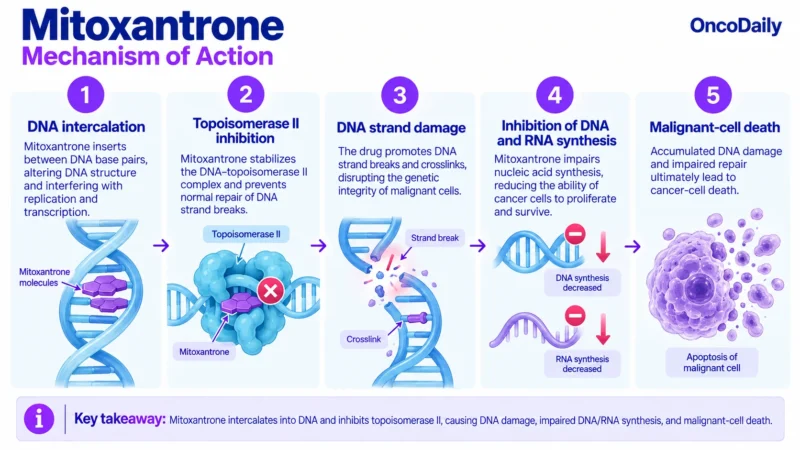
Mitoxantrone produces antitumor activity through several related mechanisms.
1. DNA Intercalation
Mitoxantrone inserts between DNA base pairs through hydrogen bonding.
This alters normal DNA structure and interferes with replication and transcription.
2. Topoisomerase II Inhibition
Mitoxantrone is a potent inhibitor of topoisomerase II.
This enzyme normally creates temporary DNA strand breaks and then repairs them during replication.
Mitoxantrone stabilizes the DNA–topoisomerase II complex, preventing normal DNA repair and promoting accumulation of DNA strand breaks.
3. DNA Crosslinking and Strand Damage
Mitoxantrone can cause DNA crosslinks and strand breaks, further impairing genetic integrity.
4. Interference With RNA
Mitoxantrone also interferes with RNA synthesis and transcription.
5. Cell Death
The accumulation of DNA damage ultimately prevents effective cellular replication and promotes death of malignant cells.
The mechanism can be summarized as:
Mitoxantrone → DNA intercalation + topoisomerase II inhibition → DNA crosslinks and strand breaks → impaired DNA/RNA synthesis → malignant-cell death.
What Is the Dose of Mitoxantrone?
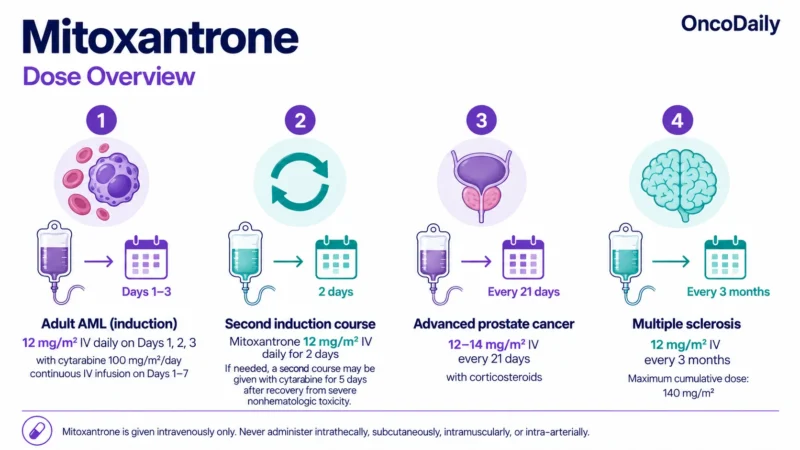
Mitoxantrone dosing depends strongly on the indication.
AML / Acute Nonlymphocytic Leukemia
For initial therapy in adults:
Mitoxantrone 12 mg/m² IV daily on Days 1–3
combined with:
Cytarabine 100 mg/m²/day by continuous IV infusion on Days 1–7.
If the first induction course does not produce an adequate antileukemic response, a second course may be given using:
- Mitoxantrone for 2 days
- Cytarabine for 5 days
at the same daily doses.
If severe or life-threatening nonhematologic toxicity occurs during the first induction course, the second course should be delayed until recovery.
Advanced Hormone-Refractory Prostate Cancer
The recommended dose is:
12–14 mg/m² IV every 21 days
in combination with corticosteroids.
This indication is primarily palliative, particularly for cancer-related pain.
Multiple Sclerosis
For selected patients with worsening forms of MS:
12 mg/m² IV every 3 months.
The lifetime cumulative dose should not exceed:
140 mg/m².
How Is Mitoxantrone Administered?
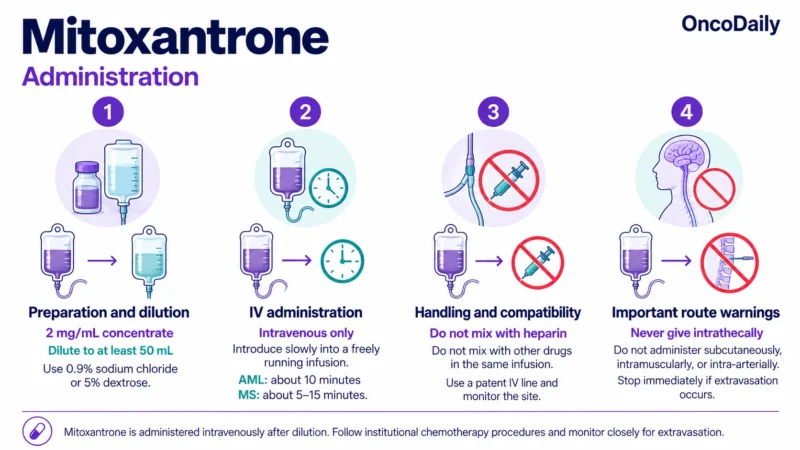
Mitoxantrone is administered intravenously only.
The concentrate contains:
2 mg/mL
and must be diluted before administration.
Preparation and Dilution
The required dose should be diluted to at least:
50 mL
using either:
- 0.9% sodium chloride
- 5% dextrose.
The diluted drug should be introduced slowly into the tubing of a freely running IV infusion.
For AML induction, the pivotal trials administered mitoxantrone over approximately 10 minutes.
For MS, the recommended infusion duration is approximately 5–15 minutes.
The product should not be mixed with heparin because a precipitate may form, and mixing with other drugs in the same infusion is not recommended.
Extravasation Precautions
Mitoxantrone can cause significant local tissue damage if extravasation occurs.
Administration should preferably use a large vein with a freely flowing infusion.
If burning, pain, swelling, erythema, blue discoloration, or other evidence of extravasation develops, administration should be stopped immediately and restarted in another vein.
Important Route Warning
Mitoxantrone must not be given:
- Intrathecally
- Subcutaneously
- Intramuscularly
- Intra-arterially.
Intrathecal administration has caused severe neurologic injury, including paralysis and permanent sequelae.
Does Mitoxantrone Require an In-Line Filter?
No routine in-line filter is specifically required by the US prescribing information.
The product should be prepared and administered according to product-specific and institutional chemotherapy procedures.
Does Mitoxantrone Require Premedication?
No universal mandatory premedication regimen is specified.
However, supportive treatment depends on the indication and complete chemotherapy regimen.
Antiemetic Prophylaxis
Nausea and vomiting are common during mitoxantrone-containing chemotherapy.
Antiemetic prophylaxis should be provided according to the emetogenic risk of the full regimen.
Tumor Lysis Prevention
In leukemia, rapid tumor-cell destruction may cause hyperuricemia and tumor lysis syndrome.
Serum uric acid should be monitored and uric acid–lowering therapy may be initiated before antileukemic treatment in high-risk patients.
Cardiac Assessment
Baseline cardiac evaluation is important before mitoxantrone.
The US label recommends assessment for cardiac symptoms, ECG, and quantitative LVEF evaluation before treatment.
Are Dose Reductions Used?
Yes.
Dose modification, treatment delay, or discontinuation may be required for:
- Severe myelosuppression
- Significant infection
- Cardiac dysfunction
- Hepatic impairment
- Severe nonhematologic toxicity.
For AML, a second induction course should be withheld until severe or life-threatening nonhematologic toxicity resolves.
For multiple sclerosis, additional treatment should not be given if LVEF falls below the lower limit of normal, if there is a clinically significant decrease in LVEF, or if the cumulative dose reaches 140 mg/m².
What Is the Pharmacokinetic Profile of Mitoxantrone?
Mitoxantrone demonstrates extensive tissue distribution.
Distribution
The steady-state volume of distribution exceeds:
1,000 L/m²
indicating extensive tissue binding.
Plasma protein binding is approximately:
78%.
Elimination Half-Life
Mitoxantrone follows a three-compartment pharmacokinetic model.
The median terminal elimination half-life is approximately:
75 hours
with a reported range of 23–215 hours.
Excretion
Approximately 11% of the dose was recovered in urine and 25% in feces during the five days following administration.
Mitoxantrone is eliminated as both unchanged drug and inactive metabolites.
Does Mitoxantrone Require Renal or Hepatic Dose Adjustment?
Renal Impairment
Mitoxantrone pharmacokinetics have not been adequately characterized in patients with renal impairment.
No standardized renal dose-adjustment scheme is established in the US label.
Because mitoxantrone is extensively tissue bound, dialysis is unlikely to meaningfully remove the drug.
Hepatic Impairment
Hepatic impairment substantially reduces mitoxantrone clearance.
In patients with severe hepatic dysfunction, defined in the label as bilirubin above 3.4 mg/dL, systemic exposure may exceed three times that observed in patients with normal liver function.
No validated laboratory-based dose-adjustment schedule exists.
Patients with hepatic dysfunction should therefore be treated cautiously, and mitoxantrone is generally not recommended for MS patients with abnormal liver function tests.
What Are the Clinical Uses of Mitoxantrone?
Acute Myeloid Leukemia
Mitoxantrone is FDA-approved in combination with other antineoplastic agents for initial therapy of adult acute nonlymphocytic leukemia, a historical category that includes AML subtypes.
A classical regimen combines:
Mitoxantrone + cytarabine
during induction.
Mitoxantrone is also incorporated into selected modern salvage regimens, including chemotherapy combinations used for relapsed or refractory AML.
Because cytarabine frequently serves as the chemotherapy backbone, learn more about cytarabine and its role in AML on OncoDaily.
Advanced Prostate Cancer
Mitoxantrone plus corticosteroids is approved for palliation of pain in advanced hormone-refractory prostate cancer.
Its contemporary role is limited because taxanes and newer systemic therapies have demonstrated survival benefits that mitoxantrone did not.
It may still be considered in selected patients when symptom palliation is the principal therapeutic goal.
Multiple Sclerosis
Mitoxantrone is also FDA-approved for reducing neurologic disability or relapse frequency in selected patients with secondary progressive, progressive-relapsing, or worsening relapsing-remitting MS.
It is not indicated for primary progressive MS.
Its use has become limited because of cardiotoxicity, myelosuppression, and the risk of therapy-related leukemia.
What Did Mitoxantrone Clinical Trials Show?
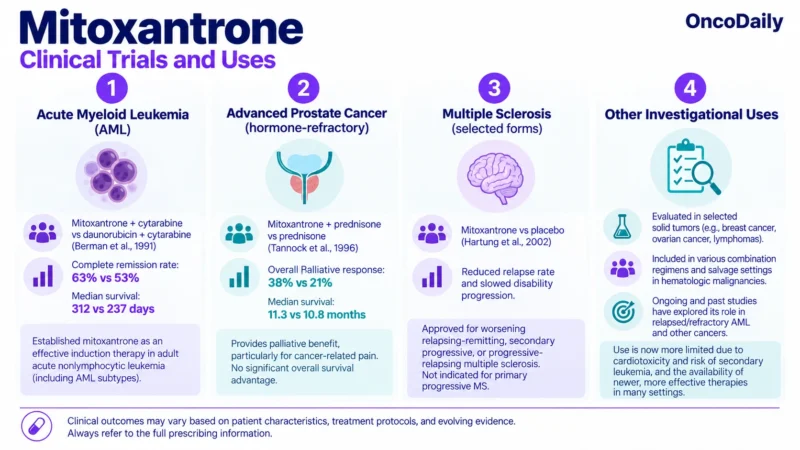
Mitoxantrone + Cytarabine in Acute Leukemia
Two randomized multicenter studies compared mitoxantrone plus cytarabine with daunorubicin plus cytarabine in adults with acute nonlymphocytic leukemia.
In the US trial, complete remission occurred in:
- Mitoxantrone + cytarabine: 63%
- Daunorubicin + cytarabine: 53%
Median survival was:
- Mitoxantrone: 312 days
- Daunorubicin: 237 days
In the international study, complete remission rates were 50% and 51%, respectively, and median survival was 192 versus 230 days.
These results supported mitoxantrone’s regulatory role in adult acute leukemia but did not demonstrate a consistent survival advantage across both studies.
Mitoxantrone + Prednisone in Advanced Prostate Cancer
The CCI-NOV22 randomized trial compared mitoxantrone plus prednisone with prednisone alone in symptomatic hormone-refractory prostate cancer.
Primary palliative response occurred in:
- Mitoxantrone + prednisone: 29%
- Prednisone: 12%
Overall palliative response was:
- 38% vs 21%
Median survival was 11.3 months versus 10.8 months, without a statistically significant survival difference.
The trial therefore established mitoxantrone primarily as a palliative treatment for pain, rather than a therapy providing an overall-survival benefit.
Mitoxantrone in Multiple Sclerosis
In a randomized trial of progressive forms of MS, mitoxantrone 12 mg/m² every three months produced significant improvements across several neurologic and relapse-related endpoints compared with placebo.
The study demonstrated reduced relapse activity and improvement in disability-related measures, supporting its historical MS indication.
Is Mitoxantrone FDA Approved?
Yes.
Mitoxantrone is FDA-approved for:
- Adult acute nonlymphocytic leukemia in combination with other antineoplastic drugs
- Pain related to advanced hormone-refractory prostate cancer in combination with corticosteroids
- Selected worsening forms of multiple sclerosis.
It is not approved for primary progressive MS.
What Is the Current Clinical Role of Mitoxantrone?
Mitoxantrone remains clinically relevant but is used more selectively than in earlier treatment eras.
In AML, it may be incorporated into intensive induction or salvage chemotherapy regimens.
In prostate cancer, its role is mainly palliative because subsequent therapies such as docetaxel and other modern systemic treatments have demonstrated stronger survival evidence.
Its use in MS has also declined substantially because newer disease-modifying therapies are available and because mitoxantrone carries important risks of cardiomyopathy and secondary leukemia.
Watch more: Acute Myeloid Leukemia (AML) Treatment Options — The Leukemia & Lymphoma Society of Canada.
What Are the Major Side Effects of Mitoxantrone?
Important adverse effects include:
- Myelosuppression
- Neutropenia
- Thrombocytopenia
- Anemia
- Infection
- Fever
- Nausea and vomiting
- Diarrhea
- Mucositis
- Alopecia
- Cardiotoxicity
- Extravasation injury
- Secondary leukemia.
Myelosuppression
Myelosuppression is one of the principal toxicities of mitoxantrone.
Severe neutropenia and marrow hypoplasia are expected during intensive leukemia induction.
This increases the risk of:
- Serious infection
- Sepsis
- Bleeding
- Transfusion requirements.
In the US AML trial, infection occurred in 66% and sepsis in 34% of patients receiving mitoxantrone plus cytarabine.
Cardiotoxicity
Mitoxantrone can cause:
- Reduced LVEF
- Cardiomyopathy
- Congestive heart failure
- Arrhythmias.
Cardiac injury may develop during treatment or months to years afterward.
Among cancer patients receiving cumulative doses up to 140 mg/m², the estimated cumulative probability of clinical congestive heart failure was approximately 2.6%.
Risk is increased by previous anthracycline exposure, mediastinal irradiation, existing cardiovascular disease, and other cardiotoxic therapies.
Infections
Severe infections are an important consequence of treatment-related neutropenia.
Reported complications include pneumonia, sepsis, urinary tract infections, and fungal infections.
Gastrointestinal Toxicity
Common gastrointestinal adverse effects include:
- Nausea
- Vomiting
- Diarrhea
- Abdominal pain
- Mucositis
- Stomatitis.
In the AML trial, nausea and vomiting occurred in 72% of patients receiving mitoxantrone plus cytarabine.
Extravasation
Mitoxantrone extravasation may cause:
- Pain
- Burning
- Erythema
- Swelling
- Blue discoloration
- Tissue necrosis.
Some severe reactions may require surgical treatment.
Secondary Leukemia
Mitoxantrone is itself associated with an increased risk of therapy-related acute myeloid leukemia.
This risk has been observed in both oncology and MS populations and is consistent with the leukemogenic potential of topoisomerase II inhibitors.
Blue-Green Urine and Scleral Discoloration
Mitoxantrone may temporarily cause:
- Blue-green urine
- Bluish discoloration of the sclera.
These color changes are generally transient and may persist for approximately 24 hours after administration.
What Monitoring Is Required?
Monitoring should include:
- CBC with differential
- Platelet count
- Baseline LVEF
- Cardiac signs and symptoms
- ECG
- Liver function
- Renal function
- Serum uric acid in leukemia
- Assessment for infection
- IV infusion-site assessment
- Cumulative mitoxantrone exposure.
Patients receiving mitoxantrone for MS require LVEF assessment before every dose and yearly after treatment discontinuation.