





Liposomal Doxorubicin: Understanding Its Mechanism, Dosing, and Clinical Role in Cancer
Key takeaways
- Pegylated liposomal doxorubicin is a liposome-encapsulated anthracycline that delivers doxorubicin with substantially altered pharmacokinetics.
- It is FDA-approved for recurrent/progressive ovarian cancer after platinum therapy, AIDS-related Kaposi sarcoma, and selected multiple myeloma in combination with bortezomib.
- Standard ovarian-cancer dosing is 50 mg/m² IV every 28 days.
- It must be diluted in 5% dextrose and administered as an IV infusion.
- Do not use an in-line filter.
- The initial infusion should begin at 1 mg/min because acute infusion reactions can occur.
- Characteristic toxicities include hand-foot syndrome and stomatitis, while cardiotoxicity and myelosuppression remain important.
- PLD must not be substituted dose-for-dose with conventional doxorubicin.
Pegylated liposomal doxorubicin (PLD; Doxil, Caelyx) is a liposomal formulation of the anthracycline doxorubicin. Encapsulation within PEG-coated liposomes alters the drug’s distribution and pharmacokinetics, prolonging circulation and changing the toxicity profile compared with conventional doxorubicin. In the United States, Doxil is approved for ovarian cancer after platinum-based chemotherapy, AIDS-related Kaposi sarcoma after failure or intolerance of prior systemic chemotherapy, and multiple myeloma in combination with bortezomib after at least one prior therapy in patients who have not previously received bortezomib.
Here, “liposomal doxorubicin” refers specifically to pegylated liposomal doxorubicin/Doxil, not conventional doxorubicin or other non-pegylated liposomal formulations.
Key Facts
- Generic name: Doxorubicin hydrochloride liposome injection
- Common abbreviation: PLD
- Brand names: Doxil; Caelyx in several non-US markets
- Drug class: Anthracycline antineoplastic antibiotic; liposomal formulation
- Route: Intravenous infusion
- Initial US approval: 1995
- FDA-approved oncology indications: Ovarian cancer, AIDS-related Kaposi sarcoma, and selected relapsed multiple myeloma
- Ovarian cancer dose: 50 mg/m² IV every 28 days
- Kaposi sarcoma dose: 20 mg/m² IV every 21 days
- Multiple myeloma dose: 30 mg/m² IV on Day 4 every 21 days with bortezomib
- Available concentration: 2 mg/mL
- Major mechanism: DNA binding/intercalation and inhibition of nucleic-acid synthesis
- Major toxicities: Hand-foot syndrome, stomatitis, myelosuppression, infusion-related reactions, and cardiotoxicity
- Important administration point: Dilute only in 5% dextrose
- Filter: Do not use an in-line filter
- Key caution: Liposomal doxorubicin must not be substituted dose-for-dose with conventional doxorubicin.
What Is Liposomal Doxorubicin?
Pegylated liposomal doxorubicin contains doxorubicin hydrochloride encapsulated within small PEG-coated liposomes.
More than 90% of the drug is encapsulated within the liposomal carrier. The PEG coating reduces rapid uptake by the reticuloendothelial system and allows prolonged circulation in the bloodstream.
This formulation changes the pharmacokinetics of doxorubicin substantially.
Compared with conventional doxorubicin, PLD has:
- Much lower plasma clearance
- A much smaller apparent volume of distribution
- Prolonged circulation
- Altered tissue exposure
- A different toxicity profile.
The active cytotoxic component remains doxorubicin.
What Is the Mechanism of Action of Liposomal Doxorubicin?
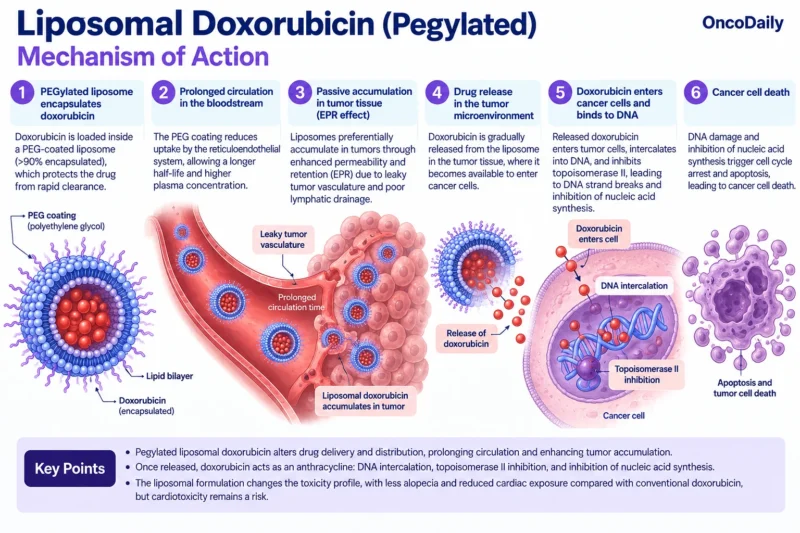
The liposome changes drug delivery, but once doxorubicin is released, its fundamental antitumor mechanisms remain those of an anthracycline.
1. Prolonged Liposomal Circulation
The PEG-coated liposome protects doxorubicin from rapid clearance.
This keeps a larger proportion of the administered drug within the vascular compartment for prolonged periods.
2. Tumor Accumulation
Liposomes may leave the circulation through abnormal, permeable tumor vasculature.
Once localized within tumor tissue, doxorubicin gradually becomes available to malignant cells.
3. DNA Binding and Intercalation
Released doxorubicin binds DNA and inserts between DNA base pairs.
This disrupts DNA structure and interferes with replication and transcription.
4. Inhibition of Nucleic-Acid Synthesis
Doxorubicin rapidly inhibits mitotic activity and nucleic-acid synthesis.
Its antitumor activity is also associated with topoisomerase II–mediated DNA damage.
5. Cancer-Cell Death
Accumulated DNA injury and impaired DNA/RNA synthesis ultimately promote malignant-cell death.
The mechanism can be summarized as:
PEG-liposome circulation → tumor accumulation → release of doxorubicin → DNA binding/intercalation + topoisomerase II–related DNA injury → impaired nucleic-acid synthesis → cancer-cell death.
What Is the Dose of Liposomal Doxorubicin?
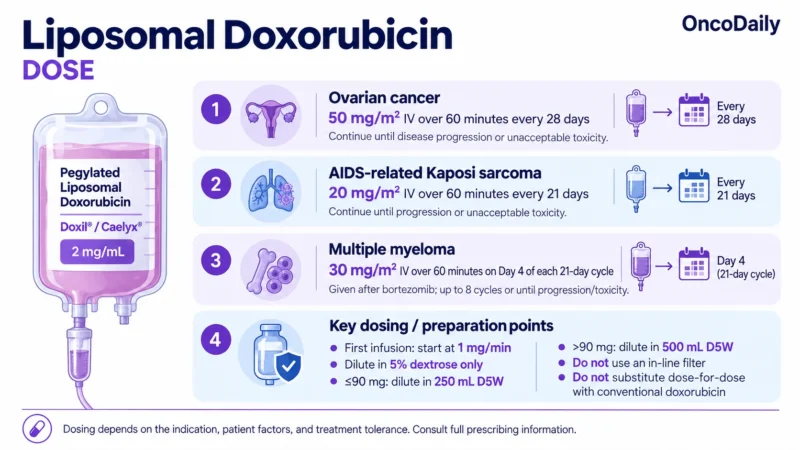
Dosing depends on the indication.
Ovarian Cancer
The FDA-recommended regimen is:
50 mg/m² IV over 60 minutes every 28 days
Treatment continues until disease progression or unacceptable toxicity.
AIDS-Related Kaposi Sarcoma
The recommended regimen is:
20 mg/m² IV over 60 minutes every 21 days
Treatment continues until progression or unacceptable toxicity.
Multiple Myeloma
In combination with bortezomib:
30 mg/m² IV over 60 minutes on Day 4 of each 21-day cycle
PLD should be given after bortezomib on Day 4.
Treatment is administered for up to eight cycles or until progression or unacceptable toxicity.
How Is Liposomal Doxorubicin Administered?
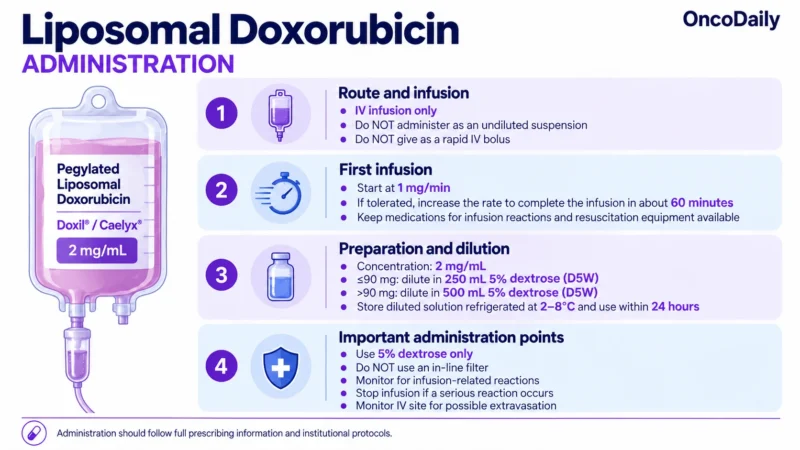
Liposomal doxorubicin is administered by intravenous infusion only.
It must not be administered as:
- An undiluted suspension
- A rapid IV bolus.
The first infusion should begin at:
1 mg/min
If no infusion-related reaction develops, the rate may be increased to complete the infusion over approximately one hour.
Preparation and Dilution
The available concentration is:
2 mg/mL
Available vial presentations include:
- 20 mg/10 mL
- 50 mg/25 mL.
For doses up to 90 mg:
Dilute in 250 mL of 5% dextrose injection.
For doses above 90 mg:
Dilute in 500 mL of 5% dextrose injection.
The diluted solution should be refrigerated at 2–8°C and administered within 24 hours.
Does Liposomal Doxorubicin Require an In-Line Filter?
No. In fact, the Doxil prescribing information specifically states not to use in-line filters.
This is an important formulation-specific point and differs from some other intravenous oncology drugs.
Does Liposomal Doxorubicin Require Premedication?
No universal routine premedication regimen is mandated.
However, infusion-related reactions can occur, particularly during the first infusion.
The prescribing information recommends that medications for treating infusion reactions and cardiopulmonary resuscitation equipment be immediately available.
The initial infusion rate of 1 mg/min is specifically designed to reduce the risk of acute reactions.
Antiemetic prophylaxis may also be administered according to the complete regimen and individual patient risk.
Are Dose Reductions Used?
Yes.
Dose delay or reduction may be required for:
- Hand-foot syndrome
- Stomatitis
- Neutropenia
- Thrombocytopenia
- Other Grade 3–4 nonhematologic toxicity.
Hand-Foot Syndrome
For Grade 2 or greater hand-foot syndrome, treatment is generally delayed until symptoms improve.
Grade 3–4 toxicity generally requires a 25% dose reduction after recovery, and treatment should be discontinued if toxicity does not adequately resolve within the recommended delay period.
Stomatitis
Clinically significant stomatitis may require treatment delay.
For Grade 3–4 stomatitis, treatment is delayed until recovery to Grade 0–1 and generally restarted at a 25% reduced dose.
Hematologic Toxicity
Treatment should be delayed when neutrophil or platelet counts fall below the required thresholds.
For Grade 2–3 neutropenia or thrombocytopenia, the label recommends waiting until:
ANC ≥1,500/mm³ and platelets ≥75,000/mm³
before resuming treatment.
What Is the Pharmacokinetic Profile of Liposomal Doxorubicin?
The liposomal formulation dramatically alters doxorubicin pharmacokinetics.
Distribution
At 20 mg/m², the steady-state volume of distribution is approximately:
2.7 L/m²
This is far smaller than the approximately 700–1,100 L/m² reported with conventional doxorubicin, indicating that PLD remains largely within the vascular compartment.
Elimination
At 20 mg/m², plasma clearance is approximately:
0.041 L/hour/m²
compared with approximately 24–35 L/hour/m² for conventional doxorubicin.
Half-Life
PLD demonstrates biphasic elimination.
Approximate half-lives at studied doses include:
Initial phase: about 5 hours
Terminal phase: about 52–55 hours.
Metabolism
Doxorubicinol remains the principal metabolite of doxorubicin, although plasma concentrations are relatively low following liposomal administration.
Does Liposomal Doxorubicin Require Renal or Hepatic Dose Adjustment?
Renal Impairment
The US Doxil label does not provide a standard creatinine-clearance-based dose-reduction scheme.
Clinical decisions should consider overall organ function, treatment indication, toxicity, and protocol-specific recommendations.
Hepatic Impairment
Doxorubicin is substantially eliminated through the liver.
The prescribing information recommends dose reduction when serum bilirubin is 1.2 mg/dL or higher.
However, the pharmacokinetics of PLD have not been adequately characterized in patients with hepatic impairment.
What Are the Clinical Uses of Liposomal Doxorubicin?
Ovarian Cancer
PLD is FDA-approved for ovarian cancer that has progressed or recurred after platinum-based chemotherapy.
It remains an important chemotherapy option in recurrent disease, particularly when avoiding substantial alopecia, neurotoxicity, or some of the toxicities associated with alternative regimens is clinically relevant.
Multiple Myeloma
PLD is FDA-approved with bortezomib in patients who:
- Have received at least one previous therapy
- Have not previously received bortezomib.
The combination demonstrated improved time to progression compared with bortezomib alone.
AIDS-Related Kaposi Sarcoma
PLD is also approved after failure of prior systemic chemotherapy or intolerance of such treatment.
Its prolonged circulation and activity within Kaposi sarcoma lesions contributed to its historical importance in this disease.
Other Clinical Uses
PLD has also been incorporated into selected regimens for other malignancies, including breast cancer and other gynecologic cancers, depending on regional approvals and treatment guidelines.
These applications should be distinguished from the formal current US Doxil indications.
For comparison with the conventional formulation, [read OncoDaily’s overview of conventional doxorubicin, including its dosing, cardiotoxicity, and clinical uses]. Doxorubicin on OncoDaily
What Did Liposomal Doxorubicin Clinical Trials Show?
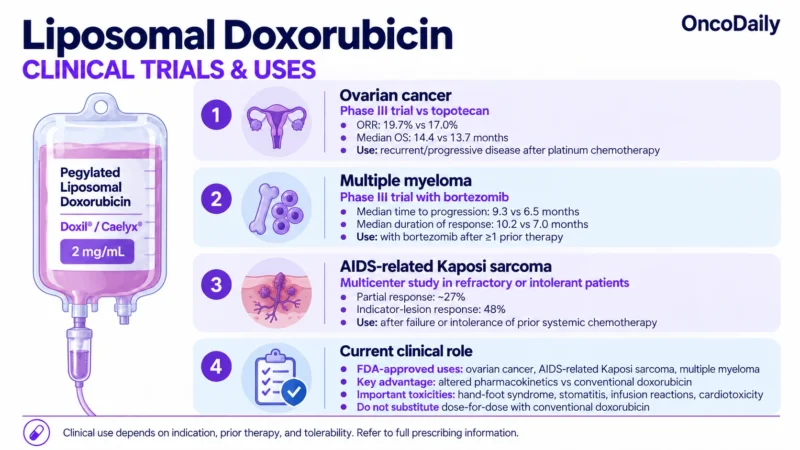
PLD Versus Topotecan in Recurrent Ovarian Cancer
A randomized phase III trial enrolled 474 patients whose epithelial ovarian cancer had recurred after platinum-based chemotherapy.
Patients received either:
- PLD 50 mg/m² every four weeks
- Topotecan 1.5 mg/m² daily for five days every three weeks.
Overall response rates were:
- PLD: 19.7%
- Topotecan: 17.0%
Median overall survival in the FDA analysis was:
PLD: 14.4 months
Topotecan: 13.7 months
The protocol-defined primary endpoint, time to progression, was similar overall between the two groups.
Long-term follow-up found the survival advantage was most pronounced in the platinum-sensitive subgroup.
PLD Plus Bortezomib in Multiple Myeloma
A randomized phase III trial enrolled 646 patients with relapsed or refractory multiple myeloma.
Median time to progression was:
PLD + bortezomib: 9.3 months
Bortezomib alone: 6.5 months
The hazard ratio was 0.55.
Median duration of response was:
- Combination: 10.2 months
- Bortezomib: 7.0 months
At the final long-term analysis, median overall survival was 33 versus 31 months, without a significant overall-survival difference.
AIDS-Related Kaposi Sarcoma
In a multicenter study of patients with refractory or treatment-intolerant AIDS-related Kaposi sarcoma, investigator-assessed partial response was approximately 27%, while indicator-lesion assessment produced a higher response estimate of 48%.
No complete responses were reported in this heavily pretreated cohort.
Is Liposomal Doxorubicin FDA Approved?
Yes.
Doxil received its original US approval on November 17, 1995, initially for AIDS-related Kaposi sarcoma.
Additional approvals followed for:
- Ovarian cancer
- Multiple myeloma in combination with bortezomib.
The current label includes all three indications.
What Is the Current Clinical Role of Liposomal Doxorubicin?
Pegylated liposomal doxorubicin remains particularly relevant in recurrent ovarian cancer and selected combination regimens where its altered pharmacokinetics and toxicity profile are advantageous.
Its liposomal formulation generally produces less alopecia and less conventional anthracycline-type cardiac exposure than standard doxorubicin, although cardiotoxicity remains clinically important and cumulative anthracycline exposure must still be considered.
In multiple myeloma, newer classes of targeted, immune, and cellular therapies have substantially changed treatment, so PLD plus bortezomib is used far less prominently than when the regimen was first approved.
What Are the Major Side Effects of Liposomal Doxorubicin?
Common adverse reactions include:
- Hand-foot syndrome
- Stomatitis
- Nausea
- Vomiting
- Diarrhea
- Constipation
- Fatigue
- Fever
- Anorexia
- Rash
- Neutropenia
- Thrombocytopenia
- Anemia.
Hand-Foot Syndrome
Palmar-plantar erythrodysesthesia, or hand-foot syndrome, is one of the characteristic toxicities of PLD.
Symptoms may include:
- Tingling or burning
- Redness
- Swelling
- Peeling
- Blisters
- Pain involving the palms or soles.
It often appears after several treatment cycles and may require treatment delay or dose reduction.
Stomatitis
Oral mucositis and stomatitis are common.
Symptoms include painful erythema, swelling, and oral ulceration.
Severe stomatitis can interfere with eating and may require a 25% dose reduction after recovery.
Infusion-Related Reactions
PLD can cause acute infusion reactions, particularly during the first administration.
Possible manifestations include:
- Flushing
- Dyspnea
- Facial swelling
- Chest or back pain
- Chills
- Rash
- Bronchospasm
- Hypotension
- Syncope.
Across studies, infusion-related reactions occurred in approximately 11% of patients receiving monotherapy for solid tumors.
Serious or life-threatening reactions require permanent discontinuation.
Cardiotoxicity
Liposomal formulation does not eliminate anthracycline cardiotoxicity.
The current label reports an approximately 11% cardiomyopathy risk at cumulative anthracycline exposure of 450–550 mg/m² in the evaluated population.
Prior anthracycline exposure must be included when calculating cumulative exposure.
Left ventricular function should be assessed before, during, and after treatment when clinically appropriate.
Myelosuppression
PLD can cause:
- Neutropenia
- Leukopenia
- Thrombocytopenia
- Anemia.
Clinically significant neutropenia increases the risk of infection and may require treatment delay.
Extravasation
Although liposomal doxorubicin has a different tissue distribution from conventional doxorubicin, extravasation can still cause local injury.
If extravasation is suspected:
- Stop the infusion
- Attempt aspiration before removing the needle
- Do not flush the line
- Apply intermittent ice
- Elevate the affected extremity when appropriate.
Secondary Oral Malignancies
Secondary oral cancers have been reported with long-term PLD exposure.
Patients receiving prolonged treatment should undergo periodic oral examination, particularly when treatment continues beyond one year.
Pregnancy and Fertility
PLD can cause fetal harm and may impair fertility.
The current label recommends effective contraception for both females and males of reproductive potential during treatment and for 6 months after the final dose.
Breastfeeding should be discontinued during therapy.
What Monitoring Is Required?
Monitoring should include:
- CBC with differential
- Platelet count
- Cardiac function and cumulative anthracycline exposure
- Liver function and bilirubin
- Assessment for hand-foot syndrome
- Oral examination and assessment for stomatitis
- Assessment for infusion reactions
- IV site monitoring
- Clinical evaluation for infection.
Cardiac monitoring remains important despite the altered liposomal formulation.