





Letrozole (Femara): Mechanism of Action, Dosage, Clinical Uses, Trials, and Side Effects
Key takeaways
- Letrozole is a third-generation, reversible, nonsteroidal aromatase inhibitor.
- It inhibits CYP19A1, reducing the conversion of androgens into estrogens.
- The standard dose is 2.5 mg orally once daily.
- BIG 1-98 established its effectiveness as adjuvant endocrine therapy.
- MA.17 and MA.17R demonstrated benefits from extended endocrine treatment in selected postmenopausal patients.
- P025 demonstrated improved time to progression compared with tamoxifen in advanced breast cancer.
- MONALEESA-2 demonstrated improved overall survival when ribociclib was added to letrozole in eligible patients with metastatic HR-positive/HER2-negative breast cancer.
- Bone loss, fractures, arthralgia, and hypercholesterolemia are important long-term safety considerations.
Letrozole (Femara) is a third-generation, nonsteroidal aromatase inhibitor (AI) used in the treatment of hormone receptor-positive (HR-positive) breast cancer. By reversibly inhibiting the aromatase enzyme (CYP19A1), letrozole reduces estrogen synthesis, suppressing estrogen-dependent tumor growth.
Unlike tamoxifen, which competitively binds estrogen receptors, letrozole blocks the production of estrogen by preventing the conversion of androgens into estrogens in peripheral tissues.
Letrozole is particularly effective in postmenopausal women, whose estrogen production depends predominantly on peripheral aromatization rather than ovarian synthesis.
First approved by the FDA in 1997, letrozole is used in adjuvant and extended adjuvant therapy for early-stage breast cancer and in the treatment of advanced or metastatic disease.
The landmark BIG 1-98 trial established letrozole as an effective alternative to tamoxifen in postmenopausal early breast cancer. MA.17 and MA.17R subsequently demonstrated benefits from extended endocrine therapy, while P025 established its activity in advanced breast cancer.
Letrozole also serves as an important endocrine therapy backbone in modern combination regimens, including CDK4/6 inhibitors such as ribociclib.
As of November 2026, letrozole remains a cornerstone of breast cancer endocrine therapy, with bone loss, musculoskeletal symptoms, and metabolic effects requiring long-term monitoring.
Key Facts
- Generic name: Letrozole
- Brand name: Femara
- Drug class: Third-generation aromatase inhibitor
- Drug type: Nonsteroidal endocrine therapy
- Molecular target: Aromatase (CYP19A1)
- Mechanism: Competitive, reversible inhibition of aromatase-mediated estrogen synthesis
- Initial FDA approval: 1997
- Administration: Oral
- Recommended dose: 2.5 mg once daily
- Available formulation: 2.5 mg tablet
- Treatment duration: Typically five years in initial adjuvant therapy; extended treatment in selected patients
- FDA indications: Adjuvant, extended adjuvant, and advanced breast cancer treatment in postmenopausal women
- Selected additional uses: Premenopausal breast cancer with ovarian suppression, neoadjuvant endocrine therapy, and risk reduction in certain settings
- Five featured pivotal trials: BIG 1-98, MA.17, MA.17R, P025, MONALEESA-2
- Principal biomarker: Estrogen receptor expression
- Important metabolic enzymes: CYP3A4 and CYP2A6
- Elimination half-life: Approximately two days
- Boxed warning: None
- Major adverse effects: Arthralgia, osteoporosis, fractures, hot flashes, fatigue, and hypercholesterolemia
- Monitoring: Bone mineral density, fracture risk, musculoskeletal symptoms, lipid profile, cardiovascular risk, and adherence
- Important dose adjustment: Severe hepatic dysfunction with cirrhosis — 2.5 mg every other day
What Is Letrozole?
Letrozole is an oral endocrine agent that selectively inhibits aromatase, the enzyme responsible for converting androgens into estrogens.
In postmenopausal women, estrogen is produced predominantly through aromatization of circulating androgens in peripheral tissues, including adipose tissue, muscle, and breast tissue.
The aromatase enzyme catalyzes two major conversions:
- Androstenedione → Estrone (E1)
- Testosterone → Estradiol (E2)
Estrogen stimulates the proliferation of hormone-sensitive breast cancer cells by activating estrogen receptors and regulating genes involved in cell growth and survival.
Letrozole reduces estrogen availability by directly inhibiting aromatase.
This decreases estrogen receptor activation and suppresses estrogen-dependent tumor proliferation.
Letrozole does not have direct estrogen receptor agonist or antagonist activity.
How Does Letrozole Differ From Tamoxifen and Anastrozole?
Letrozole versus tamoxifen: Letrozole inhibits estrogen synthesis, whereas tamoxifen modulates estrogen receptor activity. Tamoxifen can be used without ovarian suppression in premenopausal women, while letrozole requires confirmed menopause or effective ovarian suppression.
Letrozole versus anastrozole: Both are reversible, nonsteroidal aromatase inhibitors. Letrozole is often considered a highly potent suppressor of estrogen synthesis, but differences in estrogen suppression do not automatically establish superior clinical outcomes in every treatment setting.
Both aromatase inhibitors have broadly similar adverse-effect profiles, particularly regarding bone loss and arthralgia.
What Is the Mechanism of Action of Letrozole?

1. Peripheral Estrogen Synthesis
In postmenopausal women, circulating androgens are converted into estrogens by the aromatase enzyme.
Aromatase is encoded by CYP19A1 and is expressed in several peripheral tissues.
2. Competitive Aromatase Inhibition
Letrozole binds reversibly to the heme component of aromatase.
This inhibits the catalytic conversion of androgen substrates into estrogens.
3. Suppression of Estrogen Production
Aromatase inhibition reduces estradiol, estrone, and estrone sulfate concentrations.
Clinical pharmacology studies demonstrated substantial estrogen suppression, generally 75–95% across studied doses, with maximal suppression occurring within approximately two to three days.
4. Reduced Estrogen Receptor Activation
Lower estrogen concentrations reduce the activation of estrogen receptors in HR-positive breast cancer cells.
This inhibits estrogen-dependent transcriptional activity.
5. Inhibition of Tumor-Cell Proliferation
Reduced estrogen receptor signaling suppresses cell-cycle progression and proliferation.
In endocrine-sensitive tumors, this can produce tumor regression or prolonged disease stabilization.
6. Development of Endocrine Resistance
Resistance may develop through:
- ESR1 mutations
- PI3K/AKT/mTOR signaling
- Growth factor receptor activation
- Altered cell-cycle regulation
- Other ligand-independent estrogen receptor signaling mechanisms
These resistance pathways are particularly important in metastatic breast cancer.
7. Systemic Estrogen Deprivation
Reduced estrogen production also affects normal tissues.
Consequences may include bone mineral density loss, arthralgia, vasomotor symptoms, and changes in lipid metabolism.
Overall mechanism:
Letrozole → competitive aromatase (CYP19A1) inhibition → reduced estrogen synthesis → decreased ERα activation → suppression of tumor-cell proliferation → improved disease control.
What Is the Recommended Dose of Letrozole?
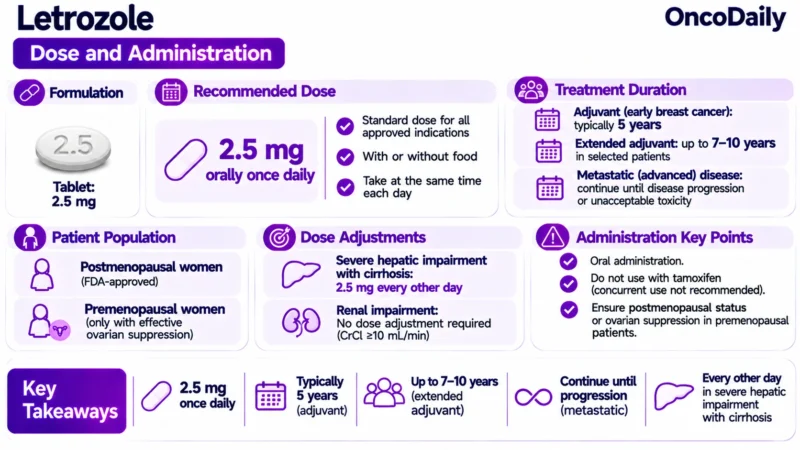
Standard Adult Dose
The FDA-recommended dose is:
Letrozole 2.5 mg orally once daily.
It can be administered with or without food.
Early-Stage HR-Positive Breast Cancer
For postmenopausal women with HR-positive early breast cancer:
2.5 mg once daily, typically for five years.
Letrozole may be used as initial adjuvant therapy or as part of a sequential endocrine strategy.
Sequential Therapy After Tamoxifen
Letrozole may be administered following an initial period of tamoxifen.
Treatment selection depends on menopausal status, recurrence risk, previous endocrine exposure, and tolerability.
Extended Adjuvant Treatment
Letrozole is approved for extended adjuvant treatment in postmenopausal women with early breast cancer who have completed approximately five years of adjuvant tamoxifen.
Dose: 2.5 mg once daily.
Longer treatment strategies may extend total endocrine therapy to approximately 7–10 years in selected patients.
The optimal duration is individualized because extended treatment increases cumulative skeletal toxicity.
Locally Advanced or Metastatic Breast Cancer
2.5 mg orally once daily.
Continue until disease progression or unacceptable toxicity.
Letrozole may be administered alone or as the endocrine component of an appropriate combination regimen.
Letrozole With Ribociclib
In an eligible combination regimen:
- Letrozole: 2.5 mg orally once daily, continuously
- Ribociclib: Dose and schedule according to its indication-specific prescribing information
The adverse effects and dose modifications of the CDK4/6 inhibitor must be managed separately.
Premenopausal Breast Cancer With Ovarian Suppression
Letrozole 2.5 mg daily can be used in selected premenopausal patients only with effective ovarian function suppression.
Letrozole monotherapy is inappropriate in women with functioning ovaries because aromatase inhibition can stimulate ovarian gonadotropin feedback and does not reliably suppress ovarian estrogen production.
Neoadjuvant Endocrine Therapy
Letrozole may be used before surgery in selected patients with strongly HR-positive breast cancer, particularly postmenopausal women.
Treatment commonly lasts several months, with response and operability reassessed during therapy.
This is an evidence-supported use rather than a separately listed FDA indication.
How Should Letrozole Be Administered?
Oral Administration
Take one 2.5 mg tablet once daily.
It may be taken with or without food.
Patients should aim to take the medication at approximately the same time each day.
Available Formulation
Femara and generic letrozole are available as:
2.5 mg oral tablets.
Timing With Other Treatments
In early breast cancer, adjuvant endocrine treatment usually begins after indicated cytotoxic chemotherapy.
Letrozole may overlap with radiotherapy, depending on the treatment plan.
In appropriate modern regimens, it may also be combined with certain targeted therapies.
Treatment Adherence
Long-term adherence is important for reducing recurrence risk.
Joint pain, menopausal symptoms, and fatigue should be addressed early to minimize unnecessary discontinuation.
What Should You Do If a Letrozole Dose Is Missed?
If a dose is missed:
- Take it when remembered, unless the next scheduled dose is approaching.
- If it is nearly time for the next dose, skip the missed dose.
- Resume the regular dosing schedule.
- Do not double the dose.
Patients who frequently miss doses should discuss adherence barriers with their treatment team.
How Are Letrozole Dose Modifications Managed?
There is no established routine toxicity-based dose-reduction schedule for letrozole.
Severe Hepatic Impairment With Cirrhosis
Reduce to 2.5 mg orally every other day.
This is an important FDA-label recommendation because drug exposure may increase in patients with cirrhosis and severe hepatic dysfunction.
Arthralgia or Musculoskeletal Symptoms
Mild or moderate symptoms are usually managed with supportive care.
Severe persistent symptoms may require temporary interruption or a change in endocrine therapy.
Bone Loss or Osteoporosis
Bone density decline does not routinely require dose reduction.
Consider bone-protective interventions or an alternative endocrine strategy based on fracture risk.
Severe Hypersensitivity
Discontinue letrozole in patients with serious hypersensitivity reactions.
Clinically Significant Hepatic Toxicity
Treatment interruption or discontinuation may be appropriate after individualized assessment.
What Drug Interactions Are Important With Letrozole?
Tamoxifen
Avoid routine concurrent use of tamoxifen and letrozole.
Tamoxifen can reduce letrozole plasma concentrations, and the combination has not demonstrated an established clinical advantage over appropriate sequential endocrine therapy.
Estrogen-Containing Medications
Systemic estrogen-containing products may counteract letrozole’s therapeutic effects.
Avoid concurrent hormone replacement therapy unless a specialist has explicitly reassessed the endocrine treatment plan.
CYP-Mediated Drug Interactions
Letrozole is metabolized partly through CYP3A4 and CYP2A6.
In vitro, it inhibits CYP2A6 and CYP2C19, although clinically significant interactions at standard therapeutic concentrations are not consistently established.
Medication reconciliation remains important, particularly when letrozole is combined with other anticancer agents.
Targeted Therapies
Letrozole may be administered with selected targeted treatments, including CDK4/6 inhibitors.
Interactions, contraindications, and monitoring requirements must be evaluated according to the accompanying agent.
Warfarin
Clinical interaction studies did not establish a major clinically significant interaction between letrozole and warfarin.
Continue standard anticoagulation monitoring when indicated.
Does Letrozole Require Dose Adjustment in Renal or Hepatic Impairment?
Renal Impairment
No dose adjustment is required for creatinine clearance ≥10 mL/min.
Data are limited in patients with creatinine clearance below 10 mL/min.
Mild or Moderate Hepatic Impairment
No routine dose adjustment is recommended.
Severe Hepatic Impairment With Cirrhosis
Reduce the dose to 2.5 mg every other day.
The pharmacokinetic effects of significant noncirrhotic liver dysfunction with elevated bilirubin are less clearly established.
This distinction is important because severe hepatic impairment is one of the few settings requiring a specific letrozole dose modification.
What Is the Pharmacokinetic Profile of Letrozole?
Absorption
Letrozole is rapidly and almost completely absorbed following oral administration.
Its absolute bioavailability is approximately 99.9%.
Peak plasma concentrations generally occur within approximately one to two hours.
Food does not meaningfully affect overall exposure.
Distribution
Letrozole is approximately 60% protein-bound, primarily to albumin.
Metabolism
Letrozole undergoes hepatic metabolism to a pharmacologically inactive carbinol metabolite.
CYP3A4 and CYP2A6 contribute to its metabolism.
Elimination Half-Life
Approximately two days.
Steady State
Steady-state concentrations are generally achieved within two to six weeks of daily administration.
Excretion
Letrozole is primarily eliminated following metabolism, with metabolites excreted mainly in the urine.
Pharmacodynamic Activity
Letrozole produces substantial suppression of estrone, estradiol, and estrone sulfate in postmenopausal women.
Its pharmacological effects reflect estrogen deprivation rather than direct estrogen receptor binding.
What Are the Clinical Uses of Letrozole?
Adjuvant Treatment of Early-Stage HR-Positive Breast Cancer
Letrozole is FDA-approved for adjuvant treatment of postmenopausal women with HR-positive early breast cancer.
It may be used as initial endocrine therapy or incorporated into a sequential strategy.
Extended Adjuvant Treatment
Letrozole can reduce late recurrence risk following previous endocrine therapy.
Extended treatment is particularly relevant in selected higher-risk patients, including some with node-positive disease.
The decision must balance absolute recurrence benefit against skeletal and other long-term adverse effects.
Advanced or Metastatic Breast Cancer
Letrozole is approved for first-line treatment of postmenopausal women with HR-positive or HR-unknown locally advanced or metastatic breast cancer.
It is also approved for advanced disease that progresses following antiestrogen treatment.
Combination Therapy With CDK4/6 Inhibitors
Letrozole serves as an endocrine backbone in multiple CDK4/6 inhibitor regimens.
For eligible patients with HR-positive/HER2-negative metastatic breast cancer, combination therapy generally offers better disease control than aromatase inhibitor monotherapy.
Regulatory indications and available combinations vary by agent and setting.
Premenopausal Breast Cancer
Letrozole may be used with ovarian suppression in selected premenopausal patients.
Effective ovarian suppression is mandatory while ovarian function remains active.
Neoadjuvant Endocrine Therapy
Letrozole is used in selected patients with endocrine-sensitive breast cancer to reduce tumor volume before surgery.
It may facilitate breast-conserving surgery in appropriately selected postmenopausal patients.
Breast Cancer Risk Reduction
Aromatase inhibitors have a role in breast cancer risk reduction for selected postmenopausal women, but evidence and regulatory status differ by agent.
Letrozole is not FDA-approved for primary breast cancer prevention, and it should not automatically be substituted for anastrozole or exemestane in prevention protocols.
What Molecular Testing Is Required Before Letrozole?
Estrogen Receptor Testing
ER immunohistochemistry is essential for selecting endocrine therapy in early invasive breast cancer.
Tumors with at least 1% ER-positive invasive tumor-cell nuclei are considered ER-positive.
ER-low tumors (1–10%) may derive less predictable benefit and require individualized assessment.
Progesterone Receptor Testing
PR expression provides additional information about endocrine responsiveness.
HER2 Testing
HER2 status should be established to guide the overall systemic treatment strategy.
Menopausal Status
Confirmed menopause or effective ovarian suppression is required.
Amenorrhea caused by chemotherapy does not necessarily indicate permanent menopause.
ESR1 Mutations
Acquired ESR1 mutations may promote ligand-independent estrogen receptor activation and contribute to aromatase inhibitor resistance.
In advanced breast cancer, ESR1 testing can help guide subsequent endocrine treatment choices.
Additional Molecular Biomarkers
Depending on clinical setting, relevant testing may include:
- PIK3CA
- AKT1
- PTEN
- Germline BRCA1/2
These biomarkers guide broader treatment selection rather than the routine dose of letrozole.
What Did the Pivotal Clinical Trials Show?
1. BIG 1-98 — Letrozole Versus Tamoxifen in Early Breast Cancer
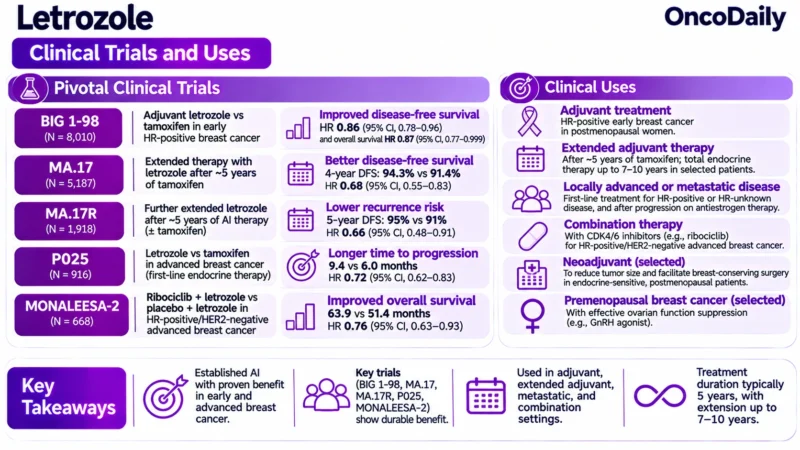
BIG 1-98 (NCT00004205) was a randomized phase III trial involving approximately 8,010 postmenopausal women with hormone receptor-positive early breast cancer.
The trial compared five years of letrozole or tamoxifen, as well as sequential strategies.
Letrozole Versus Tamoxifen — Long-Term Analysis
Disease-Free Survival
HR: 0.86 (95% CI, 0.78–0.96) in the intention-to-treat analysis.
Overall Survival
HR: 0.87 (95% CI, 0.77–0.999) in the same analysis.
An analysis adjusting for selective treatment crossover estimated a DFS HR of 0.82.
Letrozole improved recurrence-related outcomes compared with tamoxifen.
Later long-term analyses demonstrated that the magnitude and statistical significance of treatment differences depended on follow-up duration and analysis method.
2. MA.17 — Extended Letrozole After Five Years of Tamoxifen
MA.17 (NCT00003140) randomized approximately 5,187 postmenopausal women who had completed around five years of adjuvant tamoxifen to letrozole or placebo.
Disease-Free Survival — Initial Analysis
HR: 0.57
P = 0.00008
Four-Year Disease-Free Survival — Updated Intention-to-Treat Analysis
Letrozole: 94.3%
Placebo: 91.4%
HR: 0.68 (95% CI, 0.55–0.83)
The trial established the benefit of extended endocrine treatment with letrozole following tamoxifen.
The magnitude of benefit should be interpreted in the context of early unblinding and subsequent treatment crossover.
3. MA.17R — Extending Aromatase Inhibitor Therapy
MA.17R (NCT00754845) was a randomized trial involving 1,918 postmenopausal women who had already completed approximately five years of aromatase inhibitor therapy, often preceded by tamoxifen.
Participants received an additional five years of letrozole or placebo.
Five-Year Disease-Free Survival
- Letrozole: 95%
- Placebo: 91%
Hazard Ratio
HR: 0.66 (95% CI, 0.48–0.91)
P = 0.01
No significant overall survival advantage was demonstrated.
Extended letrozole therapy increased bone-related adverse effects, emphasizing the importance of individualized treatment duration.
4. P025 — Letrozole Versus Tamoxifen in Advanced Breast Cancer
P025 was a randomized phase III study comparing letrozole 2.5 mg daily with tamoxifen 20 mg daily as initial endocrine treatment in 916 postmenopausal women with locally advanced or metastatic breast cancer.
Median Time to Progression
- Letrozole: 9.4 months
- Tamoxifen: 6.0 months
Hazard Ratio
HR: 0.72 (95% CI, 0.62–0.83)
P < 0.0001
Objective Response Rate
- Letrozole: 32%
- Tamoxifen: 21%
P = 0.0002
Median Overall Survival
Letrozole: 35 months
Tamoxifen: 32 months
The overall survival difference was not statistically significant.
P025 established letrozole’s efficacy as an initial endocrine therapy for advanced breast cancer.
5. MONALEESA-2 — Ribociclib Plus Letrozole
MONALEESA-2 (NCT01958021) was a randomized phase III study involving 668 postmenopausal women with HR-positive/HER2-negative advanced breast cancer who had not received prior systemic treatment for advanced disease.
Patients received ribociclib plus letrozole or placebo plus letrozole.
Median Overall Survival
- Ribociclib + letrozole: 63.9 months
- Placebo + letrozole: 51.4 months
Overall Survival Hazard Ratio
HR: 0.76 (95% CI, 0.63–0.93)
P = 0.008
Median Progression-Free Survival — Updated Analysis
- Ribociclib + letrozole: 25.3 months
- Placebo + letrozole: 16.0 months
This trial demonstrated the importance of letrozole as an endocrine backbone for targeted combination therapy.
The additional survival benefit is attributable to adding ribociclib, rather than to letrozole alone.
Read More: ctDNA Dynamics May Predict Ribociclib Benefit in HR+/HER2− Advanced Breast Cancer: BioItaLEE Trial by OncoDaily.
Watch More: MONALEESA-2: Ribociclib + Letrozole in Metastatic Breast Cancer — VJOncology.
Does Letrozole Have CNS Activity?
Letrozole is not a CNS-directed anticancer therapy.
Although endocrine treatment can contribute to systemic disease control in patients with HR-positive breast cancer and brain metastases, reliable prospective evidence of meaningful intracranial response to letrozole alone is limited.
CNS treatment should be individualized according to neurological symptoms, tumor biology, previous systemic treatment, and suitability for local intervention.
Letrozole is not approved for primary CNS malignancies.
Is Letrozole FDA Approved?
Yes.
Letrozole was initially approved in the United States in 1997.
Its U.S. indications include:
- Adjuvant treatment of postmenopausal women with HR-positive early breast cancer.
- Extended adjuvant treatment following five years of adjuvant tamoxifen.
- First-line treatment of postmenopausal women with HR-positive or HR-unknown locally advanced or metastatic breast cancer.
- Treatment of advanced breast cancer following progression on antiestrogen therapy in postmenopausal women.
Other uses, such as neoadjuvant endocrine therapy or treatment with ovarian suppression in premenopausal women, should be distinguished from the standalone Femara label.
What Is the Current Clinical Role of Letrozole in 2026?
Letrozole remains a standard aromatase inhibitor for postmenopausal women with HR-positive early-stage breast cancer.
It can be used as initial adjuvant therapy, following tamoxifen, or as extended endocrine treatment in selected higher-risk patients.
For premenopausal patients, use requires effective ovarian suppression.
In advanced HR-positive/HER2-negative breast cancer, letrozole is an important endocrine backbone for combination treatment, particularly in patients without established resistance to aromatase inhibition.
The choice between letrozole and other endocrine agents depends on prior therapy, molecular alterations, disease characteristics, menopausal status, tolerability, and access to targeted treatments.
Bone health and long-term adherence remain central considerations throughout treatment.
What Are the Major Side Effects of Letrozole?
Arthralgia and Musculoskeletal Symptoms
Arthralgia is one of the most frequent adverse effects of letrozole.
Patients may experience joint pain, stiffness, muscle discomfort, and reduced mobility.
Symptoms can interfere with daily activities and contribute to treatment discontinuation.
Bone Mineral Density Loss
Letrozole suppresses estrogen-mediated bone protection.
This increases bone turnover and may contribute to:
- Osteopenia
- Osteoporosis
- Reduced bone mineral density
- Fragility fractures
In BIG 1-98, fractures were reported in 14.7% of letrozole-treated patients versus 11.4% receiving tamoxifen over the reported follow-up.
Osteoporosis was reported in 5.1% versus 2.7%, respectively.
Hypercholesterolemia
Letrozole can increase serum cholesterol.
In BIG 1-98, hypercholesterolemia was reported more frequently with letrozole than tamoxifen.
Assess cardiovascular risk and manage dyslipidemia according to applicable clinical guidelines.
Vasomotor Symptoms
Hot flashes and increased sweating are common.
These symptoms result from reduced estrogen activity.
Fatigue
Fatigue and reduced energy may occur, particularly during prolonged treatment.
Persistent symptoms should prompt evaluation for other contributing causes.
Vaginal and Genitourinary Symptoms
Potential adverse effects include vaginal dryness, dyspareunia, reduced libido, and genitourinary discomfort.
Cardiovascular Events
Cardiovascular risk requires consideration, particularly in patients with pre-existing disease.
Differences in cardiovascular adverse events between aromatase inhibitors and tamoxifen may partly reflect tamoxifen’s effects on lipid metabolism.
Risk should be interpreted according to individual cardiovascular history.
Mood and Sleep Disturbances
Patients may experience sleep difficulties, mood changes, or depressive symptoms.
Gastrointestinal Symptoms
Nausea, vomiting, and gastrointestinal discomfort may occur.
Edema
Peripheral edema has been reported.
Hepatic Abnormalities
Elevated liver enzymes and rare clinically important hepatic reactions may occur.
Hypersensitivity
Rare serious hypersensitivity reactions, including angioedema and anaphylaxis, have been reported.
Pregnancy and Reproductive Toxicity
Letrozole may cause fetal harm and is contraindicated during pregnancy.
Women with reproductive potential should use effective contraception during treatment and for at least three weeks after the final dose, according to U.S. prescribing information.
Breastfeeding is not recommended during treatment or for at least three weeks after the final dose.
These precautions also matter when letrozole is prescribed with ovarian suppression.
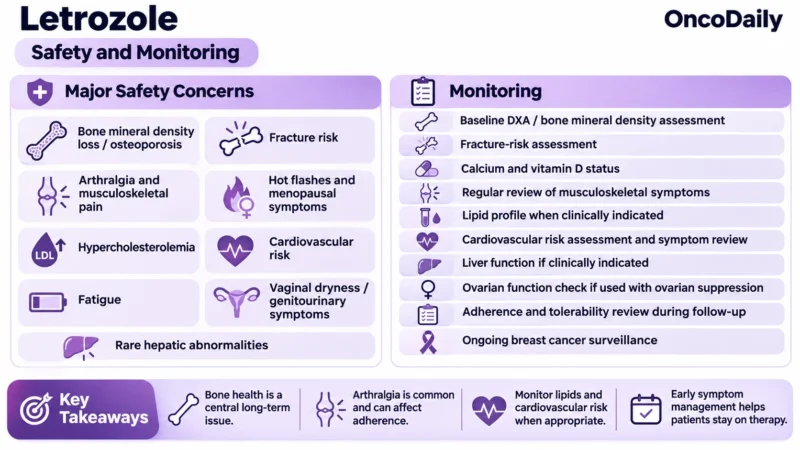
What Monitoring Is Required During Letrozole Treatment?
Bone Mineral Density
Assess baseline bone mineral density, typically using DXA.
Repeat assessment according to fracture risk, previous results, and local guidelines.
A one- to two-year monitoring interval may be appropriate for patients at increased risk.
Fracture Risk
Assess osteoporosis history, previous fragility fractures, corticosteroid exposure, smoking, and other clinical risk factors.
Consider antiresorptive therapy when indicated.
Calcium and Vitamin D
Assess dietary intake and correct deficiencies.
Encourage appropriate bone-health measures, including weight-bearing exercise.
Musculoskeletal Symptoms
Evaluate arthralgia, stiffness, muscle pain, and functional limitations regularly.
Early supportive management may improve adherence.
Lipid Profile
Monitor lipid levels according to baseline cardiovascular risk and clinical circumstances.
Cardiovascular Assessment
Assess hypertension, diabetes, dyslipidemia, smoking status, and known cardiovascular disease.
Investigate new cardiac symptoms promptly.
Hepatic Function
Liver function testing is appropriate when clinically indicated, particularly in patients with hepatic disease or suspected toxicity.
Ovarian Function
For premenopausal patients receiving ovarian suppression, assess for ovarian function recovery when clinically suspected.
Estradiol measurement may be useful in selected situations where suppression is uncertain.
Adherence and Tolerability
Review adherence during follow-up.
Discuss adverse effects and the expected duration of endocrine therapy.
Breast Cancer Surveillance
Continue recommended imaging and clinical follow-up according to treatment setting.