





Idarubicin: Understanding Its Mechanism, Dosing, and Clinical Role in Leukemia
Key takeaways
- Idarubicin is an anthracycline chemotherapy approved for adult AML as part of combination treatment.
- It intercalates into DNA, inhibits topoisomerase II, and generates free radicals, leading to DNA damage and apoptosis.
- The standard AML induction dose is 12 mg/m² intravenously over 10–15 minutes daily for three consecutive days.
- Idarubicin is commonly combined with cytarabine as part of the traditional 7+3 induction regimen.
- Clinical trials demonstrated substantial antileukemic activity when idarubicin was combined with cytarabine.
- Major toxicities include myelosuppression, infections, mucositis, cardiotoxicity, and extravasation-related tissue injury.
- Cumulative anthracycline exposure and cardiac function must be carefully monitored.
Idarubicin (Idamycin, Idamycin PFS) is an anthracycline chemotherapy used primarily in the treatment of acute myeloid leukemia (AML). It interferes with DNA synthesis and repair through DNA intercalation, topoisomerase II inhibition, and free radical formation. Idarubicin is FDA-approved for the treatment of adult AML as part of combination chemotherapy and is commonly administered with cytarabine during remission induction.
This article aims to review idarubicin’s mechanism of action, dose, administration, clinical uses, clinical-trial findings, pharmacokinetics, safety profile, and current clinical role, with particular attention to its importance in AML treatment and its potentially serious cardiac toxicity.
Key Facts
- Generic name: Idarubicin hydrochloride
- Brand names: Idamycin, Idamycin PFS
- Drug class: Anthracycline; antitumor antibiotic
- Route: Intravenous (IV)
- Primary approved indication: Acute myeloid leukemia in adults
- Standard AML induction dose: 12 mg/m² daily for 3 consecutive days
- Administration: Slow IV injection over 10–15 minutes
- Common combination: Cytarabine
- Major mechanism: DNA intercalation and topoisomerase II inhibition
- Active metabolite: Idarubicinol
- Major toxicities: Myelosuppression, cardiotoxicity, mucositis, infections, and extravasation-related tissue injury
- Important monitoring: CBC, cardiac function, renal function, and liver function
- Key caution: Cumulative anthracycline exposure increases the risk of cardiomyopathy.
What Is Idarubicin?
Idarubicin is a semisynthetic anthracycline derived from daunorubicin.
It differs structurally from daunorubicin by the absence of a methoxy group at position 4 of the anthracycline ring.
This modification increases its lipophilicity and contributes to its ability to enter malignant cells.
After administration, idarubicin interacts with DNA and interferes with topoisomerase II, an enzyme required for DNA replication and repair.
Idarubicin is also converted into an active metabolite:
Idarubicinol
Both idarubicin and idarubicinol contribute to its cytotoxic activity.
Idarubicin is particularly important in AML, where it is frequently combined with cytarabine as part of intensive induction chemotherapy.
What Is the Mechanism of Action of Idarubicin?
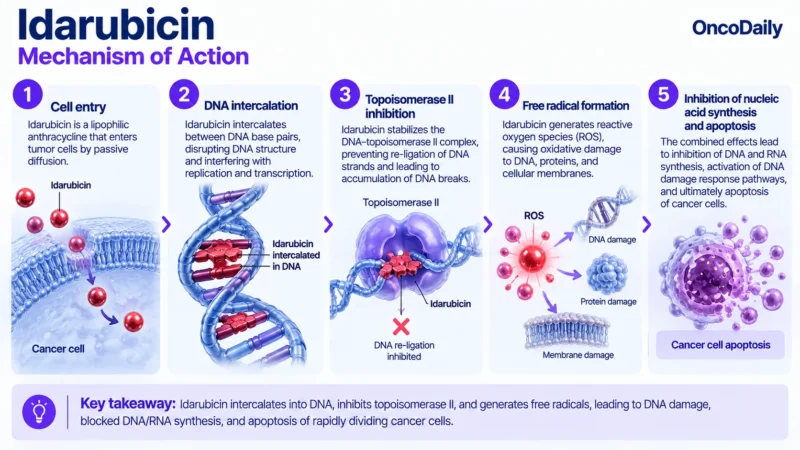
Idarubicin produces cytotoxic effects through several interconnected mechanisms.
1. DNA Intercalation
Idarubicin inserts itself between DNA base pairs.
This disrupts DNA structure and interferes with normal DNA replication and transcription.
2. Topoisomerase II Inhibition
Idarubicin inhibits topoisomerase II, an enzyme responsible for managing DNA strand breaks during replication.
This interferes with DNA re-ligation and contributes to the accumulation of DNA breaks.
3. Free Radical Formation
Idarubicin can promote the generation of reactive oxygen species.
These free radicals contribute to oxidative damage involving DNA and cellular membranes.
4. Inhibition of DNA and RNA Synthesis
The combined effects of DNA intercalation and topoisomerase II inhibition impair nucleic acid synthesis.
Malignant cells become unable to maintain normal DNA replication and repair.
5. Apoptosis
Accumulated DNA damage ultimately activates programmed cell-death pathways.
The mechanism can be summarized as:
Idarubicin → DNA intercalation + topoisomerase II inhibition + free radical generation → DNA damage → impaired DNA synthesis and repair → apoptosis.
What Is the Dose of Idarubicin?
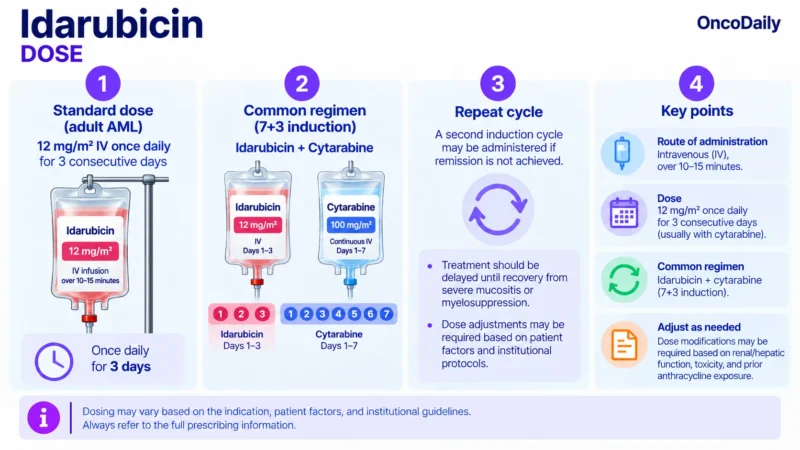
For adults with AML, the FDA-recommended induction regimen is:
12 mg/m² IV once daily for 3 consecutive days.
Idarubicin is typically combined with cytarabine.
Standard AML Induction — 7+3 Regimen
A commonly used induction approach consists of:
Idarubicin: 12 mg/m² IV on Days 1–3
Cytarabine: 100 mg/m²/day by continuous IV infusion on Days 1–7
This is commonly referred to as the 7+3 regimen, representing seven days of cytarabine and three days of an anthracycline.
A second induction cycle may be administered if remission is not achieved after the first course.
The dose and schedule may differ according to the treatment protocol, patient characteristics, and prior chemotherapy exposure.
How Is Idarubicin Administered?
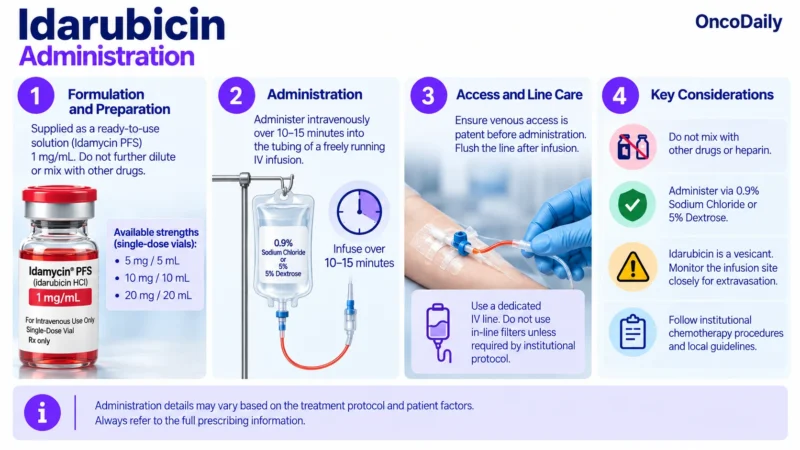
Idarubicin is administered intravenously.
For standard AML induction:
12 mg/m² IV → over 10–15 minutes → Days 1–3.
The US Idamycin PFS formulation contains:
1 mg/mL
Available single-dose vial strengths include:
- 5 mg/5 mL
- 10 mg/10 mL
- 20 mg/20 mL.
Preparation and Administration
Idarubicin is supplied as a ready-to-use, orange-red aqueous solution.
According to the updated US Idamycin PFS prescribing information, the required dose should not be further diluted before administration.
It should be administered over 10–15 minutes into the tubing of a freely running intravenous infusion of:
- 0.9% sodium chloride
- 5% dextrose.
The intravenous catheter should be flushed and assessed for patency before administration.
Idarubicin should not be mixed with other drugs or heparin.
Extravasation Precautions
Idarubicin is a vesicant chemotherapy.
Extravasation can cause severe local tissue injury and necrosis.
The infusion site should be monitored carefully during administration.
If extravasation occurs, administration must be stopped immediately and the institutional anthracycline extravasation protocol initiated.
Does Idarubicin Require an In-Line Filter?
No routine in-line filter is specifically required by the US prescribing information.
Administration should follow the product-specific instructions and institutional chemotherapy procedures.
Does Idarubicin Require Premedication?
No specific routine premedication regimen is mandatory in the US idarubicin label.
However, supportive treatment is important because idarubicin-containing chemotherapy can cause substantial nausea, vomiting, myelosuppression, and tumor lysis syndrome.
Antiemetic Prophylaxis
Antiemetic prophylaxis is recommended according to the emetogenic risk of the complete treatment regimen.
A 5-HT3 receptor antagonist, dexamethasone, and an NK1 receptor antagonist may be incorporated into prophylaxis according to institutional guidelines.
Tumor Lysis Prevention
Patients with substantial leukemia burden may require:
- Intravenous hydration
- Allopurinol or rasburicase
- Electrolyte monitoring
- Renal-function assessment.
Cardiac Assessment
Baseline cardiac function should be evaluated before treatment.
Patients with previous anthracycline exposure or existing cardiac disease require particular attention.
Are Dose Reductions Used?
Yes.
Dose reduction or treatment interruption may be necessary for:
- Severe myelosuppression
- Severe mucositis
- Renal impairment
- Hepatic impairment
- Cardiac toxicity
- Other significant treatment-related adverse reactions.
The updated US Idamycin PFS prescribing information recommends a 25% dose reduction in subsequent cycles for severe myelosuppression or severe mucositis, as clinically indicated.
If a second induction cycle is planned, treatment should be delayed until severe mucositis has resolved.
Idarubicin should be discontinued if the patient develops signs or symptoms of cardiomyopathy.
What Is the Pharmacokinetic Profile of Idarubicin?
Idarubicin demonstrates extensive tissue distribution and is metabolized into an active compound.
Distribution
Idarubicin is highly lipophilic and rapidly distributed into tissues.
Plasma protein binding is approximately 97%.
Metabolism
Idarubicin is primarily converted into:
Idarubicinol
Idarubicinol retains cytotoxic activity and contributes to the drug’s prolonged pharmacologic effects.
Elimination
Idarubicin is eliminated predominantly through biliary excretion, with a smaller contribution from renal excretion.
Its mean terminal elimination half-life is approximately:
20–22 hours
The terminal half-life of idarubicinol exceeds 45 hours.
The prolonged persistence of idarubicinol contributes to ongoing exposure after administration.
Does Idarubicin Require Renal or Hepatic Dose Adjustment?
Renal Impairment
Yes. Renal function should be evaluated before and during treatment.
According to the updated February 2026 US Idamycin PFS label:
- GFR ≥30 mL/min: No adjustment required
- GFR <30 mL/min: Reduce dose by 33%
- Hemodialysis: Reduce dose by 33%.
Patients with significant renal impairment require close monitoring.
Hepatic Impairment
Hepatic impairment can increase idarubicin exposure and toxicity.
The updated US prescribing information recommends:
- Bilirubin ≤2.6 mg/dL: No adjustment required
- Bilirubin >2.6 to <5 mg/dL: Reduce dose by 50%
- Bilirubin >5 mg/dL: Avoid use.
Liver function should be evaluated before and during therapy.
What Are the Clinical Uses of Idarubicin?
Acute Myeloid Leukemia
Idarubicin’s principal clinical application is AML.
It is commonly combined with cytarabine during remission induction.
The traditional 7+3 approach consists of seven days of cytarabine and three days of an anthracycline.
Idarubicin is one of the anthracyclines used in this regimen.
Watch more: Acute Myeloid Leukemia (AML) Treatment Options — an overview of AML treatment strategies from The Leukemia & Lymphoma Society of Canada.
Acute Promyelocytic Leukemia
Idarubicin has also been used in acute promyelocytic leukemia (APL).
Historically, it was incorporated into the AIDA regimen:
ATRA + Idarubicin
The introduction of arsenic trioxide has changed the APL treatment landscape, but idarubicin-containing regimens remain relevant in selected clinical settings, including some approaches for high-risk disease.
Relapsed or Refractory AML
Idarubicin may be incorporated into selected salvage regimens.
An important example is:
FLAG-IDA
This combination includes:
- Fludarabine
- Cytarabine
- Granulocyte colony-stimulating factor
- Idarubicin.
FLAG-IDA is used in selected intensive AML treatment strategies and has been evaluated in both newly diagnosed and relapsed or refractory disease.
These applications should follow the relevant disease-specific protocol.
What Did Idarubicin Clinical Trials Show?
Idarubicin Versus Daunorubicin in AML
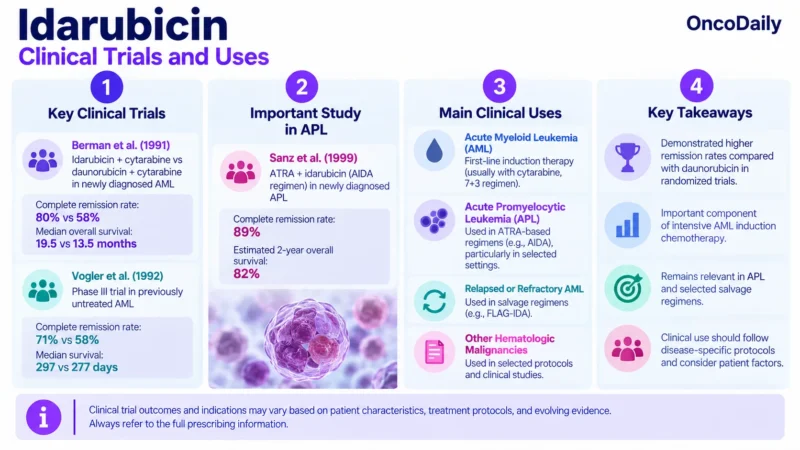
A randomized study conducted at Memorial Sloan Kettering Cancer Center compared idarubicin plus cytarabine with daunorubicin plus cytarabine in adults with newly diagnosed AML.
The study enrolled 130 patients aged 16–60 years.
Among the 120 patients included in the reported efficacy analysis, complete remission rates were:
- Idarubicin + cytarabine: 80%
- Daunorubicin + cytarabine: 58%.
Median overall survival was:
- Idarubicin + cytarabine: 19.5 months
- Daunorubicin + cytarabine: 13.5 months.
The trial demonstrated greater antileukemic activity with idarubicin in this study population and with the specific daunorubicin dose used at the time.
Southeastern Cancer Study Group Trial
Another randomized phase III study compared idarubicin and daunorubicin, each combined with cytarabine, in previously untreated AML.
Complete remission rates were:
- Idarubicin: 71%
- Daunorubicin: 58%.
Median survival was 297 days with idarubicin and 277 days with daunorubicin.
The remission-rate difference was statistically significant, while overall survival did not differ significantly between the study arms.
AIDA Regimen in Acute Promyelocytic Leukemia
The PETHEMA group investigated all-trans retinoic acid combined with idarubicin in newly diagnosed APL.
The study included 123 patients.
Complete remission was achieved in 109 patients:
89%
The estimated two-year overall survival was:
82%
These findings helped establish ATRA and anthracycline-based chemotherapy as an important historical treatment approach for APL.
Is Idarubicin FDA Approved?
Yes.
Idarubicin received its initial FDA approval on September 27, 1990.
Its current US indication is treatment of adult patients with AML as a component of combination chemotherapy.
The safety and effectiveness of Idamycin PFS in pediatric patients have not been established under the US label.
What Is the Current Clinical Role of Idarubicin?
Idarubicin remains an important anthracycline in intensive AML treatment.
Its principal roles include:
- AML remission induction
- Selected AML salvage regimens
- FLAG-IDA chemotherapy
- Selected APL treatment protocols.
The development of targeted therapies has expanded AML treatment options, but cytarabine and anthracycline-based induction remains an important chemotherapy backbone for appropriately selected patients.
Idarubicin is frequently combined with cytarabine during AML induction. Learn more about cytarabine and its mechanism of action, dosing, and clinical role on OncoDaily.
What Are the Major Side Effects of Idarubicin?
Idarubicin can cause substantial hematologic and nonhematologic toxicity.
Common adverse reactions include:
- Myelosuppression
- Neutropenia
- Thrombocytopenia
- Anemia
- Nausea and vomiting
- Mucositis
- Diarrhea
- Alopecia
- Fever
- Infections
- Fatigue
- Cardiac dysfunction.
Myelosuppression
Myelosuppression is one of the principal dose-limiting toxicities of idarubicin.
Common hematologic abnormalities include:
- Neutropenia
- Thrombocytopenia
- Anemia
- Leukopenia.
Severe bone-marrow suppression is expected during AML induction and may result in life-threatening infections and bleeding.
Cardiotoxicity
Cardiotoxicity is one of the most important serious adverse effects of idarubicin.
Idarubicin can cause myocardial injury and cardiomyopathy.
Potential manifestations include:
- Reduced left ventricular ejection fraction
- Congestive heart failure
- Arrhythmias
- Myocarditis
- Pericarditis.
Cardiac dysfunction may occur during treatment or several years after completion.
The risk increases with cumulative anthracycline exposure and may be greater in patients with previous anthracycline treatment, mediastinal irradiation, or pre-existing cardiac disease.
The US label reports an increased incidence of drug-induced congestive heart failure in adults at cumulative idarubicin doses exceeding approximately 90 mg/m². This is not a universally safe threshold, and the tolerable exposure may be lower in patients with additional risk factors.
Cardiac function should be assessed before treatment and monitored during and after therapy.
Infections
Idarubicin-associated myelosuppression increases susceptibility to bacterial, viral, and fungal infections.
Severe complications may include:
- Pneumonia
- Bacteremia
- Sepsis
- Septic shock.
Infections may be fatal, particularly during prolonged neutropenia.
Gastrointestinal Toxicity
Common gastrointestinal adverse reactions include:
- Nausea
- Vomiting
- Diarrhea
- Abdominal pain
- Mucositis.
In the Southeastern Cancer Study Group safety population, nausea and vomiting occurred in 82%, while abdominal pain or diarrhea occurred in 73% of patients receiving idarubicin with cytarabine.
Mucositis
Idarubicin may cause significant inflammation and ulceration of the oral and gastrointestinal mucosa.
Severe mucositis can interfere with eating and drinking and increase the risk of infection.
Treatment interruption or dose reduction may be required.
Extravasation
Idarubicin is a vesicant.
Accidental leakage outside the vein may cause:
- Pain
- Erythema
- Swelling
- Skin ulceration
- Severe tissue necrosis.
Extravasation requires immediate discontinuation of administration and management according to the institutional anthracycline extravasation protocol.
Alopecia
Hair loss is common during idarubicin-containing chemotherapy.
In the Southeastern Cancer Study Group trial, alopecia occurred in approximately 77% of patients receiving idarubicin with cytarabine.
Hepatotoxicity
Idarubicin may cause elevated liver enzymes and hepatic dysfunction.
Patients with pre-existing hepatic impairment may experience increased drug exposure and toxicity.
Tumor Lysis Syndrome
Rapid destruction of malignant cells may cause tumor lysis syndrome.
This can lead to electrolyte abnormalities, acute kidney injury, and cardiac complications.
Patients with substantial leukemia burden require risk-adapted prophylaxis and biochemical monitoring.
Secondary Malignancies
Anthracyclines, including idarubicin, have been associated with an increased risk of secondary AML and myelodysplastic syndrome.
Long-term monitoring is important in patients who survive their original malignancy.
Pregnancy and Reproductive Toxicity
Idarubicin may cause fetal harm and impair fertility.
According to the updated US Idamycin PFS label, effective contraception is recommended during treatment and for 6.5 months after the final dose for females of reproductive potential.
Males with female partners of reproductive potential should use effective contraception during treatment and for 3.5 months after the final dose.
Breastfeeding is not recommended during treatment or for 14 days after the final dose.
What Monitoring Is Required?
Monitoring should include:
- CBC with differential
- Platelet count
- Cardiac function, including LVEF
- Electrocardiogram when clinically indicated
- Renal function
- Liver function
- Electrolytes and uric acid
- Assessment for infection
- Assessment for mucositis
- Evaluation of the IV administration site
- Cumulative anthracycline exposure.
Cardiac monitoring is particularly important because anthracycline-induced cardiomyopathy may develop during treatment or years after therapy.