





Docetaxel: Understanding Its Mechanism, Dosing, and Clinical Role in Cancer
Key takeaways
- Docetaxel is a taxane chemotherapy that stabilizes microtubules and inhibits mitosis.
- It is FDA-approved for selected breast, lung, prostate, gastric, and head and neck cancers.
- A common dose is 75 mg/m² IV over 1 hour every 3 weeks, although dosing varies significantly by indication.
- Corticosteroid premedication is required to reduce fluid retention and hypersensitivity.
- Severe neutropenia is a major dose-limiting toxicity.
- Characteristic toxicities include fluid retention, peripheral neuropathy, skin and nail changes, and alopecia.
- Significant hepatic dysfunction substantially increases toxicity and may preclude treatment.
- Docetaxel remains an important chemotherapy backbone despite the increasing use of targeted and immune-based therapies.
Docetaxel (Taxotere) is a taxane chemotherapy and microtubule inhibitor used across several solid tumors, including breast cancer, non-small cell lung cancer (NSCLC), prostate cancer, gastric adenocarcinoma, and squamous cell carcinoma of the head and neck. Like paclitaxel, docetaxel binds tubulin and stabilizes microtubules, preventing their normal disassembly and interfering with mitosis.
Docetaxel remains an important component of combination chemotherapy and is commonly administered with platinum agents, anthracyclines, fluorouracil, prednisone, and other systemic therapies depending on the cancer type.
Key Facts
- Generic name: Docetaxel
- Brand name: Taxotere
- Drug class: Taxane; microtubule inhibitor
- Route: Intravenous infusion
- Initial US approval: 1996
- Common dose: 75 mg/m² IV every 3 weeks
- Infusion duration: Usually 1 hour
- Available concentration: 20 mg/mL for the current one-vial formulation
- Major mechanism: Stabilization of microtubules and inhibition of mitosis
- Major indications: Breast cancer, NSCLC, metastatic castration-resistant prostate cancer, gastric adenocarcinoma, and locally advanced head and neck cancer
- Premedication: Oral corticosteroid required
- Major toxicities: Neutropenia, febrile neutropenia, peripheral neuropathy, fluid retention, hypersensitivity, mucositis, skin and nail toxicity, and alopecia
- Important monitoring: CBC, liver function, neuropathy, fluid retention, and hypersensitivity
- Key caution: Docetaxel carries a boxed warning for toxic deaths, hepatotoxicity, neutropenia, hypersensitivity reactions, and fluid retention.
What Is Docetaxel?
Docetaxel is a semisynthetic taxane antineoplastic agent.
It is produced from a precursor derived from renewable yew-tree needle biomass and belongs to the same general drug family as paclitaxel.
Docetaxel interferes with the microtubular network that cells require for normal mitotic and interphase functions.
By stabilizing microtubules rather than allowing them to continuously assemble and disassemble, docetaxel prevents malignant cells from successfully completing cell division.
What Is the Mechanism of Action of Docetaxel?
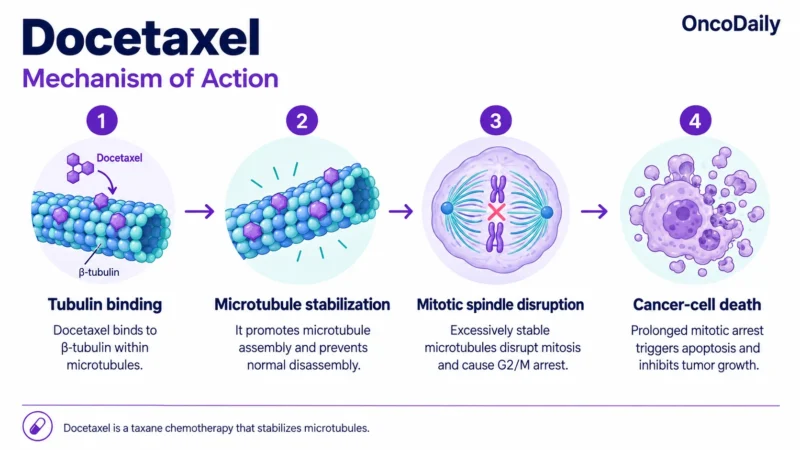
1. Binding to Tubulin
Docetaxel binds to free tubulin, the structural protein from which microtubules are assembled.
2. Microtubule Assembly
Docetaxel promotes the assembly of tubulin into stable microtubules.
3. Prevention of Microtubule Disassembly
Once formed, these microtubules cannot undergo their normal depolymerization.
The result is abnormal bundles of stable microtubules that cannot function normally.
4. Mitotic Disruption
Dynamic microtubules are essential for formation and function of the mitotic spindle.
Their excessive stabilization prevents proper chromosome segregation and interferes with mitosis.
5. Cell Death
Prolonged mitotic dysfunction and cellular stress ultimately promote malignant-cell death.
The mechanism can be summarized as:
Docetaxel → tubulin binding → microtubule assembly and stabilization → inhibition of microtubule disassembly → mitotic arrest → cancer-cell death.
What Is the Dose of Docetaxel?
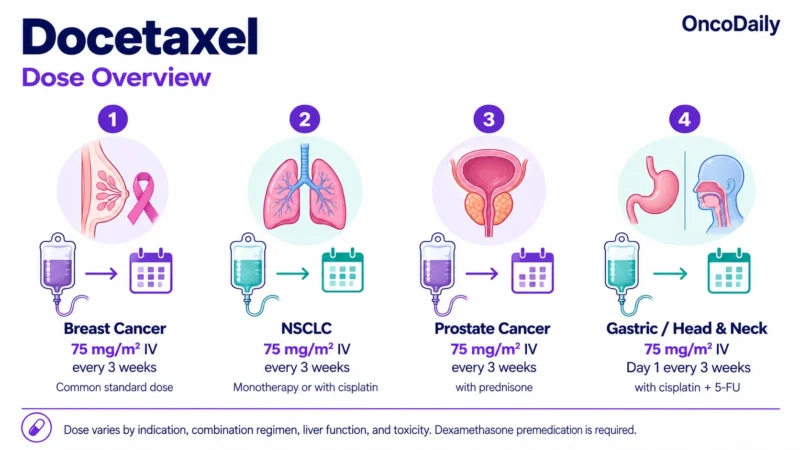
Docetaxel dosing varies substantially by indication and combination regimen.
Breast Cancer
For locally advanced or metastatic breast cancer after failure of previous chemotherapy:
60–100 mg/m² IV over 1 hour every 3 weeks.
For adjuvant treatment of operable node-positive breast cancer, the TAC regimen uses:
Docetaxel 75 mg/m² IV every 3 weeks for 6 cycles
administered after:
- Doxorubicin 50 mg/m²
- Cyclophosphamide 500 mg/m².
Non-Small Cell Lung Cancer
After failure of prior platinum-based chemotherapy:
75 mg/m² IV over 1 hour every 3 weeks.
For chemotherapy-naive advanced NSCLC:
Docetaxel 75 mg/m² IV over 1 hour
followed by:
Cisplatin 75 mg/m²
every 3 weeks.
Metastatic Castration-Resistant Prostate Cancer
The FDA-labeled regimen is:
Docetaxel 75 mg/m² IV over 1 hour every 3 weeks
with:
Prednisone 5 mg orally twice daily continuously.
Gastric Adenocarcinoma
The TCF regimen uses:
Docetaxel 75 mg/m² IV over 1 hour on Day 1
followed by cisplatin 75 mg/m² and fluorouracil 750 mg/m²/day as a continuous infusion for 5 days.
Treatment is repeated every 3 weeks.
Head and Neck Cancer
For induction treatment of locally advanced squamous cell carcinoma of the head and neck, docetaxel is incorporated into TPF chemotherapy.
A commonly labeled schedule uses:
Docetaxel 75 mg/m² IV over 1 hour on Day 1
with cisplatin and continuous-infusion fluorouracil, repeated every 3 weeks. Exact cisplatin and fluorouracil schedules differ between the TAX323 and TAX324 protocols.
How Is Docetaxel Administered?
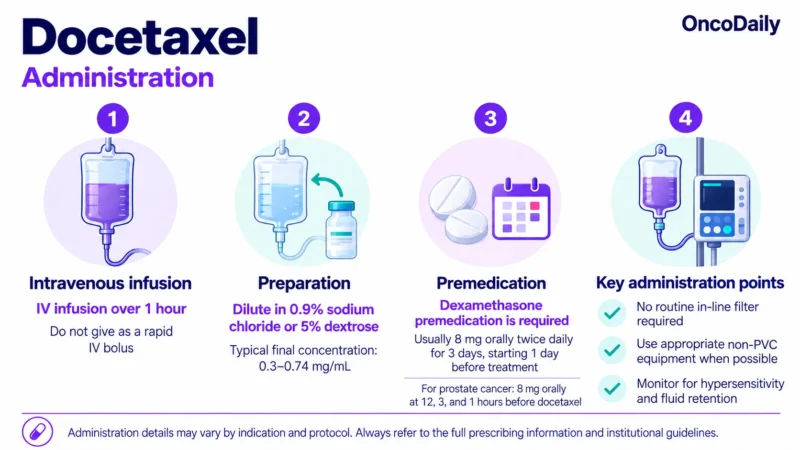
Docetaxel is administered by intravenous infusion, usually over:
1 hour
The current one-vial formulation contains:
20 mg/mL
and is available in single-dose vial presentations containing 20 mg, 80 mg, or 160 mg.
Preparation and Dilution
The current one-vial docetaxel formulation does not require preliminary reconstitution with a separate diluent.
The required amount is added directly to an infusion bag or bottle containing:
- 0.9% sodium chloride, or
- 5% dextrose.
The recommended final concentration is approximately:
0.3–0.74 mg/mL
If more than 200 mg is required, a larger infusion volume should be used so that the concentration does not exceed 0.74 mg/mL.
Administration Equipment
The label recommends avoiding plasticized PVC equipment where possible because the formulation may allow DEHP to leach from PVC.
Suitable containers include glass, polypropylene, or polyolefin, with appropriate administration sets.
Does Docetaxel Require an In-Line Filter?
No routine in-line filter is specifically required by the current US prescribing information.
The diluted solution should nevertheless be visually inspected for precipitation or particulate matter before administration.
Does Docetaxel Require Premedication?
Yes. Corticosteroid premedication is an important part of docetaxel treatment.
For most indications, a commonly recommended regimen is:
Dexamethasone 8 mg orally twice daily for 3 days, beginning 1 day before docetaxel.
This is intended to reduce:
- Fluid retention
- Hypersensitivity reactions.
Prostate Cancer
Because patients with metastatic castration-resistant prostate cancer are already receiving prednisone, the labeled dexamethasone regimen is:
8 mg orally at 12 hours, 3 hours, and 1 hour before docetaxel.
Other Supportive Medication
Depending on the regimen, patients may also require:
- Antiemetics
- G-CSF prophylaxis
- Hydration for cisplatin
- Antimicrobial prophylaxis in selected intensive regimens.
Are Dose Reductions Used?
Yes.
Docetaxel frequently requires dose modification for hematologic or nonhematologic toxicity.
Treatment generally should not be administered if:
ANC <1,500 cells/mm³.
Dose reduction or treatment delay may be required for:
- Febrile neutropenia
- Prolonged Grade 4 neutropenia
- Severe skin reactions
- Severe stomatitis
- Significant peripheral neuropathy
- Other Grade 3–4 toxicity.
For example, in metastatic castration-resistant prostate cancer, the labeled dose may be reduced from:
75 mg/m² → 60 mg/m²
after clinically important neutropenia, cutaneous toxicity, or moderate neurosensory toxicity.
Persistent significant toxicity at 60 mg/m² may require discontinuation.
Patients developing Grade 3 or greater peripheral neuropathy should discontinue docetaxel under the labeled recommendations.
What Is the Pharmacokinetic Profile of Docetaxel?
Distribution
Docetaxel has a mean steady-state volume of distribution of approximately:
113 L
It is highly protein bound:
approximately 94%, with some studies reporting approximately 97%.
Binding occurs predominantly to α1-acid glycoprotein, albumin, and lipoproteins.
Metabolism
Docetaxel is metabolized primarily through:
CYP3A4
Strong CYP3A4 inhibitors may substantially increase docetaxel exposure and toxicity.
Elimination
Docetaxel is eliminated predominantly through fecal excretion.
Approximately:
- 75% of administered radioactivity was recovered in feces
- 6% was recovered in urine.
Half-Life
With extended pharmacokinetic sampling, the mean terminal elimination half-life was approximately:
116 hours
with reported mean values ranging from approximately 92 to 135 hours.
Does Docetaxel Require Renal or Hepatic Dose Adjustment?
Renal Impairment
No standardized creatinine-clearance-based docetaxel dose-adjustment schedule is provided in the US prescribing information.
Docetaxel has limited renal elimination, but renal function remains important when it is combined with nephrotoxic agents such as cisplatin.
Hepatic Impairment
Hepatic dysfunction substantially increases the risk of severe docetaxel toxicity.
The US prescribing information recommends avoiding docetaxel in patients with:
- Bilirubin above the upper limit of normal, or
- AST and/or ALT >1.5 × ULN together with alkaline phosphatase >2.5 × ULN.
Liver function should be checked before every treatment cycle.
Patients meeting the combined liver-function abnormality criteria had an average reduction in docetaxel clearance of approximately 27% and a corresponding increase in systemic exposure of approximately 38%.
What Are the Clinical Uses of Docetaxel?
Breast Cancer
Docetaxel is used in both early and advanced breast cancer.
Its labeled roles include:
- Locally advanced or metastatic disease after prior chemotherapy
- Adjuvant treatment of operable node-positive breast cancer in combination with doxorubicin and cyclophosphamide.
Non-Small Cell Lung Cancer
Docetaxel is approved:
- As monotherapy after failure of platinum chemotherapy
- With cisplatin as first-line treatment for chemotherapy-naive unresectable locally advanced or metastatic NSCLC.
Prostate Cancer
Docetaxel plus prednisone is approved for:
Metastatic castration-resistant prostate cancer.
Taxane therapy remains an important component of systemic treatment across several stages of advanced prostate cancer.
Gastric and Gastroesophageal Junction Adenocarcinoma
Docetaxel combined with cisplatin and fluorouracil is approved for previously untreated advanced gastric or gastroesophageal junction adenocarcinoma.
Head and Neck Cancer
Docetaxel forms part of the TPF regimen:
Docetaxel + cisplatin + fluorouracil
for induction treatment of selected patients with locally advanced squamous cell carcinoma of the head and neck.
What Did Docetaxel Clinical Trials Show?
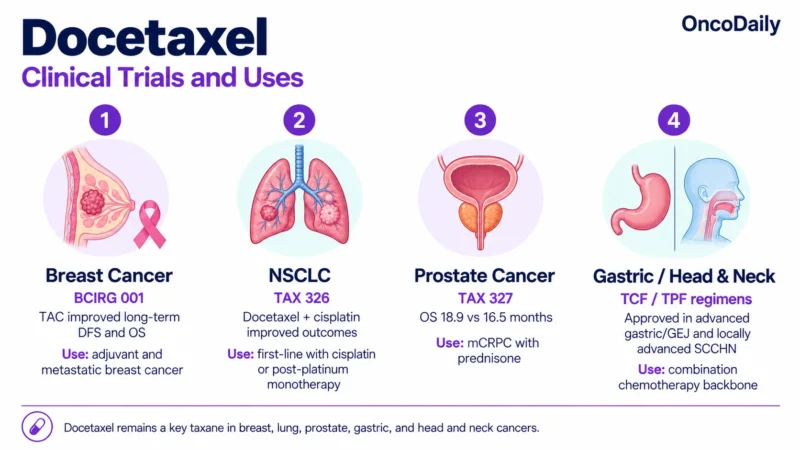
BCIRG 001: Docetaxel in Early Breast Cancer
BCIRG 001 compared docetaxel, doxorubicin, and cyclophosphamide (TAC) with fluorouracil, doxorubicin, and cyclophosphamide (FAC) in 1,491 patients with node-positive breast cancer.
At approximately 10 years:
- Disease-free survival was 62% with TAC vs 55% with FAC
- Overall survival was 76% vs 69%.
The results demonstrated durable benefit from adding docetaxel to the adjuvant regimen.
TAX 327: Docetaxel in Prostate Cancer
TAX 327 randomized 1,006 men with metastatic hormone-refractory, now termed castration-resistant, prostate cancer.
Median overall survival was:
- 18.9 months with docetaxel 75 mg/m² every 3 weeks plus prednisone
- 16.5 months with mitoxantrone plus prednisone.
The every-three-week docetaxel regimen also improved pain, PSA responses, and quality-of-life outcomes.
Watch more: Using PSA Dynamics to Optimize Docetaxel Scheduling in Metastatic Prostate Cancer Patients Receiving Hormone Therapy — Renee Brady-Nicholls, Moffitt Cancer Center. The talk focuses on docetaxel timing, treatment resistance, PSA dynamics, and mathematical modeling in metastatic prostate cancer.
TAX 326: Docetaxel in Advanced NSCLC
The phase III TAX 326 trial enrolled more than 1,200 patients with advanced NSCLC.
Docetaxel 75 mg/m² plus cisplatin 75 mg/m² every three weeks produced:
- Median overall survival of 11.3 months
- Two-year survival of 21%
compared with 10.1 months and 14%, respectively, with vinorelbine plus cisplatin.
Docetaxel in Gastric Cancer
In the randomized study supporting the gastric-cancer indication, docetaxel/cisplatin/fluorouracil improved:
- Median time to progression: 5.6 vs 3.7 months
- Median overall survival: 9.2 vs 8.6 months
- Overall response rate: 36.7% vs 25.4%
compared with cisplatin plus fluorouracil.
Is Docetaxel FDA Approved?
Yes.
Docetaxel received its initial US approval in 1996.
Current US labeling includes indications in:
- Breast cancer
- NSCLC
- Metastatic castration-resistant prostate cancer
- Advanced gastric/GEJ adenocarcinoma
- Locally advanced squamous cell carcinoma of the head and neck.
What Is the Current Clinical Role of Docetaxel?
Docetaxel remains one of the major taxane chemotherapies in solid-tumor oncology.
Its use has evolved as targeted therapies, antibody-drug conjugates, immune checkpoint inhibitors, and androgen receptor–targeted agents have expanded treatment options. Nevertheless, docetaxel remains an important chemotherapy backbone in breast, lung, prostate, gastric, and head and neck cancers.
Docetaxel and paclitaxel share the same general taxane mechanism but differ substantially in dosing, premedication, formulations, and toxicity patterns.
Docetaxel and paclitaxel belong to the same taxane class but differ in dosing, administration, and toxicity profiles. Learn more about paclitaxel and its role in cancer treatment on OncoDaily
What Are the Major Side Effects of Docetaxel?
Common and clinically important adverse reactions include:
- Neutropenia
- Febrile neutropenia
- Anemia
- Thrombocytopenia
- Infection
- Peripheral neuropathy
- Fluid retention
- Hypersensitivity reactions
- Alopecia
- Fatigue
- Mucositis
- Nausea
- Diarrhea
- Myalgia
- Skin reactions
- Nail changes
- Dysgeusia.
Neutropenia
Neutropenia is one of the principal dose-limiting toxicities of docetaxel.
Grade 4 neutropenia is common at standard oncology doses and can result in:
- Febrile neutropenia
- Serious bacterial infection
- Sepsis
- Treatment-related death.
Docetaxel should not be administered when the neutrophil count is below 1,500 cells/mm³.
Fluid Retention
Fluid retention is a characteristic toxicity of docetaxel.
Manifestations may include:
- Peripheral edema
- Weight gain
- Pleural effusion
- Ascites
- Generalized edema.
Corticosteroid premedication reduces the incidence and severity but does not completely eliminate the risk.
Hypersensitivity Reactions
Acute hypersensitivity reactions may occur despite corticosteroid premedication.
Symptoms may include:
- Flushing
- Rash
- Dyspnea
- Bronchospasm
- Hypotension
- Chest or back discomfort
- Anaphylaxis.
Severe reactions require immediate discontinuation and appropriate emergency treatment.
Peripheral Neuropathy
Docetaxel can cause sensory and motor neuropathy.
Symptoms include:
- Numbness
- Tingling
- Burning
- Sensory loss
- Weakness.
Grade 3 or greater peripheral neuropathy generally requires permanent discontinuation.
Skin and Nail Toxicity
Docetaxel may cause:
- Rash
- Desquamation
- Nail discoloration
- Nail pain
- Onycholysis.
Rare severe cutaneous reactions have also been reported.
Alopecia
Hair loss is very common.
Cases of persistent or permanent alopecia have also been reported with docetaxel-containing treatment.
Mucositis and Gastrointestinal Toxicity
Docetaxel may cause:
- Stomatitis
- Mucositis
- Nausea
- Vomiting
- Diarrhea
- Reduced appetite.
Rare but serious enterocolitis and neutropenic colitis can occur and may be fatal.
Lacrimation and Eye Disorders
Excessive tearing may develop with repeated docetaxel exposure.
This can be associated with lacrimal-duct obstruction.
Other reported ophthalmologic effects include conjunctivitis and rare cystoid macular edema.
Secondary Malignancies
Secondary malignancies including:
- AML
- Myelodysplastic syndrome
- Non-Hodgkin lymphoma
have been reported after docetaxel-containing treatment, particularly in combination chemotherapy settings.
Pregnancy and Reproductive Toxicity
Docetaxel can cause fetal harm based on its mechanism of action and animal studies.
Patients of reproductive potential should receive appropriate contraception and fertility counseling according to current prescribing information.
What Monitoring Is Required?
Monitoring should include:
- CBC with differential
- Platelet count
- Bilirubin, AST/ALT, and alkaline phosphatase before each cycle
- Assessment for fever and infection
- Peripheral neuropathy assessment
- Weight and signs of fluid retention
- Skin and nail examination
- Oral examination for mucositis
- Assessment for hypersensitivity during infusion
- Gastrointestinal symptoms
- Eye symptoms with prolonged treatment.