





Decitabine: Understanding Its Mechanism, Dosing, and Clinical Role
Key takeaways
- Decitabine is a hypomethylating agent and cytidine nucleoside analog.
- It is primarily administered intravenously in its injectable formulation.
- Decitabine incorporates into DNA and inhibits DNA methyltransferases, producing DNA hypomethylation.
- The standard five-day regimen is 20 mg/m² IV daily for 5 days every 4 weeks.
- An alternative labeled regimen is 15 mg/m² every 8 hours for 3 days every 6 weeks.
- MDS is the principal established indication for injectable decitabine.
- Decitabine has also demonstrated activity in AML and CMML.
- The DACO-016 trial showed improved response rates in older patients with AML compared with physician's choice, although the primary OS analysis was not statistically significant.
- Decitabine/cedazuridine (Inqovi) provides an oral alternative to IV decitabine.
- In May 2026, the FDA approved oral decitabine/cedazuridine with venetoclax for selected newly diagnosed AML patients unable to receive intensive induction chemotherapy.
- Myelosuppression, infection, anemia, thrombocytopenia, and neutropenia are major treatment-related concerns.
Decitabine is an intravenous hypomethylating agent and cytidine nucleoside analog used primarily in myelodysplastic syndromes (MDS) and other myeloid malignancies. It is incorporated into DNA and inhibits DNA methyltransferases, leading to DNA hypomethylation and altered expression of genes involved in differentiation and malignant-cell proliferation.
This article aims to review decitabine’s mechanism of action, dose, administration, clinical uses, clinical-trial findings, pharmacokinetics, safety profile, and current approval status, including its established role in MDS and its evolving role in acute myeloid leukemia (AML).
Key Facts
- Generic name: Decitabine
- Brand name: Dacogen
- Drug class: Hypomethylating agent; cytidine nucleoside analog
- Route: Intravenous (IV)
- Primary approved indication: Myelodysplastic syndromes
- Initial U.S. approval: 2006
- Standard 5-day regimen: 20 mg/m² IV daily for 5 days
- Treatment cycle: Every 4 weeks
- Alternative labeled regimen: 15 mg/m² IV every 8 hours for 3 days, repeated every 6 weeks
- Key mechanism: DNA methyltransferase inhibition and DNA hypomethylation
- Major toxicities: Neutropenia, thrombocytopenia, anemia, and fever
- Important monitoring: CBC, platelets, renal function, liver function, infection, and treatment response
- Oral formulation: Decitabine/cedazuridine (Inqovi) provides oral decitabine exposure for MDS/CMML; in 2026, the FDA also approved it with venetoclax for certain newly diagnosed AML patients.
What Is Decitabine?
Decitabine is a deoxycytidine analog and DNA hypomethylating agent.
It is a prodrug that undergoes intracellular phosphorylation to its active triphosphate metabolite. The active compound is incorporated primarily into DNA during replication, where it interferes with DNA methyltransferase activity.
By reducing abnormal DNA methylation, decitabine can reverse epigenetic silencing of genes involved in:
- Cellular differentiation
- Tumor suppression
- Growth regulation
- Apoptosis.
Unlike conventional cytotoxic chemotherapy, its clinical activity is strongly related to its epigenetic effects at lower exposure, although DNA damage and other cellular effects also contribute.
What Is the Mechanism of Action of Decitabine?
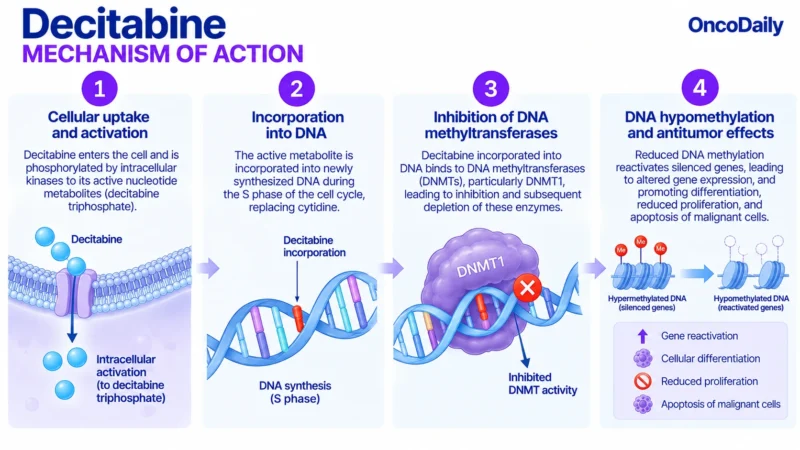
1. Cellular Uptake and Activation
Decitabine enters cells and is phosphorylated by cellular kinases to generate its active nucleotide metabolites.
2. DNA Incorporation
The active metabolite is incorporated into newly synthesized DNA during the S phase of the cell cycle.
3. DNA Methyltransferase Inhibition
Decitabine-containing DNA interacts with DNA methyltransferases (DNMTs), particularly DNMT1.
This results in inhibition and depletion of DNMT activity.
4. DNA Hypomethylation
Reduced DNA methylation can reactivate genes that had been epigenetically silenced.
This can promote:
Differentiation → reduced proliferation → apoptosis of malignant cells
The mechanism can be summarized as:
Decitabine → intracellular activation → DNA incorporation → DNMT inhibition → DNA hypomethylation → altered gene expression → antitumor effects
What Is the Dose of Decitabine?
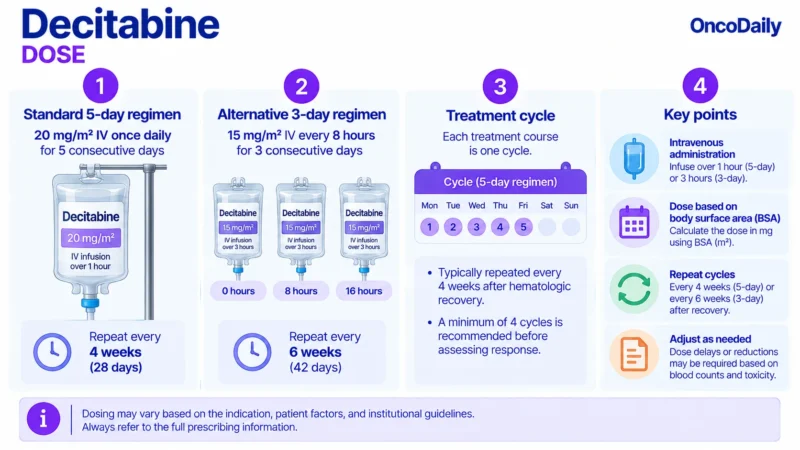
The current injectable prescribing information provides two dosing regimens.
Five-Day Regimen
20 mg/m² IV over 1 hour once daily for 5 consecutive days
The cycle is generally repeated:
Every 4 weeks
after hematologic recovery.
A minimum of 4 cycles is recommended before determining that a patient has not responded, because complete or partial responses can take longer to develop.
Three-Day Regimen
An alternative regimen is:
15 mg/m² IV over 3 hours every 8 hours for 3 consecutive days
This regimen is repeated:
Every 6 weeks
after hematologic recovery.
The five-day regimen is commonly used in contemporary practice.
How Is Decitabine Administered?
Decitabine injection is administered intravenously.
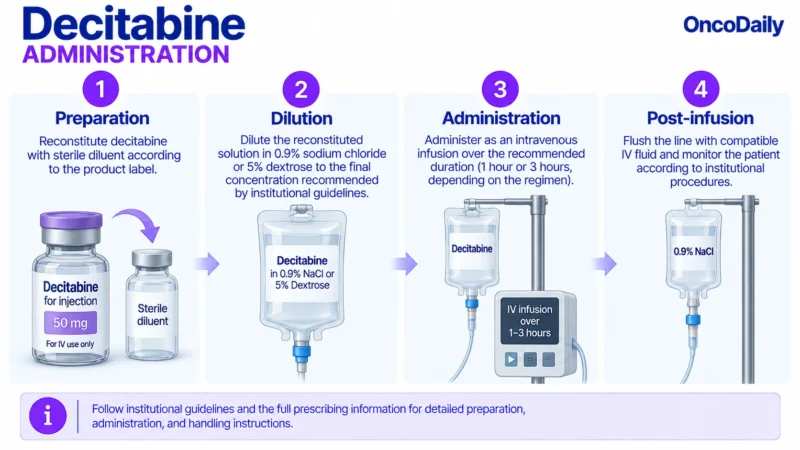
For the five-day regimen:
20 mg/m² → IV infusion over 1 hour → once daily → Days 1–5 → repeat every 28 days
For the three-day regimen:
15 mg/m² → IV infusion over 3 hours → every 8 hours → Days 1–3 → repeat every 6 weeks.
Patients should receive treatment under appropriate oncology supervision with regular hematologic monitoring.
Does Decitabine Require an In-Line Filter?
An in-line filter is not routinely required solely because of decitabine administration.
Preparation and administration should follow the specific product labeling and institutional IV chemotherapy procedures.
Does Decitabine Require Premedication?
Antiemetic premedication may be considered because nausea can occur during treatment.
The prescribing information recommends considering antiemetic premedication and obtaining baseline:
- CBC with platelets
- Hepatic panel
- Serum creatinine.
Are Dose Reductions Used?
Yes.
Dose delays and reductions may be required, particularly for prolonged hematologic toxicity.
For the five-day regimen, treatment cycles are generally delayed until adequate recovery, including:
- ANC ≥1,000/µL
- Platelets ≥50,000/µL
according to the prescribing information.
Patients with prolonged marrow suppression may require additional dose modification.
What Is the Pharmacokinetic Profile of Decitabine?
Decitabine has a short plasma half-life, historically reported at approximately 15–25 minutes, largely because of rapid metabolism by cytidine deaminase.
Despite its short plasma exposure, decitabine produces longer-lasting biological effects because its active metabolites become incorporated into DNA and affect DNA methyltransferase activity.
This pharmacology is one reason why repeated low-dose exposure over several days and multiple treatment cycles is important for clinical activity.
Does Decitabine Require Renal or Hepatic Dose Adjustment?
Renal Impairment
Decitabine has not been adequately studied in patients with pre-existing renal impairment.
The prescribing information recommends weighing the potential risks and benefits before initiating treatment in patients with renal impairment.
Hepatic Impairment
Similarly, patients with significant hepatic impairment were not adequately represented in clinical studies.
Treatment should therefore be approached cautiously, with appropriate monitoring and consideration of the individual risk-benefit profile.
What Are the Clinical Uses of Decitabine?
Myelodysplastic Syndromes
MDS is the principal FDA-approved indication for injectable decitabine.
It can be used in patients with:
- Previously treated MDS
- Untreated MDS
- De novo MDS
- Secondary MDS
- Higher-risk MDS
- Chronic myelomonocytic leukemia within the labeled MDS classification.
Decitabine has demonstrated clinically meaningful response rates and delayed disease progression in MDS.
Acute Myeloid Leukemia
Decitabine has been extensively studied in AML, particularly in older adults and patients who are not candidates for intensive chemotherapy.
The phase III DACO-016 study compared decitabine with physician’s choice of low-dose cytarabine or supportive care in older patients with newly diagnosed AML. Decitabine improved response rates, although the primary overall-survival analysis did not reach statistical significance.
Decitabine has also been investigated using 10-day schedules in AML.
Chronic Myelomonocytic Leukemia
Decitabine has activity in CMML, which is biologically related to both MDS and myeloid neoplasms.
Oral decitabine/cedazuridine is FDA approved for adult patients with MDS, including CMML.
Oral Decitabine/Cedazuridine
Decitabine/cedazuridine (Inqovi) is an oral fixed-dose combination containing:
35 mg decitabine + 100 mg cedazuridine
Cedazuridine inhibits cytidine deaminase, increasing the bioavailability of orally administered decitabine.
It provides comparable cumulative decitabine exposure to the standard five-day IV regimen.
Watch more: Hypomethylating Agents: Azacitidine and Decitabine in AML
What Did Decitabine Clinical Trials Show?
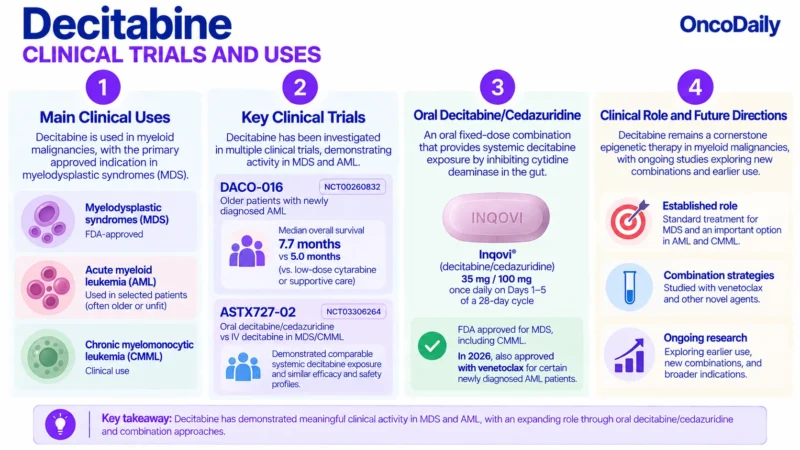
DACO-016 — AML
The phase III DACO-016 trial enrolled older patients with newly diagnosed AML who were not candidates for intensive chemotherapy.
Decitabine was compared with physician’s choice of low-dose cytarabine or supportive care.
Median overall survival was:
7.7 months with decitabine vs 5.0 months with control
The primary analysis did not reach statistical significance for overall survival, but decitabine significantly improved the combined complete remission and complete remission without platelet recovery rate: 17.8% vs 7.8%.
ASTX727-02 — Oral Decitabine/Cedazuridine
The phase III ASTX727-02 study evaluated oral decitabine/cedazuridine compared with IV decitabine in patients with MDS and CMML.
The study demonstrated comparable cumulative decitabine exposure and supported the use of the oral formulation as an alternative to the IV regimen.
ASTX727-01
The earlier phase I/II study evaluated oral decitabine/cedazuridine in MDS and CMML.
The phase II population demonstrated a complete response rate of 18%, with a median response duration of approximately 8.7 months.
10-Day Decitabine in AML
Extended decitabine schedules have been investigated in AML because prolonged exposure may increase hypomethylating activity.
A randomized phase III study comparing 10-day decitabine with 3+7 intensive chemotherapy in older patients with AML did not demonstrate superior overall survival, although the decitabine group had fewer severe infections and some other treatment-related toxicities.
Is Decitabine FDA Approved?
Yes.
Injectable decitabine received its initial U.S. FDA approval in 2006 for the treatment of MDS.
The oral combination decitabine/cedazuridine (Inqovi) was subsequently approved for adult MDS, including CMML.
Importantly, in May 2026, the FDA expanded the role of oral decitabine/cedazuridine by approving it in combination with venetoclax for newly diagnosed AML in adults aged 75 years or older, or adults with comorbidities that preclude intensive induction chemotherapy.
The recommended Inqovi dose for this AML indication is:
One tablet (35 mg decitabine/100 mg cedazuridine) orally once daily on Days 1–5 of each 28-day cycle, in combination with venetoclax.
What Is the Current Clinical Role of Decitabine?
Decitabine remains an important hypomethylating therapy for myeloid malignancies, particularly MDS.
Its clinical role has expanded beyond the original IV formulation through decitabine/cedazuridine, which provides an oral treatment option.
The 2026 FDA approval of oral decitabine/cedazuridine plus venetoclax for selected newly diagnosed AML patientsis particularly important because it brings an oral decitabine-containing regimen into an FDA-approved AML treatment setting.
Decitabine therefore has an evolving role across:
- MDS
- CMML
- AML
- Combination treatment with venetoclax
- Oral hypomethylating therapy.
Read more: Azacitidine or Decitabine for Newly Diagnosed TP53-Mutant AML? on OncoDaily.
What Are the Major Side Effects of Decitabine?
Myelosuppression
The most important toxicity is bone-marrow suppression.
Common adverse effects include:
- Neutropenia
- Thrombocytopenia
- Anemia
- Febrile neutropenia.
These effects can increase the risk of infection and bleeding.
Infection
Patients receiving decitabine may develop:
- Pneumonia
- Sepsis
- Febrile neutropenia
- Other serious infections.
Fatigue
Fatigue and weakness are common during treatment.
Nausea and Vomiting
Gastrointestinal toxicity can occur, which is why antiemetic prophylaxis may be considered.
Fever
Pyrexia is frequently reported in clinical studies.
Mucositis
Oral mucositis and other gastrointestinal effects may occur, particularly with intensive treatment schedules.
What Monitoring Is Required?
Monitoring should include:
- CBC with differential
- Platelet count
- Renal function
- Liver function
- Assessment for infection
- Assessment for bleeding
- Assessment of treatment response.
Before initiating therapy, the prescribing information recommends baseline CBC with platelets, hepatic panel, and serum creatinine.
Because cytopenias can worsen during early treatment cycles, close monitoring is particularly important at treatment initiation.