





Dacarbazine: An Established Alkylating Chemotherapy for Melanoma and Hodgkin Lymphoma
Key takeaways
- Dacarbazine is an intravenous chemotherapy that damages DNA and interferes with cancer-cell survival.
- It remains FDA approved for metastatic melanoma and for Hodgkin lymphoma in combination therapy.
- In Hodgkin lymphoma, dacarbazine is the “D” in the established ABVD regimen: doxorubicin, bleomycin, vinblastine, and dacarbazine.
- In advanced melanoma, its role has become substantially smaller because immunotherapy and molecularly targeted therapies have produced better outcomes in many patients. In CheckMate-066, nivolumab produced superior survival, progression-free survival, and response rates compared with dacarbazine.
- Bone-marrow suppression is one of its most important toxicities, requiring careful hematologic monitoring.
- Rare but potentially severe hepatic injury has also been reported.
Dacarbazine, also known as DTIC, is an intravenous cytotoxic chemotherapy and triazene derivative that damages cancer-cell DNA. It is FDA approved for metastatic malignant melanoma and, in combination with other anticancer agents, for Hodgkin lymphoma in the second-line setting.
This article aims to review dacarbazine’s mechanism of action, administration, clinical role, pharmacokinetics, safety profile, approval status, and current place in oncology. Because dacarbazine is a hazardous clinician-administered chemotherapy, exact preparation, dilution, and dosing instructions should come from the applicable prescribing information and oncology protocol rather than a general article.
Dacarbazine Key Facts
- Generic name: Dacarbazine
- Common abbreviation: DTIC
- Drug class: Triazene alkylating antineoplastic agent
- Administration: Intravenous
- Main FDA-approved cancers: Metastatic malignant melanoma and Hodgkin lymphoma in combination therapy
- Common Hodgkin lymphoma regimen: Component of ABVD
- Approval status: FDA approved
- Important toxicities: Bone-marrow suppression, nausea and vomiting, hepatic toxicity, infusion-site injury, flu-like symptoms, and hypersensitivity reactions.
What Is Dacarbazine?
Dacarbazine is an intravenous triazene chemotherapy that exerts anticancer effects primarily through DNA damage.
It has long been used in melanoma and Hodgkin lymphoma and has also served as a comparator chemotherapy in numerous trials evaluating newer systemic treatments.
Dacarbazine remains an established component of several Hodgkin lymphoma strategies. NCI continues to describe ABVD—doxorubicin, bleomycin, vinblastine, and dacarbazine—as an important chemotherapy platform in classical Hodgkin lymphoma.
Dacarbazine Mechanism of Action
Dacarbazine is considered a DNA-damaging alkylating agent. Its precise pharmacologic activity is complex, but its anticancer effects are associated with conversion to active intermediates that interfere with DNA integrity.
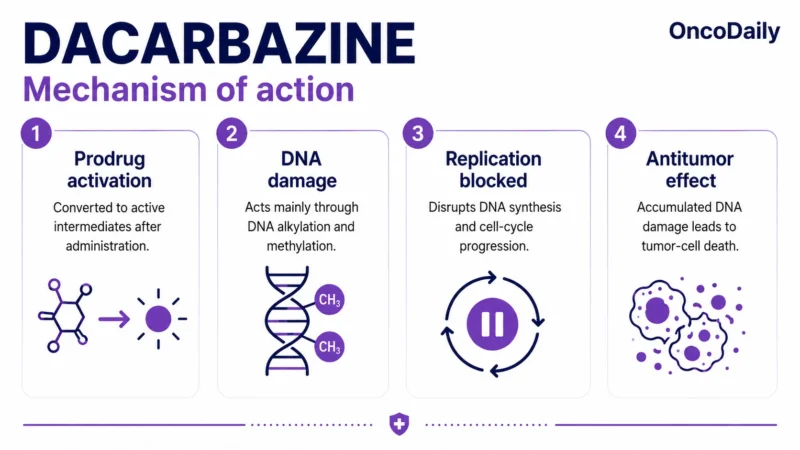
The NCI describes dacarbazine as a triazene derivative capable of alkylating and cross-linking DNA, resulting in disruption of DNA function, cell-cycle arrest, and apoptosis.
The proposed effects include:
DNA alkylation
DNA cross-link formation
Interference with DNA synthesis
Disruption of cellular replication
Cell-cycle arrest
Cancer-cell death
What Is the Dose of Dacarbazine?
Dacarbazine dosing is disease- and regimen-specific.
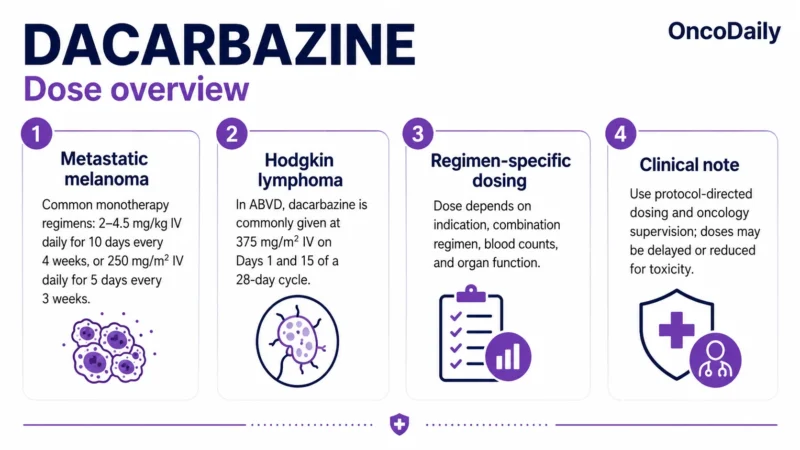
Melanoma monotherapy and Hodgkin lymphoma combination protocols use different schedules, and contemporary Hodgkin lymphoma treatment incorporates dacarbazine as one component of multidrug therapy.
Because dacarbazine is a hazardous cytotoxic medicine, exact patient-specific dosing should be calculated and administered by an oncology team according to the relevant treatment protocol and prescribing information.
How Is Dacarbazine Administered?
Dacarbazine is administered intravenously by trained healthcare professionals. It is supplied as a formulation that requires preparation for IV administration and is light sensitive.
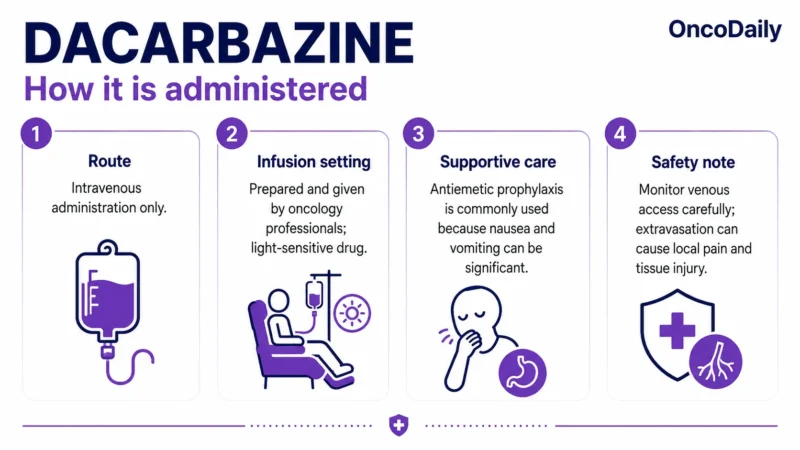
Administration requires careful attention to venous access because accidental extravasation can produce severe local pain and tissue injury.
Does Dacarbazine Require an In-Line Filter?
There is no single universal filter instruction that should be applied independently of the specific dacarbazine product and institutional chemotherapy protocol.
Preparation and administration should follow the applicable pharmacy and manufacturer instructions.
Is Premedication Required?
Dacarbazine is associated with substantial chemotherapy-induced nausea and vomiting, so antiemetic prophylaxis is typically incorporated into treatment protocols.
The exact antiemetic regimen depends on the complete chemotherapy combination, patient risk factors, and institutional practice.
Are Dose Reductions Used?
Yes. Treatment may need to be delayed, modified, or discontinued for significant toxicity.
The most important reasons include:
- Leukopenia
- Thrombocytopenia
- Severe infection
- Significant hepatic toxicity
- Serious hypersensitivity
- Persistent clinically important nonhematologic toxicity
The product labeling specifically emphasizes careful monitoring of blood-cell counts because severe leukopenia and thrombocytopenia can occur.
What Is Known About Dacarbazine Pharmacokinetics?
After intravenous administration, dacarbazine distributes extensively into body tissues. The current DailyMed labeling describes a biphasic decline from plasma, with a short initial distribution phase followed by a longer terminal elimination phase.
A substantial proportion of unchanged dacarbazine is eliminated in urine, while the drug also undergoes extensive metabolic transformation. Renal and hepatic dysfunction can prolong systemic exposure.
Are Renal or Hepatic Dose Adjustments Required?
There is no simple universal renal- or hepatic-adjustment schedule that applies to every dacarbazine regimen.
Renal and hepatic function are clinically relevant because both organ systems contribute to dacarbazine disposition, and impaired function may increase exposure. Treatment decisions should therefore follow the relevant oncology protocol and prescribing information.
What Did Dacarbazine Clinical Trials Show?
Dacarbazine in Hodgkin Lymphoma
Dacarbazine became established as part of ABVD, which combines:
- Doxorubicin
- Bleomycin
- Vinblastine
- Dacarbazine
ABVD has been evaluated extensively across early- and advanced-stage classical Hodgkin lymphoma. Modern Hodgkin lymphoma studies increasingly use PET-adapted approaches or evaluate newer agents while retaining dacarbazine-containing backbones.
Current research also continues to investigate combinations containing dacarbazine. For example, NCT03646123 evaluates brentuximab vedotin–based strategies incorporating doxorubicin and dacarbazine in classical Hodgkin lymphoma.
Dacarbazine in Metastatic Melanoma
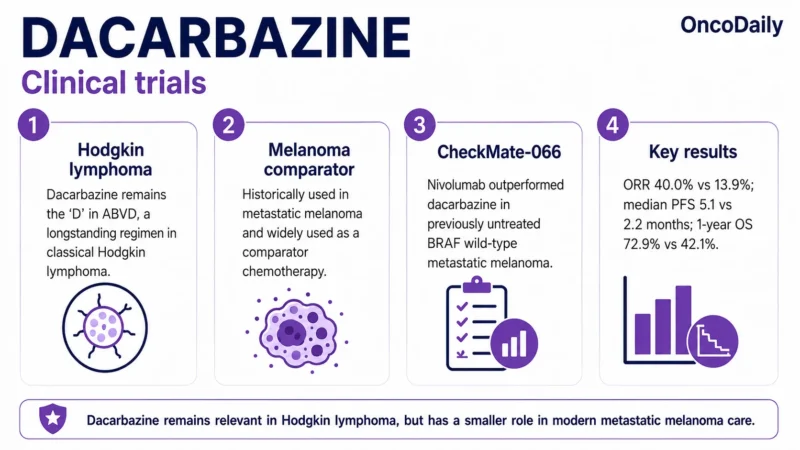
Dacarbazine was historically a standard systemic treatment for metastatic melanoma and subsequently became an important comparator in trials of newer therapies.
In the Phase 3 CheckMate-066 study of previously untreated BRAF wild-type metastatic melanoma:
- Nivolumab achieved an objective response rate of 40.0%
- Dacarbazine achieved 13.9%
- Median progression-free survival was 5.1 months with nivolumab versus 2.2 months with dacarbazine
- One-year overall survival was 72.9% versus 42.1%, respectively.
These results helped demonstrate why immune-checkpoint inhibition replaced dacarbazine as a preferred systemic strategy for many patients with advanced melanoma.
Watch more: Ipilimumab Plus Dacarbazine for Metastatic Melanoma — discussion of the Phase III trial comparing the immunotherapy combination in metastatic melanoma.
Is Dacarbazine Approved?
Yes.
In the United States, dacarbazine is indicated for:
- Metastatic malignant melanoma
- Hodgkin lymphoma as second-line therapy when combined with other effective agents.
What Is the Current Role of Dacarbazine?
Dacarbazine remains clinically relevant, but its importance differs markedly by disease.
In Hodgkin lymphoma, it remains an important component of established multidrug chemotherapy regimens, including ABVD and newer treatment strategies built around an AVD backbone.
In metastatic melanoma, its role is now much more limited because checkpoint inhibitors and targeted therapies have substantially improved outcomes for many patients.
Read more: Explore how targeted therapy and immunotherapy have transformed the treatment of metastatic melanoma on OncoDaily.
What Are the Side Effects of Dacarbazine?
Reported adverse effects include:
- Leukopenia
- Thrombocytopenia
- Anemia
- Nausea
- Vomiting
- Reduced appetite
- Fatigue
- Flu-like symptoms
- Injection-site pain
- Hypersensitivity reactions
- Liver toxicity.
Bone-Marrow Suppression
Myelosuppression is the major toxicity of dacarbazine.
Leukopenia and thrombocytopenia can become severe, making regular blood-count monitoring essential during treatment.
Hepatic Toxicity
Rare cases of serious hepatic injury involving hepatic-vein thrombosis and hepatocellular necrosis have been reported. The labeling describes this complication as uncommon but potentially fatal.
Extravasation
Dacarbazine can produce significant local tissue injury if it escapes from the vein during administration. Pain, burning, and irritation at the infusion site therefore require prompt evaluation.
Written by Mirna Antabian, MD