





Clofarabine: Understanding Its Mechanism, Dosing, and Clinical Role in Leukemia
Key takeaways
- Clofarabine is a purine nucleoside analog chemotherapy approved for patients aged 1–21 years with relapsed or refractory ALL after at least two previous treatment regimens.
- Its mechanism involves inhibition of ribonucleotide reductase and DNA polymerases, disruption of DNA synthesis and repair, and induction of apoptosis.
- The standard pediatric dose is 52 mg/m² intravenously over 2 hours daily for 5 consecutive days, with cycles generally repeated every 2–6 weeks.
- Clofarabine has also been investigated in AML, combination chemotherapy, and hematopoietic stem-cell transplantation.
- Major toxicities include myelosuppression, serious infections, hepatotoxicity, nephrotoxicity, tumor lysis syndrome, and capillary leak syndrome.
- Renal function is particularly important because dose reduction is required in patients with moderate renal impairment.
Clofarabine is a purine nucleoside analog and antimetabolite chemotherapy used primarily in the treatment of relapsed or refractory acute lymphoblastic leukemia (ALL) in children and young adults. It interferes with DNA synthesis and repair, inhibits essential enzymes involved in DNA replication, and promotes apoptosis in malignant cells.
This article aims to review clofarabine’s mechanism of action, dose, administration, clinical uses, clinical-trial findings, pharmacokinetics, safety profile, and current clinical role.
Key Facts
- Generic name: Clofarabine
- Brand names: Clolar, Evoltra
- Drug class: Purine nucleoside analog; antimetabolite
- Route: Intravenous (IV)
- Primary approved indication: Relapsed or refractory ALL in patients aged 1–21 years after at least two prior treatment regimens
- Standard dose: 52 mg/m² daily for 5 consecutive days
- Infusion duration: 2 hours
- Treatment cycle: Generally every 2–6 weeks
- Active metabolite: Clofarabine triphosphate
- Major mechanism: Inhibition of DNA synthesis and induction of apoptosis
- Major toxicities: Myelosuppression, infections, hepatotoxicity, nephrotoxicity, and capillary leak syndrome
- Important monitoring: CBC, renal function, liver function, electrolytes, and fluid balance
- Key caution: Dose adjustment is required in renal impairment.
What Is Clofarabine?
Clofarabine is a second-generation purine nucleoside analog developed from structural features of fludarabine and cladribine.
It is designed to interfere with DNA metabolism in malignant cells.
After entering the cell, clofarabine undergoes phosphorylation to form its active intracellular metabolite:
Clofarabine triphosphate
This metabolite inhibits DNA synthesis and repair through several complementary mechanisms.
Clofarabine has demonstrated antileukemic activity in both ALL and acute myeloid leukemia (AML), although its FDA-approved indication is restricted to selected pediatric and young-adult patients with relapsed or refractory ALL.
What Is the Mechanism of Action of Clofarabine?
Clofarabine produces cytotoxic effects through several interconnected mechanisms.
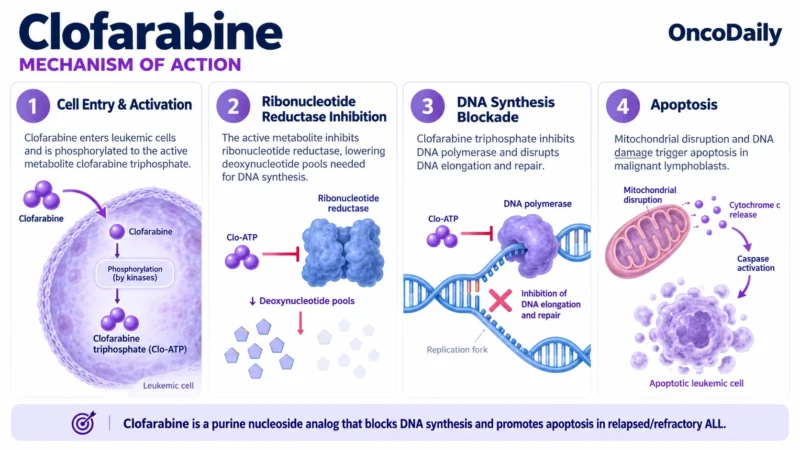
1. Intracellular Activation
Clofarabine enters malignant cells and undergoes sequential phosphorylation by intracellular kinases.
The resulting active metabolite is:
Clofarabine triphosphate
2. Inhibition of Ribonucleotide Reductase
Clofarabine inhibits ribonucleotide reductase, reducing the availability of deoxyribonucleotides required for DNA synthesis.
This prevents malignant cells from maintaining adequate nucleotide pools for DNA replication.
3. Inhibition of DNA Polymerase
Clofarabine triphosphate inhibits DNA polymerases and can become incorporated into newly synthesized DNA.
This interferes with DNA-chain elongation and repair.
4. Mitochondrial Disruption
Clofarabine can disrupt mitochondrial membrane integrity, promoting the release of proapoptotic proteins.
These include cytochrome c and apoptosis-inducing factor.
5. Apoptosis
The combined disruption of DNA synthesis, DNA repair, and mitochondrial function ultimately promotes malignant-cell death.
The mechanism can be summarized as:
Clofarabine → intracellular phosphorylation → clofarabine triphosphate → inhibition of ribonucleotide reductase + DNA polymerase → impaired DNA synthesis + mitochondrial disruption → apoptosis.
What Is the Dose of Clofarabine?
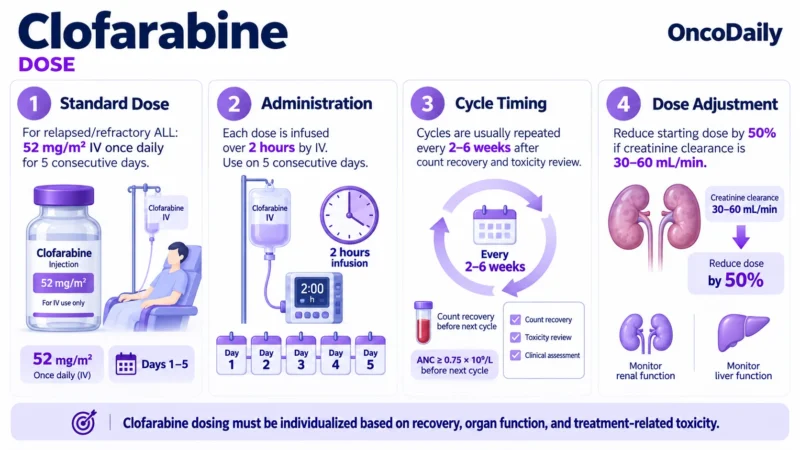
For pediatric patients with relapsed or refractory ALL, the FDA-recommended regimen is:
52 mg/m² IV once daily for 5 consecutive days.
The drug is infused over:
2 hours
Treatment cycles are generally repeated every 2–6 weeks, depending on hematologic recovery and treatment-related toxicity.
Subsequent cycles should not begin earlier than 14 days after the beginning of the preceding cycle, and the absolute neutrophil count should have recovered to at least 0.75 × 10⁹/L.
Combination Regimens
Clofarabine has also been investigated with other chemotherapy drugs.
Examples include:
- Clofarabine + cyclophosphamide + etoposide
- Clofarabine + cytarabine
A pediatric ALL combination study used clofarabine at 40 mg/m²/day with cyclophosphamide and etoposide.
These doses are protocol-specific and should not be confused with the approved monotherapy regimen.
How Is Clofarabine Administered?
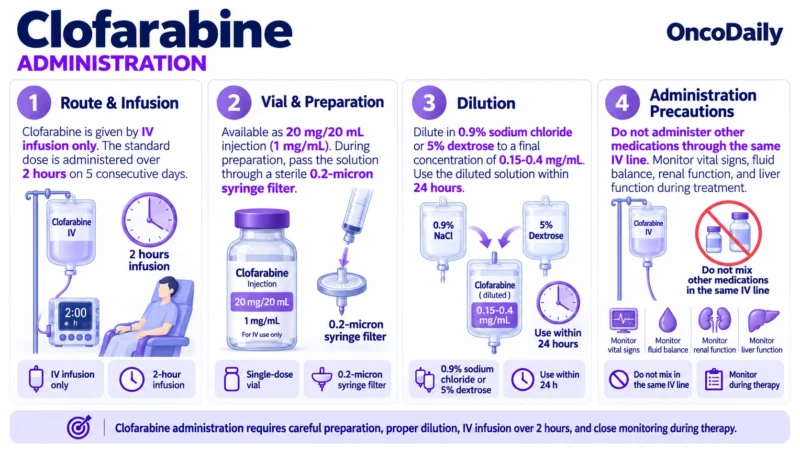
Clofarabine is administered intravenously.
For the standard pediatric ALL regimen:
52 mg/m² IV → over 2 hours → Days 1–5 → repeat approximately every 2–6 weeks.
The available injection contains 20 mg in a 20 mL single-dose vial, corresponding to 1 mg/mL.
Preparation and Dilution
Clofarabine should be filtered through a sterile 0.2-micron syringe filter during preparation.
It is then diluted with:
- 0.9% sodium chloride
- 5% dextrose.
The recommended final concentration is:
0.15–0.4 mg/mL
The diluted preparation should be used within 24 hours.
Other medications should not be administered simultaneously through the same intravenous line.
Does Clofarabine Require an In-Line Filter?
The US prescribing information requires a sterile 0.2-micron syringe filter during preparation.
A separate routine in-line filter during infusion is not specifically required by the US label.
Product-specific preparation instructions and institutional pharmacy procedures should be followed.
Does Clofarabine Require Premedication?
There is no single mandatory premedication regimen.
However, supportive treatment is important because clofarabine can cause nausea, tumor lysis syndrome, systemic inflammatory response syndrome, and capillary leak syndrome.
Antiemetic Premedication
Clofarabine is moderately emetogenic.
A 5-HT3 receptor antagonist may be administered according to the treatment protocol.
Corticosteroid Prophylaxis
Prophylactic corticosteroids may be considered to reduce the risk of systemic inflammatory response syndrome and capillary leak syndrome.
The US prescribing information describes hydrocortisone 100 mg/m² on Days 1–3 as one possible prophylactic approach.
Hydration and Tumor Lysis Prevention
Adequate hydration and uric acid–lowering therapy are important during treatment.
Allopurinol or rasburicase may be considered according to individual tumor lysis risk.
Are Dose Reductions Used?
Yes.
Dose reduction or treatment interruption may be necessary for:
- Prolonged Grade 4 neutropenia
- Severe infection
- Grade 3–4 nonhematologic toxicity
- Renal impairment
- Significant hepatotoxicity
- Systemic inflammatory response syndrome
- Capillary leak syndrome.
For Grade 4 neutropenia lasting at least four weeks, the FDA label recommends a 25% dose reduction for the next cycle.
For eligible patients with Grade 3 noninfectious, nonhematologic toxicity, treatment may be restarted with a 25% dose reduction after recovery.
Grade 4 noninfectious, nonhematologic toxicity generally requires discontinuation.
What Is the Pharmacokinetic Profile of Clofarabine?
Clofarabine undergoes intracellular phosphorylation to form its active triphosphate metabolite.
Distribution
Plasma protein binding is approximately 47%.
The steady-state volume of distribution is approximately 172 L/m².
Metabolism
Clofarabine undergoes limited systemic metabolism.
Its intracellular phosphorylation is essential for pharmacologic activity.
Elimination
Renal elimination is an important clearance pathway.
Approximately 49–60% of the administered dose is recovered unchanged in urine.
The terminal plasma elimination half-life is approximately 5.2 hours.
Renal impairment can substantially increase systemic exposure.
Does Clofarabine Require Renal or Hepatic Dose Adjustment?
Renal Impairment
Yes. Renal function is an important determinant of clofarabine dosing.
For creatinine clearance between 30 and 60 mL/min, the US prescribing information recommends reducing the starting dose by 50%.
There is insufficient information to establish a recommended dose for patients with creatinine clearance below 30 mL/min or those receiving dialysis.
Hepatic Impairment
There is no validated universal dose-adjustment schedule for patients with hepatic impairment.
Clofarabine should be used cautiously because severe hepatotoxicity and hepatic failure have been reported.
Liver function should be monitored throughout treatment.
What Are the Clinical Uses of Clofarabine?
Acute Lymphoblastic Leukemia
Clofarabine’s principal approved indication is relapsed or refractory ALL in patients aged 1–21 years after at least two prior treatment regimens.
It may produce remission in selected patients with heavily pretreated disease.
Acute Myeloid Leukemia
Clofarabine has also been investigated in AML.
It has been evaluated alone and in combination with cytarabine, particularly in older patients with relapsed or refractory disease.
AML is not an FDA-approved indication for clofarabine.
Hematopoietic Stem-Cell Transplantation
Clofarabine-containing regimens have been investigated before hematopoietic stem-cell transplantation.
In selected patients, clofarabine may be used as part of a cytoreductive strategy before transplantation.
Watch more: 60+1 Questions About Acute Lymphoblastic Leukemia in Children with Scott Howard on OncoDaily TV.
What Did Clofarabine Clinical Trials Show?
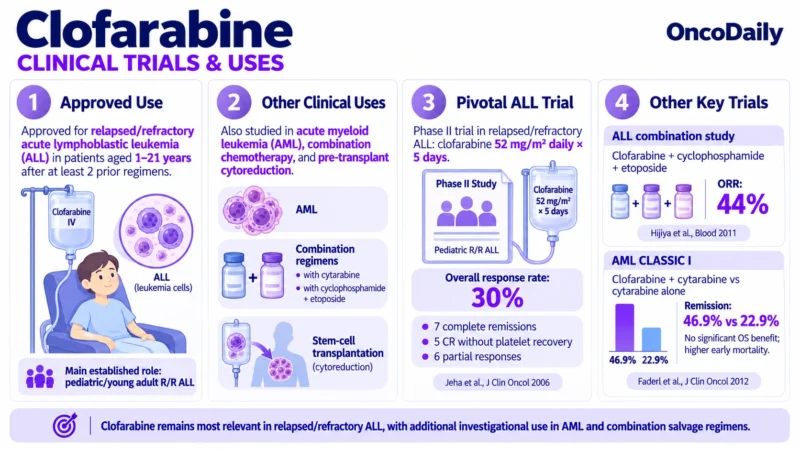
Clofarabine in Pediatric Relapsed or Refractory ALL
The pivotal phase II study by Jeha and colleagues included 61 pediatric patients with relapsed or refractory ALL.
Patients received clofarabine 52 mg/m² daily for five consecutive days.
The overall response rate was:
30%
Responses included:
- Complete remission: 7 patients
- Complete remission without platelet recovery: 5 patients
- Partial response: 6 patients.
These findings supported clofarabine’s regulatory approval for heavily pretreated pediatric ALL.
Clofarabine With Cyclophosphamide and Etoposide
A phase II study evaluated clofarabine combined with cyclophosphamide and etoposide in 25 pediatric patients with relapsed or refractory ALL.
The overall response rate was:
44%
Ten patients subsequently underwent hematopoietic stem-cell transplantation.
However, the combination was associated with substantial treatment-related toxicity, including fatal complications.
CLASSIC I Trial in AML
The randomized phase III CLASSIC I study compared clofarabine plus cytarabine with cytarabine alone in older patients with relapsed or refractory AML.
The overall remission rate was:
- Clofarabine + cytarabine: 46.9%
- Cytarabine alone: 22.9%.
However, the combination did not significantly improve overall survival.
Median overall survival was 6.6 versus 6.3 months, respectively.
Thirty-day mortality was higher with the combination, highlighting the importance of treatment-related toxicity.
Is Clofarabine FDA Approved?
Yes.
Clofarabine received FDA approval on December 28, 2004.
Its approved indication is relapsed or refractory ALL in patients aged 1–21 years after at least two previous treatment regimens.
Clofarabine is also authorized in Europe under the brand name Evoltra.
It is not FDA-approved for AML.
What Is the Current Clinical Role of Clofarabine?
Clofarabine remains a treatment option for selected patients with multiply relapsed or refractory ALL.
Its role has evolved with the development of newer immunotherapies, including blinatumomab, inotuzumab ozogamicin, and CAR T-cell therapy.
Nevertheless, clofarabine-containing regimens remain relevant in selected salvage-treatment strategies and investigational transplantation approaches.
Clofarabine has also been investigated with cytarabine and cyclophosphamide.
Learn more about cytarabine and its role in leukemia treatment on OncoDaily.
What Are the Major Side Effects of Clofarabine?
Common adverse effects include:
- Neutropenia
- Anemia
- Thrombocytopenia
- Febrile neutropenia
- Nausea and vomiting
- Diarrhea
- Fatigue
- Fever
- Headache
- Rash and pruritus
- Abdominal pain
- Elevated liver enzymes
- Renal dysfunction.
Myelosuppression
Clofarabine can cause severe bone-marrow suppression.
Common hematologic toxicities include:
- Neutropenia
- Thrombocytopenia
- Anemia
- Leukopenia.
Severe myelosuppression increases the risk of infection, bleeding, and transfusion requirements.
Serious Infections
Clofarabine can cause profound immunosuppression.
Patients may develop bacterial, viral, or fungal infections.
Severe infections, including sepsis and septic shock, may be fatal.
Hepatotoxicity
Clofarabine can cause elevated liver enzymes, hyperbilirubinemia, and hepatic injury.
Severe complications include hepatic failure and hepatic sinusoidal obstruction syndrome.
Patients who previously underwent stem-cell transplantation may be particularly vulnerable to hepatic sinusoidal obstruction syndrome.
Nephrotoxicity
Clofarabine can cause acute kidney injury and renal failure.
The risk may increase with dehydration, tumor lysis syndrome, sepsis, or pre-existing renal impairment.
Capillary Leak Syndrome
Clofarabine may cause systemic inflammatory response syndrome and capillary leak syndrome.
Potential manifestations include:
- Hypotension
- Tachycardia
- Tachypnea
- Pulmonary edema
- Pleural effusions
- Fluid retention.
Severe cases can progress to multiorgan failure.
Tumor Lysis Syndrome
Rapid destruction of leukemia cells may cause tumor lysis syndrome.
This can result in electrolyte abnormalities, acute kidney injury, cardiac arrhythmias, and other serious complications.
Gastrointestinal Toxicity
Common gastrointestinal adverse effects include nausea, vomiting, diarrhea, abdominal pain, and mucositis.
Serious enterocolitis, including neutropenic enterocolitis, has also been reported.
Skin Toxicity
Clofarabine may cause rash, pruritus, erythema, and palmar-plantar erythrodysesthesia syndrome.
Rare but serious reactions include Stevens-Johnson syndrome and toxic epidermal necrolysis.
Infertility and Pregnancy Risk
Clofarabine may impair fertility and can cause fetal harm.
Effective contraception is recommended during and after treatment according to the prescribing information.
What Monitoring Is Required?
Monitoring should include:
- CBC with differential
- Platelet count
- Renal function
- Liver function
- Electrolytes and uric acid
- Fluid balance and urine output
- Blood pressure and heart rate
- Respiratory status
- Assessment for infection
- Assessment for tumor lysis syndrome
- Assessment for capillary leak syndrome.
Because clofarabine can cause severe hematologic and organ toxicity, close monitoring throughout the five-day treatment course is particularly important.