





Chlorambucil: An Established Alkylating Chemotherapy for Hematologic Malignancies
Key takeaways
- Chlorambucil is an oral DNA-alkylating chemotherapy used mainly in hematologic cancers.
- It forms DNA cross-links that prevent normal replication and can trigger cancer-cell death.
- Dosing varies by disease and treatment strategy; there is no single universal regimen.
- It is administered orally and does not require an in-line filter.
- Routine drug-specific premedication is generally not required.
- The major dose-limiting toxicity is bone-marrow suppression.
- Chlorambucil has largely been replaced by more effective targeted therapies in chronic lymphocytic leukemia.
- It remains FDA approved, although its role in modern oncology is more limited than in previous decades.
Chlorambucil is an oral alkylating chemotherapy used mainly in selected hematologic malignancies, including chronic lymphocytic leukemia and some indolent lymphomas. It is a nitrogen-mustard derivative that damages DNA by forming covalent cross-links, thereby interfering with cancer-cell replication and survival.
This article aims to review chlorambucil’s mechanism of action, dose, administration, pharmacokinetics, clinical uses, safety profile, approval status, and current role in oncology.
Chlorambucil Key Facts
- Generic name: Chlorambucil
- Brand name: Leukeran
- Drug class: Alkylating agent; nitrogen-mustard derivative
- Administration: Oral tablets
- Main historical indications: Chronic lymphocytic leukemia, Hodgkin lymphoma, and selected non-Hodgkin lymphomas
- Typical adult starting dose: Approximately 0.1–0.2 mg/kg orally daily, depending on indication and protocol
- Main toxicities: Myelosuppression, infection, nausea, infertility, seizures at high exposure, secondary malignancies, and embryo-fetal toxicity
- Approval status: FDA approved
- Current role: Limited compared with newer targeted therapies, but still used in selected patients and regions
What Is Chlorambucil?
Chlorambucil is an oral bifunctional alkylating agent that belongs to the nitrogen-mustard class of chemotherapy drugs.
It has historically been used to treat:
- Chronic lymphocytic leukemia
- Hodgkin lymphoma
- Follicular lymphoma
- Other indolent non-Hodgkin lymphomas
Chlorambucil was widely used before the development of anti-CD20 monoclonal antibodies, BTK inhibitors, BCL-2 inhibitors, and other modern targeted treatments.
Chlorambucil Mechanism of Action
Chlorambucil exerts its anticancer effect through DNA alkylation.
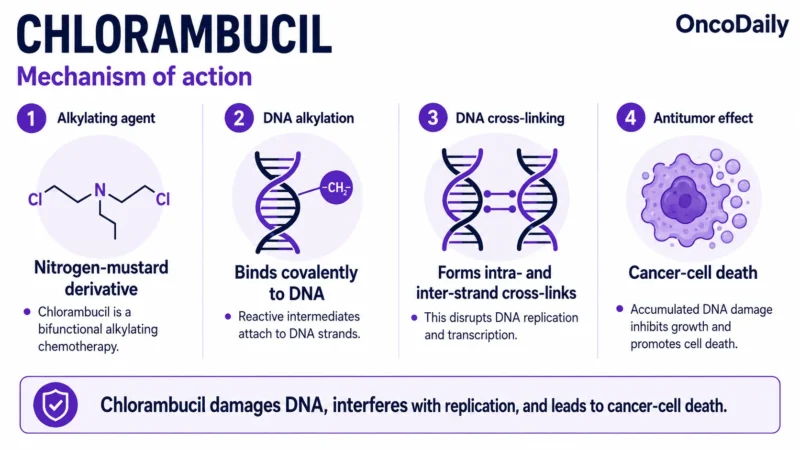
The mechanism includes:
- Formation of reactive alkylating intermediates
- Covalent binding to DNA
- Formation of intra-strand and inter-strand DNA cross-links
- Disruption of DNA replication and transcription
- Accumulation of DNA damage
- Cancer-cell death
Chlorambucil is considered cell-cycle nonspecific, although rapidly proliferating cells are particularly sensitive to its effects.
What Is the Dose of Chlorambucil?
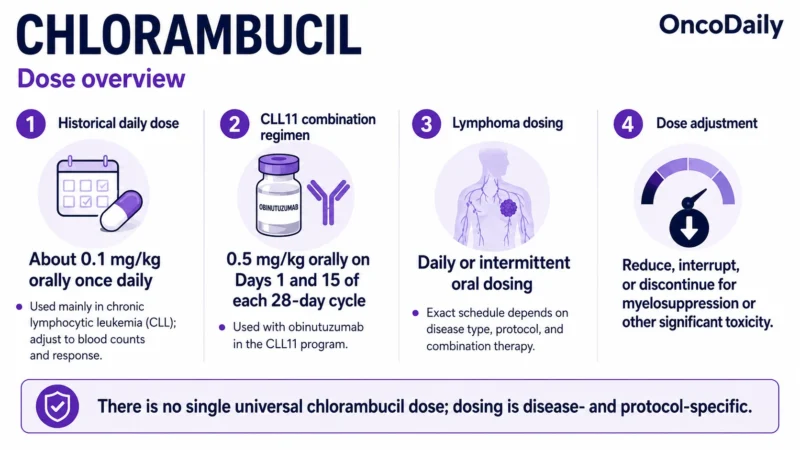
Chlorambucil dosing depends on the disease, treatment intent, blood counts, age, and combination therapy.
Chronic Lymphocytic Leukemia
Historically used regimens include:
Chlorambucil 0.1 mg/kg orally once daily
or intermittent regimens using higher doses on defined treatment days.
Some combination protocols, particularly those developed with anti-CD20 antibodies such as obinutuzumab, used:
Chlorambucil 0.5 mg/kg orally on Days 1 and 15 of each 28-day cycle.
This schedule was used in the CLL11 program.
Lymphoma
Historical lymphoma regimens used daily or intermittent oral chlorambucil, frequently in combination with corticosteroids or other chemotherapy drugs.
Because many of these schedules have been replaced by newer therapies, the exact dose should follow the disease-specific protocol.
How Is Chlorambucil Administered?
Chlorambucil is administered orally as a tablet.
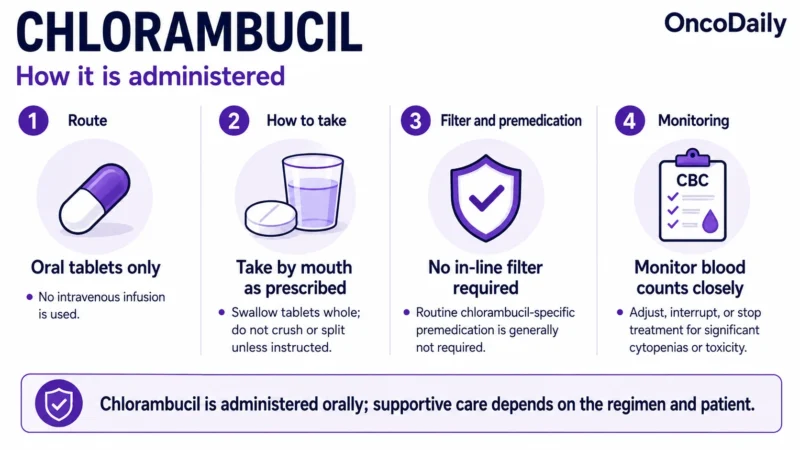
Patients generally take the prescribed dose according to the protocol-defined schedule.
Important administration considerations include:
- Swallow tablets whole
- Do not crush or split unless specifically instructed
- Handle as hazardous cytotoxic medication
- Store according to the product label
- Take consistently with regard to food if the protocol specifies this
Because chlorambucil is administered orally, no IV dilution, infusion tubing, or flushing procedure is required.
Does Chlorambucil Require an In-Line Filter?
No.
Chlorambucil does not require an in-line filter because it is taken orally rather than administered intravenously.
Is Premedication Required?
No standard chlorambucil-specific premedication regimen is required.
Supportive medication may include:
- Antiemetics for nausea
- Antimicrobial treatment or prophylaxis in selected immunosuppressed patients
- Tumor-lysis monitoring or prophylaxis when clinically appropriate
- Growth-factor support in selected patients
Premedication requirements may differ when chlorambucil is combined with monoclonal antibodies such as obinutuzumab.
Are Dose Reductions Used?
Yes.
Treatment may be delayed, reduced, or discontinued for:
- Neutropenia
- Thrombocytopenia
- Severe anemia
- Serious infection
- Significant neurologic toxicity
- Severe gastrointestinal toxicity
- Prolonged marrow suppression
- Other clinically significant adverse events
Complete blood counts should be monitored closely because bone-marrow suppression can be cumulative.
Exact dose-reduction levels depend on the treatment protocol.
What Is Known About Chlorambucil Pharmacokinetics?
Chlorambucil is well absorbed after oral administration.
After absorption, it undergoes metabolism to phenylacetic acid mustard, an active alkylating metabolite that contributes to the drug’s cytotoxic effects.
Important pharmacokinetic features include:
- Rapid gastrointestinal absorption
- Conversion to an active metabolite
- Extensive protein binding
- Relatively short plasma half-life for the parent drug
- Predominantly metabolic rather than unchanged renal elimination
Systemic exposure can vary between patients.
Are Renal or Hepatic Dose Adjustments Required?
Renal Impairment
No universally established renal dose-adjustment schedule is required for mild or moderate renal dysfunction.
Because chlorambucil is mainly metabolized rather than eliminated unchanged by the kidneys, renal impairment has less influence on exposure than with some other cytotoxic drugs.
However, patients should still be monitored closely for:
- Myelosuppression
- Infection
- General treatment intolerance
Hepatic Impairment
Chlorambucil is metabolized in the liver.
Patients with hepatic impairment may have increased exposure, and dose reduction may be considered in clinically significant liver dysfunction.
There is no single universally validated dose-reduction table applicable to every degree of hepatic impairment.
What Did Chlorambucil Clinical Trials Show?
Chlorambucil Plus Obinutuzumab in CLL
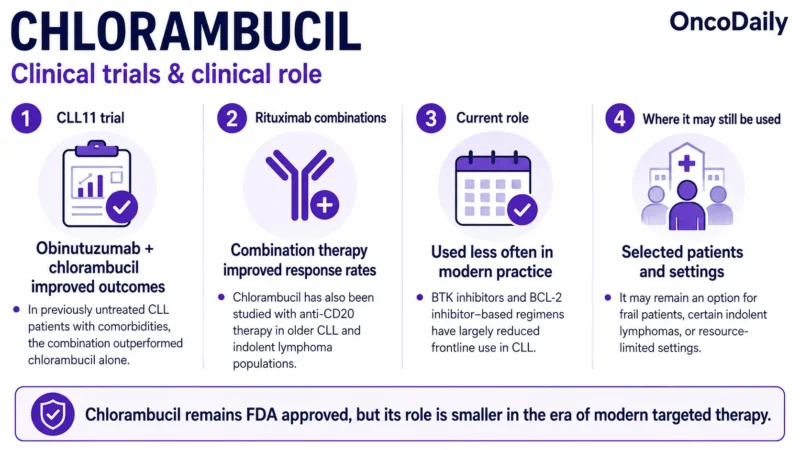
The Phase 3 CLL11 trial evaluated chlorambucil alone and in combination with anti-CD20 monoclonal antibodies in previously untreated patients with chronic lymphocytic leukemia and significant comorbidities.
The combination of obinutuzumab plus chlorambucil produced substantially better disease control than chlorambucil alone.
The regimen became an important treatment option for older or medically frail patients before newer targeted therapies became widely established.
Chlorambucil Plus Rituximab
Chlorambucil has also been studied with rituximab in older patients with CLL and indolent lymphomas.
Adding anti-CD20 therapy improved response rates compared with chlorambucil monotherapy, although these regimens have largely been replaced by newer targeted combinations.
Modern CLL Therapy
In contemporary practice, oral targeted agents have significantly reduced the use of chlorambucil.
These include:
- BTK inhibitors
- BCL-2 inhibitors
- Anti-CD20–based targeted combinations
Chlorambucil is therefore now used much less frequently as first-line treatment in many countries.
Is Chlorambucil Approved?
Yes.
Chlorambucil is FDA approved for selected hematologic malignancies, historically including:
- Chronic lymphocytic leukemia
- Hodgkin lymphoma
- Certain non-Hodgkin lymphomas
Its regulatory approval remains in place even though its clinical use has declined.
What Is the Current Role of Chlorambucil?
Chlorambucil is no longer a preferred frontline therapy for most patients with CLL when modern targeted drugs are available.
Read more: Explore how modern targeted therapies are reshaping treatment for chronic lymphocytic leukemia on OncoDaily.
Its current role may include:
- Selected older or frail patients
- Situations where newer targeted drugs are unavailable
- Resource-limited settings
- Particular indolent lymphomas
- Specific combination regimens
Its major advantages are oral administration, long clinical experience, and relatively simple dosing.
Its disadvantages include:
- Myelosuppression
- Lower efficacy compared with many newer agents
- Mutagenic and carcinogenic potential
- Gonadal toxicity
- Risk of secondary malignancies
Chlorambucil is no longer a preferred frontline therapy for most patients with CLL when modern targeted therapies are available. BTK inhibitors and BCL-2 inhibitor–based regimens have substantially changed the treatment landscape.
Watch more: Treatment Options for Chronic Lymphocytic Leukemia (CLL) — The Leukemia & Lymphoma Society of Canada.
What Are the Side Effects of Chlorambucil?
Reported adverse effects include:
- Neutropenia
- Leukopenia
- Anemia
- Thrombocytopenia
- Infection
- Nausea
- Vomiting
- Diarrhea
- Mouth sores
- Fatigue
- Rash
- Fever
- Infertility
- Menstrual changes
- Reduced sperm production
Myelosuppression
Bone-marrow suppression is the principal dose-limiting toxicity.
Patients require regular monitoring of:
- White blood cell count
- Absolute neutrophil count
- Platelets
- Hemoglobin
Severe or prolonged cytopenias may require dose interruption or discontinuation.
Neurologic Toxicity
High-dose exposure has been associated with:
- Tremor
- Confusion
- Muscle twitching
- Seizures
The risk may be greater in children, patients with prior seizure disorders, or those receiving unusually high doses.
Secondary Malignancies
As an alkylating agent, chlorambucil is mutagenic and carcinogenic.
Long-term exposure may increase the risk of:
- Myelodysplastic syndrome
- Acute myeloid leukemia
- Other secondary malignancies
Fertility and Pregnancy
Chlorambucil can impair ovarian and testicular function and may cause temporary or permanent infertility.
It can also harm a developing fetus, so pregnancy-prevention counseling is required during treatment.
Written by Mirna Antabian, MD