





Azacitidine: Understanding Its Mechanism, Dosing, and Clinical Role
Key takeaways
- Azacitidine is a hypomethylating agent and cytidine nucleoside analog.
- It is administered subcutaneously or intravenously.
- Its antitumor activity involves DNA methyltransferase inhibition, DNA hypomethylation, and RNA/DNA incorporation.
- The standard adult MDS regimen is 75 mg/m² daily for 7 days every 28 days.
- Antiemetic premedication is recommended.
- Azacitidine is a foundational treatment for higher-risk MDS.
- The CALGB 9221 trial demonstrated higher response rates and longer time to leukemic transformation or death compared with supportive care.
- The AZA-001 trial demonstrated a significant overall-survival benefit in higher-risk MDS.
- Azacitidine has an important role in AML, particularly in combination with venetoclax for patients who are not candidates for intensive chemotherapy.
- Cytopenias, nausea, vomiting, fatigue, and injection-site reactions are among the most common toxicities.
- Renal and hepatic function should be monitored throughout treatment.
- Responses may require several treatment cycles, so early cytopenias should not automatically be interpreted as treatment failure.
Azacitidine is a hypomethylating agent and pyrimidine nucleoside analog used primarily in the treatment of myelodysplastic syndromes (MDS). It is administered by subcutaneous injection or intravenous infusion and exerts its effects through incorporation into RNA and DNA, inhibition of DNA methyltransferase, and reversal of abnormal DNA methylation patterns.
This article aims to review azacitidine’s mechanism of action, dose, administration, clinical uses, clinical-trial findings, pharmacokinetics, safety profile, and current approval status, including its established role in MDS and its broader use in myeloid malignancies.
Key Facts
- Generic name: Azacitidine
- Brand name: Vidaza
- Drug class: Hypomethylating agent; pyrimidine nucleoside analog
- Route: Subcutaneous (SC) or intravenous (IV)
- Primary approved indication: Myelodysplastic syndromes
- U.S. approval: 2004
- Standard adult MDS dose: 75 mg/m² daily for 7 days
- Typical schedule: Every 28 days
- Key mechanisms: DNA methyltransferase inhibition and incorporation into RNA/DNA
- Major toxicities: Neutropenia, thrombocytopenia, anemia, nausea, vomiting, fatigue, and injection-site reactions
- Important monitoring: CBC, renal function, liver function, and treatment response
- Pediatric indication: Newly diagnosed juvenile myelomonocytic leukemia (JMML) in patients aged 1 month and older with the FDA-approved Vidaza formulation.
What Is Azacitidine?
Azacitidine is a cytidine nucleoside analog that belongs to the class of hypomethylating agents.
It is structurally related to cytidine and can become incorporated into both RNA and DNA.
Azacitidine has two important pharmacologic effects:
- At the RNA level, it can interfere with RNA metabolism and protein synthesis.
- At the DNA level, its metabolites inhibit DNA methyltransferases, particularly DNA methyltransferase 1 (DNMT1), resulting in reduced DNA methylation.
Abnormal DNA methylation contributes to the silencing of tumor-suppressor and differentiation-associated genes in myeloid malignancies. By reducing aberrant methylation, azacitidine can promote differentiation and/or apoptosis of malignant cells.
What Is the Mechanism of Action of Azacitidine?
Azacitidine produces its effects through RNA incorporation and DNA hypomethylation.
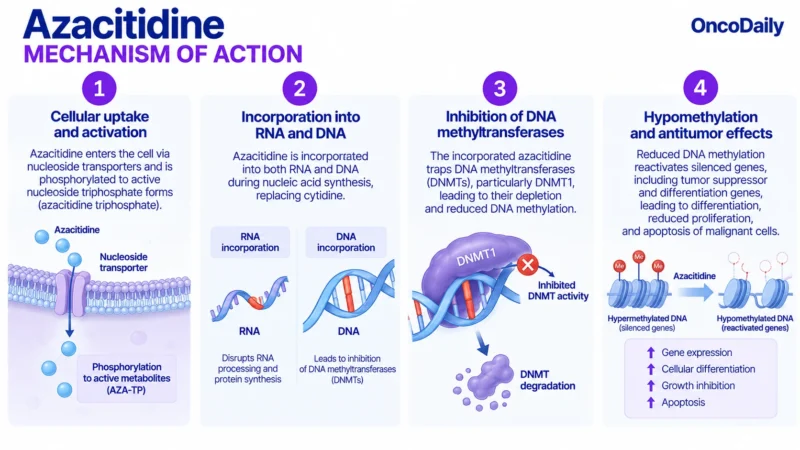
1. Cellular Uptake
Azacitidine enters cells through nucleoside transport mechanisms.
2. Conversion to Active Metabolites
Inside cells, azacitidine undergoes phosphorylation to active nucleotide forms.
A portion is incorporated into RNA, while its deoxyribonucleotide metabolite is incorporated into DNA.
3. DNA Methyltransferase Inhibition
The DNA-incorporated metabolite forms complexes with DNA methyltransferases, resulting in inhibition of DNA methylation.
4. Hypomethylation and Antitumor Effects
Reduced DNA methylation can reactivate genes involved in:
- Cellular differentiation
- Growth regulation
- Tumor suppression
This can ultimately lead to differentiation, reduced proliferation, and death of malignant cells.
The mechanism can be summarized as:
Azacitidine → intracellular phosphorylation → RNA/DNA incorporation → DNMT inhibition → DNA hypomethylation → altered gene expression → differentiation/apoptosis
What Is the Dose of Azacitidine?
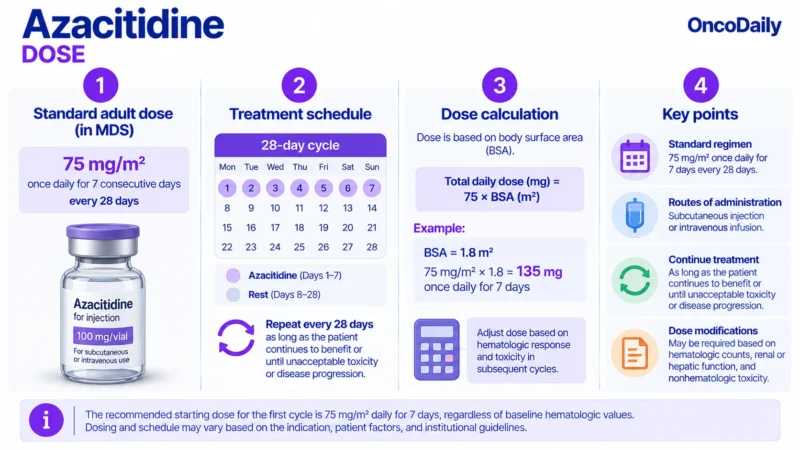
For adult patients with MDS, the recommended starting dose of injectable azacitidine is:
75 mg/m² once daily for 7 consecutive days
The regimen is generally repeated:
Every 28 days
Treatment is continued as long as the patient continues to benefit or until unacceptable toxicity or disease progression.
The FDA prescribing information recommends the 75 mg/m² dose for the first treatment cycle regardless of baseline hematologic values, with subsequent cycles adjusted according to hematologic response and toxicity.
Common Schedule
Days 1–7: Azacitidine
Days 8–28: Rest
Then:
Repeat every 28 days
In clinical practice, alternative schedules may sometimes be used to facilitate administration, but the standard FDA-labeled regimen remains 75 mg/m² daily for 7 days.
How Is Azacitidine Administered?
Azacitidine injection can be administered by either:
Subcutaneous injection
or
Intravenous infusion
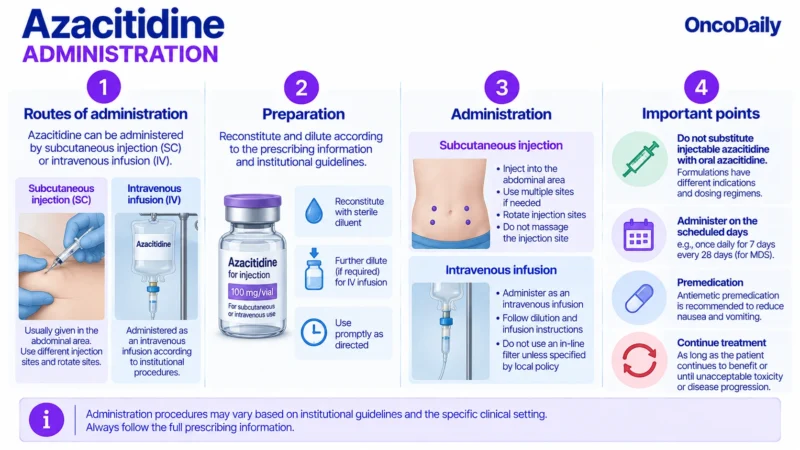
The FDA-approved injectable formulation should not be substituted for oral azacitidine, because the formulations have different indications and dosing regimens.
For subcutaneous administration, the drug is generally divided into multiple injection sites when necessary because of the volume required.
For IV administration, the reconstituted drug is administered according to the prescribing information.
Does Azacitidine Require an In-Line Filter?
No routine in-line filter is required for subcutaneous administration.
For IV administration, preparation and administration should follow the specific product labeling and institutional procedures.
Does Azacitidine Require Premedication?
Yes, antiemetic premedication is recommended.
The prescribing information specifically recommends premedication for nausea and vomiting before azacitidine treatment.
Antiemetic selection should be individualized according to the patient’s risk factors and treatment setting.
Are Dose Reductions Used?
Yes.
Dose modification can be required for:
- Neutropenia
- Thrombocytopenia
- Anemia
- Renal toxicity
- Significant nonhematologic toxicity
- Poor hematologic recovery.
CBC monitoring is essential, particularly during the first treatment cycles.
The prescribing information recommends adjusting subsequent cycles based on nadir blood counts and hematologic response.
What Is the Pharmacokinetic Profile of Azacitidine?
Azacitidine has a relatively short systemic half-life after administration.
It undergoes rapid metabolism and elimination, but its biologic effects on DNA methylation persist beyond its plasma exposure.
This distinction is important: the clinical effect of azacitidine is not simply determined by how long the drug remains in plasma.
Repeated treatment cycles are therefore necessary to achieve and maintain its hypomethylating effects.
Clinical studies have shown that responses may take several treatment cycles. In the CALGB studies, the median number of cycles to first response was approximately three, with most responses occurring by cycle six.
Does Azacitidine Require Renal or Hepatic Dose Adjustment?
Renal Impairment
Renal function should be monitored during treatment.
Azacitidine can cause renal toxicity, and dose delays or reductions may be required depending on laboratory abnormalities and clinical circumstances.
Hepatic Impairment
Patients with pre-existing hepatic impairment should be monitored carefully.
Severe hepatic impairment may increase the risk of toxicity, and the prescribing information includes specific warnings regarding hepatotoxicity in patients with severe pre-existing hepatic impairment.
What Are the Clinical Uses of Azacitidine?
Myelodysplastic Syndromes
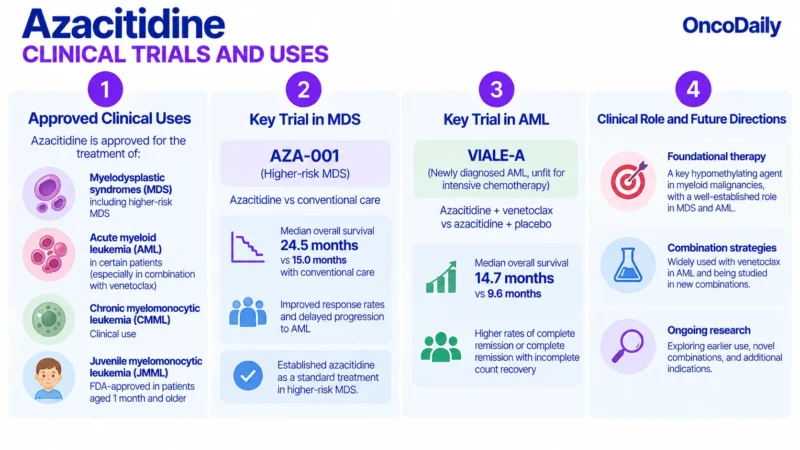
MDS is the principal established indication for injectable azacitidine.
Azacitidine is particularly important for patients with higher-risk MDS, where it can reduce disease progression and improve survival compared with conventional care.
The landmark AZA-001 trial established a survival advantage for azacitidine compared with conventional care in higher-risk MDS.
Juvenile Myelomonocytic Leukemia
The FDA-approved Vidaza formulation is also indicated for newly diagnosed JMML in pediatric patients aged 1 month and older.
Acute Myeloid Leukemia
Azacitidine has a major role in the treatment of AML, particularly in older or medically unfit patients, most commonly as part of combination therapy with venetoclax.
Importantly, the current U.S. labeling for injectable azacitidine is more specific than the broad clinical use of azacitidine in AML. Therefore, the distinction between FDA-labeled indications and evidence-based off-label/combination use is important.
Chronic Myelomonocytic Leukemia
Azacitidine has also demonstrated activity in chronic myelomonocytic leukemia (CMML) and has historically been included within the MDS-related indications in U.S. labeling.
Watch more: Venetoclax + azacitidine in unfit patients with AML — VJHemOnc.
What Did Azacitidine Clinical Trials Show?
CALGB 9221
The landmark CALGB 9221 randomized trial evaluated azacitidine against supportive care in patients with MDS.
Azacitidine was administered at:
75 mg/m²/day subcutaneously for 7 days every 28 days.
Responses occurred in 60% of patients receiving azacitidine compared with 5% with supportive care.
Azacitidine also prolonged median time to leukemic transformation or death:
21 months vs 13 months
and improved several quality-of-life measures.
AZA-001
The pivotal AZA-001 phase III trial evaluated azacitidine in patients with higher-risk MDS.
Azacitidine significantly improved overall survival compared with conventional care regimens.
Median overall survival was approximately:
24.5 months with azacitidine vs 15.0 months with conventional care.
The trial established azacitidine as a key treatment for higher-risk MDS.
Azacitidine in AML
Azacitidine has also been extensively evaluated in AML, particularly in patients who are not candidates for intensive induction chemotherapy.
Its clinical role expanded substantially with combination approaches, particularly azacitidine plus venetoclax, which has become an important lower-intensity treatment strategy for many patients with newly diagnosed AML who are ineligible for intensive chemotherapy.
Is Azacitidine FDA Approved?
Yes.
Injectable azacitidine was initially approved by the FDA in 2004.
The current U.S. prescribing information includes treatment of adult patients with specified MDS subtypes and newly diagnosed JMML in pediatric patients aged 1 month and older for the Vidaza formulation.
Azacitidine is also widely used in AML treatment, particularly in combination with venetoclax, based on substantial clinical evidence and regulatory indications for specific treatment contexts.
What Is the Current Clinical Role of Azacitidine?
Azacitidine remains a foundational hypomethylating agent in myeloid malignancies.
Its most established role is in:
- Higher-risk MDS
- CMML
- AML treatment strategies
- Selected pediatric JMML settings.
In AML, the combination of azacitidine plus venetoclax has substantially expanded the use of lower-intensity therapy for patients who are not candidates for intensive chemotherapy.
In MDS, azacitidine remains one of the key disease-modifying treatments, particularly for patients with higher-risk disease.
An important clinical principle is that azacitidine usually requires multiple treatment cycles before response can be adequately assessed. Early cytopenias do not necessarily indicate treatment failure.
Read more: Azacitidine or Decitabine for Newly Diagnosed TP53-Mutant AML? on OncoDaily.
What Are the Major Side Effects of Azacitidine?
Myelosuppression
The most important toxicities include:
- Neutropenia
- Thrombocytopenia
- Anemia
- Febrile neutropenia.
Cytopenias are particularly common during the initial treatment cycles.
Nausea and Vomiting
Gastrointestinal toxicity is common and is one reason antiemetic premedication is recommended.
Injection-Site Reactions
Patients receiving subcutaneous azacitidine may develop:
- Injection-site erythema
- Pain
- Bruising
- Swelling.
Fatigue
Fatigue and weakness are frequently reported.
Diarrhea and Constipation
Both diarrhea and constipation can occur during treatment.
Renal Toxicity
Renal abnormalities can occur and require monitoring during therapy.
Hepatotoxicity
Liver enzyme abnormalities and clinically significant hepatic toxicity can occur, particularly in patients with underlying hepatic impairment.
What Monitoring Is Required?
Monitoring should include:
- CBC with differential
- Platelet count
- Renal function
- Liver function
- Electrolytes
- Assessment for infection
- Assessment for bleeding
- Assessment of treatment response
- Injection sites when administered subcutaneously.
The FDA prescribing information recommends monitoring patients for hematologic response and renal toxicity and adjusting treatment accordingly.