


Alemtuzumab (Campath, Lemtrada): Mechanism of Action, Dosing, Clinical Uses, Trials, and Side Effects
Key takeaways
- Alemtuzumab is a humanized anti-CD52 IgG1κ monoclonal antibody.
- Its principal mechanisms include CDC, ADCC, and ADCP.
- It produces profound and prolonged lymphocyte depletion.
- It was first FDA approved in 2001.
- Campath is approved for B-cell CLL.
- Lemtrada is approved for relapsing forms of multiple sclerosis in adults.
- Campath dosing is 30 mg IV three times weekly for up to 12 weeks, following dose escalation.
- Lemtrada is administered in short annual courses of 12 mg IV daily.
- CAM307 demonstrated superior PFS and response rates with alemtuzumab versus chlorambucil.
- CARE-MS I and II established its efficacy in relapsing MS.
- Major safety concerns include infections, severe cytopenias, infusion reactions, autoimmunity, and vascular events.
- Campath has a limited role in modern CLL therapy, although alemtuzumab remains relevant in selected specialist hematologic settings.
Alemtuzumab (Campath, Lemtrada) is a humanized IgG1κ monoclonal antibody targeting CD52, a glycoprotein expressed on mature B and T lymphocytes, natural killer cells, monocytes, and several other immune-cell populations. By binding CD52, alemtuzumab induces profound lymphocyte depletion through complement-dependent cytotoxicity (CDC), antibody-dependent cellular cytotoxicity (ADCC), and antibody-dependent cellular phagocytosis (ADCP).
First approved by the FDA in May 2001, alemtuzumab was developed for B-cell chronic lymphocytic leukemia (CLL) under the brand name Campath. It subsequently became an important immune-depleting treatment for relapsing multiple sclerosis (MS), marketed as Lemtrada.
Although the two products contain the same active monoclonal antibody, their doses, treatment schedules, indications, and safety-monitoring requirements differ substantially.
In oncology, alemtuzumab has largely been replaced by more effective and generally better-tolerated targeted treatments, including BTK inhibitors and venetoclax-based regimens. However, it remains relevant in selected hematologic settings and as a historical example of CD52-directed therapy.
Key Facts
- Generic name: Alemtuzumab
- Brand names: Campath and Lemtrada
- Drug class: CD52-directed cytolytic monoclonal antibody
- Antibody type: Humanized IgG1κ
- Molecular target: CD52
- Mechanism: CDC, ADCC, ADCP, and prolonged lymphocyte depletion
- Initial FDA approval: May 2001
- Administration: Intravenous infusion
- Campath dose: Up to 30 mg three times weekly for 12 weeks
- Lemtrada dose: 12 mg daily for five days, followed one year later by 12 mg daily for three days
- FDA indications: B-cell CLL (Campath); relapsing forms of MS in adults (Lemtrada)
- Important trials: CAM307, CAMMS223, CARE-MS I, CARE-MS II
- Principal adverse reactions: Infusion reactions, cytopenias, infections, and lymphopenia
- Serious toxicities: Opportunistic infections, autoimmunity, stroke, vascular events, and malignancies
- Important monitoring: CBC, CD4 count, CMV surveillance when appropriate, renal function, urinalysis, and thyroid function
- Metabolism: Proteolytic catabolism
- Important distinction: Campath and Lemtrada should not be interchanged according to dose or indication.
Campath’s U.S. labeling remains available, but the product is supplied through a restricted distribution program rather than ordinary commercial channels.
What Is Alemtuzumab?
Alemtuzumab is a humanized monoclonal antibody targeting CD52, a small glycosylphosphatidylinositol (GPI)-anchored protein expressed predominantly on mature immune cells.
CD52 expression is particularly abundant on:
- Mature B lymphocytes
- Mature T lymphocytes
- Certain NK-cell populations
- Monocytes and macrophage populations
- Many malignant cells in CLL and some other lymphoid malignancies
Unlike CD38, the therapeutic target of daratumumab and isatuximab, CD52 is broadly distributed across mature lymphocyte populations.
Consequently, alemtuzumab produces substantial and prolonged immunosuppression.
In CLL, this effect is directed against malignant B cells. In multiple sclerosis, it depletes circulating lymphocytes and alters the subsequent composition and activity of the immune system.
What Is the Mechanism of Action of Alemtuzumab?
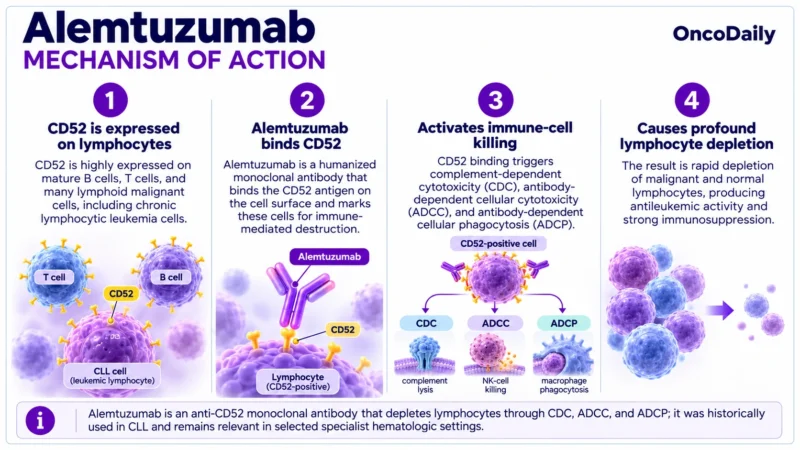
1. Alemtuzumab Binds CD52
Alemtuzumab binds the extracellular CD52 antigen on lymphocytes and other CD52-positive cells.
This provides the initial signal for antibody-mediated immune-cell elimination.
2. Complement-Dependent Cytotoxicity
Antibody binding activates the classical complement pathway.
Complement proteins assemble a membrane attack complex, resulting in cell-membrane damage and lysis.
3. Antibody-Dependent Cellular Cytotoxicity
The Fc portion of alemtuzumab interacts with Fcγ receptors on immune effector cells.
NK cells and other cytotoxic immune cells participate in the destruction of CD52-expressing targets.
4. Antibody-Dependent Cellular Phagocytosis
Macrophages recognize antibody-coated lymphocytes and facilitate their removal through phagocytosis.
5. Profound Lymphocyte Depletion
Alemtuzumab rapidly reduces circulating B- and T-cell populations.
Lymphocyte recovery occurs gradually after treatment, with different cell populations recovering at different rates.
B-cell recovery is generally faster than CD4-positive T-cell recovery.
6. Immune Reconstitution
Following lymphocyte depletion, immune-cell populations repopulate.
In multiple sclerosis, this process can produce sustained suppression of inflammatory disease activity.
However, altered immune reconstitution can also contribute to secondary autoimmune disorders, including thyroid disease, immune thrombocytopenia, and autoimmune renal disease.
Overall mechanism:
Alemtuzumab → CD52 binding → CDC + ADCC + ADCP → lymphocyte depletion → antileukemic activity or immune reconstitution.
What Is the Recommended Dose of Alemtuzumab?
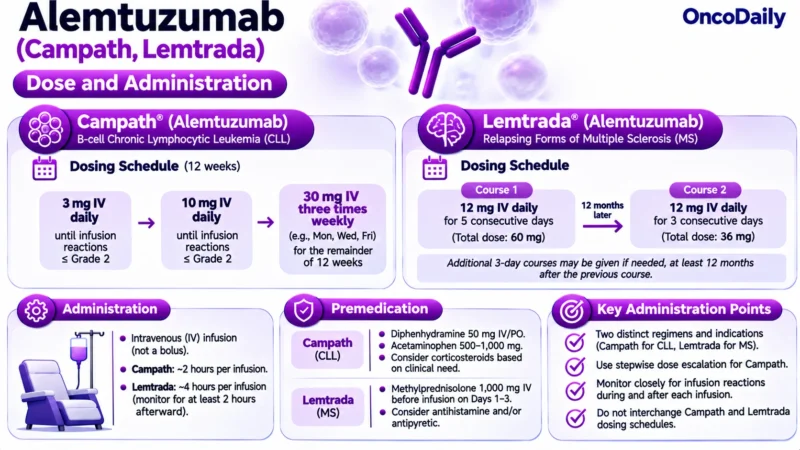
Campath — B-Cell Chronic Lymphocytic Leukemia
Alemtuzumab is administered intravenously.
Initial Dose Escalation
- 3 mg IV daily until infusion reactions are Grade 2 or lower
- Increase to 10 mg IV daily until reactions are Grade 2 or lower
- Increase to the recommended maintenance dose
Maintenance
30 mg IV three times per week, generally on alternate days.
The total treatment duration, including dose escalation, is:
12 weeks.
Maximum Dose
- Maximum single dose: 30 mg
- Maximum weekly cumulative dose: 90 mg
Doses above these limits increase the risk of severe hematologic toxicity.
Lemtrada — Relapsing Multiple Sclerosis
First Treatment Course
12 mg IV daily for five consecutive days.
Total dose: 60 mg.
Second Treatment Course
12 mg IV daily for three consecutive days, administered 12 months after the first course.
Total dose: 36 mg.
Additional Courses
If needed, additional three-day courses may be administered at least 12 months after the preceding course, according to the prescribed treatment strategy.
Critical distinction: The Campath CLL schedule must not be substituted for the Lemtrada MS regimen.
How Should Alemtuzumab Be Administered?
Campath Administration
Administer intravenously over approximately:
2 hours.
Do not administer as an IV push or bolus.
Premedication
Before initial treatment and dose escalation, administer:
- Diphenhydramine 50 mg
- Acetaminophen 500–1,000 mg
Additional supportive medications, including corticosteroids, may be required to manage infusion reactions.
Lemtrada Administration
Administer intravenously over:
4 hours.
Monitor during the infusion and for at least two hours afterward.
Premedication
dminister high-dose corticosteroids immediately before Lemtrada for the first three days of each treatment course.
In practice, intravenous methylprednisolone 1,000 mg is commonly used.
Consider additional antihistamines or antipyretics according to the treatment protocol.
What Should You Do If an Alemtuzumab Dose Is Missed?
If a dose is missed:
- Contact the treating specialist.
- Administer the delayed dose when clinically appropriate.
- Adjust the remaining treatment schedule.
- Reassess the need for dose escalation if Campath treatment has been interrupted for seven days or longer.
Do not double subsequent doses.
How Are Alemtuzumab Dose Modifications Managed?
Severe Infusion Reactions
Interrupt treatment for significant infusion reactions.
Provide appropriate supportive care.
For Campath, Grade 3–4 infusion reactions require withholding therapy until clinically appropriate for reassessment.
Life-threatening reactions or anaphylaxis may require permanent discontinuation.
Severe Cytopenias
Campath should be withheld for severe hematologic toxicity according to the label-defined thresholds.
Permanently discontinue for autoimmune anemia or autoimmune thrombocytopenia.
Serious Infections
Withhold treatment during serious active infection until the infection resolves.
Lemtrada-Associated Autoimmunity
New immune thrombocytopenia, autoimmune nephropathy, thyroid dysfunction, or other autoimmune conditions require appropriate specialist evaluation and management.
The decision to administer additional treatment courses must account for the severity of previous adverse events.
What Drug Interactions Are Important With Alemtuzumab?
Other Immunosuppressive Therapies
Combining alemtuzumab with other potent immunosuppressive agents may increase susceptibility to serious infections.
Live Vaccines
Avoid live vaccines during clinically significant immunosuppression and follow product-specific vaccination guidance.
For Lemtrada, required vaccinations should be completed before initiation whenever possible.
Antiviral Prophylaxis
Antiviral prophylaxis is important because alemtuzumab can produce prolonged T-cell depletion.
CYP450 Interactions
Alemtuzumab is not metabolized primarily through hepatic CYP450 enzymes.
Conventional CYP-mediated interactions are not expected to be a major concern.
Does Alemtuzumab Require Dose Adjustment in Renal or Hepatic Impairment?
Renal Impairment
Alemtuzumab is a monoclonal antibody predominantly eliminated through catabolic pathways rather than direct renal excretion.
No standard renal dose-adjustment algorithm is established.
Nevertheless, renal monitoring is particularly important for Lemtrada because autoimmune glomerular disease can develop after treatment.
Hepatic Impairment
No conventional hepatic dose-adjustment algorithm is established.
The limited evidence in significant hepatic impairment requires individualized assessment.
What Is the Pharmacokinetic Profile of Alemtuzumab?
Distribution
Alemtuzumab distributes primarily within vascular and extracellular compartments.
Metabolism
It undergoes proteolytic catabolism into amino acids and small peptides.
Clearance
Elimination includes target-mediated binding to CD52-positive cells and other antibody-catabolic pathways.
Half-Life
Alemtuzumab displays nonlinear, time-dependent pharmacokinetics.
Its apparent elimination half-life varies substantially with the disease, dose, and circulating CD52-positive cell burden.
The clinical duration of immunosuppression may extend far beyond measurable circulating drug exposure.
What Are the Clinical Uses of Alemtuzumab?
B-Cell Chronic Lymphocytic Leukemia
Campath is FDA approved as a single agent for B-cell CLL.
Historically, alemtuzumab was particularly active against circulating and bone marrow leukemia cells, including some patients with high-risk cytogenetic features.
However, its effectiveness against bulky lymphadenopathy was less favorable, and prolonged immunosuppression significantly limited its use.
Current clinical role: Alemtuzumab is not a routine frontline or preferred relapsed CLL therapy in 2026.
BTK inhibitors, venetoclax-based combinations, and other modern targeted agents have largely replaced it.
Campath remains accessible in the United States through a special restricted distribution arrangement.
Relapsing Forms of Multiple Sclerosis
Lemtrada is FDA approved for adults with relapsing forms of MS, including relapsing-remitting disease and active secondary progressive disease.
Because of its substantial safety risks, it is generally reserved for patients with an inadequate response to at least two other MS treatments.
Its efficacy depends on profound immune-cell depletion followed by immune reconstitution.
Other Hematologic Uses
Alemtuzumab has been investigated or used off-label in selected settings, including:
- T-cell prolymphocytic leukemia (T-PLL)
- Certain mature T-cell leukemias
- Selected transplant conditioning regimens
- Certain difficult-to-treat immune-mediated hematologic conditions
In T-PLL, alemtuzumab has historically demonstrated substantial antileukemic activity and remains clinically relevant in specialist care.
However, these uses should not be confused with the labeled Campath indication for CLL.
What Molecular Testing Is Required Before Alemtuzumab?
CD52 Expression
Alemtuzumab targets CD52.
CD52 expression may be evaluated using flow cytometry or immunohistochemistry, particularly in uncommon hematologic malignancies where anti-CD52 treatment is being considered.
Routine molecular mutation testing is not required specifically to prescribe Campath for its labeled CLL indication.
CLL Diagnostic Testing
Relevant evaluation includes:
- Peripheral blood flow cytometry
- Complete blood count
- Immunophenotyping
- FISH for del(17p) and other CLL-associated abnormalities
- TP53 mutation testing
- IGHV mutation status
These tests guide contemporary CLL treatment decisions.
Infection Screening
Before initiating alemtuzumab, assess infection history and risk factors.
Relevant testing may include:
- CMV serology and/or PCR according to the clinical setting
- Hepatitis B and C screening
- HIV testing
- Tuberculosis screening when indicated
- Other pathogen-specific investigations depending on risk
Lemtrada-Specific Baseline Assessment
Before MS treatment, evaluate:
- CBC with differential
- Serum creatinine
- Urinalysis
- Thyroid function
- Liver function
- Infection and vaccination status
Screening and follow-up must be tailored to the specific formulation and indication.
What Did the Pivotal Clinical Trials Show?
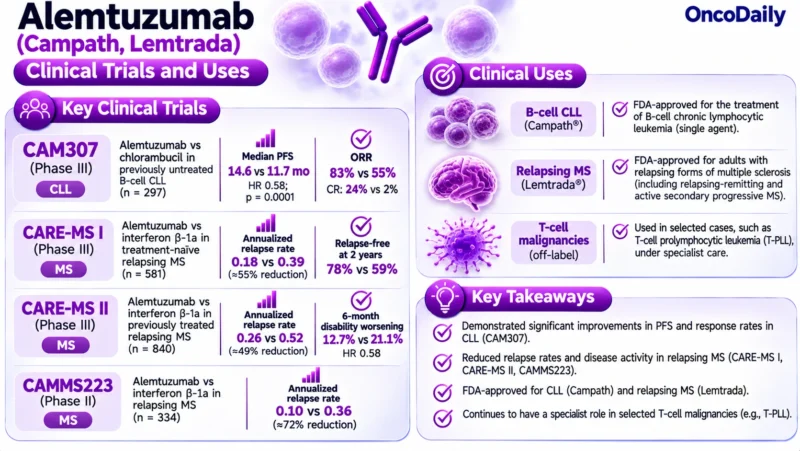
CAM307 — Alemtuzumab Versus Chlorambucil in CLL
The randomized phase III CAM307 trial compared:
- Alemtuzumab
- Chlorambucil
in previously untreated patients with progressive B-cell CLL.
A total of 297 patients were randomized.
Median Progression-Free Survival
- Alemtuzumab: 14.6 months
- Chlorambucil: 11.7 months
HR: 0.58; p = 0.0001
Overall Response Rate
- Alemtuzumab: 83%
- Chlorambucil: 55%
Complete Response
- Alemtuzumab: 24%
- Chlorambucil: 2%
Median Time to Alternative Treatment
- Alemtuzumab: 23.3 months
- Chlorambucil: 14.7 months
The trial demonstrated superior progression-free survival and response rates with alemtuzumab, although cytomegalovirus reactivation and infusion reactions were more frequent.
These results supported expansion of Campath’s CLL indication in 2007.
Watch More: Itacitinib Plus Alemtuzumab for Patients With T-PLL.
CAMMS223 — Alemtuzumab in Relapsing Multiple Sclerosis
CAMMS223 was a phase II randomized study comparing alemtuzumab with interferon beta-1a in relapsing MS.
Annualized Relapse Rate
- Alemtuzumab: approximately 0.10
- Interferon beta-1a: approximately 0.36
This represented a substantial reduction in relapse activity.
The trial also demonstrated improved disability outcomes, although serious autoimmune complications emerged as an important safety concern.
CARE-MS I — Previously Untreated Relapsing MS
This phase III trial compared alemtuzumab with interferon beta-1a in patients with relapsing-remitting MS who had not previously received disease-modifying treatment.
Annualized Relapse Rate
- Alemtuzumab: 0.18
- Interferon beta-1a: 0.39
Approximately 55% relative reduction in relapse rate.
Patients Relapse-Free at Two Years
- Alemtuzumab: 78%
- Interferon beta-1a: 59%
The disability endpoint did not demonstrate a statistically significant difference.
CARE-MS II — Previously Treated Relapsing MS
This phase III trial evaluated patients with relapsing-remitting MS who had experienced inadequate control with previous treatment.
Annualized Relapse Rate
- Alemtuzumab: 0.26
- Interferon beta-1a: 0.52
Approximately 49% relative reduction.
Six-Month Confirmed Disability Worsening
- Alemtuzumab: 12.7%
- Interferon beta-1a: 21.1%
HR: 0.58
CARE-MS II demonstrated reduced relapse activity and disability progression with alemtuzumab.
Does Alemtuzumab Have CNS Activity?
Alemtuzumab is not a conventional CNS-penetrating targeted anticancer agent.
Its effects in MS result predominantly from systemic lymphocyte depletion and subsequent changes in immune responses.
It has not demonstrated an established role as a standalone treatment for CNS leukemia or brain metastases.
Is Alemtuzumab FDA Approved?
Yes, under distinct brand names and indications.
Campath
Initial FDA approval: 2001.
Indication: Single-agent treatment of B-cell CLL.
Campath is distributed through a special restricted program, and access is not equivalent to ordinary commercial supply.
Lemtrada
FDA approved for relapsing forms of multiple sclerosis in adults.
Its use is generally reserved for patients with an inadequate response to two or more MS therapies.
Lemtrada is not an oncology formulation intended to replace the Campath CLL dosing regimen.
What Is the Current Clinical Role of Alemtuzumab in 2026?
Chronic Lymphocytic Leukemia
Alemtuzumab now has a very limited clinical role.
The treatment landscape has shifted toward targeted agents, including:
- BTK inhibitors
- BCL2-directed regimens
- Anti-CD20-containing combinations
These therapies provide substantially different efficacy and safety profiles.
T-Cell Prolymphocytic Leukemia
Alemtuzumab remains relevant in the specialist management of T-PLL, where CD52 expression is frequently high.
Although not FDA approved specifically for this indication, it has historically been a key therapeutic option, sometimes used to achieve disease control before allogeneic stem cell transplantation.
Read More: Miguel Bronchud: Universal Base-Edited CAR7 T Cells — A Breakthrough for T-Cell ALL by OncoDaily.
Multiple Sclerosis
Lemtrada remains a disease-modifying treatment option in selected patients with relapsing MS.
Its use requires careful selection because of potentially fatal autoimmune, vascular, infectious, and malignancy-related complications.
What Are the Major Side Effects of Alemtuzumab?
Infusion-Related Reactions
Alemtuzumab frequently causes infusion-related adverse reactions, including:
- Fever and chills
- Headache
- Rash
- Nausea
- Dyspnea
- Hypotension or hypertension
- Bronchospasm
Severe reactions may include anaphylaxis and cardiopulmonary complications.
Severe Cytopenias
Campath carries an FDA boxed warning for severe cytopenias.
Potential complications include:
- Neutropenia
- Anemia
- Thrombocytopenia
- Pancytopenia
- Autoimmune hemolytic anemia
- Immune thrombocytopenia
Severe or fatal hematologic toxicity can occur.
Serious and Opportunistic Infections
Profound T-cell depletion increases infection risk.
Important infections include:
- Cytomegalovirus reactivation and disease
- Pneumocystis jirovecii pneumonia
- Herpes simplex and herpes zoster
- Bacterial pneumonia
- Fungal infections
- Other opportunistic infections
The risk may persist after the last infusion because lymphocyte recovery is prolonged.
Secondary Autoimmune Disorders
Autoimmunity is particularly important with Lemtrada.
Reported complications include:
- Autoimmune thyroid disease
- Immune thrombocytopenia
- Anti-glomerular basement membrane disease
- Other autoimmune nephropathies
- Autoimmune cytopenias
These conditions may appear months or years after treatment.
Stroke and Arterial Dissection
Lemtrada carries an FDA boxed warning for serious vascular complications.
These include:
- Ischemic stroke
- Hemorrhagic stroke
- Cervicocephalic arterial dissection
Some events have occurred shortly after infusion.
Malignancies
Lemtrada carries warnings concerning increased risk of malignancies, including:
- Thyroid cancer
- Melanoma
- Lymphoproliferative disorders
Patients require appropriate screening and surveillance.
Other Serious Adverse Reactions
Additional concerns include:
- Renal injury
- Thyroid dysfunction
- Liver injury
- Pulmonary complications
- Secondary hemophagocytic lymphohistiocytosis
Important safety distinction: Campath and Lemtrada have different boxed warnings. Campath emphasizes cytopenias, infusion reactions, and infections; Lemtrada emphasizes autoimmunity, infusion reactions, stroke, and malignancies.
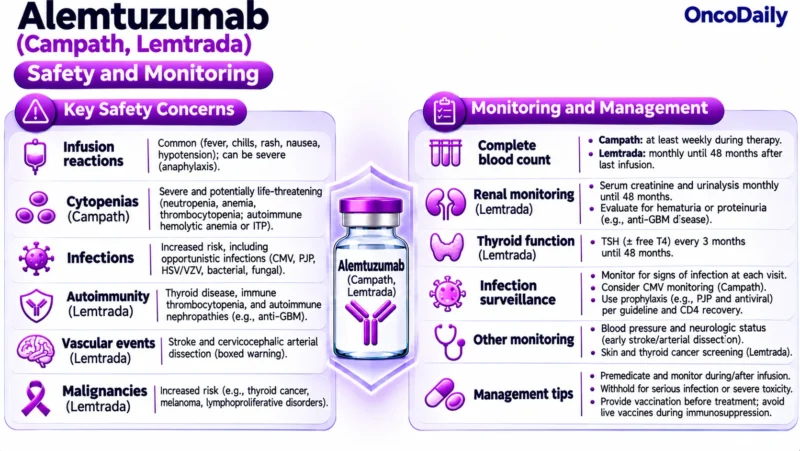
What Monitoring Is Required During Alemtuzumab Treatment?
Complete Blood Count
Campath
Monitor CBC and platelets:
At least weekly during therapy.
Assess for severe cytopenias and infection risk.
Lemtrada
Monitor CBC with differential:
Monthly until 48 months after the last infusion.
CD4-Positive T-Cell Count
For Campath, follow CD4 recovery after treatment.
Continue appropriate opportunistic infection prophylaxis until the required post-treatment interval and CD4 recovery criteria are met.
Infection Surveillance
Monitor for signs of infection, including fever, cough, dyspnea, and other symptoms.
In CLL treatment, consider regular CMV monitoring according to the product label, infection risk, and clinical context.
Renal Function
For Lemtrada, obtain serum creatinine and urinalysis:
Monthly until 48 months after the last infusion.
Investigate hematuria, proteinuria, and unexpected renal function changes.
Thyroid Function
For Lemtrada, monitor thyroid function:
Every three months until 48 months after the last infusion.
Blood Pressure and Neurological Symptoms
Monitor for acute vascular complications during and following infusion.
Sudden neurological deficits, severe headache, or neck pain require emergency evaluation.
Malignancy Surveillance
Patients receiving Lemtrada should undergo appropriate cancer screening, including thyroid and skin assessment.
Pregnancy and Reproductive Monitoring
Alemtuzumab can cause fetal harm.
For Lemtrada, patients of reproductive potential should use effective contraception during treatment and for four months after each treatment course.