
Key takeaways
- KEYNOTE-564 established adjuvant pembrolizumab as an effective treatment for selected patients with high-risk clear cell RCC, improving disease-free and overall survival.
- LITESPARK-022 demonstrated improved disease-free survival with pembrolizumab plus belzutifan, although overall survival data remain immature.
- Managing recurrence after adjuvant pembrolizumab remains challenging, with no clearly established optimal systemic treatment sequence.
- Time to relapse and metastatic burden are key considerations when selecting subsequent treatment, including the potential role of local therapies.
- TKI monotherapy is an important option for early recurrence, while immunotherapy rechallenge after a longer treatment-free interval remains uncertain.
Giuseppe Procopio, Full Professor of Medical Oncology and Director of the Genitourinary Cancer Unit at Fondazione IRCCS Istituto Nazionale dei Tumori in Milan, examined the evolving evidence for adjuvant treatment in renal cell carcinoma (RCC) and the clinical challenges of managing patients who experience recurrence after pembrolizumab.
During his presentation at VIRO 2026 – Global Voices in Renal Oncology by OncoDaily, Procopio reviewed the survival benefits established by KEYNOTE-564, recent developments in adjuvant immunotherapy, and the emerging role of HIF-2α inhibition.
Although surgery remains the primary curative treatment for localized RCC, disease recurrence continues to affect a substantial proportion of patients, particularly those with high-risk features. Adjuvant treatment has improved outcomes, but it has also introduced a difficult clinical question: how should treatment be selected when kidney cancer returns after exposure to immunotherapy?
KEYNOTE-564 and the Established Role of Adjuvant Pembrolizumab
The introduction of adjuvant pembrolizumab marked a significant change in the management of patients with clear cell RCC at increased risk of recurrence following nephrectomy.
The randomized phase III KEYNOTE-564 trial evaluated one year of pembrolizumab against placebo in 994 patients with intermediate-high-risk or high-risk clear cell RCC, including selected patients who had undergone complete resection of metastatic disease and had no evidence of disease (M1 NED).
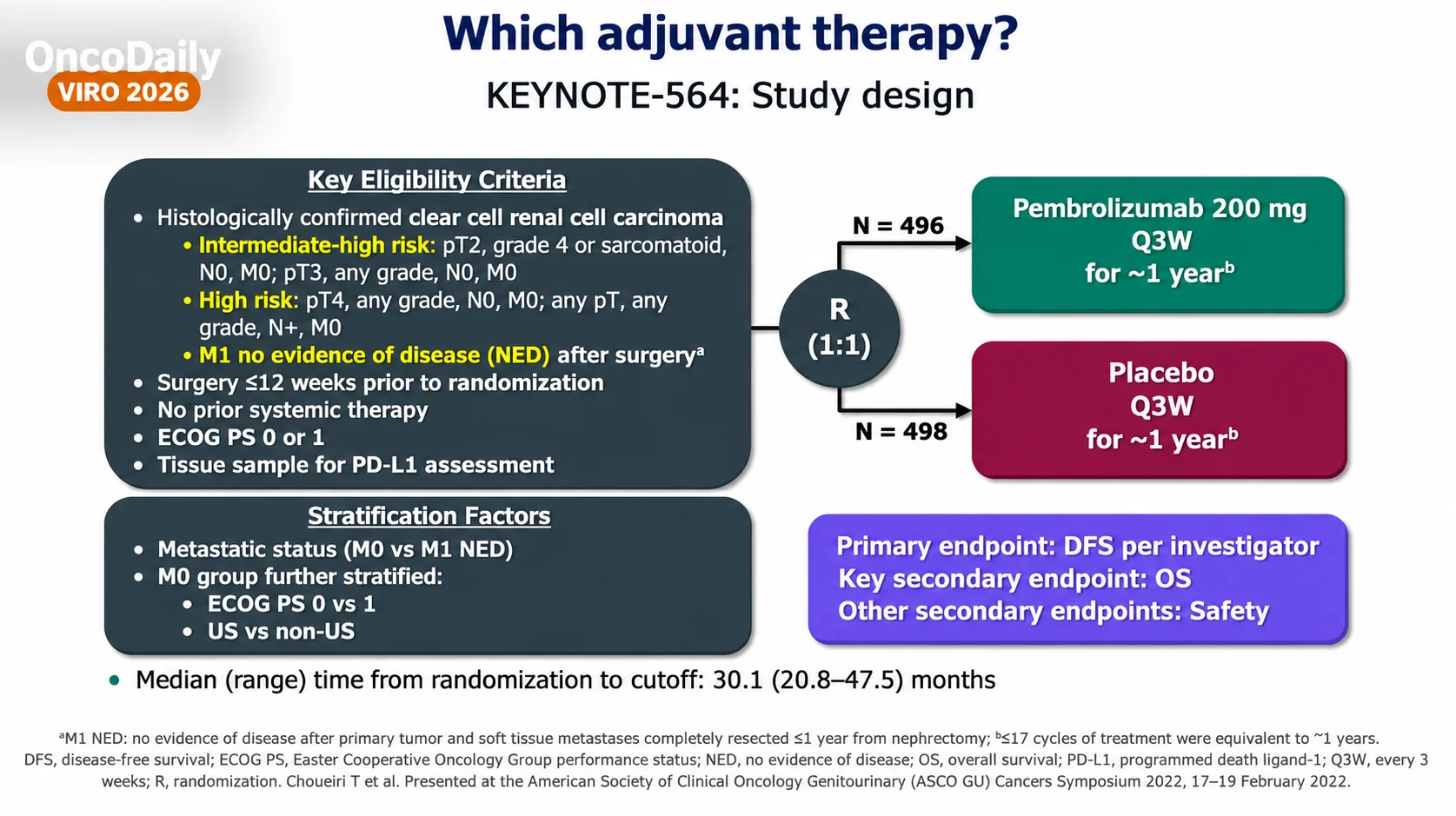
The trial demonstrated improvements in both disease-free survival (DFS) and overall survival (OS), establishing pembrolizumab as an important adjuvant treatment option.
Updated five-year results have reinforced these findings. After a median follow-up of approximately 70 months, the estimated five-year disease-free survival rate was 60.9% with pembrolizumab compared with 52.2% with placebo.
The corresponding five-year overall survival rates were 87.7% and 82.3%, respectively, with a hazard ratio for death of 0.66.
These results provide long-term evidence supporting adjuvant pembrolizumab in appropriately selected patients.
However, Procopio noted that the broader history of adjuvant therapy in RCC has been considerably less consistent.
Why Have Other Adjuvant RCC Trials Produced Different Results?
Several randomized studies have investigated systemic treatment following nephrectomy, but most failed to demonstrate a meaningful clinical benefit.
Trials involving multikinase inhibitors and mTOR inhibitors generally did not meet their primary endpoints. An exception was S-TRAC, which demonstrated improved disease-free survival with adjuvant sunitinib but did not establish an overall survival benefit.
Results from immune checkpoint inhibitor studies have also varied.
The IMmotion010 trial evaluating atezolizumab, CheckMate 914 investigating nivolumab with or without ipilimumab, and the perioperative PROSPER study did not demonstrate significant improvements in their primary disease-free or recurrence-free survival endpoints.
More recently, however, the RAMPART trial reported encouraging findings with dual checkpoint inhibition.
The international phase III study investigated durvalumab alone or in combination with tremelimumab against active monitoring in patients with resected RCC at intermediate or high risk of recurrence.
Durvalumab plus tremelimumab significantly improved disease-free survival compared with active monitoring, with a hazard ratio of 0.65. The benefit appeared particularly pronounced among patients at higher risk of recurrence.
Durvalumab monotherapy did not meet the prespecified threshold for statistical significance.
Procopio discussed several possible explanations for the differences across adjuvant trials, including patient selection, treatment duration, mechanisms of action, and toxicity-related treatment discontinuation.
Differences in the inclusion of patients with completely resected metastatic disease may also influence results.
These findings reinforce the importance of interpreting each trial within its specific patient population and treatment design rather than treating all adjuvant strategies as interchangeable.
LITESPARK-022: Adding HIF-2α Inhibition to Pembrolizumab
Another important development in adjuvant RCC treatment emerged from the phase III LITESPARK-022 trial, which evaluated the addition of belzutifan, a hypoxia-inducible factor 2 alpha (HIF-2α) inhibitor, to pembrolizumab.
The study enrolled 1,841 patients with clear cell RCC at intermediate-high or high risk of recurrence following nephrectomy, including selected patients with completely resected metastatic disease.
Patients were randomized to receive pembrolizumab with either belzutifan or placebo for approximately one year.
At the prespecified interim analysis, the combination significantly improved disease-free survival, reducing the relative risk of recurrence or death by 28% compared with pembrolizumab alone.
The estimated 24-month disease-free survival rates were:
- 80.7% with pembrolizumab plus belzutifan
- 73.7% with pembrolizumab plus placebo
- The hazard ratio was 0.72 (95% CI, 0.59–0.87; P = 0.0003).
These findings led to the FDA approval of belzutifan in combination with pembrolizumab on June 12, 2026, for eligible patients with clear cell RCC at increased risk of recurrence following nephrectomy, with or without resection of metastatic lesions.
However, the overall survival data were immature at the time of the analysis.
The additional clinical benefit must also be considered alongside increased toxicity. Grade 3 or higher treatment-emergent adverse events occurred in 52.1% of patients receiving the combination, compared with 30.2% receiving pembrolizumab alone.
Anemia, elevated liver enzymes, and hypoxia were among the notable adverse events.
LITESPARK-022 therefore represents an important advance in preventing disease recurrence, while longer follow-up will be necessary to clarify the magnitude of its overall survival benefit and its optimal place in routine clinical practice.
Recurrence After Adjuvant Pembrolizumab: Emerging Patterns and Treatment Challenges
Despite improvements in disease-free survival, some patients experience metastatic recurrence during or after adjuvant pembrolizumab, raising questions about subsequent treatment selection.
Managing these patients remains challenging because most established first-line metastatic RCC regimens were evaluated in populations without prior exposure to immune checkpoint inhibitors. Whether patients should receive another immunotherapy-containing combination or transition to a different therapeutic approach remains uncertain.
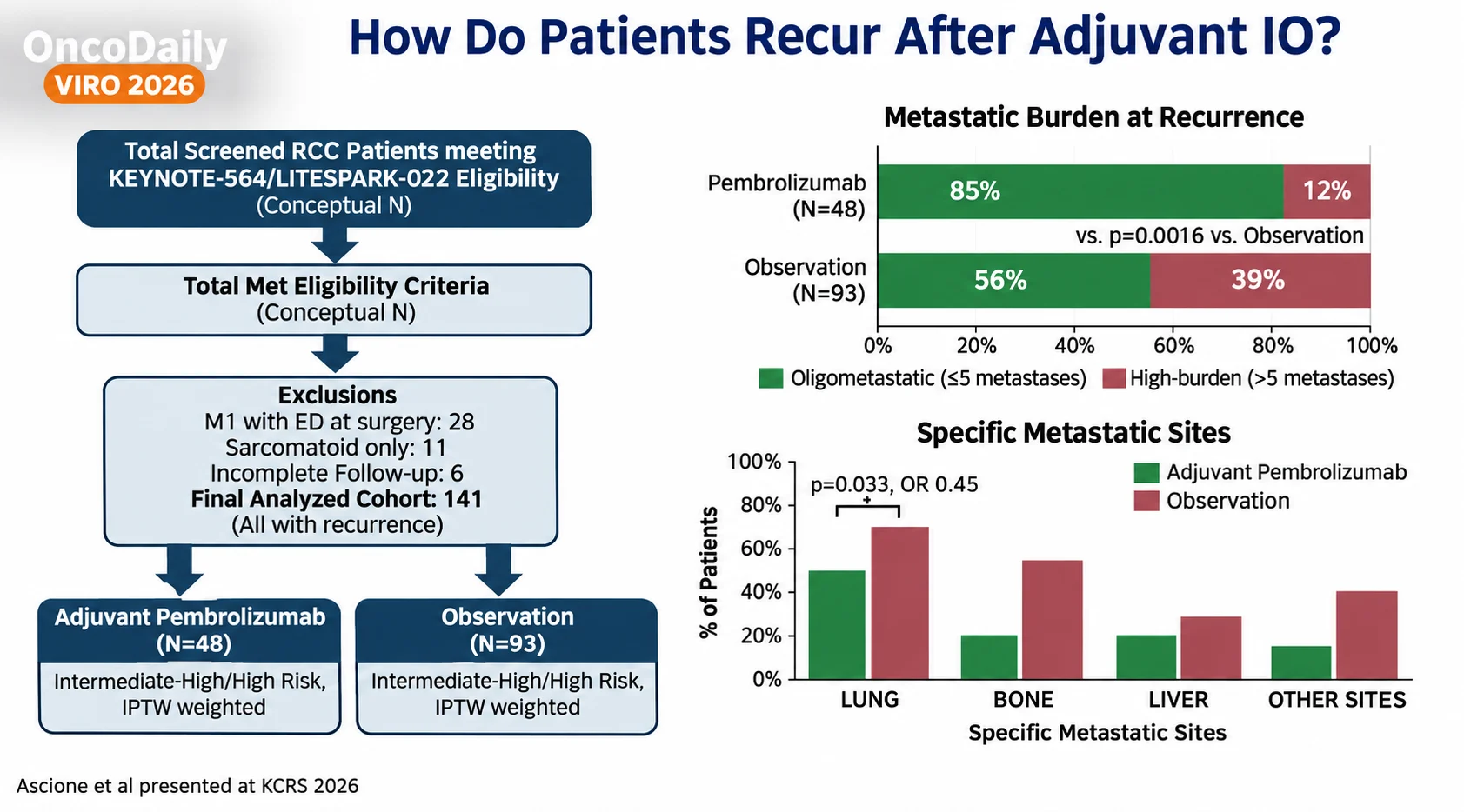
Emerging retrospective evidence also suggests that prior adjuvant pembrolizumab may influence the pattern of recurrence. Procopio discussed analyses indicating that patients previously treated with pembrolizumab may be more likely to develop limited-volume or oligometastatic disease rather than widespread metastases, with potential differences in the sites of recurrence.
This distinction could have important therapeutic implications, as patients with limited metastatic disease may be candidates for local treatments such as surgery or stereotactic radiotherapy. However, these observations are based on indirect, retrospective comparisons and do not establish that pembrolizumab alters the biological pattern of recurrence.
For Procopio, two factors are particularly important when considering subsequent treatment: the interval between immunotherapy exposure and recurrence, and the extent of metastatic disease at relapse. Both may help determine whether local treatment or systemic therapy is more appropriate, although prospective evidence is still needed to guide these decisions.
Time to Relapse May Influence the Next Treatment
One of the most important distinctions discussed by Procopio was whether disease recurrence occurs during adjuvant treatment, shortly after treatment discontinuation, or following a longer treatment-free interval.
Early progression may indicate resistance to PD-1 inhibition, while later recurrence raises the possibility that some tumors may retain sensitivity to immune-based approaches.
The European Association of Urology (EAU) guidelines address this distinction.
For patients who develop recurrence during pembrolizumab or within six months of stopping treatment, the guidelines favor VEGF receptor tyrosine kinase inhibitor (VEGFR-TKI) therapy and advise against immune checkpoint inhibitor monotherapy or combinations.
This recommendation is informed partly by evidence from CONTACT-03 and TiNivo-2, which did not demonstrate additional clinical benefit from reintroducing immune checkpoint inhibition alongside a TKI in previously immunotherapy-treated metastatic RCC.
However, these studies were conducted predominantly in metastatic treatment settings and cannot fully resolve the question of treatment after adjuvant pembrolizumab.
For patients experiencing later recurrence, particularly beyond six months after completing adjuvant therapy, the possibility of introducing an immunotherapy-containing combination remains an area of clinical discussion.
Such treatment is not established as superior to TKI monotherapy in this population, and decisions must account for previous treatment exposure, toxicity, disease burden, and individual patient characteristics.
Oligometastatic Relapse: When Local Treatment May Be Appropriate
The number and location of metastatic lesions also influence treatment selection.
For patients with a limited number of metastatic sites, particularly after a longer disease-free interval, local approaches such as metastasectomy or stereotactic ablative radiotherapy may offer disease control and potentially delay the need for systemic treatment.
The situation differs considerably for patients who develop rapid, multifocal progression during or shortly after adjuvant pembrolizumab.
These patients are generally more likely to require systemic treatment, with TKI monotherapy representing an evidence-supported option.
Procopio emphasized that neither relapse timing nor metastatic burden should be considered in isolation.
The patient’s prior tolerance of immunotherapy, overall condition, disease distribution, and feasibility of local intervention must also inform the decision.
A Clinical Case: Exploring New Treatment Strategies After Adjuvant Pembrolizumab
To illustrate the challenges of treatment selection after adjuvant immunotherapy, Procopio presented the case of a 50-year-old woman diagnosed with clear cell RCC in June 2023.
Initial investigations identified a right renal tumor, and subsequent radical nephrectomy confirmed Fuhrman grade 3 clear cell RCC, staged as pT2, without sarcomatoid differentiation.
Seven months after surgery, the patient developed a solitary pulmonary metastasis and underwent lung metastasectomy, which confirmed metastatic clear cell RCC. With no remaining evidence of disease, she received one year of adjuvant pembrolizumab and tolerated treatment well.
However, nine months after completing pembrolizumab, multiple pancreatic metastases were detected.
The recurrence raised a difficult treatment question: should the patient receive dual immunotherapy, an IO-TKI combination, or TKI monotherapy?
Given the limited prospective evidence available to guide this decision, the treating team enrolled her in LITESPARK-033, an ongoing phase III trial specifically investigating treatment strategies for patients with clear cell RCC recurring during or after adjuvant anti-PD-1/PD-L1 therapy.
The trial compares belzutifan plus zanzalintinib with cabozantinib, an established TKI treatment option following prior immunotherapy exposure.
Belzutifan targets HIF-2α, a key molecular driver of clear cell RCC, while zanzalintinib is an investigational multikinase inhibitor targeting pathways involved in tumor growth, angiogenesis, and therapeutic resistance. By combining these agents, researchers aim to determine whether targeting complementary biological mechanisms can improve outcomes compared with cabozantinib alone.
The patient was randomized to receive belzutifan plus zanzalintinib and achieved a partial response according to RECIST 1.1 criteria at her first response assessment.
Although encouraging, this individual response cannot establish the superiority of the investigational combination. The randomized trial results will be necessary to determine whether the addition of HIF-2α inhibition provides a meaningful clinical benefit in this population.
For now, the case illustrates both the complexity of recurrence after adjuvant pembrolizumab and the importance of prospective clinical trials in defining more effective post-adjuvant treatment strategies.
Toward More Individualized Treatment After Adjuvant Therapy
The expanding evidence for adjuvant treatment has improved prospects for selected patients with high-risk clear cell RCC. KEYNOTE-564 established a survival benefit with pembrolizumab, while LITESPARK-022 has demonstrated that adding HIF-2α inhibition can further improve disease-free survival.
At the same time, these developments are creating new clinical scenarios that existing metastatic RCC treatment algorithms do not fully address.
The management of recurrence after adjuvant pembrolizumab remains particularly complex because treatment decisions depend on previous immune exposure, the interval to recurrence, metastatic burden, and the potential role of local treatment.
As Procopio emphasized, prospective clinical trials should remain a priority whenever feasible, particularly for patients in whom the relative benefits of TKI monotherapy and renewed immune checkpoint inhibition are uncertain.
The next challenge in adjuvant kidney cancer treatment is therefore twofold: improving the likelihood of cure after surgery while developing more reliable strategies for the patients whose disease returns despite treatment.
Written by Eliz Baloyan, MD, Features Writer and Editor at OncoDaily and CancerWorld