Key takeaways
- Low- and middle-income countries have diverse healthcare realities, with major differences in resources, infrastructure, and access to kidney cancer treatment both between and within countries.
- Limited imaging, pathology services, and oncology workforce capacity contribute to delayed diagnosis and barriers to effective RCC management.
- Modern immunotherapy combinations remain inaccessible to many patients, despite their established clinical benefits and international guideline recommendations.
- Clinical trial participation is concentrated in high-income countries, reinforcing the need for stronger regional research networks and more representative evidence.
- Collaboration, virtual tumor boards, artificial intelligence, and locally driven research offer opportunities to improve access to expertise, support treatment decisions, and advance kidney cancer care in resource-limited settings.
Federico Losco, Clinical Oncologist in the Genitourinary Oncology Unit at Instituto Alexander Fleming in Buenos Aires, Argentina, and Co-Chair of the Latin American Cooperative Oncology Group (LACOG) Genitourinary Group, examined the disparities affecting renal cell carcinoma diagnosis, treatment, and research across low- and middle-income countries.
During his presentation at VIRO 2026 – Global Voices in Renal Oncology by OncoDaily, Losco explored how differences in healthcare infrastructure, oncology workforce capacity, access to medicines, and clinical research shape the management of kidney cancer. He also discussed emerging opportunities through international collaboration, virtual multidisciplinary tumor boards, artificial intelligence, and locally driven research.
His starting point was an important distinction: countries classified within the same broad economic category may have profoundly different healthcare systems, resources, and treatment opportunities.
“Low- and middle-income countries are not one thing.”
Even within the same city, patients may encounter entirely different standards of care. One hospital may struggle with overcrowded waiting rooms and delayed investigations, while another provides robotic surgery and advanced cancer treatments.
Understanding these differences is essential when considering how international clinical evidence can be translated into routine practice.
Why Economic Classification Does Not Tell the Whole Story
The term low- and middle-income countries covers a wide range of economic and healthcare environments.
Losco illustrated this diversity by comparing Argentina, India, and Ethiopia, countries with substantially different population sizes, economic resources, cancer burdens, and medical workforce capacities.
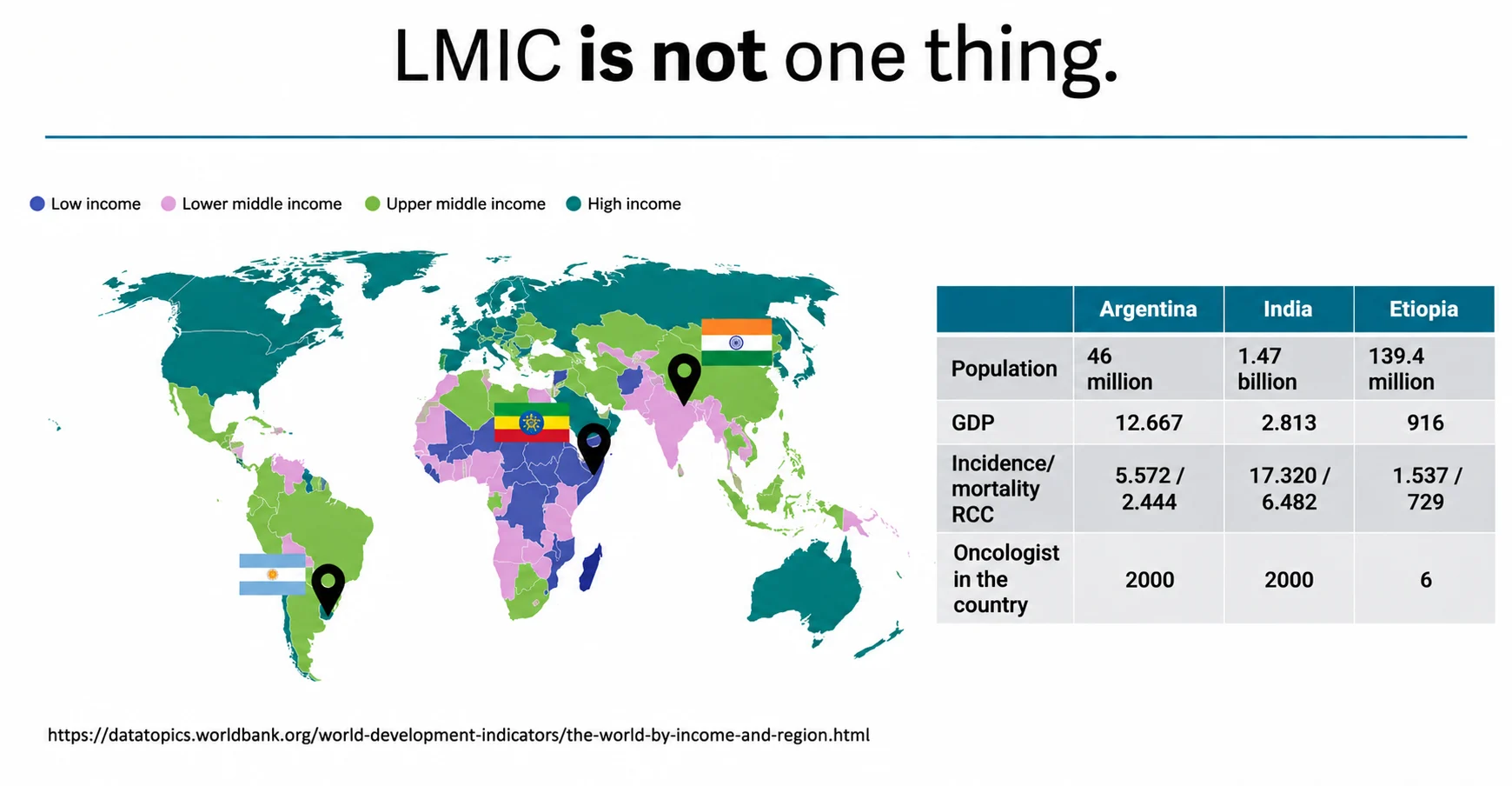
Argentina is classified as an upper-middle-income country, India as a lower-middle-income country, and Ethiopia as a low-income country.
However, national income classifications cannot fully describe the availability of specialized cancer services or the inequalities that exist within individual countries.
In major Latin American cities, highly specialized private institutions may offer sophisticated imaging, molecular pathology, robotic surgery, and contemporary immunotherapy combinations. Public hospitals in the same urban area may face long waiting times, limited specialist availability, and restrictions on treatment access.
Losco used the contrast between a crowded public waiting room and a robotic partial nephrectomy performed in a private hospital to illustrate these different realities.
Such inequalities can affect the entire course of kidney cancer care, from the initial diagnosis to surgery, systemic therapy, and long-term follow-up.
Resource availability may therefore influence treatment decisions even when clinicians are familiar with the best available scientific evidence.
Kidney Cancer Incidence, Mortality, and the Problem of Underdiagnosis
Global kidney cancer statistics also reflect substantial geographical variation.
Incidence rates are generally higher in North America and Western Europe, where widespread access to imaging has increased the detection of incidentally discovered renal tumors.
In some high-income countries, rising incidence has been accompanied by relatively stable or declining mortality rates.
The situation is less consistent across Latin America and other resource-constrained regions.
Losco discussed epidemiological patterns in Argentina, Brazil, Chile, and Colombia, emphasizing that incidence and mortality trends must be interpreted alongside differences in diagnostic access and the quality of cancer registration.
Low reported incidence in some countries does not necessarily indicate a low underlying burden of disease.
Limited imaging availability, incomplete cancer registries, and underreporting may contribute to lower recorded rates of diagnosis.
These concerns are especially relevant in regions where patients have difficulty accessing routine medical examinations or diagnostic investigations.
The clinical presentation of kidney cancer can reflect these differences.
In healthcare systems with widespread imaging, many renal tumors are detected incidentally before symptoms appear. In contrast, Losco cited hospital-based research from Mosul, Iraq, where patients more frequently presented with hematuria, flank pain, and constitutional symptoms.
He also referred to research from Argentina examining kidney cancer patients treated surgically in the public healthcare system.
Although these individual studies cannot represent every LMIC, they illustrate how delayed diagnosis and limited access to imaging may alter the characteristics of patients entering oncology care.
The Global Oncology Workforce Shortage
Access to effective cancer treatment depends not only on medications and technology but also on the availability of trained healthcare professionals.
Losco presented findings from a global medical oncology workforce analysis reported at ESMO 2025.
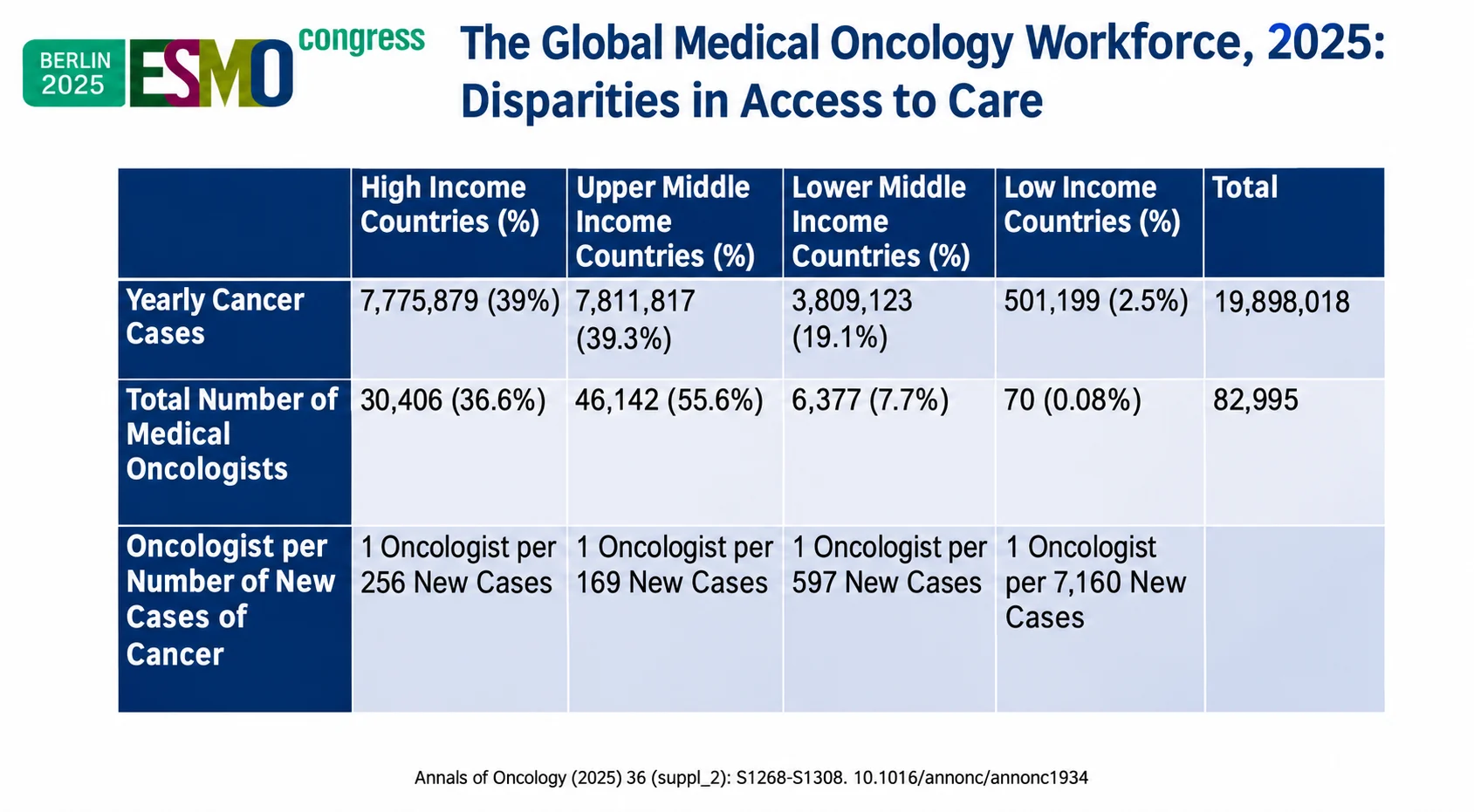
The study estimated approximately 82,995 medical oncologists worldwide, with a highly unequal distribution across World Bank income categories.
The estimated workforce included:
- High-income countries: 30,406 medical oncologists.
- Upper-middle-income countries: 46,142.
- Lower-middle-income countries: 6,377.
- Low-income countries: Only 70.
The distribution becomes even more revealing when the number of oncologists is considered relative to the cancer burden.
In high-income countries, there was approximately one medical oncologist for every 256 newly diagnosed cancer cases annually.
The corresponding ratio was approximately one per 170 cases in upper-middle-income countries, one per 600 in lower-middle-income countries, and one per 7,160 cases in low-income countries.
Although upper-middle-income countries appeared comparatively well represented in the overall figures, Losco cautioned that national totals can conceal substantial internal inequalities.
Large healthcare workforces may be concentrated in major cities and specialized centers, leaving smaller communities with limited access to oncology expertise.
For patients with RCC, these inequalities may influence the availability of diagnostic evaluation, specialist consultations, multidisciplinary treatment planning, and management of therapy-related adverse events.
Beyond Drug Availability: The Infrastructure Needed for Kidney Cancer Care
Modern RCC management requires a coordinated network of diagnostic and therapeutic services.
Losco emphasized that improving access to systemic treatment alone cannot resolve the broader limitations of cancer care.
Accurate diagnosis depends on imaging technologies such as computed tomography and magnetic resonance imaging, supported by appropriate pathology services.
The 2021 Lancet Oncology Commission on Medical Imaging and Nuclear Medicine documented major shortages in imaging equipment and trained personnel across LMICs, reinforcing the importance of investing in diagnostic infrastructure.
Kidney cancer classification also increasingly requires specialized pathology and immunohistochemistry, particularly when distinguishing uncommon histological subtypes.
Surgical expertise is another essential component. Patients with localized RCC may benefit from nephron-sparing procedures when clinically appropriate, but access to experienced surgeons and specialized facilities can vary considerably.
Losco also emphasized the importance of healthcare professionals trained to administer systemic therapies and manage complications.
Immunotherapy and targeted treatments require monitoring, supportive care, and reliable follow-up systems.
A patient who cannot obtain timely imaging, pathology review, surgery, or toxicity management may be unable to benefit fully from an otherwise effective treatment.
The Gap Between International Guidelines and Treatment Affordability
Immunotherapy-based combinations have transformed the management of metastatic clear cell RCC.
Long-term findings from studies such as CheckMate 214 have demonstrated durable responses and substantial survival improvements with nivolumab plus ipilimumab.
Other established regimens, including pembrolizumab combined with VEGFR-targeted therapy, have further expanded treatment options.
However, the availability of these treatments remains uneven.
Losco pointed to the World Health Organization’s Model List of Essential Medicines as an example of the challenges surrounding global access to modern oncology drugs.
In its 2025 review, the WHO Expert Committee did not recommend adding the evaluated checkpoint inhibitor combinations for metastatic RCC to the Essential Medicines List for that indication.
Consequently, there remains a gap between the treatments recommended by major international oncology guidelines and those prioritized through global essential-medicine frameworks.
For Losco, the primary concern is not the absence of evidence supporting these therapies, but their affordability and availability.
“The evidence is not the barrier, the price is.”
International guidelines may recommend combinations that remain inaccessible to large portions of the population.
Regionally adapted treatment recommendations can help clinicians navigate these limitations, although they cannot replace the need for greater access to effective medicines.
Treatment Patterns in Argentina: Progress With Persistent Gaps
Argentina offers an example of how treatment adoption can evolve within an upper-middle-income healthcare system.
Losco discussed findings from a multicenter study published in JCO Global Oncology in 2025, examining treatment trends among patients with metastatic clear cell RCC in Argentina.
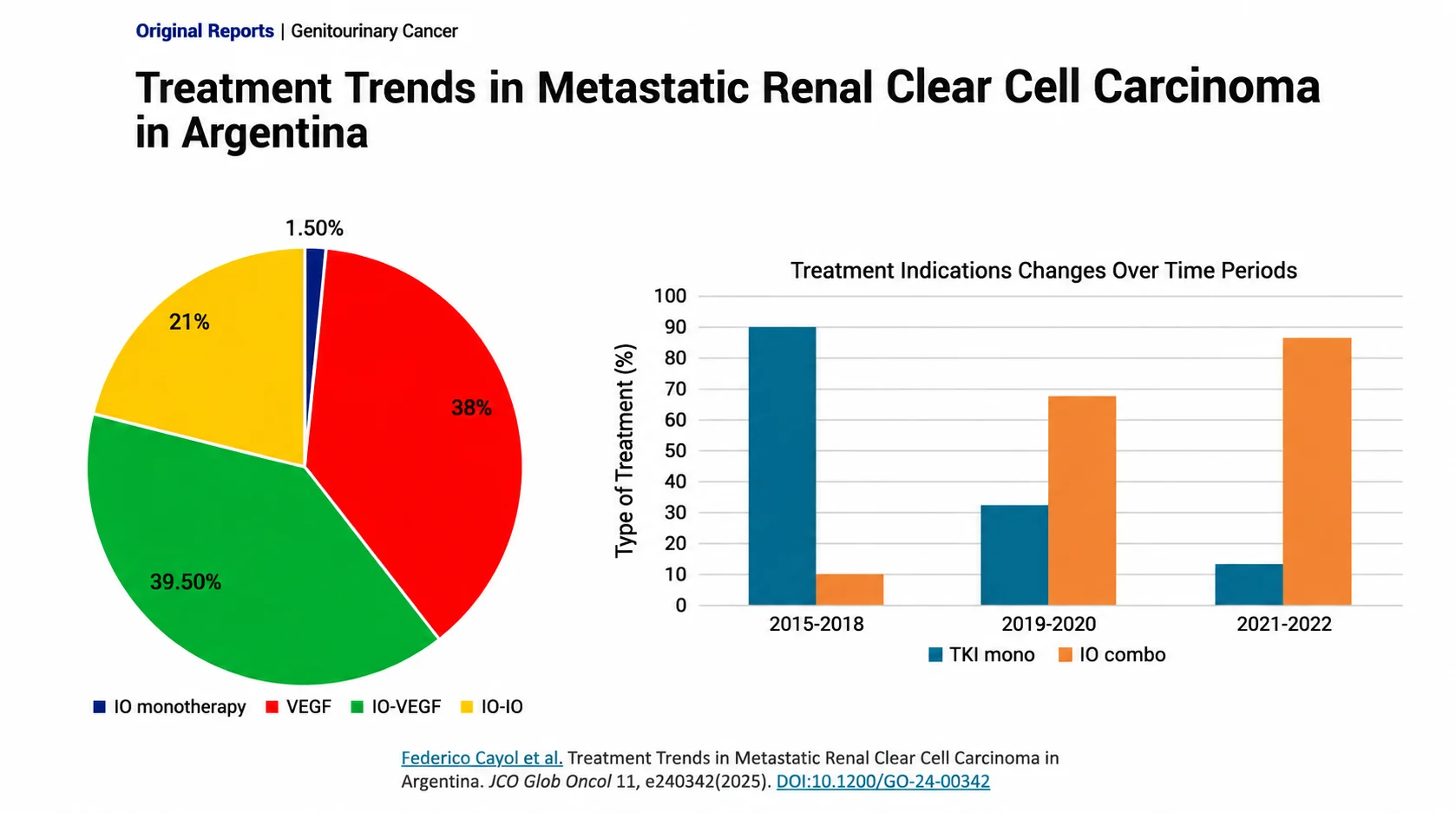
The analysis included 615 patients treated between 2015 and 2023.
Across the overall study population, first-line treatment consisted of:
- Antiangiogenic therapy alone in 38%.
- Immunotherapy plus a VEGF-targeted agent in 39.5%.
- Dual immunotherapy in 21%.
- Other treatments in approximately 1.5%.
However, the study also demonstrated a major change in prescribing patterns over time.
The use of immunotherapy-based combinations increased from approximately 9.9% in 2015-2018 to 86.6% in 2022-2023.
These findings suggest that contemporary RCC treatment standards have become increasingly integrated into clinical practice among the participating Argentine centers.
Nevertheless, Losco cautioned against interpreting this cohort as representative of every patient in Argentina or across Latin America.
Access can vary by institution, region, healthcare coverage, and financial circumstances.
The experience of Argentina therefore illustrates both the potential for rapid adoption of newer treatments and the limitations of using national income classifications to describe healthcare access.
Why RCC Clinical Trials Remain Concentrated in Wealthier Countries
Clinical trials can provide access to investigational therapies, structured follow-up, and specialized diagnostic services.
However, participation opportunities are unevenly distributed.
Losco referred to research presented by Dr. Regina Barragán-Carrillo at the 2025 ASCO Genitourinary Cancers Symposium, examining the geographical distribution of RCC clinical trials.
The analysis identified 357 trials conducted between 2019 and 2024.
Approximately 76% were conducted exclusively in high-income countries, while 23% included upper-middle-income countries, 3% included lower-middle-income countries, and none included low-income countries.
These categories are not mutually exclusive because multicountry trials can involve countries from more than one income group.
The analysis also found substantial differences in whether individual countries had any RCC trials available.
Clinical trials were accessible in approximately 60% of high-income countries, compared with 23.9% of upper-middle-income countries and only 7.7% of lower-middle-income countries.
No trials were identified in low-income countries during the study period.
This concentration limits opportunities for patients outside established research centers and reduces the representation of populations experiencing different healthcare conditions.
It also raises questions about how effectively findings from international trials reflect routine clinical practice in resource-constrained environments.
Building Regional Research Through LACOG
For Losco, international collaboration provides an opportunity to address some of these gaps.
Through the Latin American Cooperative Oncology Group (LACOG), investigators across the region are developing research networks capable of generating evidence relevant to Latin American populations.
Rather than relying exclusively on trials designed and conducted in wealthier countries, regional collaborative groups can investigate clinical questions arising directly from local healthcare realities.
These may include treatment access, diagnostic limitations, real-world outcomes, and approaches to reducing the financial burden of cancer care.
Losco also referred to the work of Argentine oncologist Dr. Pablo Mandó and colleagues examining the opportunities and obstacles facing academic collaborative research groups in Latin America.
Such initiatives depend on sustained partnerships between institutions, researchers, professional societies, and healthcare systems.
Clinical trial infrastructure, research training, funding, regulatory coordination, and data management all require investment.
However, stronger regional networks could help ensure that Latin American investigators contribute not only patients to international research but also the scientific questions and study designs.
Virtual Tumor Boards: Connecting Specialists Across Borders
Technology offers another way to address geographical inequalities in specialist care.
Losco described his involvement in a multidisciplinary genitourinary oncology tumor board conducted through a virtual ECHO model.
The meetings bring together medical oncologists, urologists, and other specialists to discuss challenging cases, with participation extending beyond Buenos Aires to other parts of Argentina and Latin America.
For clinicians working in areas without access to specialized genitourinary oncology teams, these discussions offer opportunities to obtain multidisciplinary input without requiring every patient to travel to a major academic center.
Virtual tumor boards can also support professional education and facilitate collaboration between institutions.
Their potential value extends beyond RCC to other genitourinary malignancies requiring complex treatment decisions.
However, remote consultation cannot eliminate every healthcare barrier. Patients may still require specialized imaging, surgery, systemic therapies, or referral to centers capable of delivering the recommended treatment.
Losco’s approach demonstrates how digital collaboration may help distribute clinical expertise more widely, even when specialized resources remain geographically concentrated.
MARCO: Artificial Intelligence Adapted to Latin American Oncology
Losco also discussed the development of MARCO, an artificial intelligence-based conversational assistant designed to support oncology decision-making using locally relevant medical information.
Unlike general-purpose language models, the initiative aims to integrate regional clinical guidelines, regulatory information, and treatment availability into its responses.
Losco described work involving professional organizations and medical guidelines from Argentina, Peru, Paraguay, and Chile, alongside collaboration with the Brazilian Society of Clinical Oncology.
The objective is to make medical information more applicable to the environments in which clinicians practice.
For example, an international recommendation may include a drug that has not been approved or is not accessible in a particular country.
A locally adapted clinical support tool could help clinicians identify this distinction and review alternatives within national regulatory and guideline frameworks.
Losco has also been involved in research examining the use and perceptions of generative AI among Argentine oncology professionals.
A 2026 study published in JCO Global Oncology found that most surveyed professionals considered AI training necessary, while a substantial proportion believed these technologies could improve cancer care.
However, questions remain regarding clinical validation, the reliability of generated recommendations, patient privacy, and the risk of inaccurate information.
MARCO should therefore be considered an emerging decision-support initiative rather than a validated substitute for multidisciplinary assessment or independent clinical judgment.
Its potential value lies in helping clinicians access and interpret locally relevant information while preserving professional oversight.
More Research From Underrepresented Populations
Losco identified another opportunity for LMICs: generating clinical evidence from populations that have historically been underrepresented in oncology research.
Countries across Latin America, Africa, and Asia account for a substantial proportion of the world’s population, yet their participation in clinical trials remains disproportionately low.
Better collection and analysis of real-world data could help investigators understand how RCC treatments perform across different healthcare settings.
Such research may identify variations in diagnosis, treatment adherence, toxicity management, access to subsequent therapy, and clinical outcomes.
Losco also discussed efforts to investigate dose optimization and more affordable treatment approaches.
These include research into weight-based or reduced-dose immunotherapy strategies and the potential role of biosimilars as patents expire and additional products enter the market.
The objective is to determine whether effective treatment can be delivered more sustainably in settings where conventional dosing and drug prices restrict access.
However, reduced-dose immunotherapy strategies require rigorous clinical evaluation before they can be considered equivalent to established regimens.
Likewise, biosimilars must meet appropriate regulatory standards for quality, safety, and clinical comparability.
Locally driven research could help answer these questions while expanding the evidence available to clinicians treating patients under different economic and healthcare conditions.
A More Representative Future for Renal Oncology
The treatment of RCC in low- and middle-income countries cannot be understood through income classifications alone.
Differences in diagnostic infrastructure, specialist availability, access to systemic therapies, surgical capacity, and clinical research exist both between countries and within the same healthcare system.
Losco’s presentation examined how these factors shape the translation of clinical evidence into patient care and why solutions need to reflect local circumstances.
Regional research networks, virtual multidisciplinary collaboration, locally adapted guidelines, AI-assisted information tools, and studies focused on treatment affordability offer opportunities to address some of these challenges.
However, their effectiveness will depend on clinical validation, sustained investment, and improvements in the healthcare infrastructure needed to deliver treatment.
For Latin America, strengthening research capacity and international collaboration could help produce evidence that better reflects the populations being treated.
As Losco concluded, resource constraints continue to influence treatment decisions, but collaboration, technology, and locally driven innovation can help expand opportunities for patients with kidney cancer across different healthcare systems.
The event is supported by AVEO Oncology as bronze sponsor and Arcus Biosciences as Innovation Supporter.
Written by Eliz Baloyan, MD, Features Writer and Editor at OncoDaily and CancerWorld